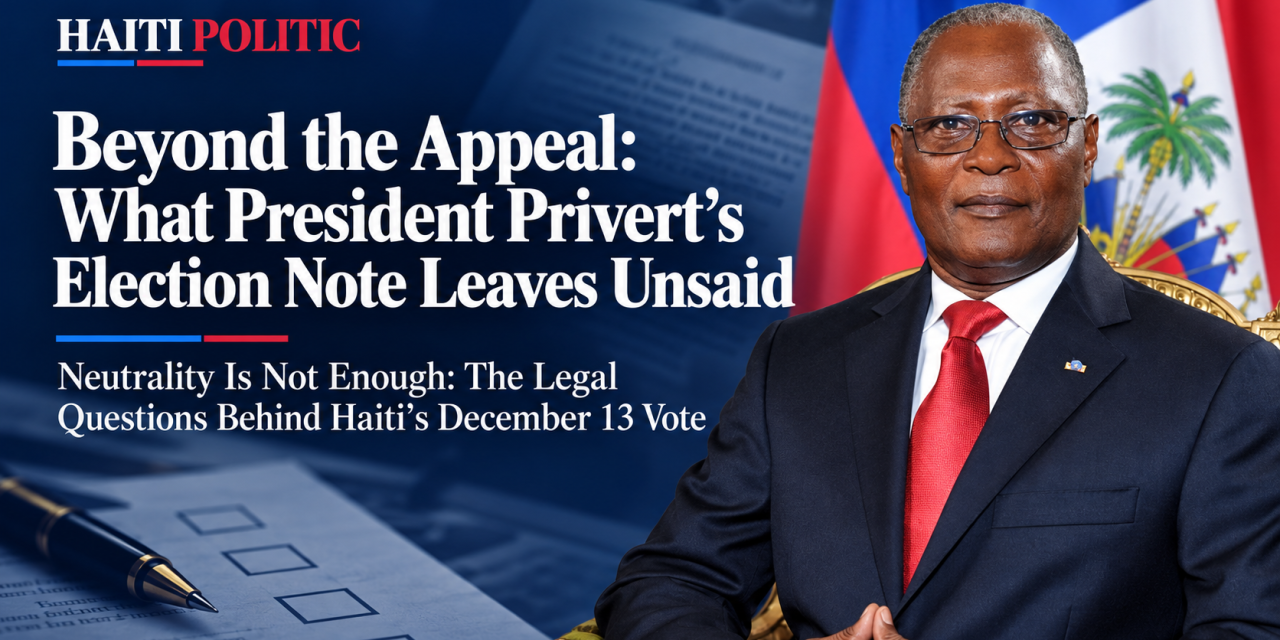
Former President Jocelerme Privert’s September 30 note, “Processus électoral : appel à la responsabilité républicaine,” lands at a decisive moment. Haiti’s first national elections in a decade are scheduled for December 13, and the note reads as a plea to keep the process from becoming the next crisis. Much of it is sound. But a call for republican responsibility works best when it names the specific legal weaknesses that threaten trust, and this one mostly does not.
What the note gets right
Privert asks the government to guarantee the strictest neutrality of the public administration, with no vehicle, building, social program or tax-funded resource used to favor or hurt a candidate or party. He draws on his own service in the state and the tax administration to argue that public resources belong to the whole nation. He also asks electoral authorities to act with independence and rigor, security forces to protect voters, and parties to compete with ideas rather than violence. He stresses the need for transparent counting, use of legal remedies, and acceptance of results by all actors. Those are the right principles, and most Haitians would sign them.
The note also raises the plight of displaced citizens, who cannot be left out because violence removed them from their communes. With roughly 12% of the population living in camps or with host families, this is not a footnote. It is a test of whether the vote can be called universal.
Where the note stops short
1. The independence of the CEP is a legal question, not only a moral one. The note urges the electoral authorities to act independently, but the recent history matters. The June 2 electoral decree was drawn up by the Prime Minister’s office after a meeting in which the CEP was informed of the government’s decision to adopt it, and critics said it increased executive influence, including through a government-appointed Director General position. A month later, following work by a joint CEP-Primature commission, a July 2 amending decree repealed provisions that constrained the CEP’s board. Anyone serious about independence should say plainly that the framework was contested and only partly repaired, and ask for the remaining safeguards to be published and enforced.
2. The legal basis of the framework is fragile. The June decree was issued under the National Pact of February 21, 2026, which followed the expiry of the Transitional Presidential Council’s mandate on February 7 and placed the Prime Minister as sole executive until elections. That arrangement is a political compromise, not something the 1987 Constitution describes. The ballot will be run under an executive decree rather than a law passed by a legislature, and it replaced the earlier December 1, 2025 decree. Privert, who presided over a previous transition, knows that a process is only as credible as its legal foundation.
3. The biggest omission: the ballot itself. The December 13 vote is not only about candidates. It also includes a popular ratification of a limited set of constitutional changes, the mechanism that the electoral decree uses in place of a full constitutional referendum. Haitian constitutional tradition is hostile to that approach: the 1987 Constitution sets a specific amendment procedure involving Parliament, and as I read Articles 282 to 284-3, it forbids modifying the Constitution by popular referendum. Opponents of Jovenel Moïse’s 2021 referendum project made exactly this argument, and the Venice Commission raised concerns about the draft referendum decree in 2025. A call to accept the results has little force if the legality of part of the ballot remains unresolved. The note should have said so.
4. Candidacy rules need consistent, transparent enforcement. Candidates must meet the constitutional qualifications, including those in Article 135, plus the added requirements of the current decree, such as a sworn notarized attestation of no convictions for economic crimes, sexual violence, arms or drug trafficking, or kidnapping. Such rules can protect the process or be used selectively to exclude rivals. The CEP should publish the reasons for every rejection and offer a fast appeal.
5. Security promises must be measurable. The note asks the forces of order to protect voters and candidates, but security depends on institutions that are stretched. The Security Council extended the Gang Suppression Force on September 29 even though only about 1,083 personnel had been deployed by early July, a fraction of the 5,500 authorized. The CEP itself has tied its calendar to an acceptable security climate and available funding. Haitians deserve a public map showing which communes are expected to be safe enough to vote in and what happens if they are not.
6. Disputes must be settled before the vote, not after. Privert calls for the use of legal remedies. That only works if electoral dispute bodies are constituted, staffed and funded ahead of time, with published deadlines. Haiti’s past cycles show that disputes left vague become street conflicts.
What a serious follow-through would look like
- Publish the legal framework. Post the consolidated electoral decree, with all amendments, in accessible form, and clarify its relationship to the National Pact and the Constitution.
- Clarify the constitutional ballot. Explain, in writing, the legal basis for the popular ratification, and allow judicial and civil society review before December 13.
- Enforce neutrality with sanctions. Adopt specific, public rules on the use of state resources, with an independent body able to investigate and penalize violations.
- Guarantee displaced voters’ rights. Set out how they will register and vote, and where.
- Build dispute mechanisms now. Constitute and publish the bodies and timelines for electoral disputes.
- Report security readiness. Give monthly public updates on which areas are open for registration, campaigning and voting.
Conclusion
President Privert is right that Haiti cannot afford another post-electoral crisis. But crises are prevented by rules that are clear, legal and enforced, not by appeals alone. Neutrality of the administration is necessary, and so are an independent electoral council, a lawful ballot, protected voters and credible dispute resolution. Haitians should welcome the note as a starting point and press its author, the government and the electoral authorities to turn each principle into a published, checkable commitment before December 13.