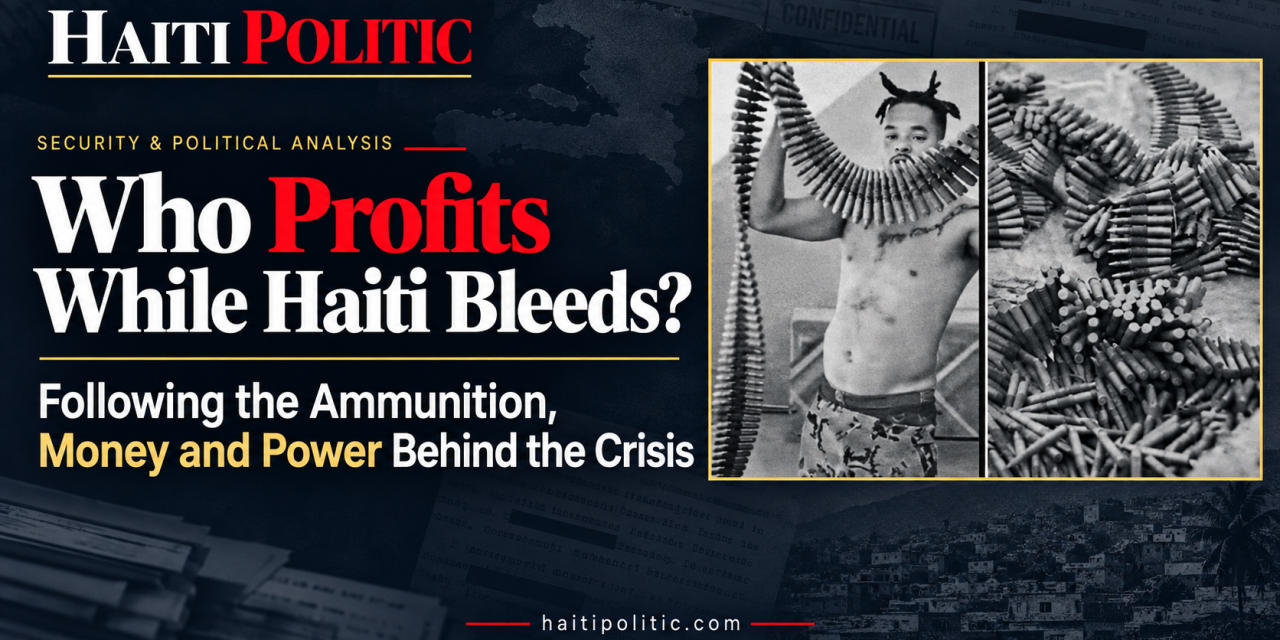
The ammunition trail points beyond the gunmen—to the suppliers, financial networks and political incentives that allow violence to endure.
PORT-AU-PRINCE, October 8, 2026 — Haiti’s insecurity is a catastrophe for ordinary citizens. For people who sell weapons, collect ransom, charge illegal tolls or buy protection from accountability, it can also become a source of income and power. The question is how those benefits are produced, who receives them and whether investigators can follow the transactions.
An October 8 report by Listín Diario, supplied to Haiti Politic, draws attention to ammunition from Dominican security stocks appearing in the hands of Haitian gangs. The newspaper attributes its findings to the UN Panel of Experts on Haiti. Its headline is alarming, but the underlying report requires a more precise reading. [1]
What the ammunition evidence establishes
Annex 18 of the Panel’s final report, S/2026/714, describes 908,001 items, mostly ammunition, diverted from Dominican National Police stocks. Investigators found ammunition consistent with those diversions in use by 400 Mawozo and gangs in Bel-Air. Dominican authorities conducted an inventory and arrested officers after information-sharing with the Panel. The experts could not determine precisely how much diverted material reached Haiti. The figure is therefore not a verified count of rounds consumed by 400 Mawozo alone. [2, annex 18]
The Panel also documented ERD-marked ammunition associated with Dominican military procurement. Separately, at least 15 of 32 documented .50-caliber rounds from 400 Mawozo were manufactured in the Dominican Republic. Their chain of custody remained unclear: older surplus ammunition had also entered the US civilian market. Dominican authorities said they had detected no diversion of that surplus. Manufacturing origin alone does not establish its route to the gang. [2, annex 18]
The evidence calls for accountability for specific diversions and trafficking networks. It does not establish that the Dominican government, the Dominican population or every member of its security forces supports Haitian gangs.
The most direct beneficiaries: gangs and their suppliers
UNODC’s January 2026 assessment describes criminal networks that control territory and exploit transport routes and economic hubs. It identifies extortion, kidnapping, trafficking and coercive control as parts of an increasingly structured criminal economy. It also reports financial channels involving bulk cash, unregulated remittance operators, trade-based schemes and front companies. [3, paragraphs 3–8 and 25–26]
The economic implication is straightforward: controlling a road can create repeated opportunities to demand payment. Controlling a neighborhood can make residents and businesses dependent on an armed group’s permission. Violence helps enforce those demands. What looks like institutional collapse to the public can operate as a revenue system for the people imposing it.
The supply side matters just as much. A trafficker can earn money from providing weapons and ammunition without sharing the buyer’s political agenda. An official who diverts public stock for private sale can profit from access to material entrusted to the state. Those incentives warrant investigation at warehouses, borders and financial institutions—not only at gang strongholds.
A documented cycle: ransom money buying more weapons
The link between predatory income and gang firepower has already been demonstrated in a US criminal case. In June 2024, Joly Germine received a 35-year sentence for gun smuggling and money laundering connected to 400 Mawozo. The Justice Department described a conspiracy involving at least 24 firearms and ransom proceeds used to acquire weapons. Eliande Tunis and other participants were also sentenced. [4]
Germine subsequently received a life sentence in December 2025 in the separate case concerning the kidnapping of American missionaries. That later outcome should not be confused with the earlier firearms and laundering sentence. [5]
The broader lesson is that victim payments can sustain future violence. When criminal revenue purchases additional firepower, attacking civilians becomes both an immediate source of money and a way to expand the capacity to extract more.
Political benefit requires a different kind of proof
Instability can also create political advantages. In principle, intimidation can silence opponents, restrict campaigning or make residents dependent on intermediaries who promise access and protection. Emergency conditions can weaken scrutiny of spending and make temporary arrangements easier to extend.
These are mechanisms to examine, not findings that every politician facing delayed elections engineered the delay. A person’s benefit from a crisis is a reason to investigate interests and conduct; it is not proof that the person caused the crisis. Establishing responsibility requires evidence such as payments, communications, instructions, protection arrangements or interference with investigations.
Haiti Politic’s analytical judgment is that any credible security strategy must examine political protection alongside criminal financing. Arresting a gunman while leaving the people who supply, finance or shield the operation untouched risks preserving its ability to replace him.
What about businesses and foreign interests?
Some businesses may gain revenue from heightened demand for security, transport alternatives or emergency services. That alone does not make them complicit in violence. A lawful company responding to a dangerous environment is different from an operator that finances armed groups, facilitates trafficking or knowingly conceals criminal proceeds.
Claims that an entire neighboring country or an unnamed foreign power “benefits from Haiti’s chaos” obscure the actors whose conduct can actually be tested. Countries are not single commercial interests. Residents, traders and public institutions can suffer while particular traffickers profit. An investigation should identify the seller, buyer, intermediary, payment recipient and official who enabled a specific transaction.
The questions authorities should answer
- Stockpile control: Which units received the relevant ammunition lots, and who authorized, recorded or concealed their movement?
- Transport: Who moved the material, through which crossings or shipping routes, and with whose assistance?
- Payment: Who paid, who received the proceeds, and what assets were acquired with that income?
- Protection: Did anyone obstruct an arrest, warn a suspect, falsify records or interfere with a prosecution?
- Accountability: What charges, judgments and asset-recovery actions followed the investigation?
These questions should guide cooperation among Haitian, Dominican, US and other relevant authorities. Stockpile audits, ammunition tracing, financial investigations and court proceedings can connect the visible weapons to the less visible beneficiaries.
Haitians bear the cost
The strongest answer to “who benefits?” begins with the people who receive criminal income and exercise coercive power: gang leaders, trafficking intermediaries and any officials or patrons whose participation is established by evidence. Other forms of commercial or political advantage require separate scrutiny.
Ordinary Haitians do not benefit from losing their homes, livelihoods, freedom of movement or confidence in public institutions. Their suffering should never become an excuse for sweeping accusations that cannot be proved. It should drive a precise demand: identify the people who earn from the violence, establish how they earn, and hold them accountable.
Haiti’s instability will be harder to sustain when its financial rewards and protective relationships become harder to preserve.
Source and methodology note: This article uses the supplied October 8 Listín Diario report; the UN Panel of Experts report S/2026/714, annex 18, consulted through the HaitiDocs reproduction; UNODC report S/2026/32; and US Justice Department case announcements. UN findings are attributed as such; convictions are distinguished from allegations. Statements about incentives and potential political benefits are Haiti Politic’s analysis. No new interviews were conducted.