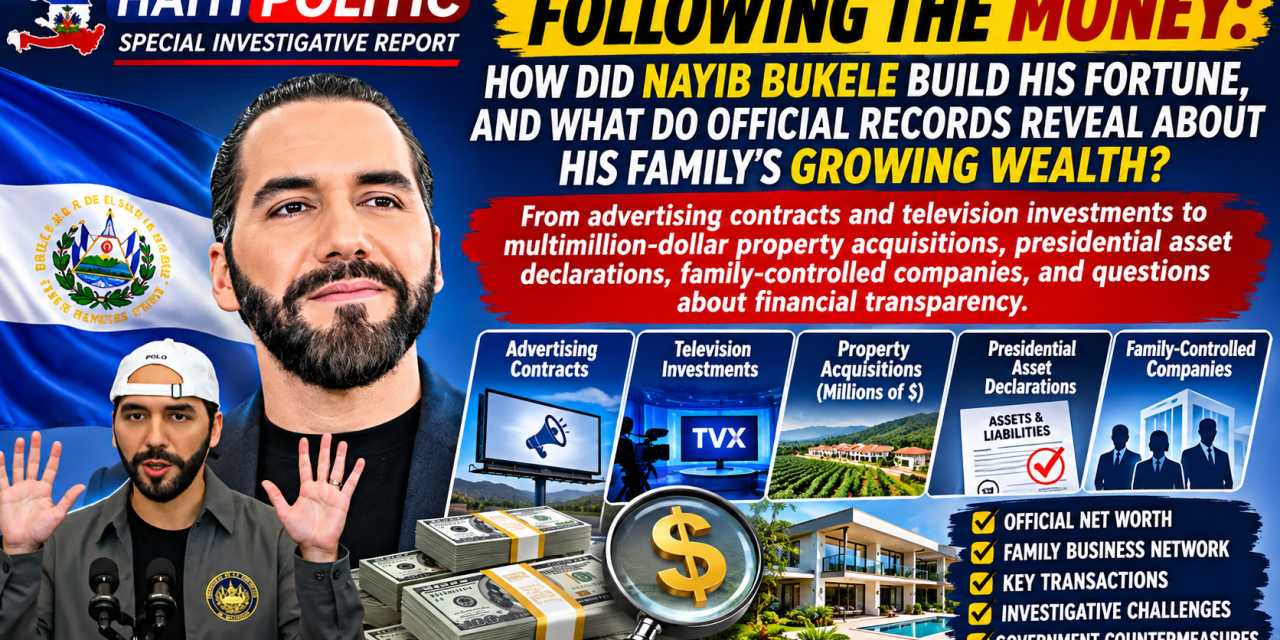
From advertising contracts and television investments to multimillion-dollar property acquisitions, presidential asset declarations, family-controlled companies, and questions about financial transparency.
HAITI POLITIC | SPECIAL INVESTIGATIVE REPORT
November 9, 2026
By Haiti Politic Investigative Desk
THE PRESIDENT, THE CROWDS, AND THE MONEY QUESTION
President Nayib Bukele has built one of Latin America’s most recognizable political brands.
His supporters point to El Salvador’s dramatic reduction in gang violence, his enormous electoral victories, and images of enthusiastic crowds as evidence of his popularity.
His critics raise a different set of questions: How much money does Bukele possess? Where did it come from? How did his family’s businesses expand while he occupied public office? And how effectively can Salvadoran institutions investigate the finances of the president and those closest to him?
A recent social media argument illustrates the divide.
In a post defending Bukele, commentator Alexandra Sagastume challenged allegations that the president pays people to attend events or create videos supporting him.
She pointed to images of Salvadorans filming the president with their phones, laughing, and celebrating.
Her argument was straightforward: Why would thousands of people need to be paid to express enthusiasm for a president they genuinely support?
That is a legitimate question.
But it is not the same question as the one addressed in this investigation.
The issue is not whether Salvadorans genuinely support Bukele. The issue is whether his personal wealth, family investments, corporate transactions, and political expenditures can be independently accounted for.
A president can enjoy substantial public support and still face legitimate financial scrutiny.
Likewise, a president’s increasing wealth does not automatically establish corruption.
The appropriate starting point is the documentary record.
And that record contains some remarkable numbers.
PART I — THE OFFICIAL RECORD: BUKELE’S DECLARED FORTUNE
1. THE $4.46 MILLION PRESIDENT
On May 25, 2026, the Spanish news agency EFE reported that El Salvador’s Ministry of Finance had published financial information concerning President Nayib Bukele.
According to the published figures, Bukele declared:
| Financial category | Amount |
|---|---|
| Total assets | $4,561,160.23 |
| Total liabilities | $94,681.99 |
| Declared net worth | $4,466,478.24 |
The figures were made available through the Ministry of Finance’s public asset-and-liability consultation system.
Their publication followed the adoption of an anticorruption law in February 2026.
EFE reported that this was the first time comparable presidential financial information had been made publicly available since Bukele assumed office in 2019.
For years, his declarations submitted to the Supreme Court’s Probity Section had been restricted from public access.
The 2026 disclosure therefore provided an important opportunity to examine his financial position.
But it also raised a question.
How did Bukele accumulate his declared fortune, and how much of it was already established before he became president?
Net worth is not cash
The $4.46 million figure does not mean Bukele necessarily has that amount sitting in a bank account.
Net worth represents the declared value of assets minus liabilities.
Assets may include property, company shares, investments, cash, and other holdings.
Their reported value may differ from what they could actually sell for.
Consequently, an asset declaration is a starting point for financial analysis, not a complete forensic audit.
Source: EFE, May 25, 2026 — El Salvador Ministry of Finance asset disclosure.
PART II — HOW MUCH DID BUKELE’S WEALTH GROW?
2. FROM NEARLY $1 MILLION TO MORE THAN $4 MILLION
A June 2026 investigation published by Infodemia compared Bukele’s historical asset declarations with the newer Ministry of Finance figures.
The reported financial progression was substantial.
| Year | Political position | Declared net worth |
|---|---|---|
| 2012 | Mayor of Nuevo Cuscatlán | $964,546 |
| 2015 | Mayor of San Salvador | $1,598,110 |
| 2018 | Leaving the San Salvador mayor’s office | $2,213,734 |
| 2019 | Beginning his presidency | $2,312,547 |
| 2025 | President of El Salvador | $4,466,478 |
The reported increase between 2012 and 2025 was approximately $3.5 million.
That represents an increase of roughly 363%.
Between the beginning of his presidency in 2019 and the 2025 declaration, his reported net worth increased by approximately $2.15 million.
These are nominal figures drawn from different declaration periods. They do not establish that the entire increase resulted from new income.
Property appreciation, corporate valuations, investment returns, and debt repayment can also increase net worth.
Nevertheless, the figures establish that Bukele’s declared wealth grew significantly during his political career.
CAN HIS PRESIDENTIAL SALARY EXPLAIN THE INCREASE?
The Infodemia investigation reported a monthly presidential salary of approximately $5,181.
That would equal roughly $62,172 annually.
Over six years, a salary at that rate would total approximately $373,000 before taxes and personal expenses.
The reported net-worth increase during the presidency was considerably larger.
Does that prove illicit enrichment?
No.
Bukele entered politics with business interests and substantial declared wealth.
A president may receive legitimate income from investments, businesses, or other lawful sources.
But the difference between salary and net-worth growth demonstrates why examining his private financial activities is necessary.
The relevant question is:
Can the increase be reconciled with documented business earnings, investment appreciation, financing, and other lawful sources?
That requires more than a salary comparison.
It requires financial records.
PART III — BEFORE BUKELE BECAME PRESIDENT, HE WAS ALREADY A BUSINESSMAN
3. THE BUSINESS ROOTS OF HIS POLITICAL CAREER
Nayib Bukele did not begin his career as a politician without financial resources.
He came from a Salvadoran family with established commercial interests.
Before entering electoral politics, he was involved in advertising, media, and other business activities.
His early political career was also closely connected to the Farabundo Martí National Liberation Front, commonly known as the FMLN.
This is an important historical detail.
Today, Bukele is associated with Nuevas Ideas, the political movement that transformed El Salvador’s political system.
But he originally entered elected office through the FMLN.
He became mayor of Nuevo Cuscatlán in 2012 and later mayor of San Salvador in 2015.
His business relationships therefore predate his presidency and his break with the traditional political parties.
OBERMET: ADVERTISING AND POLITICAL CONTRACTS
One of the companies associated with Bukele’s business career was Obermet S.A. de C.V.
The advertising company provided services connected to political campaigns and institutions during the period when