
A political analysis of the press communiqué published by former provisional president Jocelerme Privert on the resurgence of armed violence and the electoral process in Haiti.
The Context Behind the Statement
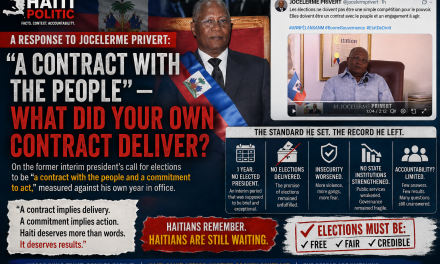
On August 21, 2026, Jocelerme Privert — senator and later Haiti’s provisional president from February 14, 2016 to February 7, 2017 — issued a press communiqué through his “Private Secretariat” condemning two waves of armed attacks over the summer: the assault on the population of Morne à Bateau, in Gressier, and the incursion by the “Kokorat San Ras” and “Gran Grif” gangs into the Mamon-Pòl locality, the 7th communal section of Saint-Michel de l’Attalaye, in late July 2026. The text condemns these acts “with the utmost firmness,” expresses solidarity with the affected populations, and urges the government and national security forces to retake control of affected territories and end the impunity enjoyed by perpetrators.
On the strictly humanitarian level, the statement rests on documented facts: the Gressier attack displaced more than 4,400 people according to the International Organization for Migration, and the Saint-Michel de l’Attalaye incursion spread terror through an area already known for chronic insecurity. Nothing in the substance of the communiqué is, in itself, disputable — the violence is described accurately, and the call to secure the electoral process reflects a widely shared concern, including from CARICOM, which had already pressed authorities in late July to accelerate the electoral process while strengthening security.
But to understand why it is Jocelerme Privert specifically issuing this text, at this specific moment, it needs to be placed in a broader political context.
Why Privert, and Why Now?
1. An Institutional Vacuum He Refuses to Acknowledge as Such
The Transitional Presidential Council (CPT/TPC), installed in April 2024 following the April 3, 2024 political accord, formally ended its mandate on February 7, 2026, transferring executive power from Council president Laurent Saint-Cyr to the Council of Ministers led by Prime Minister Alix Didier Fils-Aimé — a transfer that several foreign ministries, including France’s, described as “orderly.” Yet in the weeks before and after that deadline, Privert publicly distinguished himself by insisting on the “continuity of executive power” and rejecting the notion of an “institutional vacuum” after February 7, 2026 — a notable stance for a man who currently holds no official position, but who continues to have letterhead printed in the name of “His Excellency Mr. Jocelerme Privert, 57th President of the Republic of Haiti.”
This choice to retain the presidential title, nearly a decade after his term ended, is not incidental in Haiti’s current context. It fits a strategy of continued self-legitimization: Privert is working to keep himself relevant in the political landscape as a figure of moral and institutional authority, capable of speaking on behalf of state continuity at precisely the moment when that continuity is in question.
2. Positioning Himself as the Voice of Experience Amid a New Transition Crisis
Privert is no ordinary political actor when it comes to this type of crisis: he is the only leader in Haiti’s recent history to have personally guided the country through a post-presidential-vacuum transition all the way to an election, between 2016 and 2017. By issuing this communiqué at the very moment the country is entering a new phase of transition — with no elected president, and general elections announced for August and December 2026 — Privert implicitly reminds the public of his own track record and presents himself as a voice of experience, almost a moral recourse, at a time when the traditional political class is largely discredited in the eyes of the population.
3. Pressuring the Government and Electoral Council Without Naming Them
The communiqué names no specific government official or institution — a rhetorical choice that lets him level a substantive criticism (the inadequacy of the state’s security response) without directly confronting the de facto government or the Provisional Electoral Council, both of which have recently announced their intent to hold elections. By insisting that “security is not a secondary issue in the electoral process” but rather “one of its fundamental conditions,” Privert delivers a carefully calibrated warning: any election organized without a serious reconquest of territory would lack credibility — while preserving his ability to later claim to have been a consistent early voice of warning.
4. Building an Image as National Unifier Ahead of the Electoral Deadline
Finally, on the level of political communication, the text is structured to appeal to a wide audience: it expresses solidarity with victims, praises the courage of affected communities, appeals to national unity (“Our people have suffered too much”), and closes on a near-programmatic formula — “Without security, there is no liberty; without liberty, there are no credible elections; and without legitimate institutions, there can be no real exit from crisis.” This rhetorical triptych, built to be quoted and repeated, functions as a miniature political platform — useful to anyone nursing ambitions of a return to the political stage, whether as a candidate, a mediator, or a consensus figure in some future transitional arrangement, should the August–December 2026 elections, like so many previous deadlines in Haiti, end up compromised or postponed.
In Sum
Jocelerme Privert’s August 21, 2026 communiqué serves a dual function. On substance, it documents an undeniable security reality and voices a legitimate call to protect the populations of Gressier and Saint-Michel de l’Attalaye. On form, it constitutes a carefully calibrated act of political positioning: by speaking from a “Private Secretariat” that continues to style him as president, by rejecting the notion of an institutional vacuum he would, historically, have every interest in filling once again, and by pairing indirect criticism with unifying rhetoric, Privert is working to establish himself as an unavoidable voice — if not a possible recourse — during the period of uncertainty that has opened following the CPT’s dissolution and ahead of the general elections planned for late 2026.