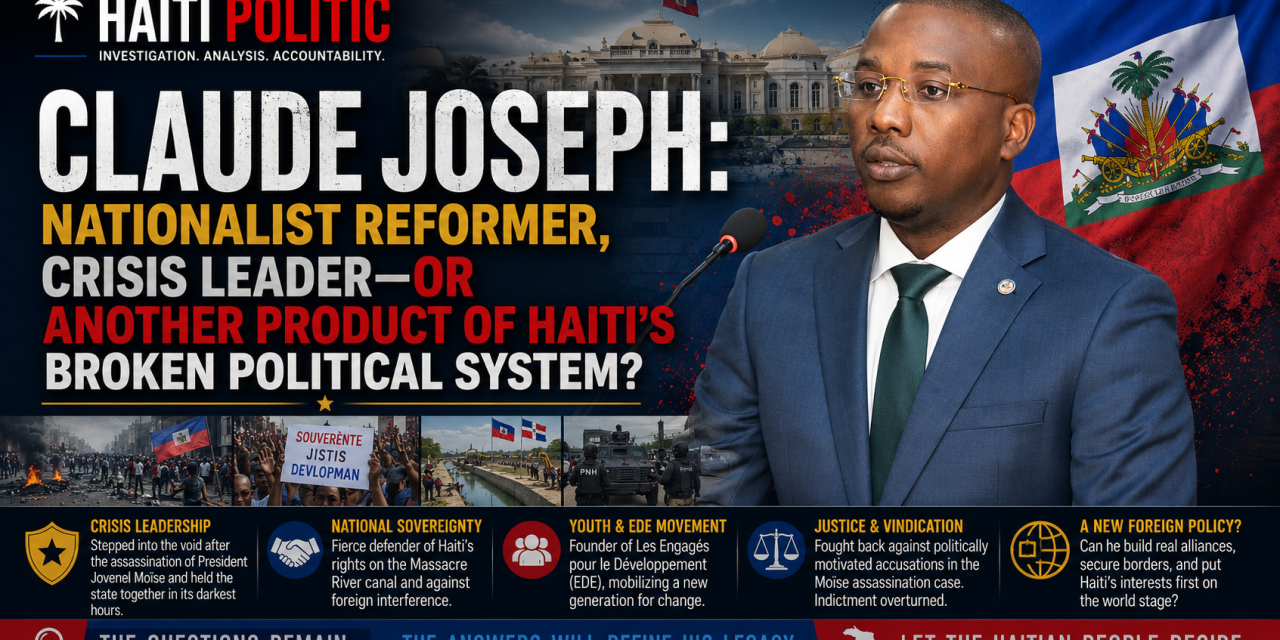
🇭🇹 Academic. Diplomat. Foreign Minister. Acting Prime Minister. Crisis leader after a presidential assassination. Founder of EDE. Opposition politician.
Claude Joseph presents an unusual case in contemporary Haitian politics.
Unlike many politicians whose careers were built through Parliament, business empires, military influence or decades-old party machines, Joseph came to national prominence through academia and diplomacy.
Then history placed him at the center of one of the darkest moments in Haiti’s modern history.
On July 7, 2021, President Jovenel Moïse was assassinated inside his private residence.
Claude Joseph—already serving as acting prime minister—suddenly found himself directing the government of a country whose president had just been murdered.
Within days, Haiti had competing claims to executive authority.
And within two weeks, Joseph surrendered the prime ministership to Ariel Henry after negotiations at home and a consequential intervention by the international Core Group.
That episode alone raises questions that go far beyond Claude Joseph.
Who really decides political succession in Haiti?
The Constitution?
Haitian institutions?
Political negotiations?
Or foreign governments?
Today, Joseph presents himself differently.
He is the founder and leading figure of Les Engagés pour le Développement—EDE, a newer political organization seeking to mobilize younger Haitians and challenge established political structures. EDE traces its founding to September 2021 and says it was formally recognized by Haitian authorities in March 2022.
Joseph has also become one of Haiti’s most outspoken nationalist voices in the dispute with the Dominican Republic over the Massacre/Dajabón River canal.
So Haiti Politic asks:
Is Claude Joseph offering a genuinely different political and foreign-policy doctrine?
Or is he attempting to reinvent himself after serving inside the same political system he now promises to change?
This is not an endorsement.
This is not an accusation.
It is an examination of the record.
And the Haitian people should decide.
🎓 WHO IS CLAUDE JOSEPH?
Before becoming a household political name, Claude Joseph built an academic career.
He earned a Master of Public Administration from Long Island University and a doctorate from The New School in New York.
He subsequently taught public policy at Long Island University before entering Haitian diplomacy.
That background distinguishes him from many Haitian presidential figures.
His professional foundation was essentially:
🎓 political science and public policy;
🌎 international affairs;
🏛️ governance;
📚 academia;
and eventually:
🇭🇹 diplomacy.
Before joining the cabinet, he also served in Haitian diplomacy, including as ambassador accredited to Argentina.
Then came his appointment as Minister of Foreign Affairs and Worship in March 2020.
And one year later, his career changed dramatically.
🏛️ ACTING PRIME MINISTER
After Prime Minister Joseph Jouthe resigned in April 2021, President Jovenel Moïse appointed Claude Joseph acting prime minister.
His initial appointment was temporary and was extended twice.
Joseph therefore did not arrive at the premiership through a parliamentary confirmation process.
He was an acting prime minister operating during a period when Haiti’s Parliament was already largely dysfunctional.
This distinction matters.
Because only months later, Haiti would face a constitutional emergency for which its institutions were disastrously unprepared.
🔫 JULY 7, 2021
President Jovenel Moïse was assassinated.
His wife, Martine Moïse, was seriously wounded.
The president was dead.
Parliament was dysfunctional.
The presidency had no functioning constitutional successor.
And two days before his death, Moïse had designated Ariel Henry to replace Claude Joseph as prime minister.
But Henry had not yet been sworn in.
Claude Joseph therefore remained the acting prime minister when the assassination occurred.
Haiti suddenly faced an extraordinary question:
WHO WAS IN CHARGE?
🚨 TEST #1 — THE STATE OF SIEGE
Joseph and the Council of Ministers declared a state of siege following Moïse’s assassination.
Joseph effectively became the government’s central executive authority during the immediate emergency.
Whatever Haitians think of him politically, this was an extraordinary leadership test.
Imagine the situation:
The president has just been murdered.
The identity and number of conspirators are unclear.
Foreign mercenaries are allegedly involved.
The security apparatus may have been penetrated.
Political rivals are positioning themselves.
Rumors of coups are spreading.
The population does not know whether additional attacks are coming.
Foreign governments are demanding information.
And there is no obvious constitutional succession mechanism capable of immediately resolving the crisis.
So Joseph deserves to be asked:
What did you know during those first 24 hours?
Who controlled the presidential security apparatus?
Who controlled the PNH?
Who controlled intelligence?
Were there fears of additional assassinations?
Were other government officials considered targets?
What communications occurred with Washington, Santo Domingo, Bogotá, Ottawa and the United Nations?
And:
What constitutional safeguards prevented emergency authority from becoming permanent authority?
These records should eventually become part of Haiti’s historical archive.
⚖️ THREE MEN—ONE VACUUM
The succession crisis became even more complicated.
Claude Joseph claimed authority as acting prime minister.
Ariel Henry had been designated prime minister by Moïse but had not yet taken office.
Meanwhile, a group of remaining senators backed Senate President Joseph Lambert as provisional president.
Haiti therefore effectively had three competing centers of political legitimacy.
Then foreign diplomacy changed the equation.
🌎 TEST #2 — THE CORE GROUP QUESTION
On July 17, 2021, the international Core Group issued a statement encouraging Ariel Henry to form a consensual and inclusive government.
The group included representatives of major foreign governments and international organizations.
The message dramatically strengthened Henry’s position.
Two days later, Joseph announced that he would step aside.
He told The Washington Post that he was doing so “for the good of the nation” and said he wanted to honor Moïse’s final decision to appoint Henry.
Joseph also said he was not interested in a power struggle.
Ariel Henry formally replaced him on July 20.
Joseph remained foreign minister in Henry’s government for several months.
But history now gives us the opportunity to ask a much harder question.
DID CLAUDE JOSEPH PROTECT HAITI FROM A POWER STRUGGLE—OR YIELD TO FOREIGN PRESSURE?
Both interpretations deserve examination.
🇭🇹 PRESIDENTIAL QUESTION #1
Dr. Joseph:
If the Core Group had never issued its July 17 statement—
would you still have transferred power to Ariel Henry?
Yes or no?
And if yes:
When?
Under what Haitian constitutional mechanism?
If no:
Then Haitians deserve to know exactly how much influence foreign diplomats exercised over the succession of their own government.
🌎 HAITI’S FOREIGN-POLICY FAILURE IS BIGGER THAN ONE MAN
This episode illustrates the central contradiction of modern Haitian diplomacy.
Haitian leaders frequently speak about sovereignty.
But when Haitian institutions collapse, foreign governments become political referees.
Why?
Because institutional weakness creates foreign leverage.
When Haiti cannot resolve:
elections,
constitutional succession,
security,
budget financing,
or political disputes—
outside actors inevitably enter the vacuum.
So perhaps Haiti’s greatest foreign-policy problem isn’t foreign interference alone.
IT IS THE DOMESTIC WEAKNESS THAT MAKES FOREIGN INTERFERENCE POSSIBLE.
That is a much harder problem to solve.
🧭 TEST #3 — WHAT DID JOSEPH LEARN?
Claude Joseph has since become much more openly critical of foreign interference in Haitian politics.
But he was once directly inside the system.
That gives him a unique burden.
He should explain:
How did the Core Group actually operate?
Were foreign ambassadors merely advisers?
Or political power brokers?
Did foreign officials pressure Haitian ministers privately?
Did they influence appointments?
Security decisions?
Electoral decisions?
Who attended the meetings?
Were minutes taken?
Were Haitian officials negotiating as equals?
If Joseph wants to build a sovereignty-centered presidency, Haitians should ask him to reveal what he learned from inside the room.
🏛️ THEN CAME EDE
After leaving government, Joseph helped build Les Engagés pour le Développement—EDE.
According to EDE’s own history, the organization originated from meetings in New York in September 2021 involving 28 participants.
Its founding declaration became known as the New York Declaration.
The organization was registered with Haiti’s Ministry of Justice in November 2021, formally recognized in March 2022 and subsequently obtained legal-person status.
That is important.
Because Joseph did not simply join one of Haiti’s traditional parties.
He attempted to build a new one.
👥 THE YOUTH STRATEGY
EDE has deliberately presented itself as a movement capable of bringing younger Haitians into politics.
Its own materials emphasize youth and diaspora participation.
At a major 2022 gathering in Pétion-Ville, contemporary reporting described the audience as overwhelmingly young and numbering in the thousands.
That creates political potential.
But crowds are not institutions.
Social-media engagement is not a national electoral machine.
And youth enthusiasm does not automatically translate into votes.
So:
CAN EDE ACTUALLY ORGANIZE HAITI?
🗳️ TEST #4 — SHOW US THE PARTY
Dr. Joseph:
How many registered EDE members exist?
How many communal sections have functioning organizations?
How many communes?
How many departments?
How many women hold leadership positions?
How many candidates are being trained?
How are candidates selected?
Who finances the party?
Does EDE publish audited accounts?
Does the diaspora finance EDE?
What percentage of party donations comes from donors giving more than $10,000?
Will every major donor be publicly identified?
A party promising to replace Haiti’s old political system should not reproduce the old political system’s secret financing.
💰 FOLLOW THE MONEY
This question should apply to every Haitian political party.
Not only EDE.
Haitian campaigns require:
vehicles,
fuel,
security,
offices,
advertising,
radio,
social media,
organizers,
travel,
lawyers,
polling agents,
and election-day logistics.
All of that costs money.
So when a politician says:
“I represent change,”
the next question should always be:
WHO IS PAYING FOR THE CHANGE?
If EDE wants to become the transparency party, it has an opportunity.
Publish:
major donors;
annual accounts;
campaign expenditures;
contracts;
party assets;
and beneficial ownership of companies providing campaign services.
Do it before the law forces you.
🗳️ TEST #5 — CAN EDE PROTECT THE VOTE?
Haiti’s next election will not be a normal election.
Gang territorial control creates unprecedented problems.
How will candidates campaign in areas controlled by armed organizations?
Who protects polling stations?
How are ballots transported?
How are observers deployed?
How do rural communities participate?
How do displaced Haitians vote?
How does the diaspora participate?
How do parties prevent armed actors from determining turnout?
EDE cannot simply promise “free elections.”
It needs an operational election-security doctrine.
🇩🇴 THEN COMES CLAUDE JOSEPH’S MOST POWERFUL POLITICAL ISSUE
THE DOMINICAN REPUBLIC.
Few issues have elevated Joseph’s nationalist political profile more than his confrontation with Dominican policy.
And no Haitian foreign-policy question is more unavoidable.
Haiti and the Dominican Republic share one island.
Their economies are deeply connected.
Their security problems cross the border.
Their environmental problems cross the border.
Their rivers cross the border.
Their history is complicated.
And their politics frequently reward confrontation.
💧 THE MASSACRE RIVER CANAL
The dispute over Haitian farmers’ construction of a canal drawing from the Massacre/Dajabón River became a major sovereignty confrontation.
Joseph became one of the most forceful Haitian defenders of the project.
He argued that the river is a shared water resource and that Haiti’s rights are protected by the 1929 bilateral treaty governing boundary and water issues.
That position resonated with Haitians who believed the Dominican government was attempting to dictate what Haiti could build on its own territory.
But defending sovereignty is the easy part politically.
The harder part is diplomacy.
🇭🇹 TEST #6 — CAN NATIONALISM PRODUCE A TREATY?
President Joseph:
Suppose you win.
The canal still exists.
The Dominican Republic still exists.
Trade still crosses the border.
Haitian workers still live in the Dominican Republic.
Dominican products still enter Haitian markets.
Both countries still need water.
So what happens next?
Would you negotiate:
a binational watershed commission?
real-time river monitoring?
agreed extraction limits?
joint environmental studies?
binding arbitration?
irrigation guarantees?
drought protocols?
A permanent technical commission?
National sovereignty needs engineering, law and diplomacy—not only speeches.
The real test of Joseph’s canal policy would therefore be whether he could transform nationalist mobilization into a durable bilateral agreement.
🇩🇴 TEST #7 — THE DOMINICAN DOCTRINE
The canal is only one issue.
A future Haitian president must negotiate with Santo Domingo over:
migration;
mass deportations;
trade;
weapons trafficking;
contraband;
agriculture;
border markets;
documentation;
health;
labor;
water;
and security.
So Joseph should publish a comprehensive Haiti–Dominican Republic doctrine.
What does Haiti want from the relationship over 10 years?
Not what Haiti opposes.
What does Haiti want?
That distinction matters.
🚔 TEST #8 — SECURITY AND FOREIGN FORCES
Joseph’s foreign-policy nationalism encounters its hardest test on security.
Haiti urgently needs to restore territorial control.
The Kenyan-led Multinational Security Support mission was designed to assist the Haitian National Police, not replace it. The mission began deploying in June 2024 with the stated objective of supporting Haitian police anti-gang operations and capacity.
By 2025, international discussions had moved toward replacing or transforming the MSS framework into a larger gang-suppression structure with stronger logistical support.
So Joseph needs to answer a fundamental sovereignty question:
WHEN DOES FOREIGN SECURITY ASSISTANCE STRENGTHEN SOVEREIGNTY—AND WHEN DOES IT REPLACE IT?
🔫 THE CLAUDE JOSEPH SECURITY TEST
If foreign forces remain involved, what measurable conditions should Haiti impose?
For example:
PNH officers trained per quarter.
Gang-controlled territory recovered.
Ports reopened.
Road corridors secured.
Kidnappings reduced.
Weapons seizures increased.
PNH intelligence capacity transferred.
Haitian tactical units independently operational.
Border surveillance restored.
Foreign personnel eventually reduced.
Without benchmarks, international security missions can become permanent.
Joseph should therefore answer:
What is the exit strategy?
🚨 BUT HAITI CANNOT OUTSOURCE SECURITY FOREVER
This is where Joseph’s nationalism should be tested against the budget.
How many PNH officers does Haiti actually need?
How much would that cost?
How many armored vehicles?
Helicopters?
Drones?
Coast Guard vessels?
Border surveillance systems?
Intelligence analysts?
Forensic laboratories?
Prosecutors?
Judges?
Prisons?
Witness-protection officers?
Where does the money come from?
Sovereignty is expensive.
A foreign-policy doctrine that demands independence must contain a domestic revenue strategy capable of financing independence.
⚖️ TEST #9 — THE JOVENEL MOÏSE ASSASSINATION CASE
Claude Joseph’s name later became entangled in the Haitian investigation into Moïse’s assassination.
In 2024, an investigating judge indicted dozens of people, including Joseph, former First Lady Martine Moïse and former police chief Léon Charles.
Joseph strongly rejected the accusation and described the proceedings as politically motivated.
Then came an important development.
In 2025, a Haitian appeals court overturned the indictment and ordered a new investigation.
That means an important correction is necessary:
Joseph was not simply “proven innocent” by a final trial.
Rather, the previous indictment was overturned and the investigation was ordered to begin again.
That distinction protects both Joseph and the integrity of the investigation.
⚖️ TEST #10 — CAN HE REFORM THE JUSTICE SYSTEM THAT INVESTIGATED HIM?
Joseph says Haiti’s judiciary has been politically weaponized.
If he believes that, then his presidential platform should specify the solution.
Would he support:
independent prosecutorial appointments?
fixed judicial terms?
transparent judicial discipline?
digital case assignment?
public disclosure of judicial assets?
statutory limits on pretrial detention?
independent budgets for courts?
witness protection?
specialized financial-crime courts?
protection against presidential interference?
And most importantly:
WOULD THOSE PROTECTIONS APPLY TO HIS POLITICAL ENEMIES?
Every politician wants judicial independence when he is under investigation.
The real test comes when his opponent is under investigation.
🕯️ TEST #11 — WHAT DOES HE KNOW ABOUT JULY 7?
Joseph was not an outside commentator when President Moïse was assassinated.
He was acting prime minister.
He was therefore among the most senior officials in the Haitian state.
Haitians deserve answers.
What did the government know about threats against Moïse before July 7?
Were warnings received?
Did Joseph know of conflicts within presidential security?
When did he first learn of the attack?
Who called him?
What instructions did he give?
Which foreign governments contacted him?
What intelligence did Colombian authorities provide?
What intelligence did the United States provide?
Did Haiti’s own intelligence services fail?
Were government officials obstructing investigators?
Joseph should support the publication—subject to legitimate security redactions—of the fullest possible historical record.
A murdered president cannot become another unresolved chapter in Haiti’s political mythology.
🌎 TEST #12 — WHAT IS THE CLAUDE JOSEPH FOREIGN-POLICY DOCTRINE?
This is where Joseph potentially has an advantage over many prospective presidential candidates.
He actually served as Foreign Minister.
So Haitians should demand more than slogans about sovereignty.
A presidential candidate with foreign-policy experience should answer:
What are Haiti’s five strategic national interests?
For example:
1. Territorial security.
2. Food and energy security.
3. Diaspora economic integration.
4. Trade diversification.
5. Diplomatic independence.
Then every embassy should serve those objectives.
🇺🇸 WASHINGTON
Haiti cannot ignore the United States.
The United States is central to:
migration;
trade;
banking;
diaspora remittances;
security;
weapons trafficking;
development assistance;
and multilateral diplomacy.
But Haiti should not conduct foreign policy by waiting for Washington to decide what happens next.
Joseph’s own 2021 experience gives this issue extraordinary relevance.
So:
HOW WOULD PRESIDENT CLAUDE JOSEPH DEAL WITH WASHINGTON?
Partner?
Strategic ally?
Security guarantor?
Sometimes adversary?
What happens when Washington supports a political arrangement Haiti rejects?
Would Joseph publicly oppose it?
Privately negotiate?
Seek CARICOM support?
Appeal to the OAS?
Build alternative alliances?
His experience with the Core Group should produce a sophisticated answer.
🇨🇦 OTTAWA
Canada also exercises significant influence through:
development assistance;
security policy;
sanctions;
diaspora relationships;
and multilateral diplomacy.
Would Joseph support foreign sanctions against Haitian political and economic actors?
Only with evidence?
Only after Haitian judicial proceedings?
Never?
Could foreign sanctions help Haiti when domestic courts fail?
Or do they undermine sovereignty?
That is a difficult foreign-policy question deserving a clear answer.
🌎 CARICOM
Haiti remains the largest country by population in CARICOM.
Yet Haiti often behaves diplomatically as though Washington, Ottawa and Paris are the only capitals that matter.
Why?
A Joseph administration could attempt to strengthen:
Caribbean security intelligence;
regional diplomacy;
food supply chains;
maritime transportation;
university exchanges;
energy markets;
and disaster response.
Could CARICOM become a counterweight rather than an afterthought?
🌍 AFRICA
Haiti’s relationship with Africa carries enormous historical symbolism but relatively little economic substance.
Could Joseph change that?
Security partnerships with Kenya have already transformed the discussion.
But why stop there?
Could Haiti pursue:
African Development Bank relationships?
university exchanges?
agricultural partnerships?
technology investment?
pharmaceutical manufacturing?
cultural industries?
diplomatic coordination within the UN?
A sovereignty doctrine should diversify Haiti’s relationships.
🇹🇼 🇨🇳 THE TAIWAN–CHINA QUESTION
Any serious Haitian foreign-policy candidate eventually faces this question.
Haiti maintains diplomatic relations with Taiwan.
China has enormous economic influence throughout the Caribbean and Latin America.
So:
Would Claude Joseph maintain recognition of Taiwan?
If yes:
What strategic benefits justify the relationship?
If no:
What would Haiti demand from Beijing?
Infrastructure?
Ports?
Energy?
Trade?
Debt relief?
Investment?
And what safeguards would prevent Haiti from simply exchanging dependence on one foreign power for dependence on another?
There is no serious foreign-policy doctrine without answering this question.
💵 TEST #13 — FOREIGN POLICY STARTS WITH THE DIASPORA
Millions of Haitians and people of Haitian descent live abroad.
They send enormous financial resources home.
Yet Haiti still treats much of its diaspora primarily as:
remittance senders.
A Joseph administration should explain whether it would create:
diaspora voting;
diaspora investment bonds;
dual-national participation in government;
diaspora investment guarantees;
professional return programs;
diaspora venture funds;
and specialized consular economic offices.
The diaspora should not simply finance household consumption.
It can help finance national reconstruction.
But only if investors trust the state.
📱 TEST #14 — IS EDE ACTUALLY DIFFERENT?
Every new Haitian political movement says:
“We are different.”
Eventually it encounters:
money;
alliances;
appointments;
campaign financing;
business interests;
regional bosses;
and electoral bargaining.
That is where reform movements usually change.
So Haiti Politic should ask EDE now—before it has presidential power:
Will you publish your finances?
Will you prohibit gang-linked financing?
Will you identify large donors?
Will you hold competitive internal elections?
Will women and young people actually hold decision-making power?
Will candidates disclose assets?
Will members accused of corruption be suspended pending investigation?
Will EDE refuse alliances with sanctioned or credibly gang-linked political actors even if those alliances are necessary to win?
That final question could determine whether EDE becomes reform—
or simply another machine.
📊 THE CLAUDE JOSEPH TEST
| AREA | EXPERIENCE / POLITICAL ASSET | QUESTION HAITIANS SHOULD ASK |
|---|---|---|
| Education | Advanced training in public administration and political science | Can academic knowledge become executable state policy? |
| Diplomacy | Former Foreign Minister | Can he transform sovereignty rhetoric into durable alliances? |
| Executive crisis management | Led government immediately after Moïse’s assassination | What did his brief exercise of emergency authority actually accomplish? |
| 2021 succession | Transferred power to Ariel Henry | Was this responsible compromise or excessive deference to foreign pressure? |
| Dominican policy | Strong defender of Haitian sovereignty and canal rights | Can nationalism coexist with productive bilateral diplomacy? |
| Security | Advocates stronger action against gangs | Where is the financing and institutional plan for a sovereign PNH? |
| EDE | Built a newer political organization with visible youth appeal | Can it become a nationwide democratic institution rather than a personality vehicle? |
| Justice | His 2024 indictment was overturned on appeal as a new investigation was ordered | Would he reform the judiciary even when reforms benefit opponents? |
| Foreign intervention | Has experience negotiating directly with international actors | Where exactly does cooperation end and unacceptable interference begin? |
| Youth politics | EDE deliberately courts younger Haitians | Can youth mobilization translate into local organization and electoral turnout? |
⚖️ THE CASE HIS SUPPORTERS WILL MAKE
Joseph’s supporters have a credible argument.
He is educated.
He understands international affairs.
He has represented Haiti diplomatically.
He has experienced executive government.
He managed the immediate aftermath of a presidential assassination without attempting to remain prime minister indefinitely.
He subsequently built a political organization rather than simply attaching himself to an old party.
He has been willing to confront Dominican political pressure.
And he speaks a language of sovereignty that resonates with Haitians exhausted by decades of international intervention.
Supporters may therefore argue:
Haiti needs a younger leader who understands both Washington and why Haiti must sometimes say no to Washington.
That argument deserves consideration.
🚨 THE CASE HIS CRITICS WILL MAKE
Critics have an equally legitimate argument.
Claude Joseph cannot entirely present himself as an outsider.
He served the Jovenel Moïse administration.
He was Foreign Minister.
He was acting prime minister.
He exercised executive authority during a government already facing enormous criticism over democratic institutions and insecurity.
He participated in the very international political system he now criticizes.
His nationalism may mobilize supporters—but governing requires compromises that political rallies do not.
And EDE remains much younger than Haiti’s established political organizations.
Critics can therefore ask:
Is Claude Joseph genuinely breaking with the old system—or simply repositioning himself after serving inside it?
That question also deserves consideration.
🔥 30 QUESTIONS CLAUDE JOSEPH SHOULD ANSWER
1. What constitutional provision gave you executive authority immediately after President Moïse’s assassination?
2. What safeguards governed the state of siege?
3. What did you know about threats against President Moïse before July 7?
4. When did you first learn he had been attacked?
5. What failures allowed foreign gunmen to penetrate the presidential residence?
6. If the Core Group had not backed Ariel Henry, would you still have transferred power?
7. Do you now believe transferring power to Henry was a mistake?
8. How should Haiti prevent foreign diplomats from becoming referees of presidential succession?
9. What is EDE’s current membership?
10. Will EDE publish audited annual financial statements?
11. Will EDE disclose every major campaign donor?
12. Would EDE reject money from individuals linked to gangs?
13. How will EDE protect ballots in gang-controlled territories?
14. How will displaced Haitians vote?
15. Should the diaspora vote in Haitian elections?
16. What legally binding agreement would you seek with the Dominican Republic over shared water resources?
17. How would you prevent another border closure from devastating Haitian merchants?
18. What is your comprehensive Dominican Republic policy beyond the canal dispute?
19. How many PNH officers does Haiti need?
20. How would you finance them?
21. What measurable objectives should any international security force meet?
22. When should foreign security forces leave Haiti?
23. What judicial reforms would prevent politically motivated prosecutions?
24. Will you support publication of the complete Moïse assassination investigation once legally possible?
25. What are Haiti’s five most important foreign-policy interests?
26. What are Haiti’s red lines with Washington?
27. Should CARICOM play a larger role than the traditional Core Group?
28. Should Haiti maintain diplomatic recognition of Taiwan?
29. How would you convert diaspora remittances into productive national investment without putting families’ money at political risk?
And finally:
30. IF YOU SERVED INSIDE THE SYSTEM THAT FAILED, WHAT EXACTLY DID YOU LEARN THAT WOULD ALLOW YOU TO BUILD A DIFFERENT ONE?
🇭🇹 THE CENTRAL QUESTION
Claude Joseph’s strongest argument may also be his greatest vulnerability.
He has seen Haiti’s dependency from the inside.
He sat across from foreign diplomats.
He ran the Foreign Ministry.
He exercised executive authority during an extraordinary national emergency.
He witnessed the Core Group’s influence over political succession.
He served alongside the political establishment.
Then he left government and built EDE.
That experience could produce a more sophisticated foreign policy.
Or it could simply produce a politician who understands how to use nationalist frustration.
The difference will be found in policy.
Not slogans.
Haiti does not need foreign policy based on permanent confrontation.
Nor does it need foreign policy based on permanent submission.
It needs something much harder:
STRATEGIC SOVEREIGNTY.
Cooperate where Haitian interests align.
Negotiate where they differ.
Say no when necessary.
Build alternative partnerships.
Strengthen CARICOM.
Engage Africa.
Professionalize diplomacy.
Mobilize the diaspora.
Secure the Dominican border.
Build Haitian security institutions.
And above all—
strengthen the Haitian state enough that foreign ambassadors no longer have the opportunity to decide questions Haitian institutions should decide themselves.
That is the standard Claude Joseph should be measured against.
Not whether he can deliver a nationalist speech.
Not whether he can criticize Ariel Henry.
Not whether EDE can fill a convention hall.
But whether he can answer three questions:
CAN HE BUILD INSTITUTIONS?
CAN HE TURN SOVEREIGNTY INTO POLICY?
CAN HE BUILD A POLITICAL PARTY THAT REMAINS DEMOCRATIC AFTER IT ACQUIRES POWER?
Claude Joseph has already experienced the consequences of a Haitian state without a functioning succession mechanism.
If he seeks Haiti’s highest office, that experience gives him a unique responsibility.
Show the constitutional plan.
Show the security budget.
Show EDE’s finances.
Show the Dominican strategy.
Show the foreign-policy doctrine.
Show the institutional reforms.
Then—
🇭🇹 LET THE HAITIAN PEOPLE DECIDE.
Pa sèlman mande si li kapab pale pou souverènte Ayiti.
Mande kijan li pral bati yon Leta ki kapab defann souverènte sa a.
Pa sèlman mande si li diferan ak ansyen politisyen yo.
Mande si pati li a fonksyone yon fason diferan.
Pa sèlman mande kiyès li pral konfwonte.
Mande kisa li pral konstwi.
🇭🇹 HAITI POLITIC — Investigation. Accountability. Debate.