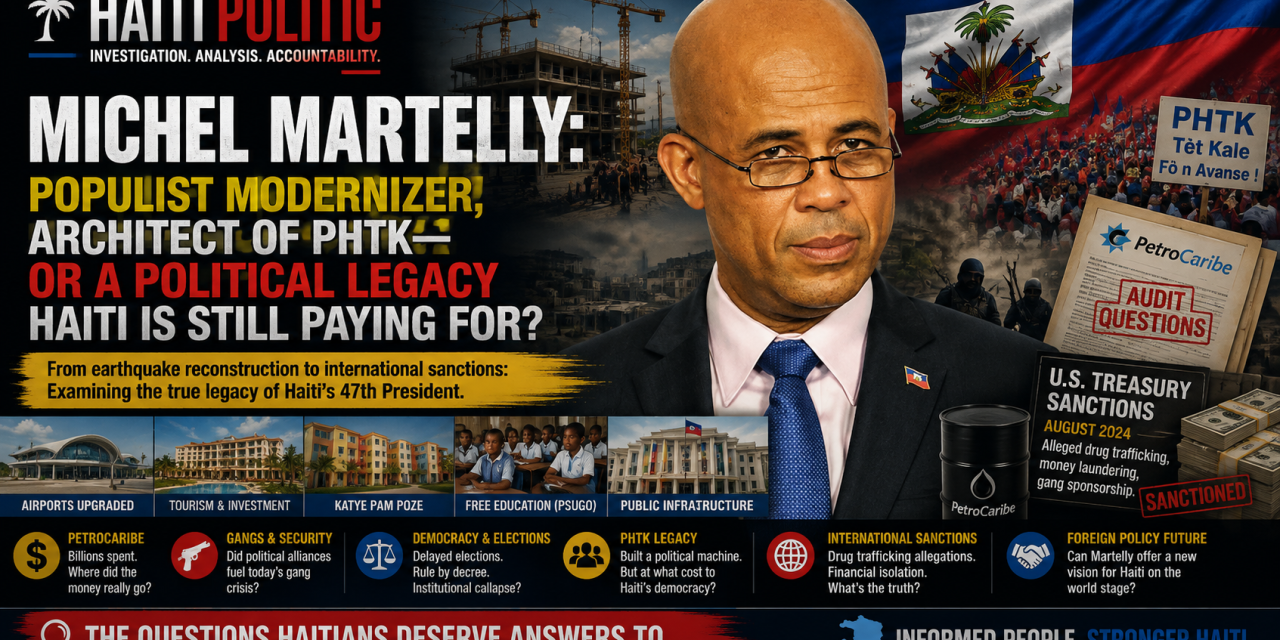
🇭🇹 Musician. Political outsider. President of Haiti. Founder of a political dynasty. Reconstruction-era executive. Internationally sanctioned former head of state.
Few Haitian presidents have transformed the country’s political culture as dramatically as Michel Joseph Martelly, better known for decades as the musician Sweet Micky.
He entered politics presenting himself as the opposite of Haiti’s traditional political class.
He was not a career parliamentarian.
He was not a conventional technocrat.
He was a celebrity entertainer with extraordinary name recognition, populist instincts and an ability to communicate directly with crowds.
In 2011, Haitians elected him president in the aftermath of one of the worst natural disasters in modern history.
Five years later, he left behind something much larger than one presidential administration.
He left:
PHTK.
A political machine.
A reconstruction record.
An education program.
A business-oriented development strategy.
A contested PetroCaribe legacy.
An electoral crisis.
And now, international sanctions involving allegations of narcotics trafficking and gang sponsorship.
So the question is no longer simply:
What did Michel Martelly do as president?
The deeper question is:
Did the Martelly era modernize Haiti—or help create some of the political and institutional conditions Haiti is struggling with today?
This is not an endorsement.
It is not a conviction.
It is an examination of the documented record—and of the questions Michel Martelly should answer if he or the political movement he built seeks renewed influence over Haiti’s future.
🇭🇹 WHO IS MICHEL JOSEPH MARTELLY?
Michel Martelly was born in Port-au-Prince in 1961.
Before entering presidential politics, he became one of Haiti’s best-known musicians under the stage name Sweet Micky.
His flamboyant performances, confrontational humor and kompa music gave him an extraordinary public profile.
That celebrity mattered politically.
After the catastrophic January 2010 earthquake, Haiti’s population was exhausted by traditional political leadership.
Hundreds of thousands had died.
Government institutions had collapsed.
Large portions of Port-au-Prince had been destroyed.
International organizations had enormous influence over reconstruction.
Martelly presented himself as an outsider capable of breaking with the old system.
In 2011, he won the presidency.
And with that victory, Haitian politics entered the Tèt Kale era.
🏛️ FROM SWEET MICKY TO PRESIDENT
Martelly’s political appeal rested partly on a simple proposition:
Haiti needed action.
Not endless speeches.
Not endless political negotiations.
Not endless dependence on humanitarian organizations.
His administration emphasized several themes:
🎓 education;
🏗️ reconstruction;
✈️ tourism;
💼 foreign investment;
🌎 international economic diplomacy;
🏨 hotels and private-sector development;
🚧 roads and public infrastructure;
and a wider strategy summarized by the slogan:
“HAITI IS OPEN FOR BUSINESS.”
This was a deliberate attempt to change Haiti’s international image.
Instead of presenting Haiti primarily as a humanitarian emergency, the administration wanted foreign governments and companies to view the country as a market and investment destination.
There were visible results.
During Martelly’s presidency, international hotel brands expanded their presence, Cap-Haïtien’s airport received upgrades, tourism promotion increased, and reconstruction projects transformed portions of Port-au-Prince.
UNESCO reported in 2014 that Martelly highlighted the new Cap-Haïtien airport, international hotel investment, entrepreneurship and efforts to shift Haiti away from aid dependence.
But visible construction is only one part of the record.
The other question is:
How was it financed—and what value did Haiti receive?
🎓 ACCOMPLISHMENT #1 — EDUCATION
Education was one of Martelly’s most prominent campaign promises.
His administration launched the Programme de Scolarisation Universelle Gratuite et Obligatoire—PSUGO, intended to expand access to tuition-free primary education.
The World Bank reported that during the 2011–2012 school year, more than one million children aged 6 to 12 were able to attend school free of charge under the broader government initiative.
UNESCO later reported approximately 1.2 million children in school under the government’s education push during the first years of Martelly’s term.
That is not insignificant.
For families unable to afford tuition, school subsidies could make the difference between a child entering a classroom and remaining outside it.
But PSUGO also developed serious implementation and oversight problems.
UNESCO’s education-planning institute later documented dysfunctions in the program, and Haitian education discussions have acknowledged weaknesses in monitoring and evaluation.
So Martelly deserves both questions:
How many children gained access because of PSUGO?
And:
How much public money was lost through poor oversight, nonexistent schools, inflated enrollment or weak controls?
Both can be true simultaneously.
A program may achieve a genuine social objective while still being badly administered.
🛢️ THEN COMES PETROCARIBE
No serious evaluation of the Martelly presidency can avoid this word:
PETROCARIBE.
Through Venezuela’s PetroCaribe program, Haiti received petroleum under favorable financing arrangements.
Rather than immediately paying the full cost of imported fuel, part of the obligation became long-term financing.
That created a large pool of money that Haitian governments could use for:
roads,
housing,
public buildings,
social programs,
agriculture,
sports facilities,
urban redevelopment,
and reconstruction.
During the Martelly period, enormous sums were authorized.
The Haitian Superior Court of Auditors—CSCCA—later conducted multiple audits of PetroCaribe management.
Its reporting identified extensive weaknesses and irregularities in project administration, procurement and financial controls.
The CSCCA’s third audit documents major PetroCaribe spending resolutions under Martelly’s presidency, including a $96.9 million resolution in May 2011 and another exceeding $210 million in February 2012, before later spending under subsequent governments during his term.
The question is therefore not whether money was spent.
It clearly was.
The question is:
WHAT DID HAITI RECEIVE FOR IT?
🔍 TEST #1 — OPEN THE PETROCARIBE BOOKS
President Martelly:
Haitians should not have to choose between defenders of your administration and critics of your administration.
They should be able to examine the evidence.
For every major PetroCaribe project approved during your presidency, publish:
The original appropriation.
The contract.
The contractor.
The beneficial owner of the company.
The amount disbursed.
The engineering estimate.
Any change orders.
The completion percentage.
The final cost.
The project’s present condition.
The independent audit.
Then Haitians can visit the project.
If a road cost $20 million:
Show the road.
If a hospital cost $15 million:
Show the hospital.
If a public building cost $30 million:
Show the building.
If social programs received millions:
Show the beneficiaries and accounting.
The most convincing defense of the Martelly reconstruction record would not be another political speech.
It would be a searchable public ledger connected to physical results.
⚠️ A 2023 UN EXPERT REPORT DEEPENED THE PETROCARIBE QUESTIONS
A United Nations expert report examining Haiti’s security and political crisis stated that PetroCaribe funds had been misappropriated and said the most serious diversions occurred during the Martelly presidency.
The report specifically discussed the period when Laurent Lamothe served as prime minister and planning minister and cited Haitian official investigations into the use of the fund.
That does not substitute for a criminal conviction against Martelly.
But it means the accountability issue cannot simply be dismissed as partisan propaganda.
It requires documentary answers.
🏗️ TEST #2 — RECONSTRUCTION OR APPEARANCE?
Supporters point to visible changes during the Martelly years.
Airports.
Hotels.
Government buildings.
Public squares.
Road rehabilitation.
Tourism infrastructure.
Housing and social programs.
The administration undeniably invested considerable political energy in projecting a sense that post-earthquake Haiti was rebuilding.
But more than a decade later, Haitians can now conduct the most important audit of all:
What survived?
Which projects are functioning?
Which generate revenue?
Which improved productivity?
Which reduced transportation costs?
Which created permanent jobs?
Which deteriorated because maintenance was never financed?
Which were abandoned?
A public plaza can look impressive.
A national development strategy has to produce measurable economic returns.
💼 “HAITI IS OPEN FOR BUSINESS”
One of Martelly’s defining ideas was that Haiti needed investment rather than permanent charity.
That argument had merit.
A country cannot develop primarily through NGOs and emergency aid.
The administration sought:
international hotels,
tourism,
industrial investment,
foreign capital,
and greater private-sector participation.
But this strategy deserves a rigorous retrospective.
How much sustainable foreign investment actually remained?
How many permanent jobs resulted?
How many investors left?
How much investment was concentrated around Port-au-Prince rather than provincial Haiti?
Did business incentives increase competition?
Or did they strengthen politically connected firms?
Did “Open for Business” reform:
electricity?
customs?
commercial courts?
property rights?
ports?
tax administration?
Without institutional reform, marketing cannot substitute for an investment climate.
🚨 THEN COMES THE MOST SERIOUS MODERN DEVELOPMENT
On August 20, 2024, the United States Treasury Department sanctioned Michel Martelly under an executive order targeting persons involved in the global illicit drug trade.
The Treasury statement was extraordinary.
The U.S. government alleged that Martelly:
abused his influence to facilitate the trafficking of cocaine destined for the United States;
participated in laundering illicit drug proceeds;
worked with Haitian drug traffickers;
and
sponsored multiple Haiti-based gangs.
Treasury coordinated the action with the U.S. Drug Enforcement Administration.
These are official allegations underlying a sanctions designation.
They are not the same thing as a criminal conviction in court, and that distinction matters.
But they are among the gravest accusations ever publicly leveled by Washington against a former Haitian president.
🇺🇸 TEST #3 — ANSWER THE U.S. DRUG-TRAFFICKING DESIGNATION
President Martelly:
The American government has effectively accused a former Haitian head of state of participating in international narcotics activity.
That cannot be answered with:
“Politics.”
“Fake accusations.”
“Foreign interference.”
Those may form part of your defense.
But Haitians deserve evidence.
Have you formally challenged the OFAC designation?
Have your attorneys requested administrative reconsideration?
What factual assertions do you dispute?
Did you have financial or political relationships with individuals identified by U.S. authorities as traffickers?
Have you submitted contrary banking records?
Travel records?
Communications?
Witness statements?
Financial audits?
Would you authorize the release of the evidence your lawyers submitted?
If the accusations are false:
Show Haitians why.
💵 IMPORTANT CORRECTION: WHAT THE U.S. SANCTIONS ACTUALLY DO
The 2024 U.S. sanctions are severe, but precision matters.
Treasury placed Martelly on its Non-SDN Menu-Based Sanctions List, rather than describing the action as a conventional full SDN asset-blocking designation.
The measures prohibit:
U.S. financial institutions from extending loans or credit to him;
certain foreign-exchange transactions under U.S. jurisdiction involving his interests;
and U.S. persons from investing in or purchasing significant equity or debt connected to him.
Therefore it would be inaccurate simply to claim that Treasury announced a blanket freeze of every Martelly asset worldwide.
But politically and financially, the designation remains extremely consequential.
🇨🇦 CANADA HAD ACTED FIRST
Canada sanctioned Martelly in November 2022.
Its Haiti sanctions regime targets political elites whom the Canadian government says used their influence to support criminal armed gangs.
Canada’s measures generally prohibit dealings with listed persons and effectively freeze covered assets in Canada.
Martelly remained on Canada’s consolidated sanctions list in its June 2026 update.
That creates an obvious diplomatic problem.
A former president associated with a major Haitian political party is sanctioned by two of Haiti’s most important international partners.
So the issue goes beyond Michel Martelly personally.
It becomes a foreign-policy question for Haiti.
🌎 TEST #4 — CAN A SANCTIONED POLITICAL LEADER SHAPE HAITIAN FOREIGN POLICY?
The United States and Canada matter enormously to Haiti.
Migration.
Banking.
Trade.
Diaspora relations.
Security assistance.
Development programs.
Diplomatic recognition.
International lending.
Sanctions.
So imagine PHTK returning to power while Martelly remains one of its dominant political personalities.
How would Washington interpret that?
How would Ottawa?
Would Martelly participate in policy decisions?
Would he meet foreign officials?
Would political allies use intermediaries?
Could sanctions complicate financial transactions involving a party or administration closely associated with him?
Would PHTK establish formal separation between Martelly and government decision-making?
This is not an abstract question.
Personal sanctions can become national diplomatic complications when the person remains politically influential.
🔫 TEST #5 — GANGS AND POLITICAL POWER
Haiti’s gang catastrophe did not appear overnight.
For years, political figures from multiple parties and factions have been accused of using armed neighborhood groups for:
electoral mobilization,
territorial control,
intimidation,
protest suppression,
and economic influence.
Canada’s sanctions rationale and the U.S. Treasury’s later allegations place Martelly directly inside that broader debate.
So Martelly should answer:
Did you, your advisers or political allies ever provide money, weapons, protection or political support to armed neighborhood groups?
Did PHTK candidates use gangs to control electoral territory?
Did members of your administration intervene to prevent arrests of gang leaders?
Were police resources used selectively to benefit political allies?
Would you support an independent commission empowered to investigate gang financing going back to your presidency?
That last question matters.
It is easy to demand investigations of today’s enemies.
A serious commitment to rule of law requires investigating yesterday’s allies.
🚔 TEST #6 — WHAT HAPPENED TO THE SECURITY STATE?
Martelly inherited a weak Haitian National Police.
Haiti also remained under significant international security influence during his presidency.
But the central long-term question is:
Did his administration leave Haiti with stronger security institutions?
More professional intelligence?
Better border controls?
More capable customs enforcement?
A stronger coast guard?
Better police vetting?
Better anti-narcotics capacity?
Independent internal affairs?
A functioning criminal-justice pipeline?
If not, visible reconstruction may have occurred without constructing the institutions most essential to sovereignty.
🗳️ TEST #7 — THE ELECTION CRISIS
This is one of the most important parts of Martelly’s political legacy.
Municipal and legislative elections were repeatedly delayed during his presidency.
By January 2015, the mandates of most legislators had expired.
Parliament lost its ability to function normally.
Martelly consequently governed by decree during the final phase of his presidency.
Then the 2015 presidential election descended into accusations of irregularities and mass political conflict.
The transition failed to produce an elected successor before Martelly’s term ended.
On February 7, 2016, Martelly left office at the expiration of his constitutional mandate.
Haiti entered another transitional arrangement.
So voters should ask:
WAS THIS THE BEGINNING OF THE CURRENT INSTITUTIONAL COLLAPSE?
Not because Martelly alone caused everything that followed.
That would be historically simplistic.
But because democratic institutions deteriorate when elections stop functioning.
⚖️ PRESIDENT MARTELLY: WHY DID THE ELECTORAL CALENDAR FAIL?
Who was responsible?
The presidency?
Parliament?
The Provisional Electoral Council?
Opposition parties?
Funding?
Political negotiations?
All of them?
Which mistakes does Martelly accept personally?
And if PHTK returned to government:
What constitutional mechanism would guarantee that parliamentary, municipal and presidential elections occur on schedule even when the ruling party expects to lose?
That is how democratic credibility is measured.
Not by winning elections.
By organizing elections you might lose.
🧩 TEST #8 — PHTK: MOVEMENT OR POLITICAL MACHINE?
Martelly’s most enduring political accomplishment may not be a road or public building.
It may be PHTK—the Parti Haïtien Tèt Kale.
PHTK became one of the dominant forces in Haitian politics after Martelly’s presidency.
The party helped propel Jovenel Moïse to the presidency.
Its allies occupied major positions throughout Haiti’s political system.
That means the Martelly legacy extends far beyond 2016.
Supporters can argue:
He built a durable political organization in a country where parties often disappear after one election.
Critics can answer:
He created a patronage machine that contributed to institutional decay.
The public should decide based on evidence.
🍌 THE JOVENEL MOÏSE DECISION
Martelly backed businessman Jovenel Moïse as PHTK’s presidential candidate.
Moïse eventually became president in 2017.
Four years later, on July 7, 2021, he was assassinated inside his private residence.
That tragedy did not begin with the choice of candidate.
Nor can Martelly reasonably be blamed for the assassination simply because he supported Moïse.
But the succession raises broader political questions.
What institutional handover did Martelly build?
Was PHTK prepared to govern institutionally without Martelly?
Did the party develop independent democratic structures?
Did it build safeguards around presidential power?
Did the movement prioritize institutions—or personalities?
And what lessons does Martelly draw from what happened to the political system under his chosen successor?
🏛️ TEST #9 — PERSONALITY POLITICS
Martelly’s greatest political strength was charisma.
That may also illuminate Haiti’s biggest political weakness.
Haitian politics repeatedly revolves around personalities:
Aristide.
Préval.
Martelly.
Moïse.
Political organizations frequently become vehicles for individual leaders rather than institutions governed by internal rules.
So if Martelly believes PHTK still has something to offer:
Would PHTK publish its membership?
Leadership elections?
Financial accounts?
Donors?
Candidate-selection rules?
Ethics standards?
Internal disciplinary procedures?
Would the party survive politically without Michel Martelly at its center?
A party that cannot survive its founder is not yet an institution.
🌾 TEST #10 — WHAT DID RURAL HAITI RECEIVE?
The Martelly administration heavily promoted reconstruction and business investment.
But Haiti cannot develop primarily through:
hotels,
Port-au-Prince redevelopment,
tourism,
and capital-city construction.
What happened to:
Artibonite agriculture?
irrigation?
regional roads?
farm credit?
food-processing infrastructure?
fishing?
rural electricity?
local hospitals?
provincial universities?
regional airports?
municipal tax capacity?
A national reconstruction strategy must be visible in communities that tourists never visit.
🌎 FOREIGN POLICY: WHERE MARTELLY’S RECORD GETS COMPLICATED
Martelly’s administration governed during a period when Haiti’s foreign policy was extraordinarily dependent on external actors.
The United States.
Canada.
France.
The United Nations.
Venezuela.
Dominican Republic.
CARICOM.
Taiwan.
Multilateral development banks.
International NGOs.
Haiti needed them.
But dependency creates leverage.
And this is where the “Haiti is Open for Business” strategy deserves another look.
The administration attempted to turn foreign relations toward:
investment,
tourism,
reconstruction finance,
trade,
and economic partnerships.
That instinct remains relevant.
Haiti needs economic diplomacy.
But Haiti also needs sovereignty.
The question is whether Martelly’s model actually increased Haitian negotiating power—or merely diversified the sources of external dependence.
🇻🇪 PETROCARIBE AND FOREIGN-POLICY DEPENDENCE
Venezuela’s PetroCaribe arrangement gave Haiti unusual financing flexibility.
Unlike many traditional aid programs, Haitian authorities had considerable control over how portions of the financing were deployed.
That gave the government greater policy space.
It also meant that Haitian institutions bore greater responsibility for accountability.
This is a central lesson for the next government:
Sovereignty without accountability can simply create domestically controlled corruption.
Foreign conditionality can be excessive.
But eliminating foreign oversight does not automatically produce good Haitian governance.
A sovereign government must be capable of auditing itself.
🇺🇸 THE WASHINGTON QUESTION
Martelly once maintained relatively normal working relations with Washington.
Today, he is sanctioned by the U.S. Treasury.
That changes everything.
So:
What would Michel Martelly’s foreign-policy doctrine toward the United States be now?
Would he challenge the sanctions formally?
Would he separate personal disputes from Haiti’s diplomatic interests?
Would he accept U.S. security assistance?
Would he expand cooperation against narcotics trafficking?
Would he permit DEA cooperation in Haiti?
Would Haitian sovereignty limit U.S. operations?
What happens if Washington insists that individuals close to PHTK are security risks?
Foreign policy becomes difficult when national diplomacy intersects with personal legal exposure.
🇨🇦 THE OTTAWA QUESTION
Canada is home to a major Haitian diaspora.
It is also one of the governments sanctioning Martelly.
A future PHTK administration therefore needs to explain:
Would Martelly participate in Canada policy?
Would officials under sanctions be excluded from negotiations?
Could Canadian-Haitian police cooperation continue?
Would Ottawa’s sanctions be formally challenged?
Would PHTK accept Canada’s allegations as legitimate concerns—or describe them as foreign political interference?
That answer would reveal much about the party’s future foreign policy.
🇩🇴 THE DOMINICAN REPUBLIC QUESTION
Martelly also had to manage Haiti’s most unavoidable bilateral relationship.
The Dominican Republic affects:
trade,
migration,
border security,
agriculture,
smuggling,
employment,
transportation,
and citizenship disputes.
Any future Martelly-aligned foreign policy should explain:
What permanent bilateral institutions should exist?
How should mass deportations be handled?
How should border trade be formalized?
How can Haiti reduce dependence on Dominican imports?
How should weapons and contraband flows be controlled?
How should water disputes be negotiated?
Nationalism without a Dominican strategy is not foreign policy.
💵 TEST #11 — WOULD MARTELLY ACCEPT FINANCIAL TRANSPARENCY NOW?
If Michel Martelly seeks any renewed political role—formal or informal—the standard should be exceptionally high.
Would he disclose:
personal assets?
companies?
properties?
offshore interests?
trusts?
major political donors?
foreign business partners?
income sources since leaving office?
major transactions during his presidency?
communications relevant to sanctions allegations?
Would he permit independent forensic review?
The burden is not ordinary.
Former heads of state accused by foreign governments of drug trafficking and gang sponsorship cannot reasonably demand ordinary levels of scrutiny.
🎤 THE POPULIST QUESTION
Martelly’s supporters should not be dismissed.
His political success reflected something real.
Many Haitians were tired of:
career politicians,
bureaucratic paralysis,
elite discourse,
international paternalism,
and governments incapable of delivering visible change.
Martelly communicated differently.
He projected optimism.
He projected confidence.
He understood popular culture.
He made people feel that political leadership did not have to belong exclusively to traditional elites.
That is a political accomplishment.
But charisma creates danger when citizens confuse connection with accountability.
A president can feel close to the people and still preside over weak institutions.
📊 THE MICHEL MARTELLY TEST
| AREA | DOCUMENTED STRENGTH OR LEGACY | QUESTION HAITIANS STILL NEED ANSWERED |
|---|---|---|
| Popular communication | Exceptional name recognition and populist appeal from his music career | Did personality politics weaken institutional politics? |
| Education | PSUGO substantially expanded access to school for many children | Were financing, verification and oversight strong enough? |
| Reconstruction | Visible public works, tourism and investment initiatives | Did projects provide sustainable value relative to cost? |
| Economic diplomacy | Promoted “Haiti is Open for Business” and foreign investment | Did branding translate into durable structural reform? |
| PetroCaribe | Administration controlled major development resources | CSCCA and UN reporting raised severe accountability concerns |
| PHTK | Built one of Haiti’s most durable post-2010 political machines | Did party power strengthen democracy or patronage? |
| Elections | Presidency eventually saw elections attempted in 2015 | Repeated delays contributed to parliamentary dysfunction and transition crisis |
| Security | Governed during a period of comparatively greater state territorial control than today | U.S. and Canadian sanctions now allege ties to gangs and illicit networks |
| U.S. relations | Previously dealt extensively with Washington as president | Now subject to U.S. narcotics-related sanctions |
| Canada relations | Large Haitian-Canadian political and diaspora relationship | Canada has sanctioned him since 2022 |
| Foreign policy | Used investment and regional diplomacy aggressively | Can he offer an independent doctrine after sanctions and the collapse of the old regional order? |
⚖️ THE ARGUMENT HIS SUPPORTERS WILL MAKE
Martelly’s supporters can make a real case.
He inherited a devastated country.
He promoted education.
He pushed reconstruction.
He reopened Haiti to international tourism and business discussion.
He encouraged investment.
He expanded infrastructure.
He broke with traditional presidential style.
He built a political movement that outlived his presidency.
And during much of his term, Haiti did not experience the degree of territorial gang domination visible today.
Supporters may therefore ask:
Was the Martelly period imperfect—but still more functional than what followed?
That question deserves consideration.
🚨 THE ARGUMENT HIS CRITICS WILL MAKE
Critics have an equally powerful case.
Martelly governed when Haiti possessed extraordinary reconstruction resources.
Yet major accountability questions remain unresolved.
PetroCaribe became synonymous with public anger over corruption.
Elections were delayed.
Parliament became dysfunctional.
His political movement dominated Haiti for years while institutions continued deteriorating.
His chosen successor inherited a profoundly polarized country and was later assassinated.
And now:
Canada has sanctioned him.
The United States has sanctioned him under a global narcotics authority.
Treasury explicitly alleges drug trafficking, money laundering and gang sponsorship.
Those are not minor political controversies.
They go directly to the question of whether a former president can again exercise legitimate influence over the Haitian state.
🔥 25 QUESTIONS MICHEL MARTELLY SHOULD ANSWER
1. Will you publish a complete project-by-project accounting of PetroCaribe spending during your presidency?
2. Which reconstruction projects from your administration remain fully operational today?
3. How much did PSUGO cost annually?
4. How many verified students benefited?
5. How many schools receiving funds were independently audited?
6. What mistakes do you acknowledge in PetroCaribe management?
7. Why were legislative and municipal elections repeatedly delayed?
8. What responsibility do you personally accept for Parliament becoming dysfunctional?
9. Would you govern by decree again under similar circumstances?
10. Why did Haiti fail to achieve an orderly presidential succession in February 2016?
11. What did PHTK learn from the presidency of Jovenel Moïse?
12. What institutional mistakes left the Haitian presidency vulnerable?
13. Did anyone within your administration finance or protect armed groups?
14. Did PHTK ever coordinate politically with gangs?
15. Would you support an independent investigation of gang financing dating back to your administration?
16. How do you answer the U.S. Treasury allegation that you facilitated cocaine trafficking?
17. How do you answer Treasury’s allegation that you laundered illicit drug proceeds?
18. How do you answer the allegation that you sponsored multiple gangs?
19. Have you formally petitioned OFAC for removal from the sanctions list?
20. Will you publish evidence supporting your defense?
21. How would a future PHTK government manage relations with the United States and Canada while you remain sanctioned?
22. What should replace PetroCaribe as Haiti’s infrastructure-financing strategy?
23. What foreign-policy doctrine should Haiti pursue toward Washington, Ottawa, Venezuela, CARICOM and the Dominican Republic?
24. Would PHTK publish its donors and independently audited financial statements?
And finally:
25. If Haiti gave Michel Martelly extraordinary power and extraordinary resources once before, why should Haitians believe the political system he helped build would produce a different result the next time?
🇭🇹 THE CENTRAL QUESTION
Michel Martelly cannot be evaluated like a first-time candidate.
Haiti already gave him the presidency.
That means voters do not need to speculate.
They can examine:
the schools;
the contracts;
the airports;
the hotels;
the roads;
the PetroCaribe audits;
the electoral calendar;
the state of Parliament;
the political party he built;
the successor he promoted;
and the institutions Haiti inherited after his administration.
Then there are the sanctions.
Those allegations require answers, not slogans.
So the defining question is not:
Was Michel Martelly popular?
He clearly was.
It is not:
Did his government build things?
It did.
The harder questions are:
Were the institutions strengthened?
Was the money properly accounted for?
Was PHTK a democratic party or a vehicle for power?
Did political relationships contribute to the growth of armed groups?
Can a sanctioned former president credibly shape Haiti’s relations with Washington and Ottawa?
And does the Martelly model offer a future—or represent a chapter Haiti should not repeat?
Haiti does not need nostalgia.
It does not need revenge.
It needs evidence.
Contracts.
Audits.
Court records.
Financial disclosures.
Security records.
Policy.
And institutional accountability.
Michel Martelly had the presidency.
Now history is auditing the presidency.
Let him answer the record.
Then:
🇭🇹 LET THE HAITIAN PEOPLE DECIDE.
Pa sèlman mande si bagay yo te sanble pi bon.
Mande si sistèm nan te vin pi solid.
Pa sèlman mande konbyen pwojè ki te lanse.
Mande konbyen ki toujou sèvi pèp la.
Pa sèlman mande kiyès ki te gen pouvwa.
Mande ki kalite Leta yo kite dèyè.
🇭🇹 HAITI POLITIC — Investigation. Accountability. Debate.