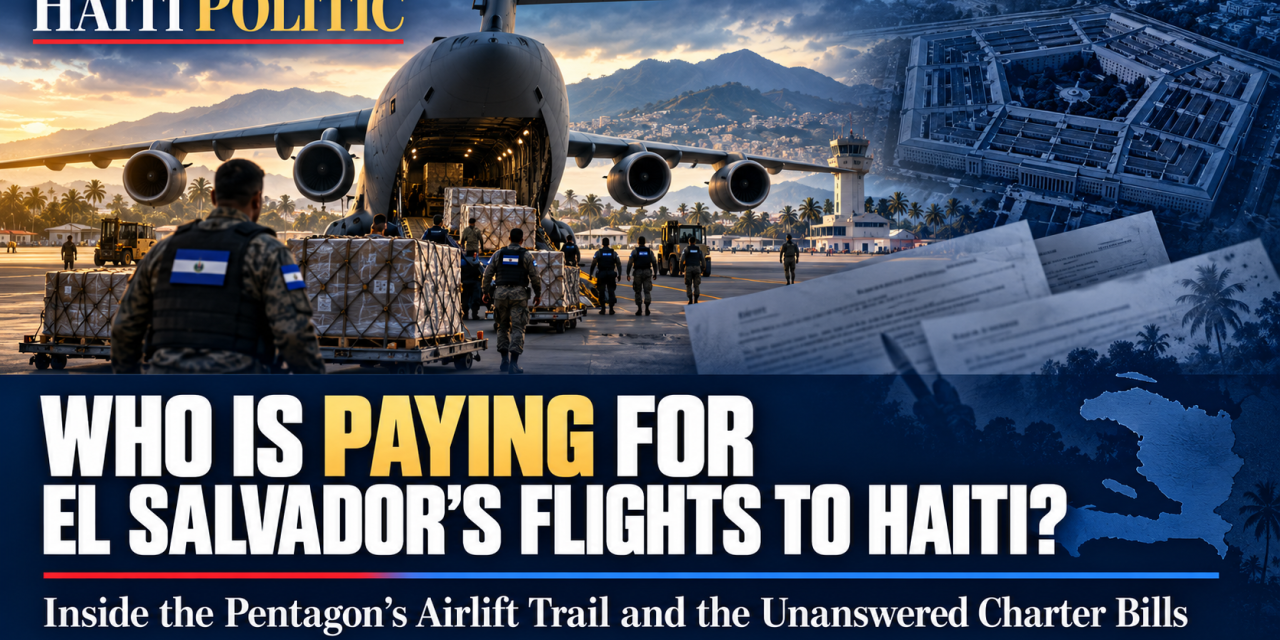
Haiti Politic | Public-record investigation and analysis | October 27, 2026
The aircraft keep arriving. The public accounting has not kept pace.
As El Salvador sends additional personnel and equipment to Haiti following the October 18 attack on four Salvadoran aviation technicians, a question raised by researcher Jake Johnston has become unavoidable: who is paying for the flights?
The evidence supports a clear but qualified answer. The United States is providing some military airlift, and federal contracting records document a separate Pentagon-funded commercial transportation channel serving Haiti. National Air Cargo Group, Inc., operating as National Airlines, is part of that contracting system.
What the reviewed records do not establish is who paid for every recent charter from El Salvador, the price of each movement, or whether any particular flight was financed through the UN-administered Gang Suppression Force trust fund.
That distinction is the center of the story. A documented U.S. airlift role is not the same as a complete flight-by-flight payment ledger.
THE C-130 CONNECTION
Reporting by Jacqueline Charles of the Miami Herald, republished by Aviation Pros on October 26, identifies one recent transport carrying Salvadoran personnel as a U.S. military C-130 supplied by the Pentagon at the State Department’s request. The report quotes Southern Command confirming that a U.S. military aircraft providing logistical support arrived in Port-au-Prince. [1]
The same account says it was unclear whether the U.S. government supplied the other three charters discussed in that report. It does not provide a complete set of invoices, manifests or contracting instructions.
A separate October 26 Charles report describes continued arrivals and at least a dozen flights since the initial reinforcement deployment. It also reports that Bukele was seeking additional troops and a role operating independently of the GSF. Those are reported developments, not an independently established final command arrangement. [2]
The public evidence therefore already places U.S. military resources inside the airlift effort. It does not establish the ultimate accounting treatment or reimbursement arrangements for every movement.
FOLLOW THE CONTRACTING OFFICE—AND THE FUNDING AGENCY
A flight can involve several different actors: the government requesting transportation, the office awarding the contract, the organization whose funds are used, the prime contractor and the airline actually operating the aircraft.
These roles should not be collapsed into one label.
USTRANSCOM—the United States Transportation Command—is a U.S. military command. Its contracting role is visible in the federal awards reviewed for this article.
In National Air Cargo’s Haiti-coded orders, USAspending identifies USTRANSCOM as the awarding subagency and the Department of the Air Force as the funding subagency. Both sit under the federal department labeled Department of Defense in the dataset. [3]
The records therefore trace a concrete funding route: Defense/Air Force funding, a USTRANSCOM transportation order and National Air Cargo Group as the prime recipient.
That is substantially more evidence than a photograph of an aircraft or a flight’s country of origin. It still does not establish which order, if any, covered a particular October 2026 flight.
NATIONAL AIR CARGO IS A USTRANSCOM CONTRACTOR
The legal recipient identified in these records is National Air Cargo Group, Inc., UEI FCZYF8MGM1K6, which operates as National Airlines. The carrier’s own documentation identifies that business name, and the Air Force’s Civil Reserve Air Fleet fact sheet lists the company among participating carriers. [4–5]
The Civil Reserve Air Fleet, or CRAF, connects participating civilian airlines with U.S. military airlift requirements. It provides a framework for commercial carriers to support government transportation needs. Participation does not mean every flight operated by a carrier is a military flight or is paid for by the Pentagon.
The retrieved Haiti-coded National Air Cargo records reference parent contracts HTC71118DCC40 and HTC71125DCC20. Ten returned orders have current award amounts totaling $2,985,334: eight positive amounts and two zero amounts. Their service descriptions identify CRAF air transportation. [3]
Illustrative orders include:
Order | Recorded award amount
HTC71125F1314 | $432,235
HTC71125F1308 | $418,235
HTC71124F3266 | $398,864
HTC71125F1131 | $396,000
These are contract records, not a fare schedule. An order’s amount should not automatically be described as the cost of one flight.
The dates are especially important. The ten orders list start dates in August–November 2024; some list end dates through September 30, 2026. Those records establish a historical Haiti airlift relationship. They are not, without additional evidence, the invoices for the new reinforcement flights arriving in October.
OTHER AIRLIFT RECIPIENTS APPEAR IN THE SAME SYSTEM
National Air Cargo is not the only name in the Pentagon’s Haiti-coded commercial air transportation records.
For transactions dated October 1, 2023 through October 27, 2026, the following recipients appear with CRAF air-transportation records awarded through USTRANSCOM and funded by the Air Force: [3]
Reported prime recipient | Net obligations in the defined search
Patriot Team | $4,998,084.98
National Air Cargo Group, Inc. | $2,985,334.00
Atlas Air, Inc. | $395,000.00
Federal Express Corporation | $150,000.00
Western Global Airlines Inc. | $124,224.65
Together, these entries account for approximately $8.65 million in recorded obligations.
They should not be presented as the cost of El Salvador’s current deployment. The search covers several years, and the returned descriptions do not match every order to a Salvadoran contingent, specific cargo or recent flight.
Patriot Team is a contracting-team label. It does not, by itself, identify which member airline flew a particular aircraft. National Shipping of America, another transportation recipient in the broader data, is a separate entity from National Air Cargo and should not automatically be included in an aviation total.
THE $597.57 MILLION FIGURE IS NOT A FLIGHT BILL
To examine the wider U.S. support system, Haiti Politic searched prime contract transactions with Haiti as their place of performance and Defense as their funding agency.
Between October 1, 2023 and October 27, 2026, that search returns $597,572,969.54 in net obligations, including $941,550 under an unnamed foreign-recipient category. [3]
The ten named recipients are:
Rank | Recipient | Net obligations
1 | Amentum Parsons Logistics Services LLC | $545,349,311.43
2 | GardaWorld Federal Services LLC | $36,728,296.50
3 | Patriot Team | $4,998,084.98
4 | National Shipping of America, LLC | $3,987,160.14
5 | National Air Cargo Group, Inc. | $2,985,334.00
6 | AM General LLC | $1,230,407.84
7 | Shipping Consultants Associated Ltd. | $683,600.00
8 | Atlas Air, Inc. | $395,000.00
9 | Federal Express Corporation | $150,000.00
10 | Western Global Airlines Inc. | $124,224.65
This is a ranking of DoD-funded contract obligations within a defined geography and period. It includes logistics, security and other activities. It is not a ranking of airlines, a calculation of GSF-only spending or a statement that each amount has already been paid.
Some activity predates the GSF and belongs to the predecessor Multinational Security Support mission. Relabeling the entire total as GSF expenditure would obscure that history.
WHAT HAS ACTUALLY BEEN PAID?
USAspending makes a distinction between obligations and outlays. An obligation is a legal commitment to spend. An outlay records expenditure or payment.
The recipient aggregation used for the ranking did not supply populated outlay totals. A separate award-level query did return payment information for two substantial awards: [3]
• Amentum Parsons award W519TC24F0212, describing LOGCAP services supporting the Haiti security mission: $79,500,000 in reported total outlays.
• GardaWorld award W519TC24F0176, describing security support services globally: $9,488,596.95 in reported total outlays.
These figures are cumulative award-level fields. They are not a complete invoice audit or a payment total restricted to the transaction period used for the ranking.
GardaWorld’s global description also means its entire outlay amount cannot automatically be allocated exclusively to Haiti.
National Air Cargo’s retrieved outlay fields were not populated. That does not establish that the airline received no payments. It means these records do not supply a verified cash-payment total.
Amentum’s much larger logistics award likewise does not prove that Amentum chartered the aircraft in the current social-media reports. That connection would require an order, subcontract, invoice or official confirmation tied to the movement.
IS USAID PAYING?
The reviewed records do not establish USAID as the payer for the recent Salvadoran military charters.
A separate search identified $53,464,839.57 in USAID-funded Haiti-coded contract obligations during the same October 2023–October 2026 period. That is an all-sector contracting figure, not an aviation budget. [6]
The USAID-specific review returned 67 contract awards and 92 grant or cooperative-agreement awards with matching Haiti performance locations and transactions in that period. Their descriptions did not explicitly match the aviation terms tested: air, flight, charter, aviation, airlift, cargo or aircraft. Both result sets reported no further pages.
This narrows the evidence; it does not rule out aviation financed through a subcontract, a broadly described grant or an award coded to another country or region.
Historical USAID support for humanitarian air services in Haiti is documented separately. A World Food Program USA account, first published in 2020 and subsequently updated, identifies USAID among donors supporting common logistics services, including UNHAS. [7]
Humanitarian passenger and light-cargo transportation is not interchangeable with military reinforcement flights. A historical humanitarian contribution cannot establish responsibility for a current troop charter.
DOES THIS COUNT AS A U.S. CONTRIBUTION TO THE GSF TRUST FUND?
Not automatically.
A direct federal transportation contract and a contribution to a UN-administered trust fund follow different financial routes.
Under the first route, a U.S. agency obligates funds to a contractor or supplies military resources. Under the second, a donor transfers money into the fund for authorized mission expenditure.
A direct U.S.-financed flight could be described as support for the GSF or as support in kind. That does not demonstrate a cash deposit into the trust fund.
Resolution 2793 provides a role for voluntary financing of GSF personnel costs and for trust-fund support. UNSOH supplies a separate logistical and operational support structure, financed through UN assessed contributions. Canada’s official briefing documents describe that distinction. [8–9]
The National Air Cargo records reviewed here identify U.S. military funding. They do not establish that the corresponding money passed through the GSF trust fund.
A specific reimbursement or contribution agreement could connect a direct service to a wider funding commitment. The reviewed material does not establish such an arrangement for these orders or the latest charters.
Adding the same transportation expense to a bilateral-support total and again to a trust-fund total without reconciling the accounts risks double-counting.
WHO COMMANDS THE TROOPS IS A DIFFERENT QUESTION
The reported possibility of Salvadoran forces operating under a national command alongside the GSF raises questions about authority and accountability.
But paying for transportation does not, by itself, establish day-to-day operational command. Nor does flying into Haiti establish a unit’s formal status within the multinational mission.
Those issues require the applicable deployment agreements, command arrangements and authorization documents. They should not be inferred solely from an airline logo, a donor announcement or the nationality of the passengers.
The financial question and the command question intersect because donors can enable deployment. They remain distinct questions requiring distinct evidence.
THE RECORDS THAT WOULD COMPLETE THE STORY
For each recent charter, a verifiable public accounting would identify the flight date and route, aircraft registration, operator, contracting customer, order number, amount obligated, amount paid and any reimbursement arrangement.
Sensitive passenger information need not be published to explain the public expenditure.
The same accounting should distinguish transport arranged for the established GSF contingent from additional national rescue or reinforcement deployments. It should show whether the expense was paid directly, supplied in kind, reimbursed later or financed through a multilateral mechanism.
Without those records, a flight tracker can show movement while leaving the transaction invisible.
The public record already answers part of Johnston’s question: American military resources and Pentagon-funded commercial airlift are part of the Haiti transportation system. It does not yet establish who paid for every newly scheduled Salvadoran flight.
The question now is which authorities will publish the documents that connect the aircraft arriving in Haiti to the budgets financing them.
METHODOLOGY AND LIMITATIONS
This article combines USAspending public API extractions conducted October 27, 2026 with official contracting and mission documents and attributed contemporary reporting. No Gazette Haiti material was used.
The principal DoD search uses funding agency Department of Defense, Haiti performance location HTI, prime contract types A/B/C/D and transaction dates October 1, 2023 through October 27, 2026. The recipient query returned 11 categories, including one unnamed category; the award query returned 42 records. Both reported no further pages and no ignored-filter warnings.
Recipient totals are transaction-based net obligations. Award amounts and outlays are award-level measures and must not be substituted for those filtered recipient totals. Outlays were quoted only where populated. An absent value is unknown, not zero.
The original user-supplied USAspending link resolves to a Haiti keyword search, without a selected performance location. The geographic and funding-agency searches used here are more specific and produce different totals.
Coding may omit Haiti-related services under global or regionally coded awards. The analysis does not comprehensively capture subcontracts, classified spending, foreign-government procurement or UN procurement. It does not identify the carrier or payer of every recent flight. No nonpublic flight manifests, invoices, military transport reimbursement agreements or internal accounting records were obtained.
Reported flight totals and proposed command arrangements remain attributed reporting. The historical CRAF orders are not presented as invoices for October 2026 flights.
SOURCES AND RECORD LINKS
[1] Jacqueline Charles, Miami Herald, republished by Aviation Pros, October 26, 2026, report identifying the Pentagon-provided C-130 and uncertainty over other charters.
https://www.aviationpros.com/aircraft-maintenance-technology/aircraft-technology/defense/news/55414282/salvadoran-troops-land-in-haiti-aboard-pentagon-plane-amid-crisis-over-ambushed-soldiers
[2] Jacqueline Charles, Miami Herald, October 26, 2026, republished by Genocide Watch: continued Salvadoran deployments and reported proposals concerning command.
https://www.genocidewatch.com/single-post/el-salvador-continues-to-deploy-soldiers-to-haiti-as-gangs-threaten-violence