Law. Development. Foreign Aid. Accountability. Security. Sovereignty.
Aviol Fleurant enters any discussion about Haiti’s future with something many aspiring political leaders do not possess: actual experience inside the machinery of the Haitian state.
He is an attorney and university professor with graduate training in international law, fundamental rights and environmental law. His professional biography says he has practiced law since 2002 and worked in business, civil, public and international law.
More importantly, Fleurant served as Minister of Planning and External Cooperation, including in the government of President Jovenel Moïse and Prime Minister Jack Guy Lafontant. Official Haitian government records confirm his appointment to that portfolio in 2017.
That experience gives him a potentially powerful argument: he understands how government, donors, investment programs and international cooperation actually work.
But it also creates his greatest political vulnerability.
If you helped operate the old system, what exactly would you do differently in a “Nouvelle Haïti”?
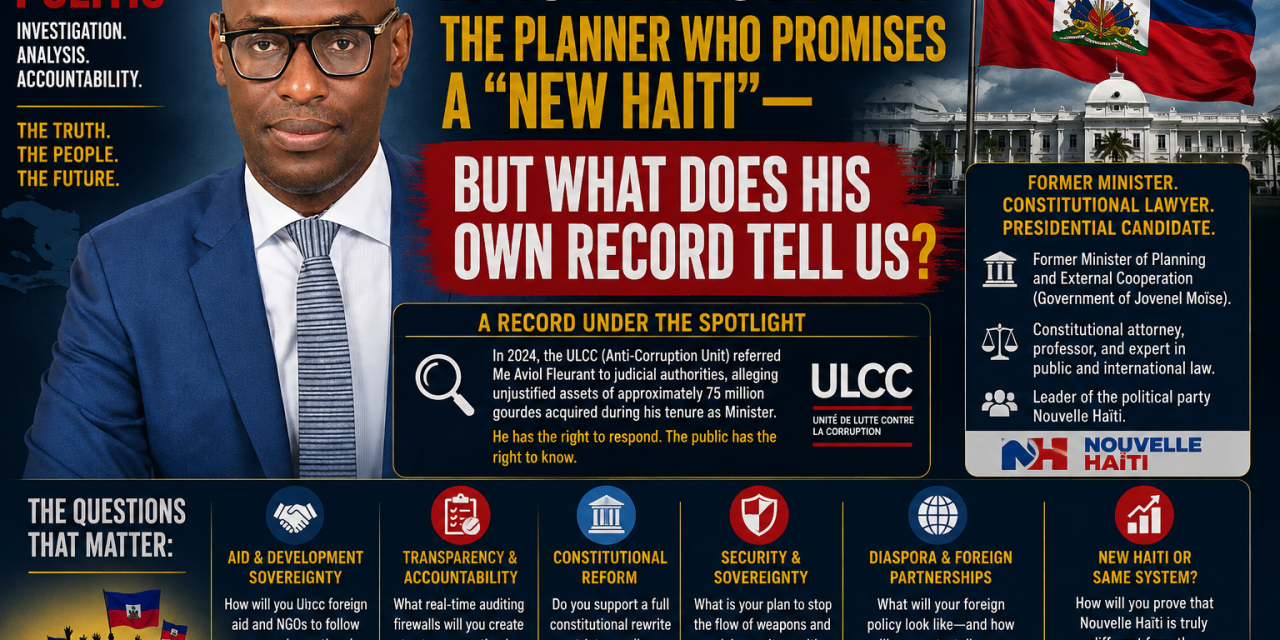
And there is now an even more serious accountability question that cannot responsibly be omitted from an investigative profile: in 2024, Haiti’s Unité de Lutte Contre la Corruption (ULCC) submitted an investigation concerning Fleurant to the judicial authorities. Reporting on the ULCC findings says investigators alleged that he could not reasonably justify approximately 75 million gourdes in increased assets during his period as planning minister.
That is an allegation/investigative finding, not a criminal conviction, and it should be treated as such. Fleurant deserves the opportunity to answer it directly.
For Haiti Politic, therefore, this investigation cannot merely ask whether Fleurant has a good development plan.
It must ask whether his record, explanations and proposals survive scrutiny.
🔎 1 | THE EXPERIENCE CASE
Fleurant’s strongest argument may be straightforward:
He has actually been inside the room.
The Ministry of Planning and External Cooperation is strategically important because Haiti’s development problem is inseparable from foreign assistance, public investment and coordination between the state and international institutions.
During Fleurant’s tenure, Haiti and the United Nations signed joint 2017–2018 work plans covering five major pillars: basic social services, poverty reduction and employment, resilience, gender equality and protection, and governance. The UN said the framework was developed under Haitian government leadership and aligned with Haiti’s Strategic Development Plan.
Fleurant also participated in high-level Haiti–European Union political dialogue in January 2018 alongside Haiti’s foreign and finance ministers.
Those are genuine credentials.
But participation in development frameworks isn’t the same as delivering development.
🎤 QUESTIONS FOR FLEURANT
Which projects initiated or supervised during your tenure were completed?
How much did they cost?
Which produced measurable economic returns?
Which failed?
What would you personally have done differently?
And perhaps most importantly:
Where can Haitian citizens independently see the numbers?
💰 2 | THE ULCC FINDINGS CANNOT BE A FOOTNOTE
Any serious examination of Fleurant’s candidacy must confront the 2024 ULCC investigation directly.
According to reporting on the agency’s findings, investigators alleged that Fleurant experienced an unjustified increase of roughly 75 million gourdes in assets while serving at the Planning Ministry. The ULCC referred investigation reports involving several former officials to judicial authorities.
Again, referral and accusation do not establish guilt.
But for someone campaigning around institutional modernization and a “New Haiti,” the allegations demand detailed answers.
🎤 THE QUESTIONS
Do you categorically reject the ULCC’s conclusions?
What specifically does the ULCC calculation get wrong?
Can you publish documentation accounting for the disputed assets?
Have you formally challenged the report before the competent authorities?
What is the present judicial status of the matter?
And then comes the institutional test:
Would President Fleurant allow an independent ULCC to investigate President Fleurant?
That question goes beyond one politician.
It tests what Nouvelle Haïti actually means.
🌎 3 | FOREIGN AID: WHO REALLY SETS HAITI’S DEVELOPMENT AGENDA?
This is where Fleurant could potentially contribute something unusual to Haiti’s foreign-policy debate.
He has firsthand experience dealing with international development institutions.
The 2017 UN framework is particularly relevant because it explicitly attempted to align international cooperation with Haitian national development priorities.
Yet Haiti’s larger historical problem remains.
International organizations may finance schools, hospitals, agriculture, humanitarian relief and governance programs—but parallel international structures can also weaken the state’s ability to plan and execute policy itself.
So what would Fleurant change?
🎤 ASK HIM:
Would every major foreign NGO be required to disclose its Haitian budget, contractors, salaries and geographic activities to the state?
Would international development projects require alignment with departmental development plans?
Should donors finance Haitian institutions directly—or would corruption risks make that irresponsible without prior reforms?
Would foreign NGOs be required to transfer technical capacity to Haitian institutions?
What happens when a major donor’s priorities conflict with Haiti’s national development strategy?
That’s where sovereignty stops being rhetoric.
🏛️ 4 | THE CONSTITUTION: REPAIR IT OR REPLACE IT?
Fleurant’s legal background gives him another advantage.
His professional biography describes extensive work involving public law and consultations concerning government formation, prime-ministerial policy, legislation and judicial matters. He also co-authored a collective work concerning amendment of Haiti’s 1987 Constitution.
So voters deserve more than another promise of constitutional reform.
They deserve specifics.
Should Haiti retain the President–Prime Minister dual executive?
Should Parliament’s confirmation powers change?
Should elections be synchronized?
How should the Electoral Council be constituted?
Should diaspora Haitians gain greater political rights?
Should local governments receive constitutionally guaranteed revenues?
Should constitutional amendment be undertaken before elections—or only by legitimately elected institutions?
And above everything:
How do you change Haiti’s constitutional architecture without using the crisis itself as justification for concentrating presidential power?
🚨 5 | YOU CANNOT PLAN DEVELOPMENT ON TERRITORY THE STATE DOESN’T CONTROL
This is perhaps the biggest difference between Fleurant’s previous ministerial experience and the Haiti a future president would confront.
Development planning requires roads.
Ports.
Electricity.
Customs.
Banks.
Schools.
Courts.
Investment.
And physical access.
Without security, the most sophisticated national development plan becomes a document sitting on a government server.
Fleurant therefore needs a detailed security doctrine.
Not simply:
“We will eliminate the gangs.”
But:
How?
🎤 QUESTIONS
How many additional PNH officers are required?
What would they be paid?
How would police corruption be investigated?
What should be the respective roles of the PNH and FAD’H?
Who controls intelligence?
How would Haiti identify the financial sponsors of armed organizations?
How would customs authorities detect weapons hidden in legitimate cargo?
What maritime-surveillance capability does Haiti require?
And after security forces recover territory:
Who governs it the next morning?
Because clearing territory without immediately restoring courts, schools, municipal government, commerce and policing simply creates another vacuum.
🇭🇹 6 | THE PHTK-ERA QUESTION
Fleurant cannot campaign solely as an outsider.
Official records establish that he served in the Moïse-Lafontant government as Minister of Planning and External Cooperation.
Voters therefore have every right to ask him to account for that government’s record.
What policies did you support?
Which did you oppose?
What mistakes did the administration make?
Did you ever consider resigning over policies you disagreed with?
What responsibility do senior ministers bear collectively when an administration fails?
This matters because Haitian politics has developed a recurring phenomenon:
Officials participate in governments and later return as opposition reformers.
The public deserves something more useful than political reinvention.
It deserves institutional memory accompanied by accountability.
⚖️ 7 | THE LAWYER AS PRESIDENT
Fleurant’s legal résumé is substantial.
His firm’s biography says he has practiced since 2002 and worked across corporate law, property, civil litigation, public law, human rights and international environmental law.
That breadth could matter enormously in a country struggling with contracts, land ownership, judicial dysfunction, business regulation and weak enforcement.
But Haiti’s problem isn’t primarily a shortage of laws.
It is frequently a shortage of enforcement.
So:
Would Fleurant establish specialized anti-corruption courts?
Would government contracts become searchable online?
Would ministers disclose assets before and after public service?
Would beneficial owners of companies receiving government contracts have to be identified?
Would procurement bids and final prices be published?
Would senior officials lose office automatically after certain corruption convictions?
Those are reforms citizens can measure.
💼 8 | CAN “NOUVELLE HAÏTI” PRODUCE AN ECONOMY?
Institutional modernization ultimately has to reach people’s pockets.
A president must answer basic questions:
Where will jobs come from?
Agriculture?
Tourism?
Manufacturing?
Construction?
Technology?
Business-process outsourcing?
Renewable energy?
Diaspora investment?
Mining?
Maritime trade?
A credible Fleurant economic platform should identify perhaps five strategic sectors, publish investment requirements for each and establish measurable five-year employment targets.
Otherwise, “economic transformation” becomes another political slogan.
🌐 9 | WHAT WOULD A FLEURANT FOREIGN POLICY LOOK LIKE?
His international-development experience gives Fleurant an opportunity to articulate something Haiti badly needs:
a foreign policy based on national interests rather than permanent crisis management.
He should explain his doctrine toward:
🇺🇸 United States
🇩🇴 Dominican Republic
🇨🇦 Canada
🇫🇷 France
🌎 CARICOM
🌍 African Union and African states
🇪🇺 European Union
🇹🇼 Taiwan / the China question
🏦 World Bank, IMF and IDB
🌐 United Nations
And the Haitian diaspora.
His 2018 participation in Haiti–EU political dialogue means he has at least some firsthand exposure to high-level international engagement.
The question is what he learned from it.
Would Haiti diversify diplomatic partnerships?
Would development assistance become conditional on Haitian priorities?
Would ambassadors receive economic-investment targets?
Would Haiti establish a professional foreign service insulated from political patronage?
What does Haitian strategic autonomy actually mean in practice?
📊 HAITI POLITIC ASSESSMENT
| AREA | STRENGTH | QUESTION THAT MUST BE ANSWERED |
|---|---|---|
| Government Experience | Former Minister of Planning with direct exposure to public investment and international cooperation. | What measurable development results can he personally demonstrate? |
| International Cooperation | Participated in UN development planning and Haiti–EU dialogue. | Can he transform donor coordination into genuine Haitian control over development? |
| Legal Expertise | Long legal career spanning business, public and international law. | Can legal expertise translate into enforcement and institutional capacity? |
| Accountability | Experience at the center of government gives voters a real record to examine. | How does he answer the ULCC’s 2024 findings concerning alleged unjustified enrichment? |
| Political Renewal | “Nouvelle Haïti” offers an opportunity to present a modernization program. | How independent is the project from the governing networks in which Fleurant previously served? |
| Foreign Policy | Unusually relevant experience in external cooperation. | What concrete doctrine would govern relations with Haiti’s major international partners? |
🔥 THE CENTRAL QUESTION
Aviol Fleurant doesn’t enter this debate as an unknown newcomer.
He has been a lawyer.
A professor.
A senior government minister.
A participant in international development negotiations.
That makes his experience potentially valuable.
It also means voters can demand more from him than promises.
Show us the record.
Explain the ULCC findings.
Publish the development blueprint.
Identify the money.
Explain the security strategy.
Define the foreign policy.
Name the first reforms.
Give the deadlines.
And answer the question at the center of the Nouvelle Haïti proposition:
🇭🇹 CAN SOMEONE WHO HELPED MANAGE THE OLD STATE CREDIBLY BUILD A NEW ONE?
Haiti Politic doesn’t decide.
The evidence matters.
The candidate should answer.
The Haitian people should decide.
HAITI POLITIC
Investigation • Accountability • Democracy
#AviolFleurant #NouvelleHaiti #HaitiPolitic #Haiti #PolitiqueHaitienne #Governance #ForeignPolicy #AntiCorruption #ULCC #HaitiElections #Development #Accountability