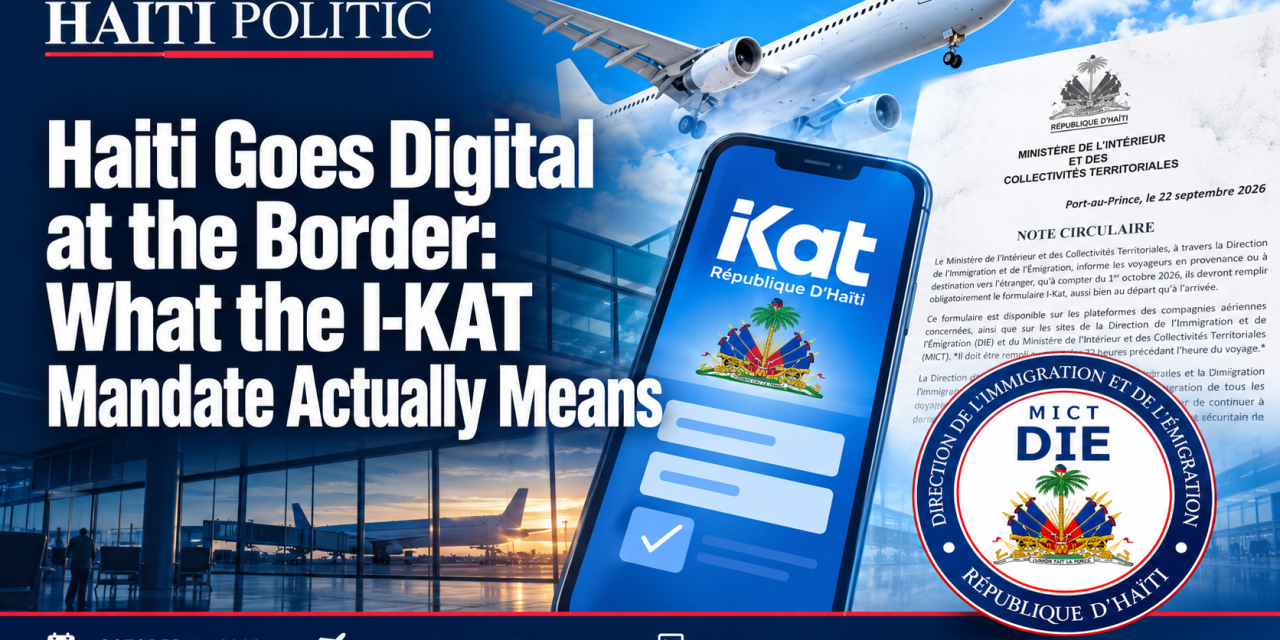
Starting October 1, 2026, anyone entering or leaving Haiti will need to complete a new digital form — I-KAT — before they travel. The notice you’ve shared, a note circulaire signed by Interior and Territorial Communities Minister Paul Antoine Bien-Aimé on September 22, 2026, makes that mandatory. Here’s what the measure actually is, what legal weight it carries, and what it means in practice.
What I-KAT Actually Is
I-KAT is a digital boarding and disembarkation card developed under Prime Minister Alix Didier Fils-Aimé’s initiative, built jointly by the Direction de l’Immigration et de l’Émigration (DIE), Haiti’s national statistics institute (IHSI), the Direction Générale des Douanes (customs), and the Ministry of Public Health. It replaces the paper embarkation/disembarkation forms travelers have filled out at Haitian airports and ports for decades, digitizing the collection of migratory, customs, and public health data in one unified system.
The rollout wasn’t sudden. DIE launched a pilot version in Pétion-Ville on December 4, 2025, moved to an operational phase at Cap-Haïtien’s international airport on March 12, 2026, and has since extended the system to Haiti’s diplomatic network abroad, including a digital form station at the Miami consulate. The September 22 circular is the final step: making completion of the form legally mandatory for all travelers nationwide, effective October 1, 2026.
The Legal Mechanism: What a “Note Circulaire” Can and Can’t Do
As a matter of Haitian administrative law, it’s worth being precise about what this document is. A note circulaire from a ministry director general is an internal administrative instruction implementing an existing policy or program — it directs how DIE and its agents will apply a measure already authorized by the ministry, but it is not itself a decree, a law passed by parliament, or a presidential arrêté with independent force of law. That distinction matters practically: the circular’s legal authority rests on the Ministry of Interior’s general regulatory power over immigration and emigration matters, exercised through DIE, rather than on new primary legislation specific to I-KAT. This is a common and legitimate vehicle for administrative modernization measures, but it means the underlying obligation to travel with proper documentation stops at existing immigration law; I-KAT is best understood as a new procedure for satisfying obligations that already exist, not a new independent legal requirement created from nothing.
How It Works
Per the notice and DIE’s own guidance, the process has four steps: complete the I-KAT form, submit it, present the confirmation to the immigration agent, and travel. Critically, the form must be filled out within the 72 hours preceding travel — not upon arrival at the airport — meaning travelers now need to plan ahead in a way the old paper form never required. The form is accessible through participating airline platforms as well as directly through DIE and MICT’s own websites, and can be confirmed via QR code scan at the point of departure or arrival.
What This Signals
The circular closes by tying I-KAT explicitly to “reinforcing the overall management of the country’s security environment” — language that places this modernization effort inside Haiti’s broader security context rather than treating it as a purely administrative upgrade. That framing is consistent with why this kind of system matters more in Haiti’s current moment than it might elsewhere: with much of the country’s territory affected by gang control and cross-border movement (including maritime cabotage routes, as covered in Haiti’s own port authority notices this year) increasingly central to how people move at all, a unified, centralized digital record of who is entering and leaving the country — cross-referenced with customs and health data — gives the state a data capacity it has largely lacked during the crisis years.
The Practical Concerns Worth Watching
A few implementation questions aren’t addressed in the notice itself and are worth flagging for any traveler or observer:
- Digital access. A mandatory online form assumes reliable internet access in the 72 hours before travel — a real barrier for travelers departing from rural areas or regions with degraded infrastructure, distinct from travelers departing through Port-au-Prince or Cap-Haïtien directly.
- Enforcement consistency. The notice states DIE is responsible for “strict application” at both departure and arrival, but doesn’t specify what happens to a traveler who arrives without having completed the form in advance — whether that means denied boarding, an on-site paper fallback, or another remedy.
- Data protection. A system consolidating migratory, customs, and health data into one digital record raises standard data-privacy questions — who has access to the consolidated record, how long it’s retained, and under what legal framework it’s protected — none of which the circular addresses, and none of which Haiti currently has a comprehensive data-protection law to answer independently.
The Bottom Line
I-KAT represents a genuine, multi-agency modernization effort — not a hastily announced rule, but the mandatory-compliance culmination of nearly a year of piloting. Its legal basis is sound as an administrative implementation of existing ministry authority. Its practical success will depend on questions the circular itself leaves open: access, enforcement, and data protection — the same three issues that determine whether any digital government system actually works for the population it’s meant to serve, rather than becoming one more procedural hurdle layered onto an already difficult journey in and out of the country.