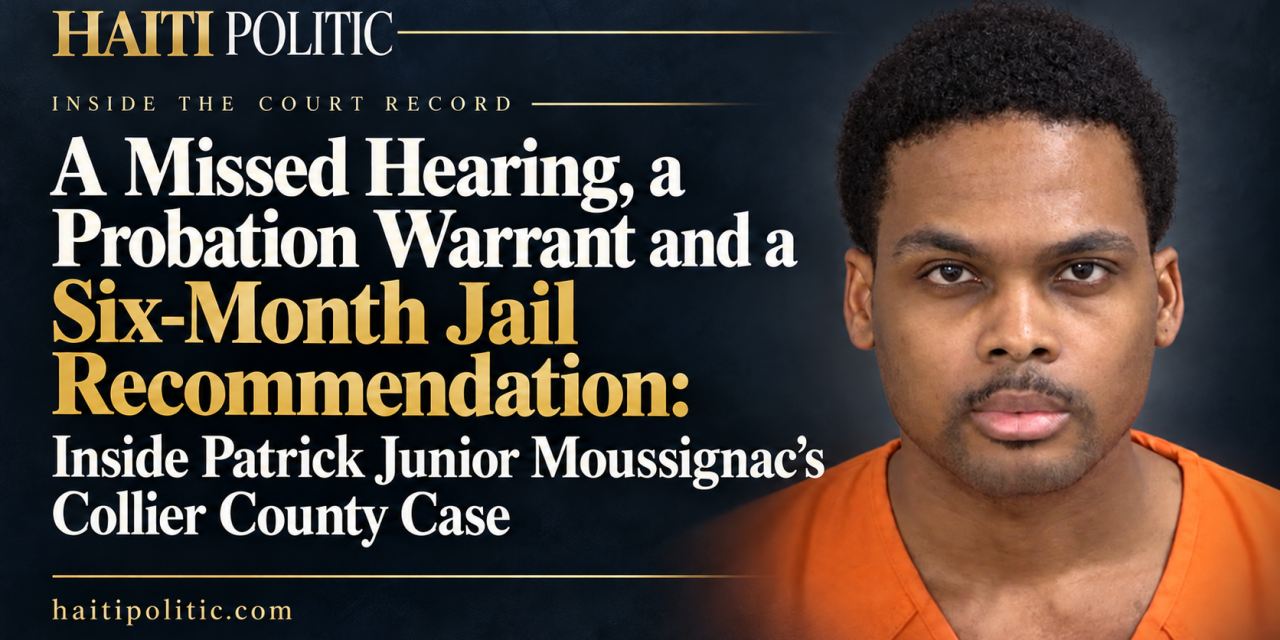
New corrections filings identify the alleged breach: failure to attend an October 7 arraignment, less than three weeks after probation began. The requested jail term has not been shown to be a sentence imposed by the court.
NAPLES, Fla. — Patrick Junior Moussignac’s October return to custody is now explained by a specific probation allegation: authorities say he missed an October 7 arraignment in a suspended-license case while serving probation imposed September 18 in an earlier driving prosecution.
A Florida Department of Corrections affidavit alleges that the missed hearing violated Condition 5 of his probation, requiring him to live without violating the law. A separate warrant dated October 8 records a judge’s reasonable-grounds finding under the Widman Act. The corrections officer subsequently recommended revocation and six months in jail. That recommendation is not a sentence, and the supplied papers do not show a final ruling on the alleged violation.
The distinction is crucial: the documents establish the stated grounds for the probation proceeding, while leaving the alleged breach for the court to resolve. They also clarify that the conduct cited as the violation is the October failure to appear, rather than the September 16 driving allegation itself.
Probation began September 18, according to corrections records
The affidavit, sworn by Officer Kimberly Polly on October 12 and filed October 13, says Moussignac was placed on probation on September 18, 2026, in case 26CF0182. It identifies six months on Count II, dangerous excessive speeding, and twelve months on Count III, DUI. The accompanying violation report marks him “Adjudicated” and describes the terms as concurrent, with a scheduled supervision termination date of September 18, 2027.
The report attributes the sentence to proceedings before Circuit Judge John O. McGowan. Its summary includes a twelve-month license revocation, a six-month ignition-interlock requirement, DUI school, an evaluation, alcohol restrictions and 100 hours of community service. These details come from the corrections account; the original judgment and signed probation order have not been supplied.
This is a material addition to the earlier record. There is now an official corrections account of adjudication and probation on Counts II and III. The final disposition of Count I, the originally charged felony fleeing-or-eluding offense, remains unestablished in the documents reviewed. A felony-numbered case does not establish a felony conviction on every original count.
The allegation that connected the two cases
The separate traffic case, 11-2026-CT-002086-AXXX-01, concerns alleged driving while a license was suspended or revoked on September 16, 2026. It was filed September 23, and an arraignment was scheduled for October 7 at 8:30 a.m.
The docket records Moussignac absent on October 7, sets a $2,000 bond and records a bench warrant or pickup order. The sheriff lists an October 7 booking for the failure-to-appear warrant. The traffic docket records the warrant served October 8. These different recording dates should not be collapsed into an invented hour-by-hour account.
Polly’s report says she learned of the October 7 arrest on October 8. It identifies the failure to appear as a new-law offense and cites sheriff’s report 26-374176. That report is not the February arrest report numbered 26-51502 already supplied. The October report and the original traffic-hearing notice would help test the allegation and explain the absence.
The affidavit says Moussignac received instructions on probation conditions on September 18 and September 24. It does not establish that his absence was deliberate, explain his reason for missing court or record his response to the violation allegation. The report expressly states that no offender statement was available for its purposes.
Florida’s criminal failure-to-appear statute includes a willfulness requirement and other elements. A bench-warrant entry alone is not a conviction for that offense. Here, the corrections officer characterizes the absence as criminal conduct; the traffic docket supplied does not show a separate formal failure-to-appear prosecution or a final determination that those elements were proved.
Why a $2,000 bond did not settle the detention question
The October 8 warrant in 26-000182CF cites § 948.06(1)(d), the Widman Act provision. It records that Moussignac appeared before a first-appearance judge who found reasonable grounds to believe he had materially violated probation or community control by committing a new violation of law. It directs that he be taken into custody. The copy’s service-return section is blank.
The corrections report dated October 12 states he was being held without bond following the Widman warrant. The sheriff’s October 14 snapshot also lists him in custody. The no-bond status is reported by corrections; the complete first-appearance order and any later release ruling have not been supplied. Current custody after those snapshots has not been independently confirmed.
The $2,000 entry belongs to the traffic case. It cannot be treated as a bond covering the separate probation matter. Likewise, a reasonable-grounds finding supporting custody is not a final finding after a contested violation hearing. Florida’s probation statute provides procedures for hearing and resolving alleged violations, with possible continuation, modification or revocation.
Corrections requests six months—but also records compliance elsewhere
On page 3 of the violation report, the Department of Corrections recommends revoking probation and imposing six months in jail, with costs remaining outstanding. No supplied order shows McGowan or another judge adopting that recommendation. Reporting that Moussignac has already been sentenced to six months for this violation would therefore be inaccurate.
The same report describes this as the first alleged violation in this case and says it is his first period of felony supervision. It marks community-service and treatment status as complying and says no violation would be submitted for financial arrears at that time. It also records an October 5 monthly check-in. Those details matter: the filed allegation concerns the missed court appearance, rather than a documented general refusal to report or a violation pursued for unpaid costs.
The driving case behind the probation
Prosecutors filed a three-count information on March 13, 2026: felony fleeing or eluding with lights and siren activated, misdemeanor dangerous excessive speeding and misdemeanor DUI labeled alcohol level of .15 or more. The file named “indicment.pdf” is a prosecutor’s information, not a grand-jury indictment.
The February arrest report provides the officer’s account. Deputy Dillon G. Blank alleged that a Toyota Camry traveled at 105 mph in a posted 45-mph zone on Immokalee Road, continued after emergency lights and siren were activated, turned off its lights and later stopped on Livingston Road. He described Moussignac as the driver and sole occupant. The report attributes to Moussignac denials of the reported speed, seeing the emergency signals and consuming alcohol. These are allegations and attributed statements, not this article’s independent findings.
The report describes sobriety exercises at the jail and lists breath readings of 0.322 and 0.305. The underlying breath-test printouts and video were not supplied. The officer says the jail exercises were not captured on body-worn or in-car camera, while the booking form separately marks car-camera footage available. Those statements concern different parts of the encounter.
The paperwork contains unresolved inconsistencies. Its narrative opens with November 21, 2025; its crime-date fields and the felony docket refer to February 6, 2026; the information alleges conduct on or about February 8, the recorded booking date. One sobriety-exercise sentence also uses a different first name. These discrepancies warrant comparison with the citations, original video and any corrected report. They do not, by themselves, prove the allegations false or the case invalid.
What the older arrest history can—and cannot—establish
| Date | Documented event | Reporting limit |
|---|---|---|
| September 23, 2018 | Booking for retail theft under $100, case 18-2286MM. | No judgment or final disposition supplied. |
| February 14, 2021 | “VOCP/PETIT THEFT” booking, case 20MM000457AMJB; bonded February 15. | No underlying order or final disposition supplied. |
| February 8, 2026 | Driving-related booking in 26CF000182; charges formally filed March 13. | Count I’s ultimate disposition remains unknown. |
| September 18, 2026 | Corrections reports adjudication and concurrent probation on Counts II and III. | Original judgment, plea and probation orders not supplied. |
| October 7–8, 2026 | Traffic failure-to-appear warrant and a separate Widman probation warrant/booking. | Final violation ruling and later custody orders not supplied. |
The sheriff’s search covers Collier County arrests from January 1, 2016 onward. It is not a complete statewide or national conviction history. Multiple booking entries may concern enforcement of an existing case, rather than separate new criminal incidents. The older theft-related entries do not establish convictions or explain the present probation allegation.
What happens next
The traffic docket records an October 12 appearance by lawyer Connor W. Hilgenfeldt, including a written not-guilty plea and waiver of arraignment. It cancels that case’s October 28 arraignment and sets a December 28, 2026, 9 a.m. pretrial appearance. The separate notice requires attendance unless the court excuses it. The September license allegation remains pending in the supplied docket.
The sheriff’s printout also lists October 28 for the probation matter. Canceling an arraignment in the traffic case does not cancel a hearing in the other case. The felony docket supplied is marked “Reopen VOP,” but displays only the first 25 of 117 entries, so its latest calendar still needs confirmation.
The principal missing records are now the September judgment and probation orders, the disposition of Count I, the remaining felony docket entries, the October failure-to-appear report and hearing notice, and the full bond/detention and violation-hearing orders.
The new documents resolve the central question of the stated grounds for October’s probation proceeding: corrections alleges that a missed arraignment violated newly imposed probation and asks the court for a six-month jail term. Whether that allegation is proved, whether probation is revoked and what sanction follows remain questions for the court.