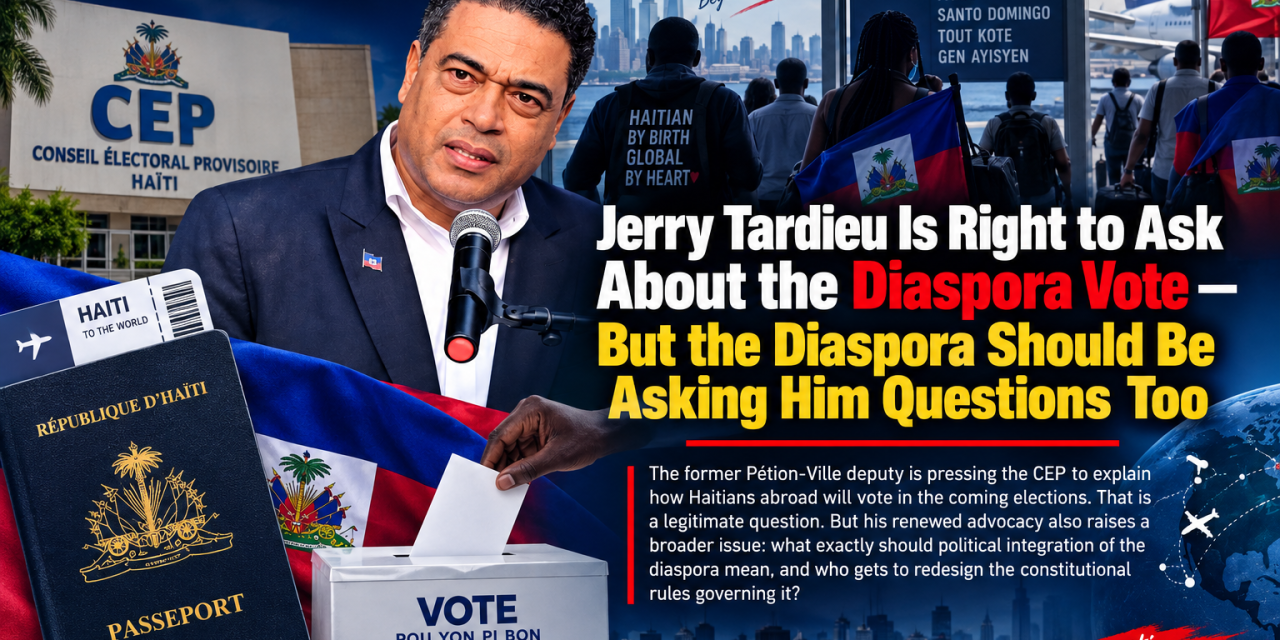
The former Pétion-Ville deputy is pressing the CEP to explain how Haitians abroad will vote in the coming elections. That is a legitimate question. But his renewed advocacy also raises a broader issue: what exactly should political integration of the diaspora mean, and who gets to redesign the constitutional rules governing it?
By Haiti Politic | Electoral Law & Constitutional Analysis | September 8, 2026
Jerry Tardieu has put an important question before Haiti’s Conseil Électoral Provisoire (CEP).
In an open letter dated September 4, 2026, Tardieu reportedly asked CEP President Jacques Desrosiers to explain how Haitians living outside Haiti will actually participate in the upcoming electoral process. His questions concern registration, identification, voting locations, embassies and consulates, election workers, security, transmission of results, observation and electoral challenges.
Those are legitimate questions.
But there is another set of questions that deserves equal attention.
If Jerry Tardieu wants to present himself as a defender of the political rights of Haitians abroad, Haitians abroad should be entitled to examine not only what he is asking the CEP to do, but also what political and constitutional system he ultimately wants to build for them.
That distinction matters.
Because diaspora voting, diaspora representation, dual nationality, eligibility for public office, constitutional reform and electoral administration are related questions—but they are not the same question.
And Haiti should be careful not to collapse all of them into a campaign slogan.
FIRST: WHAT DOES THE 2026 ELECTORAL FRAMEWORK ACTUALLY SAY?
The starting point should not be Tardieu’s statement.
It should be the law.
The CEP itself identifies the Electoral Decree of June 2, 2026, together with the July 2 amending decree, as part of the legal framework governing the current electoral process.
The June decree is particularly significant because its preamble expressly recognizes the objective of creating conditions allowing citizens to exercise their voting rights, including “les Haïtiens vivant à l’étranger” — Haitians living abroad.
That is important.
It means Tardieu is not inventing the issue.
There is a genuine legal and administrative question about how that principle becomes an operational voting system.
But the July 2 decree supplied to Haiti Politic should also be read carefully.
That decree states that the legislature is presently inoperative and that the executive therefore legislated by decree on matters of public interest. It further says that the modifications were adopted following a proposal from the CEP.
The amendment then changes a number of electoral provisions.
Among other things, it establishes procedures concerning voter identification by NINU, signatures or fingerprints on the voter list, indelible ink, and the transmission and preservation of polling-station tally sheets.
Yet something is striking:
The July 2 amendments reproduced in the document do not themselves create a detailed overseas-voting architecture.
There is no provision in those amendments establishing, for example:
- which foreign cities receive polling centers;
- how an overseas electoral register operates;
- whether voting occurs exclusively at diplomatic missions;
- whether community voting centers may be authorized;
- how overseas ballots are transported or electronically transmitted;
- which electoral jurisdiction hears diaspora disputes;
- or precisely which categories of Haitians abroad qualify.
That does not establish that diaspora voting is legally impossible.
It establishes something narrower and more important:
Recognition of diaspora participation and implementation of diaspora participation are two different things.
And that is where Tardieu’s intervention has substance.
TARDIEU’S QUESTION TO THE CEP IS LEGITIMATE
According to reporting on his September 4 letter, Tardieu wants the CEP to answer basic operational questions:
Who can vote?
What identification will be accepted?
Where will voting take place?
What role will Haitian embassies and consulates play?
Who will recruit electoral personnel?
How will votes be secured?
How will results reach Haiti?
How will candidates challenge disputed overseas results?
And what happens in countries containing significant Haitian populations but no practical Haitian diplomatic infrastructure?
Those are not trivial details.
They determine whether diaspora voting is a real electoral right or merely a declaration of principle.
The CEP’s own description of the June decree says the instrument governs voter registration, voting operations, counting, publication of results and electoral disputes.
Therefore, demanding operational clarity from the electoral authority is reasonable.
But Tardieu’s intervention should not end the debate.
It should begin one.
THE QUESTION HAITI POLITIC WOULD PUT TO JERRY TARDIEU
What exactly do you mean by “diaspora political integration”?
There are at least four fundamentally different propositions hiding behind that phrase.
A Haitian living in Boston voting for president is one question.
A Haitian living in Montreal electing a dedicated diaspora representative to Parliament is another.
A dual national living permanently in Paris becoming a Haitian senator is another.
And a dual national seeking the Haitian presidency is yet another constitutional question.
Politicians should not present those four propositions as though they were interchangeable.
They aren’t.
Each changes the relationship between citizenship, nationality, residency, representation and political accountability in a different way.
AND TARDIEU HAS BEEN INVOLVED IN THIS DEBATE BEFORE
This is important context.
Tardieu’s advocacy for diaspora political integration did not begin this week.
Material published on his own website from 2016 describes him advocating legislation on Haitian nationality that he argued was necessary to bring existing nationality law into conformity with the amended Constitution and provide greater legal clarity to Haitians living abroad.
Therefore, his current position should be evaluated as part of a longer political record rather than simply as a reaction to the 2026 election.
That also makes scrutiny appropriate.
If a politician has spent years advocating changes affecting the relationship between Haiti and its diaspora, voters have every right to ask:
What is the final institutional model?
THE CONSTITUTIONAL QUESTION IS MORE COMPLICATED THAN A TWEET
There is another reason for caution.
When discussing the “1987 Constitution,” journalists and politicians must identify which constitutional text and amendment history they mean.
The original 1987 constitutional text contained restrictive nationality provisions, including Article 15’s prohibition on dual Haitian and foreign nationality.
Later constitutional amendments altered the legal landscape surrounding nationality and diaspora participation. That history is precisely why discussions about “what the 1987 Constitution says” can become misleading when speakers fail to distinguish the original 1987 text from subsequent amendments.
The 2026 electoral process introduces yet another extraordinary element.
The June 2 electoral decree provides not merely for elections but also for a popular ratification involving a limited number of proposed constitutional changes.
That means Haiti is dealing simultaneously with:
an electoral transition, an absent functioning legislature, executive legislation by decree, diaspora enfranchisement and proposed constitutional changes.
Those circumstances demand more scrutiny, not less.
THE BIGGER PROBLEM: WHO REPRESENTS THE DIASPORA?
Suppose millions of eligible Haitians outside the country eventually acquire a practical voting mechanism.
A fundamental political question immediately follows:
What are they voting for?
If diaspora voters participate only in presidential elections, they influence the executive without obtaining geographically defined legislative representation.
If they vote for deputies or senators tied to Haitian territorial constituencies, another question emerges:
Which constituency should a Haitian who has lived in New York for twenty years belong to?
Their birthplace?
Last Haitian residence?
Parents’ commune?
A special overseas constituency?
And if Haiti establishes diaspora constituencies, how many representatives should they receive?
Those are constitutional-design questions—not merely administrative questions for the CEP.
REPRESENTATION WITHOUT RESIDENCE
This is where Haiti needs a serious national debate.
A citizen living in Jacmel experiences Haitian policing, taxation, roads, hospitals, electricity, schools and local government every day.
A Haitian citizen living in Brooklyn may remain deeply connected to Haiti, send substantial financial support to relatives, invest in Haiti and participate in civic life—but lives under a different state for most daily public services.
Both can have legitimate claims to political participation.
But those claims are not necessarily institutionally identical.
The challenge is designing a system recognizing the diaspora’s connection to Haiti without creating a political structure in which people living permanently outside the country can overwhelm the political preferences of citizens who live under the immediate consequences of Haitian governmental decisions.
That is not an argument against diaspora voting.
It is an argument for designing diaspora voting carefully.
MONEY MAKES THE QUESTION EVEN MORE IMPORTANT
Diaspora political participation cannot be separated from campaign finance.
If overseas voting expands substantially, Haitian elections will increasingly involve political organization in places such as Florida, New York, Massachusetts, Canada, France and elsewhere.
That creates obvious regulatory questions.
Who monitors fundraising abroad?
What constitutes a foreign contribution?
Can a Haitian political party operate fundraising organizations overseas?
Can foreign corporations contribute through diaspora organizations?
Can a dual-national candidate receive campaign funds raised outside Haiti?
Which institution audits those transactions?
How does the CEP enforce Haitian campaign-finance law against conduct occurring in another sovereign country?
A credible diaspora electoral system requires answers to those questions before a disputed election, not afterward.
THE QUESTIONS JERRY TARDIEU SHOULD ANSWER
If Tardieu wants a national discussion about diaspora voting, Haiti Politic believes that discussion should go beyond asking the CEP where ballot boxes will be located.
Here are the questions we would put directly to him:
- Mr. Tardieu, exactly which Haitians abroad should be permitted to vote—Haitian citizens only, dual nationals, former Haitian nationals, or descendants of Haitians born overseas?
- What documentary evidence should establish eligibility: CIN, Haitian passport, NINU, birth certificate, or some combination?
- Should an overseas Haitian be required to demonstrate a continuing legal connection with Haiti before registering?
- Should diaspora voting initially apply only to presidential elections, or also to legislative and local elections?
- If diaspora citizens vote for Parliament, which constituency represents them?
- Do you support creating dedicated diaspora seats in the Chamber of Deputies or Senate? If so, how many and according to what population formula?
- Should someone who has lived abroad for 20 or 30 years have exactly the same electoral influence over municipal or departmental government as someone currently residing there?
- Where should overseas voting occur—consulates, embassies, independent CEP centers, community organizations, postal voting or electronic voting?
- Who should control overseas polling places: the CEP or Haitian diplomatic missions?
- How would you prevent Haitian diplomatic personnel appointed by the government from influencing an election conducted inside diplomatic facilities?
- How should overseas voter lists be audited for duplicate registrations between Haiti and foreign jurisdictions?
- Would diaspora voters be required to possess a valid NINU, given the identification procedures embedded in the electoral framework?
- How would recounts work in Miami, Boston, New York, Montreal, Paris, Santiago or Santo Domingo?
- Where would an overseas voter file an electoral complaint?
- Would Haitian electoral tribunals have jurisdiction over disputes arising from polling centers physically located in foreign countries?
- Who pays for overseas elections?
- What is your estimated cost of implementing diaspora voting?
- How should Haitian law regulate political fundraising conducted abroad?
- Should Haitian political parties be permitted to receive money from diaspora organizations incorporated under foreign law?
- What safeguards would prevent foreign citizens, corporations or governments from indirectly financing Haitian campaigns through diaspora organizations?
- Do you support allowing dual nationals to serve in Parliament?
- Do you support allowing dual nationals to become Prime Minister?
- Do you support allowing a dual national to become President of Haiti?
- If your answer differs among those offices, what constitutional principle explains the distinction?
- Should candidates for Haiti’s highest offices face a minimum Haitian residency requirement immediately before an election?
- If so, how long?
- What constitutional changes concerning nationality, residency, eligibility and diaspora representation do you personally support?
- Which provisions do you oppose?
- Would you support submitting major changes to diaspora political rights to a transparent national constitutional process rather than attaching them to transitional political arrangements?
- Finally: are you advocating simply for the diaspora’s right to vote—or for a broader restructuring of political power between Haitians living inside Haiti and Haitians living abroad?
That last question may be the most important.
A RESPONSE TO JERRY TARDIEU
Mr. Tardieu is correct about one thing:
The CEP should explain how diaspora voting is supposed to work.
The June 2026 electoral framework expressly contemplates participation by Haitians abroad, while the operational questions reported in Tardieu’s letter remain significant.
But asking the right question does not exempt the questioner from scrutiny.
Tardieu has advocated diaspora political integration for years.
Therefore, Haitians abroad should ask him for something more substantial than another declaration that the diaspora deserves political rights.
They should ask him to define those rights.
Voting where?
Voting for whom?
Under which citizenship rules?
With what residency requirements?
With what representation?
Under what campaign-finance safeguards?
And with what limits on eligibility for Haiti’s highest offices?
THE DIASPORA DOES NOT NEED SYMBOLIC POLITICS
There is an opportunity here for something much larger than a dispute between Jerry Tardieu and the CEP.
Haiti could finally establish a coherent legal relationship with the millions of Haitians who live outside its territory.
But that requires more than politicians appearing in diaspora communities during election season.
It requires institutions.
A credible system would have to address voter registration, identification, constituency allocation, election administration, campaign finance, electoral litigation, diplomatic neutrality, cybersecurity, ballot security and constitutional eligibility.
The July 2 amendment demonstrates how technical the electoral architecture already is: it specifies NINU verification, voter signatures or fingerprints, indelible ink and detailed handling of polling-station records.
Diaspora voting deserves comparable precision.
HAITI POLITIC’S BOTTOM LINE
Jerry Tardieu’s demand for answers from the CEP is legitimate.
But legitimacy works both ways.
The CEP should answer Tardieu.
And Tardieu should answer the diaspora.
The central question is no longer simply:
“Will Haitians abroad be allowed to vote?”
The more consequential question is:
“What kind of political relationship between Haiti and its diaspora are we creating—and who decided what that relationship should be?”
That question belongs neither to Jerry Tardieu nor to the CEP alone.
It belongs in a transparent national constitutional and electoral debate involving Haitians inside and outside the country.
Because expanding political participation can strengthen Haitian democracy.
But rewriting the rules governing citizenship, representation and political power without clearly explaining the consequences could create an entirely different problem.
The diaspora deserves a vote.
It also deserves the full constitutional truth about what that vote means.