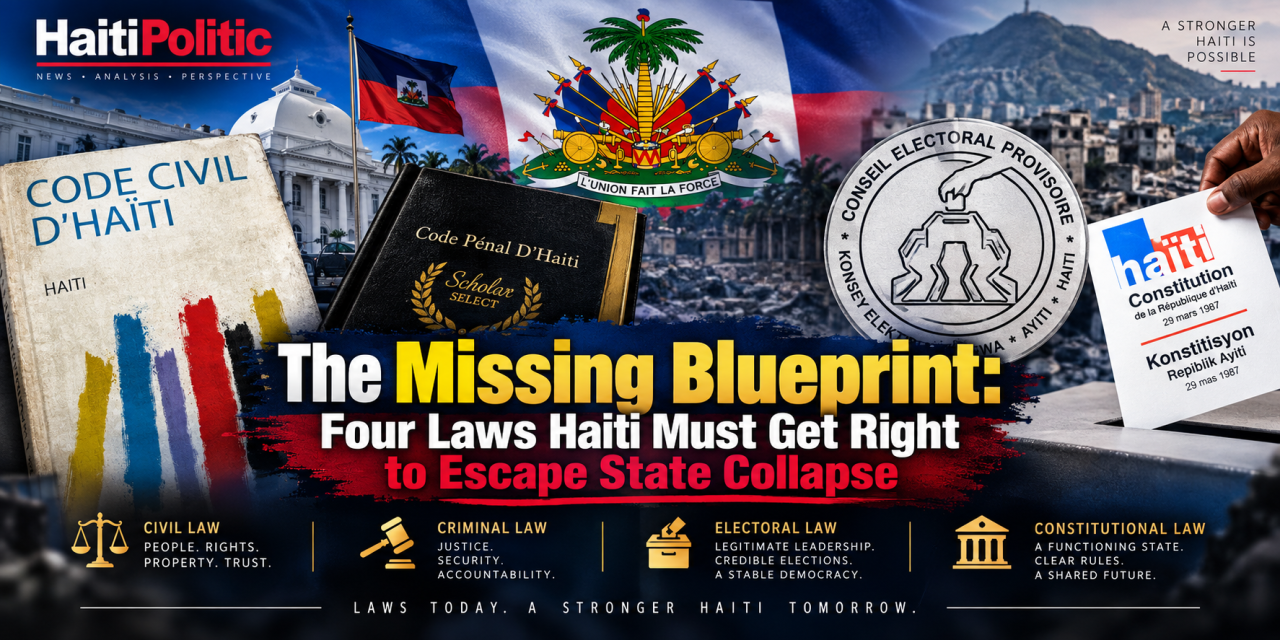
Haiti’s crisis is not simply a security crisis, a political crisis, or a corruption crisis — it is what happens when all three compound at once, in a state whose legal architecture was built for ordinary governance and has been stretched well past its design limits. Roughly 85 to 90 percent of Port-au-Prince has been under gang control, the country has gone years without a functioning elected parliament, and international bodies increasingly describe Haiti’s crisis less as a security problem and more as a governance crisis fueled by organized crime. Rebuilding a functioning state requires more than troops and elections — it requires a coherent legal architecture across four pillars: public security, transitional governance, anti-corruption, and judicial independence. Here’s what each of those pillars actually requires, what Haitian law already provides, and where the gaps remain.
Pillar 1: Robust Public Security and Disarmament Laws
Anti-Gang and Counter-Terrorism Legislation. Haiti’s Penal Code was never designed around organized, territorially-entrenched armed groups functioning as parallel governments. The legal vocabulary of “terrorism” has entered Haitian public discourse largely through external designation rather than domestic statute — in May 2025, the United States formally designated the Viv Ansanm coalition and the Gran Grif gang as foreign terrorist organizations, a move that has shaped how Haitians and international partners talk about the crisis, even as Haitian legal scholars have pointed out that domestic criminal law’s own definition of terrorism remains narrower and less developed than the political rhetoric surrounding it. This is a real gap: effective anti-gang legislation needs to define criminal organizational structure (leadership, financing networks, territorial control) as an aggravating factor distinct from individual acts of violence, so prosecutors can charge gang leadership for command responsibility rather than only for crimes personally committed. Haiti needs statutory language that criminalizes gang membership, financing, and territorial extortion as freestanding offenses — not just the underlying murders, kidnappings, and sexual violence that current law already covers.
Disarmament, Demobilization, and Reintegration (DDR) Laws. Any serious effort to dismantle gang structures eventually confronts the question of what happens to the tens of thousands of young men currently inside them. A legal DDR framework needs three components Haiti currently lacks in codified form: an amnesty-with-conditions framework that distinguishes low-level recruits (many of them minors — the UN verified 892 children recruited or used by armed groups in 2025 alone) from gang leadership; a reintegration guarantee tied to economic opportunity, since disarmament without livelihood alternatives has failed in every prior Haitian disarmament attempt since the 1990s; and a witness and informant protection statute robust enough to make defection a survivable choice. Without legal certainty about what defection actually earns a low-level gang member, DDR remains a slogan rather than a policy.
State of Exception/Emergency Regulations. Here, Haiti’s 1987 Constitution is actually more developed than the other two areas. Article 98-3 gives the National Assembly, not the Executive alone, the power to decide on the appropriateness of a state of siege, to jointly determine with the Executive which constitutional guarantees will be suspended, and to rule on any request to renew that measure. This is a deliberate check: the framers of 1987, reacting to the Duvalier dictatorship, refused to let the executive branch unilaterally suspend constitutional rights. The problem is not the constitutional text — it’s that Haiti has had no functioning elected National Assembly to exercise this power since January 2023. Emergency measures have effectively had to proceed through executive decree and transitional bodies with contested legitimacy, exposing exactly the vulnerability Article 98-3 was written to prevent. A durable framework requires either restoring a functioning legislature quickly enough to reclaim this role, or building an interim mechanism with comparable independence and legitimacy to exercise it in the meantime.
The international security dimension. Haiti’s own police and armed forces cannot yet execute a security law framework without international support, and the legal architecture of that support has shifted meaningfully. The Kenya-led Multinational Security Support (MSS) Mission, authorized in 2023, was mandated primarily to support and train the Haitian National Police. In September 2025, the UN Security Council adopted Resolution 2793, authorizing a transition from the MSS into a “Gang Suppression Force” (GSF) with a materially different legal mandate: rather than only supporting the HNP, the GSF is authorized to conduct intelligence-led, targeted counter-gang operations independently or jointly with Haitian forces, aimed at neutralizing, isolating, and deterring gangs directly. A UN Support Office in Haiti (UNSOH) was established to provide logistics, funded through assessed UN peacekeeping contributions even though the GSF itself is not a UN peacekeeping force. Roughly eighteen countries have pledged forces toward a target of 5,500 personnel. This distinction matters legally: Haiti’s domestic anti-gang statutes need to be written with enough precision to define how domestic prosecutions interact with international force operations — chain of custody for evidence gathered in joint operations, jurisdiction over detainees, and accountability mechanisms if international forces are involved in the use of lethal force on Haitian soil.
Pillar 2: Transitional Governance and Electoral Frameworks
Comprehensive Electoral Laws and the Provisional Electoral Council. Haiti’s constitutional design calls for a Conseil Électoral Permanent under Article 192, but Haiti has never actually managed to stand up the permanent council envisioned in 1987 — every election since has been run by a Provisional Electoral Council (CEP), a workaround that has now itself become a chronic institutional weakness. Haiti has cycled through multiple CEP presidents within a two-year span amid the current transition, undermining the continuity and independence an electoral body needs to be trusted by competing political factions. A durable electoral law needs to do three things current practice does not reliably deliver: fix clear, insulated selection criteria for CEP membership that reduce the incumbent government’s ability to reshape the council mid-cycle; establish binding timelines for voter registration, candidate vetting, and results certification that survive political pressure; and create enforceable sanctions for candidates and parties who violate campaign finance or disinformation rules, an area current law leaves largely aspirational.
Constitutional Clarity. Much of Haiti’s current governance paralysis is not a gap in the law so much as a dispute about which version of the law applies. Haiti has debated for years whether the controversial 2021 constitutional amendments pushed through under President Jovenel Moïse are valid, given they were never submitted to the ratification process Article 284-3 of the 1987 Constitution requires for amendments approved in the same legislative term they were proposed. That unresolved question has left basic issues — the length of presidential terms, the structure of the legislature, eligibility rules — contested rather than settled, which in turn has fueled disputes over the legitimacy of every transitional arrangement since 2021, including the Transitional Presidential Council whose own mandate lapsed in February 2026 without a clear constitutional successor in place. A functioning transitional framework needs an explicit, judicially or internationally validated determination of which constitutional text governs right now, before any electoral law built on top of it can carry real legitimacy.
Pillar 3: Anti-Corruption and Institutional Oversight Laws
Financial Crimes and Anti-Bribery Laws. Haiti already has the institutional skeleton for this pillar — the Unité de Lutte Contre la Corruption (ULCC) as an investigative anti-corruption body, the Unité Centrale de Renseignements Financiers (UCREF) for financial intelligence and anti-money-laundering, and the Cour Supérieure des Comptes et du Contentieux Administratif (CSC/CA) for public accounts oversight. The persistent problem is not the absence of institutions but their independence and enforcement capacity: these bodies have historically lacked prosecutorial teeth, secure funding insulated from the executive, and protection from political interference when investigations reach senior officials. A functioning anti-corruption framework needs statutory guarantees of budgetary and operational independence for these bodies, mandatory public disclosure requirements for officials’ financial dealings, and a clear legal pathway from ULCC/UCREF investigative findings to actual prosecution — something that has too often stalled at the referral stage.
Illicit Enrichment and Asset Recovery Frameworks. Haiti needs a functioning illicit enrichment statute — one that shifts the evidentiary burden onto officials to explain wealth disproportionate to their declared income, rather than requiring prosecutors to prove the underlying predicate crime beyond doubt, which is often functionally impossible in a country where financial records have been destroyed, hidden, or never existed in enforceable form. Paired with this, Haiti needs a credible asset recovery framework and functioning mutual legal assistance treaties, since a meaningful share of allegedly stolen public funds and gang financing has moved through offshore accounts and cross-border networks — recovery is a matter of international legal cooperation as much as domestic law.
Pillar 4: Judicial Reform and Independent Court Systems
Judicial Independence and Security Protection. No legal framework in the first three pillars functions without judges and prosecutors willing to apply it — and Haiti’s judiciary currently operates under threat levels that make independent rulings, particularly against gang-connected or politically protected figures, a genuine physical risk. A credible framework requires a judicial security statute providing protective details, relocation support, and family protection for judges and prosecutors handling gang, corruption, or politically sensitive cases, paired with a constitutionally insulated judicial appointments process that removes the executive’s current outsized discretion over judicial career advancement — discretion that has historically been used to reward compliant judges and sideline independent ones.
Transitional and Special Courts. Given the scale of gang-related crimes and the ordinary court system’s near-total incapacity to process them, Haiti needs a legal framework for specialized courts — modeled loosely on the specialized anti-corruption and organized crime chambers used elsewhere in Latin America — with dedicated jurisdiction over gang leadership prosecutions, corruption cases involving senior officials, and mass-atrocity crimes committed during the current crisis. These courts need statutory protections against the ordinary court system’s docket backlogs and physical security vulnerabilities, along with clear evidentiary rules for cases built partly on intelligence gathered through international security cooperation.
The Common Thread
Every one of these four pillars runs into the same underlying obstacle: Haiti largely has the constitutional and statutory concepts it needs — Article 98-3’s state-of-siege check, Article 192’s electoral council, an existing anti-corruption institutional architecture — but lacks the functioning political institutions required to operate them as designed. A state-of-siege provision that assumes a sitting National Assembly is only as good as Haiti’s ability to have one. An anti-corruption body’s independence is only as real as an executive’s willingness to respect it. This is the honest starting point for any legal reform agenda: new legislation matters, but it will only hold if it’s built alongside the harder, slower work of restoring the elected institutions the 1987 Constitution assumed would always be there to make these laws mean something.
Sources: https://guides.loc.gov/law-haiti