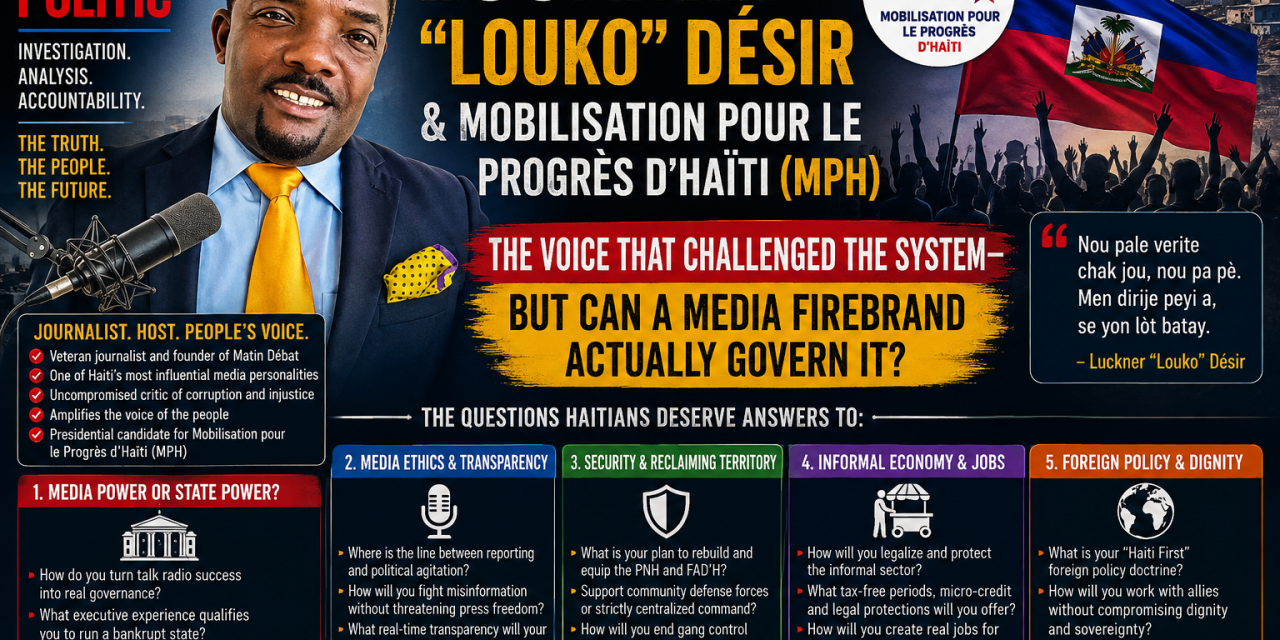
For years, Luckner Désir—widely known as “Louko Désir”—has occupied one of the most visible microphones in Haitian political media. His program Matin Débat became known for aggressive political commentary, interviews, confrontation, and discussion of Haiti’s social and political crises. Published profiles identify him as a journalist, radio host and political commentator, while contemporary coverage describes Matin Débat as a prominent sociopolitical program on Radio-Télé Éclair.
But Louko Désir has not limited himself to commenting on politics.
He tried to enter the arena himself.
Official records from Haiti’s 2015 presidential election process list Luckner Désir as an approved presidential candidate representing Mobilisation pour le Progrès d’Haïti (MPH).
That creates the central question for voters:
Can someone who has spent years diagnosing Haiti’s political failures from behind a microphone demonstrate that he can actually manage the institutions he criticizes?
That question deserves investigation—not applause and not condemnation.
🔎 1 | WHO IS LUCKNER DÉSIR?
Available biographical reporting identifies Désir as a native of Gonaïves who studied at institutions associated with the State University of Haiti before establishing himself in journalism and political commentary.
His strongest demonstrated asset is therefore not military command, economic management or cabinet administration.
It is communication.
Matin Débat gave him something many conventional politicians struggle to obtain: direct access to citizens frustrated with insecurity, corruption, unemployment and political paralysis.
In 2018, Désir also became secretary-general of the Haitian section of the Union internationale de la Presse francophone, another indication of his position within Haiti’s media community.
And his political ambition is not speculative. His name appeared on the official 2015 presidential candidate list under MPH.
The question is what happened after the microphone was turned off.
🎙️ 2 | MEDIA POWER ≠ STATE POWER
Louko’s political advantage is obvious.
He knows how to communicate.
He knows how to identify public anger.
He knows how to turn complicated political controversies into language ordinary citizens can debate.
But Haiti has had no shortage of charismatic communicators.
The presidency requires something very different: managing ministries, preparing budgets, collecting customs revenue, negotiating legislation, professionalizing the police, administering public procurement and dealing with foreign governments.
QUESTIONS FOR LOUKO
Where is the MPH governing team?
Who would be his finance, justice, security, agriculture and foreign-policy specialists?
What administrative institution has Désir personally managed that voters can examine as evidence of executive competence?
And what measurable first-100-day program would distinguish an MPH government from another personality-centered Haitian political movement?
This is perhaps the most important test of his candidacy:
Can Louko transform criticism into administration?
⚠️ 3 | THE OTHER SIDE OF POPULIST MEDIA
There is also a more uncomfortable part of Désir’s public record.
His confrontational broadcasting has repeatedly brought him into conflict with authorities.
In April 2020, Désir was detained and questioned after controversial statements surrounding COVID-19 and government purchases of medical supplies. Contemporary accounts reported that supporters gathered demanding his release; he was released later that day.
That episode can be interpreted in sharply different ways.
Supporters may see a journalist willing to confront government power.
Critics may ask whether a broadcaster with enormous influence has an increased responsibility to verify claims before putting them before a frightened population.
That debate became even more relevant in 2023.
🚨 4 | THE GANG-COMMENTARY CONTROVERSY
In September 2023, Désir was summoned by prosecutors over statements made on Matin Débat concerning gangs and employment.
Gazette Haïti reported that his remarks generated considerable criticism and that Désir subsequently apologized publicly. His attorney disputed allegations that his comments constituted promotion of criminality or incitement to violence.
That distinction matters.
An investigative profile should not convert allegations or controversial speech into findings of criminal wrongdoing.
But voters are entitled to ask a larger political question:
What standard should a president apply to his own words during a national security emergency?
A broadcaster can provoke debate.
A president’s words can move markets, police units, crowds, diplomats and armed actors.
📰 5 | PRESS FREEDOM VS. PRESIDENTIAL POWER
This could actually become one of Désir’s most interesting policy tests.
He knows firsthand what happens when government authorities confront journalists.
So an MPH presidency should be asked to commit publicly to safeguards for the same journalists who might investigate President Luckner Désir.
Would he support stronger legal protections against intimidation of reporters?
Would presidential press conferences be routine?
Would ministries have enforceable public-information requirements?
Would government contracts, procurement awards and payroll information be placed online?
And would journalists who accuse his own government of corruption receive the same freedom he demanded while criticizing previous governments?
That is where a media candidate’s commitment to press freedom becomes testable.
💰 6 | WHO WOULD FINANCE AN MPH GOVERNMENT?
Louko’s anti-establishment identity raises another question.
Campaigns cost money.
Haitian politics has historically suffered from opaque relationships among politicians, private financiers, economic interests and state contracts.
If MPH claims independence from established political-economic networks, voters deserve documentation.
Who finances MPH?
Will contributors be disclosed publicly?
Would corporate donations face limits?
Would diaspora donations be independently audited?
Would campaign accounts be published before Election Day?
A politician cannot credibly demand transparency from everyone else while treating his own financing as private information.
🛡️ 7 | SECURITY: THE MICROPHONE TEST ENDS HERE
No Haitian presidential program is credible today without a serious security doctrine.
This is where slogans become insufficient.
A Désir administration would need to explain how it intends to rebuild police capacity, intelligence, border controls, customs enforcement and judicial prosecution while protecting civilians.
And it must answer one particularly difficult question raised by the user’s proposed framework:
Would MPH support armed community “self-defense” structures?
That requires extreme caution.
Once political authorities legitimize loosely controlled armed groups, today’s community-defense structure can become tomorrow’s militia.
A serious proposal therefore needs to specify command authority, weapons accountability, recruitment standards, human-rights oversight and judicial supervision—or reject the concept altogether in favor of professional state forces.
🌎 8 | FOREIGN POLICY: WHAT WOULD “HAITI FIRST” ACTUALLY MEAN?
Louko’s communication skills could be valuable internationally.
But foreign policy is not a radio debate.
Haiti must negotiate simultaneously with the United States, Dominican Republic, CARICOM, Canada, France, the United Nations, multilateral lenders and increasingly diverse international partners.
An MPH administration therefore needs a doctrine rather than simply opposition to foreign interference.
QUESTIONS FOR DÉSIR
Would foreign security assistance remain acceptable if operational control stays Haitian?
How would he confront international arms trafficking without alienating governments whose cooperation Haiti needs?
What would his policy toward the Dominican Republic look like on trade, migration, border security and the Massacre River dispute?
How would he reduce Haiti’s dependence on foreign assistance while continuing to obtain investment?
And what would he ask the Haitian diaspora to contribute beyond remittances?
Désir’s commentary on the Massacre River dispute has already produced controversy: reporting from 2024 describes a defamation dispute arising from statements he made while criticizing Dominican executive actions concerning the canal. Those are allegations in litigation, not established findings, but they underscore how consequential a president’s language toward neighboring states could become.
🧑🏾🌾 9 | THE INFORMAL ECONOMY: CAN HIS AUDIENCE BECOME AN ECONOMIC PROGRAM?
This could be one of MPH’s strongest opportunities.
The population listening to political radio is not composed only of lawyers, executives and government employees.
It includes Madan Sara, motorcycle drivers, street merchants, tradespeople, small entrepreneurs and diaspora-supported households.
Instead of simply promising jobs, Désir should answer specific questions.
Could microbusinesses receive a two- or three-year tax-free formalization period?
Could business registration happen digitally from a phone?
Could Madan Sara obtain government-backed credit?
Could micro-enterprises build credit histories through mobile payments?
Could municipalities retain part of the taxes generated locally?
Could diaspora investors finance community enterprises through regulated investment vehicles?
Those proposals would transform “Mobilisation pour le Progrès” from a political slogan into something measurable.
⚖️ 10 | A NEW QUESTION HAS EMERGED ABOUT HIS POLITICAL LEADERSHIP
There is also a very recent development that should not be ignored.
A May 26, 2026 report states that the political party Konviksyon pou Chanjman (KPC) announced that Désir had been removed as its president following an extraordinary party meeting, with the report describing internal criticism of his leadership.
Because this is recent reporting and represents the party’s stated position, Haiti Politic should seek Désir’s response directly before drawing conclusions.
But it raises legitimate questions.
Why did he leave or lose leadership of KPC?
What exactly was disputed about his management?
Does he contest the party’s account?
What does that episode reveal about his ability to manage disagreement inside a future governing coalition?
For someone seeking to govern a politically fragmented country, internal party management is not a minor issue.
📊 HAITI POLITIC ASSESSMENT
| Area | Demonstrated strength | Question voters should press |
|---|---|---|
| Communication | Years of high-profile political broadcasting and direct public engagement. | Can communication become disciplined executive leadership? |
| Political experience | Official 2015 presidential candidate for MPH. | What measurable governing or administrative record supports another presidential bid? |
| Anti-establishment appeal | Public persona built substantially around criticizing political institutions and leadership. | Who finances the political movement, and will donors be disclosed? |
| Press & accountability | Firsthand experience with confrontation between media and government authorities. | Would he tolerate equally aggressive scrutiny of his own presidency? |
| Political rhetoric | Exceptional ability to command public attention. | Do past controversies demonstrate the need for greater presidential discipline? |
| Party leadership | Experience moving between media influence and organized politics. | What should voters conclude from the reported 2026 KPC leadership rupture? |
| Foreign policy | Long experience analyzing national and regional political affairs publicly. | Where is the detailed MPH diplomatic, trade and security doctrine? |
| Security | Strong platform from which to articulate public frustration about insecurity. | What operational plan replaces commentary with measurable security policy? |
🗳️ THE HAITI POLITIC VERDICT: NO VERDICT YET
Luckner Désir has something many Haitian politicians desperately seek:
an audience.
He knows the grievances.
He understands political communication.
He has demonstrated an ability to command public attention and has already crossed from broadcasting into presidential politics.
But popularity is not administrative capacity.
A microphone can expose corruption.
A government must prosecute it.
A broadcaster can demand security.
A president must finance, command and legally supervise the institutions that provide it.
A commentator can condemn foreign interference.
A head of state must negotiate with those same foreign governments while protecting Haitian sovereignty.
That is the test facing Luckner “Louko” Désir.
🇭🇹 CAN THE MAN WHO SPENT YEARS QUESTIONING HAITI’S LEADERS ANSWER THE HARDER QUESTION—HOW WOULD HE LEAD HAITI HIMSELF?
Haiti Politic should not answer that question for voters.
Ask for the program.
Ask for the numbers.
Ask who finances it.
Ask who will execute it.
Examine the record.
Then let the Haitian people decide.
#HaitiPolitic #LucknerDesir #LoukoDesir #MPH #HaitiElections #HaitiPolitics #MatinDebat #HaitiSecurity #ForeignPolicy #Diaspora #Accountability #LetThePeopleDecide