🇭🇹🇨🇳 Haiti’s foreign policy has been criticized for years for producing too many meetings, communiqués and diplomatic appointments—and too few measurable economic results.
But in Beijing, one Haitian official presents an interesting test case.
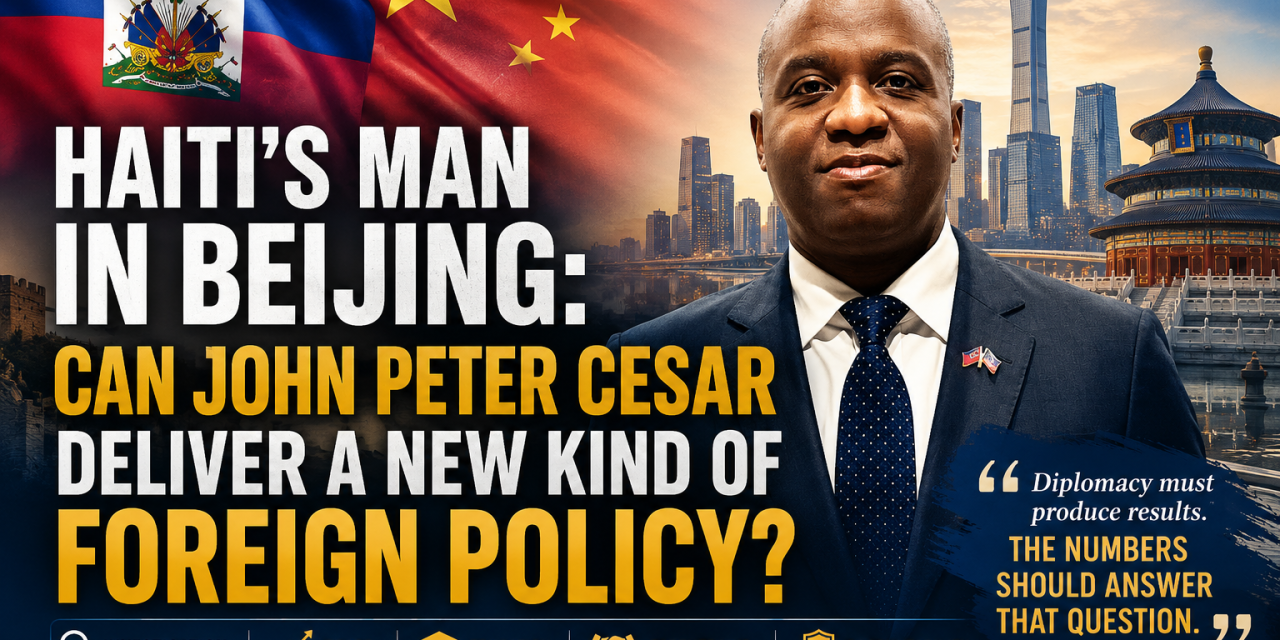
His name is John Peter César (also spelled Jhon Peter CESAR in Haiti’s official diplomatic directory), currently identified by Haiti’s Ministry of Foreign Affairs as Chargé d’Affaires and Conseiller at the Bureau de Développement Commercial d’Haïti à Beijing (BDCH).
The question is not whether César attends meetings.
The question is:
What has Haiti actually gained from his representation in China?
And, more importantly:
Does John Peter César have the background and strategy to bring something genuinely new to Haitian foreign policy?
The evidence deserves examination—and the Haitian public should make the final judgment.
👤 WHO IS JOHN PETER CÉSAR?
César’s background is somewhat different from the traditional political-diplomatic profile.
Publicly available biographical information indicates that he has spent a significant part of his academic and professional life connected to China.
Southwestern University of Finance and Economics (SWUFE) reports that César received a Chinese Government Scholarship in 2009, studied finance at the university and ultimately obtained a doctorate in accounting in 2019. While studying there, he participated in the university’s China Government Audit Research Center.
His LinkedIn profile likewise identifies SWUFE as his doctoral institution and describes his professional focus as government audit and financial analysis.
A third-party professional profile reports earlier experience including work with Haiti’s Ministry of Foreign Affairs, private-sector positions and, beginning in 2020, service as a counselor at Haiti’s Commercial Development Office in China. That source says he became Chargé d’Affaires in June 2024. Because this employment chronology comes from a commercial profile aggregator rather than official personnel records, it should be treated as provisional rather than definitive.
One part, however, can be independently confirmed.
In 2024, César publicly announced the transfer of responsibilities from outgoing representative Dwinel Bélizaire and his assumption of leadership of the BDCH.
Today, Haiti’s own Ministry of Foreign Affairs lists:
Chargé d’Affaires: Jhon Peter CESAR, Conseiller.
So César possesses something potentially valuable to Haiti:
years of direct exposure to China, Chinese institutions and Chinese economic structures.
But qualifications are only the beginning.
Diplomacy ultimately has to produce results.
📊 WHAT HAS HE ACTUALLY ACCOMPLISHED?
There are several publicly documented initiatives.
🎓 1. A CONCRETE UNIVERSITY PARTNERSHIP
One of the clearest measurable developments occurred in June 2026.
Haiti’s Université d’État d’Haïti (UEH) and César’s former university, Southwestern University of Finance and Economics, signed a framework cooperation agreement.
The agreement covers potential student mobility, faculty exchanges, joint programs and research cooperation, particularly in economics, finance and management.
César was present during the negotiations and signing.
This matters.
Unlike a diplomatic courtesy meeting, a signed institutional agreement creates an actual framework from which programs can be built.
But an agreement is not yet an outcome.
The next questions should be:
How many Haitian students will participate?
How many scholarships?
When will exchanges begin?
Who is paying?
Until those numbers become public, the agreement represents potential—not yet measurable national impact.
🥭 2. ATTEMPTING TO OPEN CHINA TO HAITIAN MANGOES
Another potentially significant development came on June 30, 2026.
César met with Qin Jinsong, a regional sales-channel executive from Joy Wing Mau, a major Chinese fruit distribution/import-export group.
According to reporting on the meeting, discussions addressed:
• Chinese market-access conditions
• mango quality requirements
• transportation logistics
• continuity of supply
• organization of Haiti’s production/export chain.
The parties reportedly agreed to continue discussions toward a longer-term partnership.
This is exactly the type of commercial diplomacy the Beijing office should pursue.
But again, Haitians should demand the next level of information:
How many containers of Haitian mangoes have entered China?
What is the dollar value?
Which Haitian producers benefit?
Has China granted the necessary phytosanitary access?
A meeting about exports is encouraging.
An export contract is better.
And actual Haitian products arriving on Chinese shelves would be the real test.
🎓 3. EDUCATION AND PEOPLE-TO-PEOPLE DIPLOMACY
In January 2026, César met with the leadership of the Beijing International Peace Culture Foundation.
According to the Foundation itself, discussions centered on NGO-level educational cooperation, higher-education talent exchanges and corporate charitable assistance.
The organization reported that the parties reached a preliminary consensus on possible cooperation.
By June, César was also participating in a meeting between the Foundation and a Haitian government education delegation. Discussions included youth development and Mandarin-language education.
These contacts demonstrate networking.
But they also create legitimate oversight questions:
How many scholarships resulted?
How many Haitian students received training?
How much charitable assistance reached Haiti?
Which programs have moved from discussion to implementation?
🎭 4. CULTURAL DIPLOMACY
César has also pursued Haiti’s visibility within Caribbean and Chinese networks.
The BDCH participated alongside several Caribbean missions in the Caribbean Ball 2026 in Beijing, an event attended by Caribbean representatives and Chinese officials.
Haiti used the event to promote Haitian identity and culture, including through national-team merchandise.
César has separately engaged Chinese media representatives about promoting Haitian tourism and culture and encouraging technical cooperation benefiting Haitian students and professionals.
This is legitimate public diplomacy.
But Haiti’s challenge is no longer simply visibility.
It is converting visibility into investment, tourism, exports, technology transfer and human-capital development.
⚠️ THE BIGGER QUESTION: WHERE ARE THE NUMBERS?
Our review found evidence of meetings, negotiations, educational initiatives, cultural diplomacy and attempts at commercial engagement.
What is much harder to find publicly is a comprehensive performance dashboard answering questions such as:
How much Chinese investment has the BDCH directly facilitated?
How much have Haitian exports to China increased?
How many jobs in Haiti resulted from BDCH initiatives?
How many Haitian students received scholarships?
How much humanitarian assistance was mobilized?
How many Haitian businesses received direct assistance?
How many commercial agreements progressed from discussion to execution?
That distinction matters.
A diplomatic office should not be evaluated solely by photographs, conferences, receptions and communiqués.
It should also be evaluated through KPIs—Key Performance Indicators.
📑 THE 8 QUESTIONS JOHN PETER CÉSAR AND THE BDCH SHOULD ANSWER
In the interest of transparency, accountability and constructive public debate, we believe the Bureau should be invited to provide a formal, data-driven performance report addressing the following issues.
I. COMMERCIAL & ECONOMIC PERFORMANCE
1️⃣ Trade Deficit Mitigation
What specific frameworks, agreements or market-access channels has the BDCH negotiated to increase Haitian exports—including mangoes, agricultural products, essential oils, coffee, cocoa, rum and artisanal goods—to mainland China?
Provide:
export volumes, dollar values, participating companies/producers and year-over-year results.
2️⃣ Supply Chain Continuity
What direct interventions has the Beijing office undertaken for Haitian merchants confronting:
shipping delays,
procurement problems,
Chinese supplier disputes,
logistics bottlenecks,
or disruptions connected to insecurity at Haitian ports?
How many Haitian businesses received assistance?
And what measurable results followed?
II. NON-GOVERNMENTAL & CULTURAL DIPLOMACY
3️⃣ Institutional Partnerships
Following engagements with organizations such as the Beijing International Peace Culture Foundation—and the newly documented UEH-SWUFE cooperation—what concrete milestones have been achieved?
How many:
scholarships?
student exchanges?
professor exchanges?
vocational-training placements?
Mandarin programs?
technology-transfer initiatives?
Announced partnerships should now be accompanied by numbers.
4️⃣ Humanitarian Channels
What is the total monetary value of:
medical equipment,
humanitarian assistance,
educational support,
infrastructure assistance,
or other donations
that the BDCH has successfully mobilized from Chinese NGOs, foundations, corporations or private donors for Haiti?
Identify the recipient institutions in Haiti and provide delivery dates where possible.
III. GEOPOLITICAL & STRATEGIC ALIGNMENT
5️⃣ Diplomatic Equilibrium
This may be César’s most complicated assignment.
Haiti’s Beijing office operates in an unusual environment because it is a commercial representation rather than a conventional embassy.
So how does the BDCH expand relationships with mainland Chinese institutions and businesses while remaining fully aligned with the official foreign-policy directives established by Haiti’s Ministry of Foreign Affairs?
What written strategic objectives guide that balancing act?
6️⃣ Multilateral Intelligence
China is a permanent member of the United Nations Security Council.
Haiti repeatedly depends on Security Council decisions involving international security assistance and stabilization.
What mechanisms does the BDCH maintain for monitoring Chinese positions concerning:
UN mandates involving Haiti,
security missions,
UN financing,
sanctions,
humanitarian assistance,
and major Security Council negotiations?
And how frequently are analytical reports transmitted to Port-au-Prince?
IV. CONSULAR OPERATIONS & CITIZEN WELFARE
7️⃣ Administrative Efficiency
What has César modernized internally?
Has the BDCH implemented:
digital document verification,
electronic appointment systems,
case tracking,
corporate-document authentication protocols,
response-time standards,
or digital trade-support services?
If so, publish the performance data.
How long did an administrative request take before these reforms?
How long does it take now?
8️⃣ Citizen Protection
Finally, what mechanisms exist to protect Haitians living in mainland China?
Does the BDCH maintain an updated emergency-registration system for:
students,
businesspeople,
professionals,
families,
and temporary visitors?
What happens during detention, hospitalization, natural disaster, immigration difficulties or another emergency?
How quickly can the office locate and contact Haitian nationals?
🧐 OUR PRELIMINARY ASSESSMENT
The available evidence presents a more nuanced picture than either unconditional praise or automatic condemnation.
César appears to possess substantial China-specific academic exposure, including graduate education in finance/accounting and years spent inside Chinese institutions.
Under his leadership or participation, we can identify potentially meaningful initiatives:
✔️ UEH-SWUFE institutional cooperation
✔️ Discussions aimed at opening Chinese distribution channels to Haitian mangoes
✔️ Engagement with Chinese NGOs on educational cooperation
✔️ Contacts promoting Haitian culture and tourism
✔️ Participation in Caribbean diplomatic-cultural networks in Beijing
But there is an equally important limitation:
Public evidence of activity is considerably easier to find than independently verifiable evidence of economic impact.
That does not prove that results do not exist.
It means the results need to be published.
🇭🇹 CAN HE BRING SOMETHING NEW TO HAITIAN FOREIGN POLICY?
Perhaps.
But Haiti should stop judging diplomacy primarily by personalities.
The standard should be performance.
For decades, Haitians have heard words such as:
“cooperation.”
“partnership.”
“investment.”
“strategic discussions.”
“strengthening bilateral relations.”
The country now needs another diplomatic vocabulary:
EXPORTS.
INVESTMENT.
SCHOLARSHIPS.
JOBS.
TECHNOLOGY TRANSFER.
CONTRACTS.
MARKET ACCESS.
MEASURABLE RESULTS.
If César’s knowledge of China can translate Chinese networks into concrete Haitian economic opportunities, his tenure could offer lessons for a more commercially focused Haitian foreign policy.
If it produces mainly meetings, photographs and preliminary discussions, then it risks reproducing precisely the diplomatic model Haiti needs to move beyond.
So rather than declaring him a success or a failure today, there is a better approach:
📢 PUBLISH THE RESULTS.
Give the BDCH an opportunity to answer these questions with documentation and data.
Then—
LET THE HAITIAN PEOPLE DECIDE. 🇭🇹
Is John Peter César helping build a new model of Haitian economic diplomacy?
Or are we watching another chapter of diplomacy without measurable returns?
The numbers should answer that question.
#Haiti #DiplomatieHaitienne #JohnPeterCesar #BDCH #HaitiChina #ForeignPolicy #EconomicDiplomacy #Accountability #Transparency #Investigation #Commerce #Education #HaitiForeignPolicy