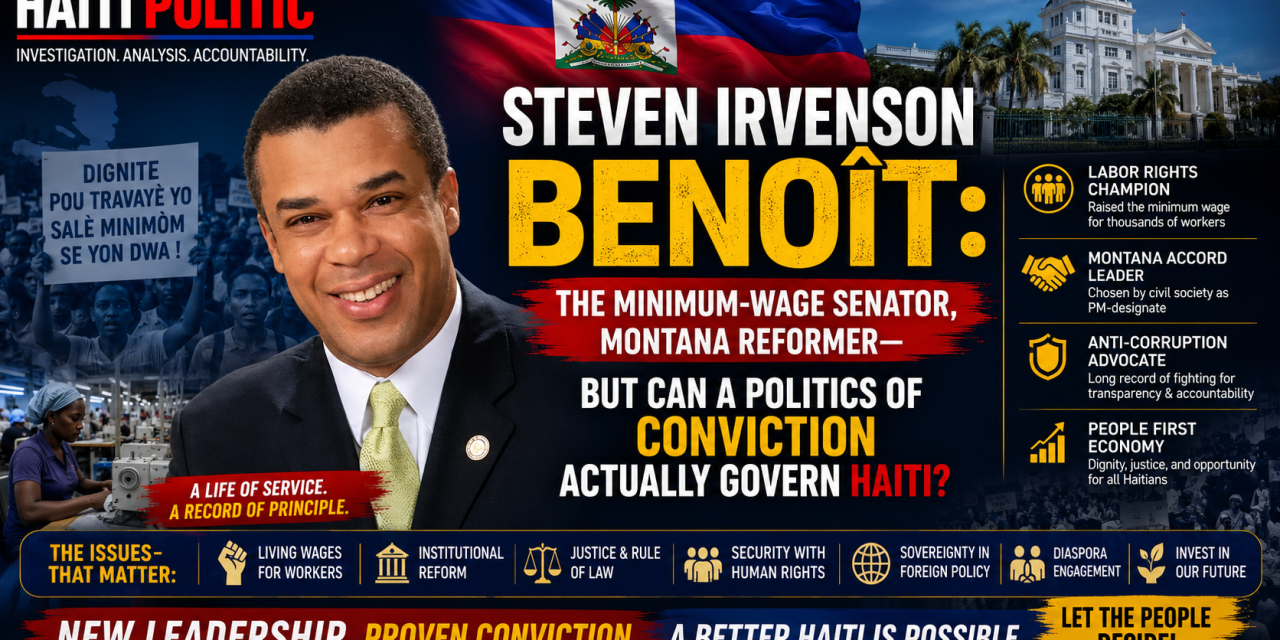
Former Deputy. Former Senator. Presidential candidate. Labor-rights advocate. Montana Accord Prime Minister-designate.
Steven Irvenson Benoît occupies an unusual place in Haiti’s political landscape.
He has been inside Parliament, competed for the presidency, challenged economic interests over workers’ wages, and later became one of the principal faces of an attempt by Haitian civil society to construct an alternative political transition after the assassination of President Jovenel Moïse.
Yet he has never controlled the executive branch.
That makes the central question surrounding Benoît different from the one confronting former presidents and prime ministers:
Has Steven Benoît remained relatively independent because of political principle—or because he has never possessed enough power to be tested by the Haitian presidency?
And after the Montana Accord failed to replace the Ariel Henry government, another question became unavoidable:
Can consensus politics defeat entrenched political power in Haiti?
Haiti Politic examines the record—and leaves the verdict to Haitians.
🔎 WHO IS STEVEN IRVENSON BENOÎT?
Benoît served as a Deputy representing Pétion-Ville before becoming a Senator for the West Department.
He later founded the political organization Konviksyon and contested Haiti’s 2015 presidential election.
The official final results credited him with 17,796 votes, approximately 1.15% of valid votes—placing him well outside the runoff.
That result matters.
Benoît has enjoyed considerable visibility in Haitian politics, but visibility is not the same as a nationwide electoral organization.
Any future presidential project would therefore have to answer a fundamental organizational question:
Can Benoît transform personal credibility into millions of votes?
💵 INVESTIGATION 1 | THE “MINIMUM-WAGE SENATOR”
Perhaps the strongest part of Benoît’s political identity is his association with Haiti’s battle over minimum wages.
His advocacy helped establish an image of a politician willing to confront powerful economic interests on behalf of factory workers and other low-income employees.
That is politically significant because Haiti’s development strategy has frequently been based on a difficult proposition:
Keep labor costs internationally competitive while somehow lifting workers out of poverty.
Those objectives can collide.
A wage that attracts assembly-sector investment may still be inadequate for a worker supporting a family.
But raising wages without increasing productivity can make Haiti less competitive against other low-cost manufacturing countries.
So Benoît’s historic position deserves a modern test.
❓ THE LIVING-WAGE QUESTION
Senator Benoît, what should Haiti’s minimum wage actually be today?
Not simply “higher.”
Give workers a number.
Then explain:
How would you prevent factories from responding through layoffs, automation, relocation or closure?
Would employers receive productivity incentives?
Would workers receive transportation or food subsidies?
Would wage increases be indexed to inflation?
Would different industries have different minimums?
And would enforcement finally apply to politically connected employers?
Workers deserve more than a slogan.
Employers deserve predictable rules.
🏭 INVESTIGATION 2 | WHAT ABOUT THE OTHER HAITI?
There is another difficulty.
A statutory minimum wage primarily protects people participating in the formal economy.
A huge portion of Haiti survives outside it.
Street merchants.
Madan Sara.
Independent drivers.
Farm workers.
Construction laborers.
Small family businesses.
Informal service providers.
For these Haitians, Parliament can announce a minimum wage without putting another gourde into their pockets.
❓ THE INFORMAL-ECONOMY TEST
What is Benoît’s economic program for people who don’t receive salaries at all?
Microcredit?
Agricultural cooperatives?
Simplified business registration?
Public works?
Vocational training?
Small-business tax holidays?
Municipal marketplaces?
Diaspora-backed lending?
A labor candidate for modern Haiti must represent more than organized employees.
He must explain how informal workers become productive members of a formal economy without being taxed into poverty.
🏛️ INVESTIGATION 3 | THE MONTANA EXPERIMENT
This is arguably the most consequential chapter of Benoît’s recent political career.
Following Moïse’s assassination and the resulting constitutional crisis, Haitian civil-society organizations developed what became known as the Montana Accord.
The movement says the initiative emerged from a broad consultation process involving political, religious, private-sector and civil-society actors and sought a Haitian-designed solution to the crisis. It eventually collected hundreds of organizational and individual endorsements.
In January 2022, the Montana process selected economist and former central-bank governor Fritz Alphonse Jean as transitional president and Steven Benoît as prime minister-designate.
On paper, it represented something extraordinary:
A Haitian civil-society attempt to construct an alternative transition outside the government already holding executive power.
But there was one enormous problem.
Montana could designate a government. It could not install one.
⚖️ INVESTIGATION 4 | WAS MONTANA DEMOCRATIC—OR EXTRA-CONSTITUTIONAL?
Supporters considered Montana a Haitian-led response to a political vacuum.
Critics could reasonably ask something else:
Who elected Montana?
The 1987 Constitution contained no mechanism resembling the Montana transition. Independent analyses sympathetic to the initiative nevertheless acknowledged this constitutional problem.
That creates a serious question for Benoît.
❓ LEGITIMACY WITHOUT AN ELECTION
If an unelected civil-society council has the authority to designate a president and prime minister during one crisis, what prevents another coalition from claiming the same authority during the next one?
What was Montana’s source of legitimacy?
Number of participating organizations?
Popular demonstrations?
Absence of constitutional succession?
Political consensus?
Moral legitimacy?
Necessity?
Those distinctions matter enormously for someone who might one day ask voters to entrust him with constitutional authority.
🚪 INVESTIGATION 5 | WHY DID BENOÎT WALK AWAY?
Benoît eventually resigned as Montana’s designated prime minister.
That decision can be interpreted in two dramatically different ways.
Supporters can see political sacrifice: an individual surrendering a title to remove himself as an obstacle to broader negotiations.
Critics can see evidence that Montana lacked the political leverage necessary to convert civil-society consensus into state power.
Either interpretation deserves examination.
❓ THE QUESTION BENOÎT SHOULD ANSWER DIRECTLY
What exactly failed?
Was it Montana’s strategy?
Internal divisions?
Ariel Henry’s refusal to relinquish authority?
Lack of public mobilization?
Weak political-party organization?
Or international policy?
The international dimension cannot simply be dismissed.
Analyses at the time noted that Washington and other foreign actors withheld endorsement of the Montana government while urging broader consensus, and some Haitian actors interpreted international ambiguity as effectively favoring Henry.
But blaming foreigners alone would be insufficient.
A movement claiming the capacity to govern Haiti must demonstrate domestic political power independent of international recognition.
🌎 INVESTIGATION 6 | FOREIGN POLICY: THE MONTANA LESSON
Benoît’s Montana experience offers an unusually useful window into what a future foreign policy might confront.
For generations, Haitian governments have complained about international interference.
Yet Haitian political factions routinely seek recognition from Washington, Ottawa, Paris, CARICOM, the OAS and the United Nations when competing for legitimacy.
That contradiction is central to Haitian politics.
The Montana experience demonstrated how consequential foreign recognition—or its absence—can become.
❓ PRESIDENT BENOÎT VS. THE CORE GROUP
Suppose Washington strongly opposes a policy adopted by a democratically elected Benoît administration.
Who wins?
Would Benoît be willing to risk aid?
Trade preferences?
International financing?
Security assistance?
Diplomatic recognition?
Or would his government compromise?
There is nothing inherently wrong with compromise.
Foreign policy is compromise.
But Haiti needs to know where Benoît’s red lines would be.
🇭🇹 INVESTIGATION 7 | WHAT WOULD “HAITIAN-LED” FOREIGN POLICY ACTUALLY MEAN?
The Montana Accord emphasized a Haitian solution and national sovereignty. Its own account describes an extensive consultation process intended to create national consensus.
That principle sounds compelling.
Implementing it is harder.
Haiti cannot simply disengage from the United States.
Nor Canada.
Nor CARICOM.
Nor the Dominican Republic.
Nor international financial institutions.
Nor the United Nations.
The real objective should therefore not be isolation.
It should be negotiating capacity.
❓ THE FOREIGN-POLICY TEST
Would Benoît support:
A professionalized diplomatic corps selected through competitive examinations?
Economic diplomacy offices dedicated to Haitian exports?
A permanent diaspora investment agency?
Greater engagement with CARICOM?
A new bilateral framework with the Dominican Republic?
Stronger African diplomatic relationships?
Diversification toward Latin America and emerging economies?
Greater parliamentary scrutiny of international agreements?
And critically:
Would his administration publish major international agreements so Haitians know exactly what their government has promised foreign partners?
That would represent genuine foreign-policy reform.
💰 INVESTIGATION 8 | THE DIASPORA MONEY QUESTION
The Haitian diaspora represents enormous economic power.
But Haiti has historically treated that population primarily as a source of remittances rather than as strategic investors and political stakeholders.
Benoît should therefore be pushed beyond criticizing fees on transfers and international calls.
❓ TURN REMITTANCES INTO CAPITAL
Would a Benoît administration establish independently audited diaspora infrastructure bonds?
Could Haitians abroad invest directly into:
- solar-energy projects,
- irrigation systems,
- municipal water,
- agricultural processing,
- regional hospitals,
- industrial parks,
- digital infrastructure?
And who would control the money?
That last question is everything.
A diaspora investment program will fail if contributors believe their savings disappear into ministries without transparent procurement.
Trust is infrastructure.
⚖️ INVESTIGATION 9 | ANTI-CORRUPTION: WILL HE INVESTIGATE HIS OWN GOVERNMENT?
Nearly every Haitian politician campaigns against corruption.
The meaningful test begins when investigators reach the president’s allies.
Benoît has cultivated an image of parliamentary independence and accountability.
A presidential platform should therefore answer measurable questions.
❓ WOULD HE SUPPORT:
Real-time publication of government contracts?
Public disclosure of beneficial ownership for companies receiving state contracts?
Digitized procurement?
Independent CSCCA auditing?
Stronger ULCC investigative powers?
Mandatory asset declarations for senior officials?
Public campaign-finance disclosures?
Protection for whistleblowers?
And most importantly:
Would the President allow those institutions to investigate members of his own cabinet without interference?
That is where anti-corruption promises become real.
🚔 INVESTIGATION 10 | SECURITY CAN DESTROY EVERY OTHER POLICY
Minimum wages are meaningless if factories close because gangs control transportation corridors.
Diaspora investment is meaningless if investors cannot safely reach their projects.
Elections are meaningless if candidates cannot campaign.
Judicial independence is meaningless if judges fear assassination.
Any Benoît presidential project therefore requires something his earlier political identity did not primarily revolve around:
A national security doctrine.
❓ THE SECURITY QUESTIONS
How many police officers does Haiti need?
What should the security budget be?
How should Haiti control ports?
How should weapons trafficking be intercepted?
What intelligence agency reforms are necessary?
How should police corruption be investigated?
Should municipalities have security units?
What happens to minors recruited by gangs?
What happens to gang leaders who surrender?
And what happens to businesspeople and politicians financing armed organizations?
No presidential candidate should receive a pass on these questions.
🗳️ INVESTIGATION 11 | CAN HE ACTUALLY WIN?
There is one political statistic Benoît cannot ignore.
In the final 2015 presidential results, he received 17,796 votes—about 1.15%.
That does not invalidate his ideas.
But it demonstrates the difference between:
media recognition,
civil-society credibility,
and
electoral power.
A future Benoît campaign would need to explain what has fundamentally changed.
Where is the national organization?
Where are the communal coordinators?
Where are the rural networks?
Who protects ballots?
Who finances the campaign?
Which political parties would form his parliamentary coalition?
And can the coalition survive after election day?
📊 HAITI POLITIC ASSESSMENT
| AREA | POTENTIAL STRENGTH | QUESTION THAT REMAINS |
|---|---|---|
| Labor Rights | Strong identification with minimum-wage advocacy | Can higher wages coexist with job creation and competitiveness? |
| Parliamentary Experience | Experience in both Chamber and Senate | Can legislative oversight translate into executive management? |
| Civil Society | Chosen as Montana’s PM-designate | Why couldn’t Montana translate consensus into governing authority? |
| Political Independence | Reputation for taking independent positions | Can independence survive coalition politics? |
| Anti-Corruption | Accountability-oriented political identity | What institutions would investigate his own administration? |
| Diaspora | Potential opening for reform | Can remittances become protected investment capital? |
| Foreign Policy | Montana experience exposed him directly to international power politics | How would he establish sovereignty without isolating Haiti? |
| Security | Opportunity to offer institutional rather than militia-based solutions | Where is the detailed operational doctrine? |
| Electoral Viability | National name recognition | Can he expand dramatically beyond his 2015 result? |
⚠️ WHAT THE RECORD DOES NOT AUTOMATICALLY PROVE
There are also claims about Benoît that should not be turned into facts merely because they circulate in political commentary.
Being associated with minimum-wage legislation does not prove that every wage proposal attributed to him was enacted exactly as proposed.
Being selected by Montana does not mean he constitutionally became Haiti’s prime minister.
Being an anti-corruption voice does not establish that every accusation he has made against political or business interests was proven.
And participation in an opposition movement does not establish guilt or innocence regarding unrelated criminal investigations.
Investigative journalism has to separate documented record, political allegation, candidate rhetoric and opinion.
🔥 THE BIGGER QUESTION
Steven Benoît’s political story raises a fascinating question about Haiti itself.
Haiti has repeatedly tried:
Strong presidents.
Technocrats.
Businessmen.
Populists.
Internationally backed transitions.
Street movements.
Political accords.
Foreign interventions.
And governments assembled through elite negotiations.
The Montana Accord attempted something different: a broad Haitian civil-society framework designed to produce political legitimacy from domestic consensus. Its breadth attracted significant attention, including from foreign-policy analysts who argued that it represented one of the more credible Haitian-generated alternatives during the Henry-era crisis.
Yet it still could not take power.
That failure—or unfinished experiment—may be the most important test of Benoît’s future political argument.
Because Haiti doesn’t merely need leaders capable of identifying what is wrong.
It needs leaders capable of assembling enough legitimate political power to make institutions work without destroying democracy in the process.
🇭🇹 HAITI POLITIC ASKS:
STEVEN IRVENSON BENOÎT: THE MINIMUM-WAGE SENATOR, CIVIL-SOCIETY REFORMER—OR A PRINCIPLED POLITICIAN WHO STILL HAS TO PROVE HE CAN TURN CONSENSUS INTO POWER?
Was his Montana resignation evidence of political integrity?
Or evidence of political weakness?
Can his labor politics evolve into a national economic strategy?
Can he build a governing coalition?
Can he confront gangs without creating another armed political machine?
Can he reform Haiti’s relationship with foreign powers without isolating the country?
And perhaps most importantly:
Can Steven Benoît convert conviction into governance?
Haiti Politic doesn’t choose the candidate.
We investigate the record. We ask the questions. The Haitian people decide.
#HaitiPolitic #StevenBenoit #IrvensonStevenBenoit #MontanaAccord #HaitiPolitics #HaitiElections #HaitiForeignPolicy #MinimumWage #HaitiDiaspora #HaitiSecurity #Accountability #LetThePeopleDecide