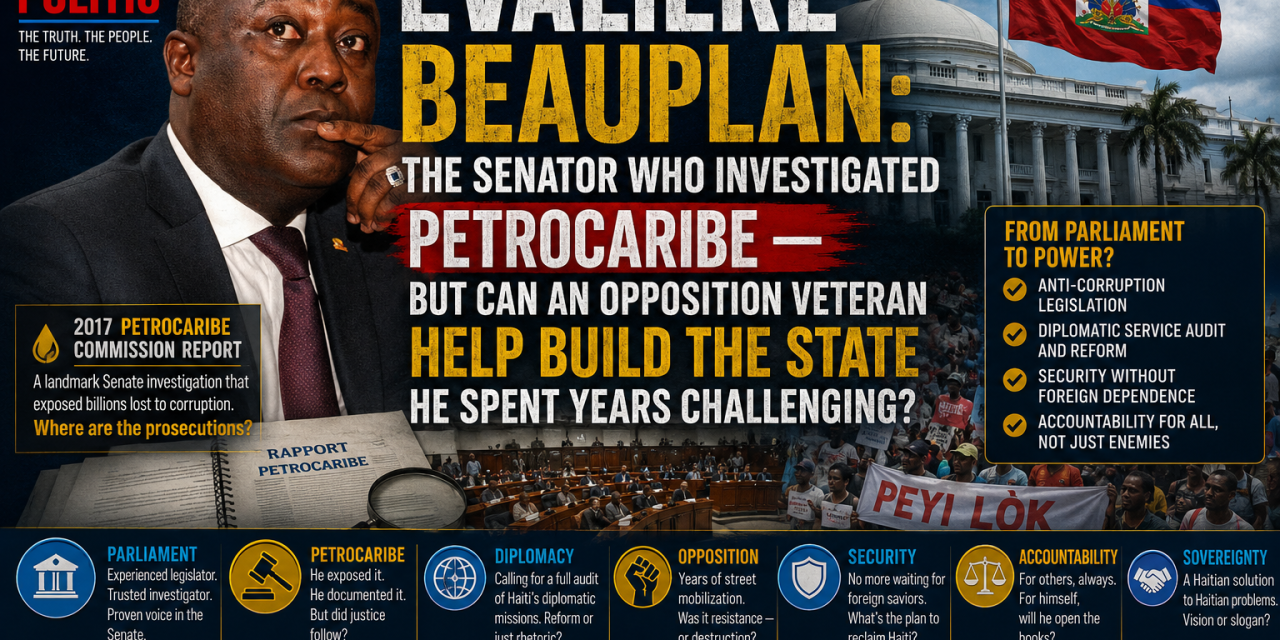
PetroCaribe. Parliament. Diplomacy. Opposition. Security. Accountability. Sovereignty.
For years, Evalière Beauplan occupied one of the most combative spaces in Haitian politics: senator, commission chairman, government critic, opposition strategist, and advocate for greater scrutiny of Haiti’s diplomatic machinery.
His strongest claim to national significance is substantial: he chaired the Senate commission that produced the second major parliamentary investigation into the management of PetroCaribe funds. The 2017 commission examined hundreds of projects and concluded that management of the program had been marked by serious anomalies, irregularities, alleged malfeasance and failures to follow public-contracting rules.
But Beauplan’s political history raises another question.
Investigating government is one thing. Governing Haiti is another.
And any examination of his future role must also confront allegations made against him, his participation in an era of confrontational opposition politics, his ideas about Haitian sovereignty, and what he has actually proposed for reforming a diplomatic system he has criticized for nearly two decades.
This article does not endorse, rank, or recommend Beauplan or any other Haitian political figure. It presents documented third-party reporting, distinguishes allegations from established facts, and puts questions before readers.
🇭🇹 WHO IS EVALIÈRE BEAUPLAN?
Beauplan is a former senator representing Haiti’s Nord-Ouest and a longtime participant in opposition and parliamentary politics.
One important part of his résumé receives less attention than PetroCaribe: foreign affairs oversight.
As far back as 2007, while chairing the Senate Foreign Affairs Commission, Beauplan publicly criticized Haiti’s diplomatic missions as expensive, dysfunctional and inefficient. The commission had spent months evaluating Haitian representations abroad.
That experience matters because Haiti’s crisis isn’t exclusively domestic.
A functioning government must simultaneously negotiate with Washington, Santo Domingo, CARICOM, the United Nations, international financial institutions and Haiti’s diaspora—all while trying to restore the Haitian state’s authority over its own policy.
So Beauplan deserves scrutiny not merely as an opposition politician, but as someone who has spent years examining parts of Haiti’s foreign-policy machinery.
💰 1 | PETROCARIBE: HIS DEFINING POLITICAL INVESTIGATION
The centerpiece of Beauplan’s parliamentary record is unquestionably PetroCaribe.
In 2017, the special Senate commission he chaired examined the management of PetroCaribe resources covering approximately September 2008 through September 2016. Reporting on the commission says it retained accounting expertise and investigated more than 300 projects associated with multiple government administrations.
Its conclusions were severe.
The commission reported serious irregularities and failures in procurement and administration, arguing that officials responsible for various PetroCaribe programs had failed to adequately protect the Haitian state’s interests.
That gave Beauplan powerful anti-corruption credentials.
But it also creates the first major test of his legacy.
❓ THE QUESTION
Where were the institutional consequences?
Producing an investigative report is not the same thing as building an enforcement system.
If Beauplan seeks future national leadership, voters should ask:
What would you do differently so that the next major corruption investigation ends in independent judicial proceedings rather than another report sitting inside the political system?
And there is another complication.
Former officials challenged parts of the commission’s conclusions. Former Public Works Minister Jacques Gabriel, for example, publicly disputed what he described as factual and legal errors in the report.
That doesn’t erase the commission’s findings.
But investigative fairness requires acknowledging the dispute.
📌 BEAUPLAN SHOULD ANSWER:
Would he support giving the ULCC, UCREF and Cour Supérieure des Comptes stronger operational independence—even when they investigate members of his own coalition?
Would procurement contracts and beneficial ownership records become publicly searchable?
Would ministers be required to publish assets before and after government service?
Would major state contracts be available online?
Anti-corruption credibility ultimately depends on whether the rules apply to friends as aggressively as they apply to enemies.
⚠️ 2 | THE ALLEGATIONS AGAINST THE INVESTIGATOR
An anti-corruption politician must also be willing to undergo scrutiny.
In 2018, former Planning Minister Yves Germain Joseph publicly alleged that Beauplan had benefited from approximately US$50,000 per month connected to airport baggage-cart revenues during the Jocelerme Privert transition. Contemporary Haitian outlets reported the accusation.
This point requires careful language:
It was an allegation by a political adversary—not proof of guilt.
The sources reviewed for this article do not establish that Beauplan was convicted of corruption over that accusation.
That distinction matters.
But the allegation still creates a legitimate transparency question for a politician whose national identity is closely connected to investigating corruption.
❓ BEAUPLAN SHOULD ANSWER:
Will you voluntarily publish documentation sufficient for independent journalists and auditors to examine the airport allegation?
If the accusation was false, transparency could strengthen his position.
If someone wants to govern on accountability, voluntary accountability should begin with his own record.
✊🏿 3 | FROM PARLIAMENTARY OVERSIGHT TO CONFRONTATIONAL OPPOSITION
Beauplan was not simply a committee-room politician.
During the Jovenel Moïse years, he became associated with an aggressive parliamentary and opposition environment.
An OFPRA research document records Beauplan among opposition senators involved in disruptions surrounding a 2019 Senate government-policy hearing.
The larger political movement against Moïse included protests, shutdowns and periods of peyi lòk that paralyzed economic activity.
That history deserves examination from both directions.
Supporters of confrontational opposition argued that conventional institutions had become incapable of checking executive power.
Critics counter that political shutdowns imposed enormous costs on workers, schools, small merchants, transportation networks and an economy already close to collapse.
❓ THE HARD QUESTION:
When does legitimate resistance become economically destructive political warfare?
A future Beauplan platform should have to explain whether the tactics of that period were justified—and whether he would tolerate comparable tactics against his own government.
Democracy cannot mean:
Street pressure when I am opposition.
State authority when I am government.
The rules must survive changes in power.
🌎 4 | FOREIGN POLICY: HERE BEAUPLAN HAS A RECORD WORTH EXAMINING
Beauplan’s foreign-policy credentials are more concrete than generic campaign rhetoric.
His criticism of Haiti’s diplomatic network goes back years.
In 2007, as chairman of the Senate Foreign Affairs Commission, he criticized the cost and dysfunction of Haitian missions abroad following an evaluation process.
Years later, in 2023, he again called for a general audit of Haiti’s diplomatic missions.
Reporting on his proposal says he pointed to earlier evaluations identifying problems including poor coordination, absence of clearly defined diplomatic strategies, inadequate instructions to diplomats participating in international organizations, salary delays, accreditation problems and administrative weaknesses.
He proposed stronger auditing and greater professionalization, including a role for the Office de Management et des Ressources Humaines (OMRH) in reviewing appointments.
That is significant because the Haitian government’s own description of the foreign ministry assigns it responsibility for directing, evaluating and controlling diplomatic and consular missions in implementing national foreign policy.
So there is a legitimate policy foundation here.
But diagnosis is not execution.
🌐 CAN HE PROPOSE A DIFFERENT HAITIAN FOREIGN POLICY?
For decades, Haitian foreign policy has frequently been overwhelmed by domestic instability.
Governments desperate for financing, humanitarian assistance, security assistance and diplomatic recognition negotiate internationally from a structurally weak position.
Beauplan has publicly expressed a sovereignty-oriented outlook.
For example, while opposing Jovenel Moïse’s constitutional initiative, he argued that constitutional reform should be determined sovereignly by Haitians rather than directed by international officials.
That position raises a much bigger question:
What does sovereignty actually mean when the state cannot finance sovereignty?
It is easy for Haitian politicians to condemn foreign interference.
The difficult part is explaining how Haiti becomes less dependent on it.
A serious Beauplan foreign-policy doctrine would therefore need answers on:
Customs revenue. Diaspora investment. Export production. Embassy reform. Border management. International negotiations. Security financing. Trade policy.
Without domestic institutional capacity, sovereignty risks becoming a slogan rather than a strategy.
🛂 5 | THE DIPLOMATIC SERVICE: AUDIT IT—THEN WHAT?
Beauplan’s longstanding criticism of Haiti’s foreign missions gives him an opportunity to offer something concrete.
If Haiti spends scarce public money maintaining embassies and consulates, every mission should have measurable objectives.
❓ QUESTIONS FOR BEAUPLAN:
Would you publish the operating budget of every embassy and consulate?
Would ambassadorial and senior diplomatic appointments require professional qualifications?
Would consular revenues from passports and documentation be digitally traceable?
Would diplomats receive written national objectives before UN, OAS and other multilateral votes?
Would underperforming diplomatic missions be consolidated or closed?
And perhaps most importantly:
What measurable economic return should Haiti demand from its diplomatic network?
Diplomacy cannot exist merely to maintain buildings abroad.
It should help Haiti attract investment, protect migrants, expand exports, mobilize diaspora capital and defend national interests.
🚨 6 | SECURITY: SOVEREIGNTY REQUIRES CAPACITY
Every Haitian political platform eventually collides with the same reality:
A government cannot conduct credible foreign policy if it cannot exercise authority at home.
Beauplan has often taken positions skeptical of externally dictated solutions.
But rejecting dependence creates an obligation to explain the domestic alternative.
❓ THE NUMBERS MATTER:
How many additional PNH officers?
What annual security budget?
What intelligence architecture?
How will ports be scanned?
How will customs corruption be reduced?
How will weapons trafficking be intercepted?
What role should the FAD’H have?
How will Haiti finance all of it?
A credible sovereignty doctrine must move beyond:
“Haitian solutions to Haitian problems.”
It must explain who does what, by when, under which law, and with what money.
⚖️ 7 | THE BIGGEST CONTRADICTION BEAUPLAN MUST ADDRESS
His political résumé contains two very different identities.
BEAUPLAN THE INSTITUTIONALIST
Senator.
Foreign Affairs Commission chairman.
PetroCaribe investigator.
Diplomatic-service auditor.
And:
BEAUPLAN THE OPPOSITION COMBATANT
Street mobilization.
Institutional confrontation.
Aggressive anti-government politics.
Resistance to executive authority.
Neither identity automatically disqualifies the other.
But Haitians deserve an explanation of how they fit together.
Because rebuilding Haiti requires something harder than opposition:
Building institutions strong enough to restrain even the people who build them.
🎯 8 QUESTIONS EVALIÈRE BEAUPLAN SHOULD ANSWER PUBLICLY
- PetroCaribe: Why did such an extensive parliamentary investigation fail to produce the institutional accountability Haitians expected?
- Personal transparency: Will you release documentation allowing independent examination of corruption allegations made against you?
- Peyi lòk: Do you believe economic shutdown was justified, and would you recognize the same tactic as legitimate against your own government?
- Diplomacy: Which Haitian embassies and consulates should be expanded, consolidated or closed—and according to what measurable criteria?
- Professionalization: Will you end political patronage appointments throughout the diplomatic service?
- Security sovereignty: How much would your government spend annually on PNH/FAD’H modernization, and where would that money come from?
- Foreign relations: How would you balance relations with the United States, Dominican Republic, CARICOM, Canada, France, the UN and emerging powers without simply moving Haiti from dependence on one foreign partner to another?
- Accountability: If the ULCC or judiciary opened an investigation into one of your closest political allies, would you guarantee investigators complete independence?
📊 THE RECORD — AND THE QUESTIONS
| AREA | DOCUMENTED EXPERIENCE | QUESTION FOR VOTERS |
|---|---|---|
| Parliament | Former senator and experienced legislative actor | Did parliamentary experience produce durable institutions? |
| PetroCaribe | Chaired the 2017 special Senate investigation | Why did accountability remain so limited? |
| Foreign Affairs | Chaired Senate foreign-affairs oversight and investigated diplomatic dysfunction | Can diagnosis become professional diplomatic reform? |
| Diplomatic Reform | Publicly called for a comprehensive audit and professionalization of missions | What would implementation look like? |
| Opposition Politics | Long record of confrontational opposition politics | Can mobilization become stable governance? |
| Personal Scrutiny | Has faced corruption allegations from a former minister; the reviewed sources establish an allegation, not guilt | Will he submit his own record to the transparency he demands from others? |
🇭🇹 HAITI POLITIC — THE PEOPLE DECIDE
Evalière Beauplan can point to something many Haitian politicians cannot:
a substantial parliamentary record of investigating government spending and diplomatic administration.
His PetroCaribe commission remains an important part of that record. His criticism of Haiti’s diplomatic dysfunction also predates today’s crisis by many years.
But experience carries baggage.
The opposition tactics of the last political era, disputed allegations against him, and the limited institutional consequences following major parliamentary investigations all deserve examination alongside his accomplishments.
The central question is therefore larger than Beauplan:
CAN THE PEOPLE WHO MASTERED HAITI’S POLITICS OF OPPOSITION MASTER THE MUCH HARDER POLITICS OF INSTITUTION-BUILDING?
And on foreign policy:
CAN HAITI MOVE FROM REACTING TO FOREIGN POWERS TO DEFINING A NATIONAL STRATEGY—AND CAN BEAUPLAN EXPLAIN HOW TO PAY FOR THAT SOVEREIGNTY?
That judgment belongs to Haitians.
The record. The questions. The answers. The people decide.
#HaitiPolitic #EvaliereBeauplan #Haiti #PetroCaribe #ForeignPolicy #Diplomacy #Corruption #Accountability #Security #Democracy #HaitianPolitics #Sovereignty