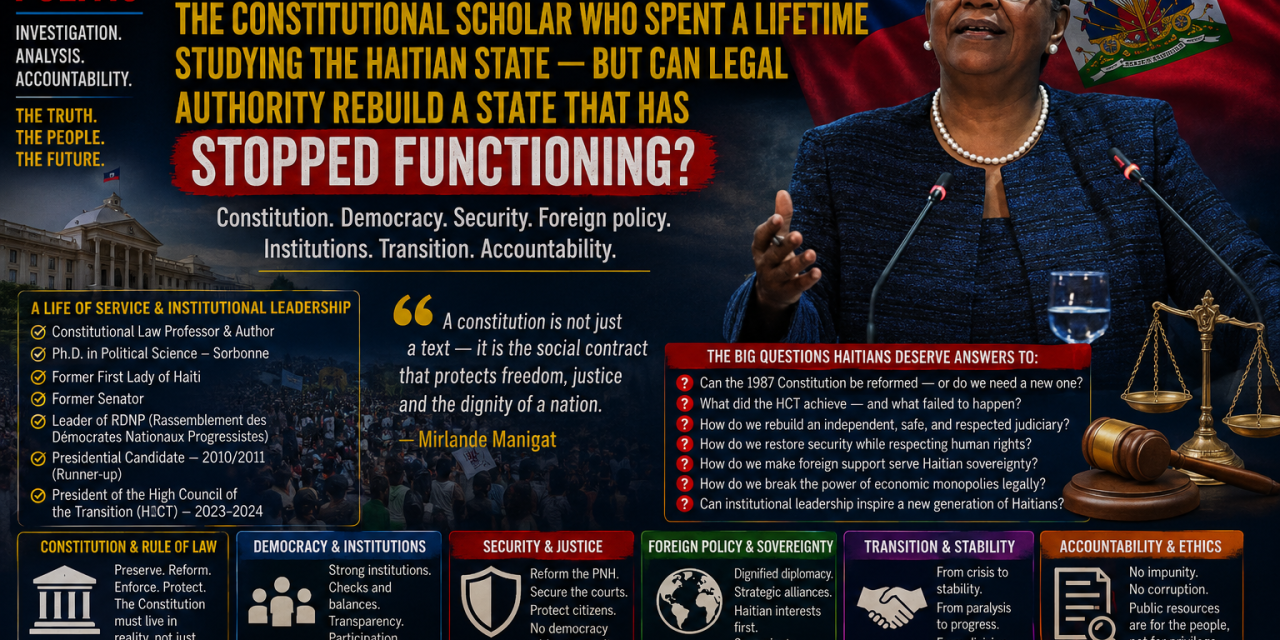
Constitution. Democracy. Security. Foreign policy. Institutions. Transition. Accountability.
Few Haitian political figures possess a résumé comparable to Dr. Mirlande Hyppolite Manigat.
Professor. Constitutional scholar. Author. Former First Lady. Former senator. Presidential candidate. Political party leader. And, most recently, member of Haiti’s controversial High Council of the Transition (HCT).
Her career stretches across academia, electoral politics and periods of profound national crisis. Her bibliography alone demonstrates an unusually sustained engagement with the machinery of the Haitian state: works include Plaidoyer pour une nouvelle Constitution, Traité de droit constitutionnel haïtien, Manuel de droit constitutionnel, and Entre les normes et les réalités: le Parlement haïtien.
But Haiti Politic is not asking whether Mirlande Manigat understands constitutional theory.
The more difficult question is:
Can someone who understands why the Haitian state fails actually make it work?
This article does not endorse, oppose, rank, or recommend Manigat or any other political figure. It uses third-party historical and contemporary sources to examine her record and identify questions Haitians can judge for themselves.
🎓 1 | FIRST, WHO IS MIRLANDE MANIGAT?
Born Mirlande Hyppolite in Miragoâne in 1940, Manigat pursued higher education in France and earned a doctorate in political science from the Sorbonne. Her academic career included teaching abroad before her return to Haiti.
She is also the widow of Leslie Manigat, the historian and political scientist who briefly served as president in 1988 before being removed in a military coup.
That made Mirlande Manigat Haiti’s First Lady—but reducing her career to that title would miss most of her political importance.
She developed an independent career in scholarship and politics, including service in the Senate. Her professional writings have covered constitutional law, Parliament, international relations and women’s status under Haitian law.
That creates an unusual presidential profile:
She did not enter politics through the military.
She did not emerge from the business oligarchy.
She did not become nationally known through entertainment.
Her principal political currency has been institutional knowledge.
And that makes her record particularly important to examine.
📚 2 | THE CONSTITUTIONAL SCHOLAR
Manigat’s scholarship is not simply commentary on politics.
She literally wrote major works about how the Haitian constitutional system operates—and fails.
Her Traité de droit constitutionnel haïtien runs hundreds of pages. She has separately examined the history of Haitian constitutions and the gap between parliamentary rules and political reality.
That background leads directly to the first major question.
❓ DR. MANIGAT:
After decades studying Haiti’s constitutions, is the principal problem really the Constitution—or the political class that repeatedly refuses to respect constitutional institutions?
Because those are very different diagnoses.
Changing the text will accomplish little if political actors continue circumventing the rules.
📜 3 | SHOULD HAITI KEEP THE 1987 CONSTITUTION?
This question is particularly interesting because Manigat’s documented position has historically been more nuanced than simply “defend the 1987 Constitution.”
Her 2010 presidential program acknowledged flaws and inadequacies in the 1987 text. The RDNP had expressed support for a new constitution, but argued that conditions at that moment were unsuitable for a serious, neutral constituent assembly. The program therefore favored constitutional amendment through the procedures already established by the Constitution.
That distinction remains extremely relevant today.
🔥 THE QUESTION:
Should Haiti:
A) preserve the existing constitutional architecture?
B) amend it substantially?
or
C) create an entirely new constitutional order?
And if the answer is C, who gets to write it?
A government?
A constituent assembly?
Legal experts?
Civil society?
The diaspora?
And ultimately—must the people approve it directly?
⚖️ 4 | ONE OF HER MOST INTERESTING OLD PROPOSALS DESERVES ANOTHER LOOK
Manigat’s 2010 program proposed creating a Constitutional Council independent of the executive, legislative and judicial branches.
Its proposed functions included reviewing whether state actions conformed to the Constitution.
More strikingly, her platform wanted questions concerning candidate eligibility and electoral regularity removed from the electoral council’s control, because concentrating those powers there risked making the electoral institution both participant and judge in electoral disputes.
That proposal looks remarkably relevant after years of Haitian electoral controversy.
❓ SO WE SHOULD ASK HER TODAY:
Would you still create that Constitutional Council?
Would its proceedings be public?
Would its members serve fixed terms?
Who would appoint them?
Could presidents remove them?
Would its finances be independently audited?
And could ordinary citizens challenge unconstitutional government actions before it?
🗳️ 5 | THE PRESIDENTIAL TEST: 2010–2011
Manigat wasn’t merely an academic discussing presidential politics.
She came close to the presidency herself.
In the chaotic election following the 2010 earthquake, she finished first in the initial presidential round with 31.37% of the vote, according to published results compiled by IFES.
She advanced to the runoff against Michel Martelly.
Martelly ultimately won the second round decisively. Published results show him receiving roughly two-thirds of the runoff vote.
This defeat deserves political examination rather than mythology.
❓ WHAT DID MIRLANDE MANIGAT LEARN?
Was her message too academic?
Did the RDNP fail to connect with younger voters?
Was its grassroots organization inadequate?
Did Haiti’s electorate want disruption rather than institutionalism?
And perhaps most importantly:
What did the 2010 election teach her about the enormous gap between being respected and being electorally persuasive?
🏛️ 6 | THEN CAME THE HCT
This is where Manigat’s recent record deserves significantly greater scrutiny.
On February 6, 2023, Ariel Henry’s government installed the three-member High Council of the Transition.
The members represented political parties, civil society and the private sector. Manigat represented the political-party component.
At its installation, she called for Haitians to put divisions aside and presented the exceptional political situation as an opportunity to seek agreement.
But the historical question cannot end with the HCT’s intentions.
Haitians deserve to examine results.
🔎 7 | THE HCT ACCOUNTABILITY QUESTION
The HCT existed while Haiti’s institutional and security crisis continued deteriorating.
That creates uncomfortable but legitimate questions for Manigat.
❓ DR. MANIGAT:
What did the HCT actually accomplish?
What institutional reforms did you propose?
What security recommendations did you submit?
Which recommendations did Ariel Henry’s government reject?
Which were accepted?
Where are the reports?
Where are the minutes?
Where are the measurable outcomes?
And if the HCT lacked sufficient authority to produce those outcomes:
Why remain inside a structure incapable of delivering them?
These questions do not establish personal responsibility for Haiti’s collapse.
But participation in transitional authority necessarily creates a public obligation to explain what that authority did—and could not do.
🚨 8 | DID THE HCT GIVE LEGITIMACY TO AN UNELECTED GOVERNMENT?
This may be the most politically difficult question Manigat faces.
Supporters of institutional compromise could argue that Haiti desperately needed respected figures willing to enter negotiations instead of allowing complete political vacuum.
Critics can make the opposite argument:
By joining the HCT, did one of Haiti’s most respected constitutional scholars provide political credibility to a transitional arrangement that lacked an electoral mandate?
Both arguments deserve examination.
❓ THE QUESTION TO MANIGAT:
Where should constitutional pragmatism end?
At what point does participating in an imperfect transitional government protect the Republic?
And at what point does participation legitimize institutional abnormality?
A constitutional scholar should be particularly capable of answering that distinction.
🚔 9 | SECURITY: WHERE CONSTITUTIONAL THEORY MEETS STATE COLLAPSE
Haiti’s immediate crisis cannot be solved by constitutional drafting alone.
A constitution means little if judges cannot safely enter courthouses.
Democracy means little if citizens cannot safely reach polling stations.
Property rights mean little if armed organizations determine who can occupy property.
So Manigat must be challenged beyond her strongest intellectual territory.
❓ WHAT IS HER SECURITY DOCTRINE?
What should the PNH become?
What is the appropriate role of the FAD’H?
How should police officers be vetted?
How should gang financiers be prosecuted?
How should ports and borders be secured?
How should kidnapping networks be financially dismantled?
What protections should prosecutors and judges receive?
And how does Haiti reclaim territory without replacing gang law with arbitrary state violence?
That last question is particularly important for a constitutionalist.
🌎 10 | FOREIGN POLICY — AN OVERLOOKED PART OF HER RECORD
Manigat’s intellectual career was not confined to constitutional law.
She has stated that her earlier publications dealt with international relations, the United Nations and the Third World before her scholarship increasingly concentrated on constitutional questions after returning to Haiti.
Even more importantly, her 2010 presidential program contained a dedicated section on international policy, including principles for Haitian diplomacy and proposals for conceptual and structural reform of diplomatic institutions.
That gives Haiti Politic a different question.
Could Manigat help move Haitian foreign policy from crisis management to strategic diplomacy?
🌐 11 | HAITI’S FOREIGN POLICY FAILURE
For decades Haiti’s international relationships have repeatedly revolved around:
foreign assistance,
humanitarian emergencies,
international security operations,
migration crises,
election mediation,
and emergency financing.
The danger is obvious.
A sovereign country gradually becomes known internationally primarily through its crises.
❓ DR. MANIGAT:
What should Haiti’s foreign-policy doctrine be for the next 20 years?
Should economic diplomacy replace traditional political diplomacy?
Should ambassadors have measurable targets for:
foreign investment,
exports,
scholarships,
technology transfer,
tourism,
diaspora investment,
and bilateral development projects?
And should ambassadors who repeatedly fail those benchmarks be recalled?
🇭🇹 12 | SOVEREIGNTY VS. INTERNATIONAL SECURITY ASSISTANCE
This question cannot be answered with slogans.
Haiti needs international cooperation.
But international involvement has repeatedly generated disputes over sovereignty, effectiveness and accountability.
So the real issue isn’t simply:
FOREIGNERS—YES OR NO?
The serious questions are:
Who commands?
Who investigates abuses?
Who determines operational priorities?
Who establishes the exit strategy?
Who measures success?
And who is accountable when civilians are harmed?
❓ MANIGAT SHOULD DEFINE A DOCTRINE:
International assistance under Haitian strategy—or Haitian strategy subordinated to international assistance?
Those are fundamentally different arrangements.
⚖️ 13 | REBUILDING THE JUDICIARY
This may be the area where Manigat’s constitutional expertise could be tested most directly.
Haiti needs more than statutes.
It needs courts capable of enforcing them.
❓ WOULD A MANIGAT REFORM PROGRAM SUPPORT:
• transparent judicial appointments?
• secure courthouses?
• specialized financial-crimes courts?
• digital case management?
• enforceable deadlines against prolonged pretrial detention?
• protected prosecutors?
• stronger judicial inspections?
• published judicial decisions?
• independent disciplinary procedures?
• modernized forensic capabilities?
Because rule of law cannot exist when justice operates only on paper.
💰 14 | AND WHAT ABOUT ECONOMIC POWER?
Constitutional democracy is also undermined when economic power becomes sufficiently concentrated to capture government.
This creates another major test.
❓ HOW WOULD MANIGAT ADDRESS:
exclusive commercial privileges,
tax avoidance,
customs corruption,
opaque corporate ownership,
political campaign financing,
state-contract favoritism,
and monopolistic practices?
Would she support stronger competition legislation?
Public beneficial-ownership registries?
Digitized customs?
Mandatory publication of government contracts?
Independent auditing of tax exemptions?
Because constitutional government isn’t merely about controlling presidents.
It is also about preventing private power from purchasing the state.
👩🏾 15 | A DIMENSION THAT SHOULD NOT BE OVERLOOKED: WOMEN AND LAW
Long before gender representation became standard political language, Manigat published extensively on women’s legal and constitutional status.
Her 2002 book Être femme en Haïti hier et aujourd’hui examined women through Haiti’s constitutions, laws and society. The bibliographic record describes a substantial 457-page work on the subject.
That creates another accountability question:
❓ WHAT WOULD THOSE DECADES OF SCHOLARSHIP MEAN IN GOVERNMENT?
Equal property rights?
Protection against gender violence?
Women’s access to credit?
Maternal healthcare?
Girls’ education?
Female representation in government?
Legal enforcement rather than symbolic quotas?
Scholarship becomes politically meaningful only when translated into institutions.
🧑🏾🎓 16 | THE GENERATIONAL QUESTION
Manigat’s experience is undeniable.
But experience creates its own challenge.
Haiti has one of the youngest populations in the hemisphere.
Many young Haitians have lived their entire lives through:
political transition,
earthquakes,
unemployment,
migration,
gang violence,
institutional collapse,
and repeated promises of reform.
❓ SO WHAT DOES MIRLANDE MANIGAT OFFER A 22-YEAR-OLD?
Not history.
Not reputation.
Not titles.
Opportunity.
Jobs.
Internet access.
Education.
Security.
Housing.
Credit.
Political representation.
A reason not to leave.
Any modern Manigat political doctrine must explain how constitutional stability produces tangible improvements in those areas.
📊 HAITI POLITIC — RECORD TO EXAMINE
| AREA | DOCUMENTED EXPERIENCE | QUESTION FOR PUBLIC SCRUTINY |
|---|---|---|
| Constitutional Law | Extensive scholarship and major published works | Can legal expertise become enforceable institutional reform? |
| Electoral Politics | First-round leader and eventual runner-up in 2010–11 | What lessons came from defeat and electoral instability? |
| Legislative Experience | Historical Senate experience | How would she resolve executive-legislative dysfunction? |
| Transition | Member of the 2023 HCT | What measurable results did the HCT produce? |
| Foreign Affairs | Academic work in international relations and a documented foreign-policy platform | How would theory become modern economic diplomacy? |
| Security | Strong rule-of-law perspective | What is the operational security strategy? |
| Judiciary | Exceptional constitutional expertise | How would courts actually be made independent and functional? |
| Generational Renewal | Deep institutional experience | Can an established political figure connect with a radically younger Haiti? |
This table summarizes documented third-party material and questions arising from it; it is not a ranking or endorsement of Manigat relative to other Haitian political figures.
🔥 THE CENTRAL QUESTION
Mirlande Manigat has spent much of her intellectual life studying the relationship between constitutional norms and Haitian political reality.
That makes the central question almost unavoidable:
WHAT HAPPENS WHEN THE GAP BETWEEN THE LAW AND REALITY BECOMES THE ENTIRE POLITICAL SYSTEM?
Haiti does not suffer from an absence of constitutions.
It suffers when institutions cannot enforce them.
It does not lack elections on paper.
It lacks durable confidence in electoral institutions.
It does not lack courts.
It lacks consistent access to functioning justice.
It does not lack diplomatic missions.
It lacks sufficient leverage internationally.
It does not lack political agreements.
It lacks institutions capable of making agreements survive political conflict.
That is the terrain on which Manigat’s legacy—and any future political role—should be judged.
🗣️ HAITI, YOU DECIDE.
Is Mirlande Manigat’s constitutional expertise precisely what Haiti needs after years of institutional improvisation?
Or has Haiti’s crisis moved beyond what traditional institutionalism can solve?
Did her participation in the HCT demonstrate willingness to accept responsibility during a national emergency—or reveal the limits of elite political compromise?
Can she articulate a foreign policy built around sovereignty, trade, diplomacy and Haitian interests rather than permanent crisis management?
Can constitutional government survive without security?
Can security be restored without sacrificing constitutional government?
And perhaps the biggest question:
AFTER A LIFETIME EXPLAINING HOW THE HAITIAN STATE SHOULD WORK—WHAT WOULD MIRLANDE MANIGAT ACTUALLY DO TO MAKE IT WORK?
THE RECORD. THE QUESTIONS. THE PEOPLE DECIDE.
#HaitiPolitic #MirlandeManigat #Haiti #RDNP #Constitution #HCT #ForeignPolicy #RuleOfLaw #Security #Democracy #HaitiPolitics #HaitiDecides