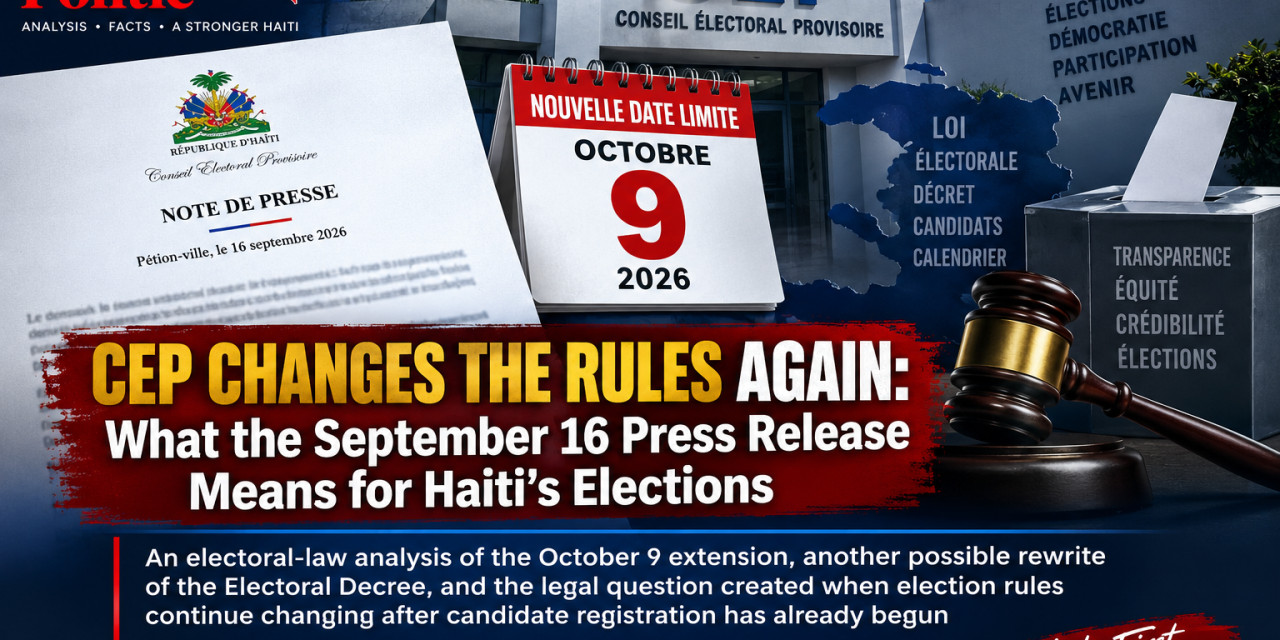
An electoral-law analysis of the October 9 extension, another possible rewrite of the Electoral Decree, and the legal question created when election rules continue changing after candidate registration has already begun
Haiti Politic — Legal & Electoral Analysis | September 17, 2026
The latest press release from Haiti’s Conseil Électoral Provisoire (CEP) looks short. Legally and institutionally, however, it raises questions that go well beyond a routine extension of a filing deadline.
On September 16, the CEP announced two significant decisions.
First, at the “insistent request” of approved political organizations, candidates are being given until October 9, 2026 for online registration and submission of required documents.
Second—and potentially much more consequential—the CEP says it is continuing discussions with political actors and the Government concerning another modification of the Electoral Decree currently governing the election. The CEP simultaneously says it remains committed to an inclusive, impartial and transparent process conducted with independence and democratic responsibility.
That combination deserves close examination.
The fundamental question is no longer simply whether Haiti needs flexibility in an extraordinarily difficult electoral environment.
It is:
How many times can the legal rules governing an election be changed after the electoral process has already begun before legal flexibility begins undermining legal certainty?
What exactly did the CEP announce?
The September 16 communiqué, reference CEP/DC/060-2526, contains three substantive points.
The first is another extension. Political organizations now have until October 9 for online candidate registration and filing documents.
The second is the explanation: the CEP explicitly attributes the decision to persistent requests from approved political structures.
The third is the most legally important sentence:
the CEP is continuing discussions with political actors and the Government “dans la perspective d’une modification du Décret électoral en vigueur.”
In other words, this is not merely a scheduling adjustment.
The substantive legal framework governing the election may change again.
And this is happening while candidates are already entering the process.
The timeline explains why this matters
The current Electoral Decree was promulgated on June 2, 2026.
Only one month later, on July 2, it was already modified. That amendment changed multiple provisions, including Article 133 governing verification of political organizations’ membership/support lists, several candidate-document requirements under Article 153, and voting safeguards involving NINU identification, signatures or fingerprints and indelible ink.
Then the CEP published its 2026–2027 electoral calendar, setting the first round of presidential and legislative elections for December 13, 2026, while expressly noting that implementation depended on acceptable security conditions and sufficient financing.
Candidate registration then began.
The CEP subsequently extended the candidate-registration operation. An earlier September adjustment had online registration ending September 20, document filing September 22 and the definitive candidate list scheduled for October 14.
Now, on September 16, another extension has arrived: October 9 for online registration and submission of documents.
That means the CEP will have to clarify publicly how this new deadline restructures the downstream calendar—analysis of candidacies, preliminary lists, challenges before electoral tribunals, appeals and publication of the definitive candidate list.
That clarification is essential because the dates can no longer simply be read independently of one another.
And candidates are already inside the process
This is what makes the timing particularly important.
Le Nouvelliste reported that, as of September 14, the CEP had already recorded online:
3 presidential candidates,
68 Senate candidates, and
205 candidates for the Chamber of Deputies.
The newspaper also reported that only 25 of the 105 approved political organizations had successfully registered the 30,000 members required under the applicable rules at that point.
Consequently, this is no longer a situation in which lawmakers are adjusting rules months before anybody acts upon them.
People have already begun organizing their conduct around the existing rules.
That distinction matters.
The constitutional question: Who controls electoral rules?
Haiti’s Constitution gives the electoral institution unusually strong language concerning its independence.
Article 191 states that the Electoral Council is responsible for organizing and controlling, “in complete independence,” electoral operations throughout Haiti until results are proclaimed.
Article 191-1 goes further: the Electoral Council prepares the electoral bill and submits it to the Executive for the necessary action.
Article 194-2 requires electoral councillors to swear to respect the Constitution and electoral law while performing their duties with dignity, independence, impartiality and patriotism.
There is therefore an important distinction between:
consultation with government, which may be necessary,
and
political control over electoral rules, which would raise a fundamentally different constitutional problem.
And remarkably, the CEP itself made essentially this argument only months ago.
The CEP previously accused the Government of interfering with its constitutional authority
This history makes the September 16 communiqué particularly noteworthy.
Earlier in 2026, the CEP publicly objected when the Prime Minister presented a version of the Electoral Decree that the Council said was “totally different” from the project it had submitted to the Executive on April 24.
At that time, the CEP said the initiative for drafting the electoral decree belonged to the electoral institution and characterized the Government’s approach as violating the principle of CEP independence.
The dispute eventually led to negotiations.
A joint CEP–Primature commission met between June 11 and June 23, including representatives of the CEP, Prime Minister’s office and political parties. Those discussions ultimately preceded the July 2 modifying decree.
Now, only a few months later, the CEP itself says it is again discussing modifications with political actors and the Government.
That does not automatically establish unconstitutional interference.
But it does make transparency about who is proposing each amendment and why particularly important.
Why change election rules in the middle of the process?
There are legitimate reasons an electoral authority might discover that rules adopted on paper do not work effectively in practice.
Haiti is operating under exceptional circumstances involving insecurity, displacement, institutional weakness and significant logistical constraints.
The CEP itself recently altered filing arrangements for candidates from several communes, allowing documents to be deposited at BED offices because of operational constraints.
There is also evidence that some candidate requirements are creating practical difficulties.
According to reporting on the September 11 meeting between the CEP and the Government, the CEP had written the Prime Minister on September 7 concerning provisions whose implementation it considered technically difficult. Discussions reportedly covered candidate-registration rules, the calendar and potentially the December 13 election date itself.
So modification is not, by itself, evidence of manipulation.
A defective electoral rule should not remain defective merely because an election has started.
But the opposite principle matters too.
An election needs rules that participants can know before deciding how to comply with them.
The real legal concern is predictability
Consider two hypothetical candidates.
Candidate A spends weeks obtaining every certificate and document required under the existing decree, meets every deadline and bears all associated costs.
Candidate B cannot satisfy one of those requirements.
If the requirement is subsequently removed or substantially relaxed after Candidate A complied with it, Candidate B may become eligible under a standard that did not exist when Candidate A prepared the dossier.
That does not automatically make the amendment illegal.
But it creates an obvious equal-treatment and procedural-fairness question.
The reverse problem is equally serious.
Suppose a new requirement is introduced after candidates have already filed their dossiers. Candidates need adequate notice and a realistic opportunity to comply.
That is why the central legal test should not be:
Who benefits from a particular amendment?
It should be:
Is the same rule published in advance and applied equally to every similarly situated candidate?
A second problem: political parties are requesting changes to rules that govern political parties
The September 16 press release contains language that should receive more attention:
“Sur demande insistante des structures politiques agréées…”
The extension came after persistent requests from approved political organizations.
Consulting political parties is normal in electoral administration.
Allowing parties to participate in discussions about practical obstacles is also normal.
But consultation cannot become negotiation over individual eligibility.
The CEP must remain the electoral administrator, not an arbitrator of bespoke rules requested by whichever political actors have the greatest access to the institution.
That means the public needs considerably more information.
Which political organizations requested these changes?
What provisions did they ask to modify?
Which requests did the CEP accept?
Which did it reject?
What technical or constitutional justification supports each proposed modification?
And will every amendment apply identically to every candidate and political organization?
Those answers matter more than the identities of individual politicians who might incidentally benefit.
There is also a calendar problem
The earlier revised calendar illustrates the difficulty.
The CEP previously scheduled the definitive candidate list for October 14.
Now candidate registration and document submission can continue until October 9.
That compresses everything that follows unless other dates move too.
Candidate dossiers must be examined.
Preliminary decisions must be published.
Challenges must be possible.
Electoral courts must hear disputes.
Appeals must be decided.
A definitive list must eventually emerge.
And the first round is still officially scheduled for December 13, 2026, although recent discussions reportedly included the calendar itself.
Therefore, the September 16 communiqué creates an immediate administrative question:
What is the new complete electoral calendar?
Publishing one deadline without simultaneously publishing the consequences for all dependent deadlines creates avoidable uncertainty.
The CEP’s independence cannot exist only in a press release
The final paragraph of the communiqué promises an electoral process that is:
inclusive, impartial, transparent and independent.
Those principles are important.
But independence is demonstrated procedurally.
If electoral rules are going to change again, the strongest protection for the CEP would be radical transparency.
Before another modifying decree takes effect, the public should be able to see exactly what is changing, the previous language, the proposed language, the legal or technical justification, when the amendment becomes effective and how transitional cases will be treated.
That would allow lawyers, candidates, parties, journalists and civil-society organizations to determine whether the rules are genuinely general or whether particular provisions produce differential treatment.
Modification does not automatically mean manipulation
This distinction is crucial.
The evidence presently available establishes that:
The Electoral Decree has already been amended once.
The candidate calendar has already been extended.
The September 16 communiqué grants another extension through October 9.
The CEP is discussing another modification of the Electoral Decree with political actors and the Government.
What the evidence does not presently establish is that these changes were designed to qualify or disqualify any particular candidate.
That allegation would require evidence connecting a particular amendment to preferential treatment.
The more defensible concern at this stage is institutional:
Repeatedly changing electoral rules after the process has begun increases the burden on the CEP to demonstrate neutrality, equal treatment and legal predictability.
The question Haiti should be asking
The central issue should therefore not become a debate over whether one politician or another benefits.
The deeper question is whether Haiti can establish a stable rule of law for elections.
An electoral system cannot reasonably demand that candidates obey the law while leaving them uncertain about what that law will say several weeks later.
At the same time, an electoral authority cannot reasonably be expected to preserve an unworkable provision simply to demonstrate consistency.
Those principles have to be reconciled.
That requires a simple standard:
Necessary corrections should be made transparently, prospectively and uniformly.
If a requirement is technically impossible, explain why.
If a deadline is unrealistic, publish the evidence.
If a provision conflicts with the Constitution, identify the conflict.
If political organizations requested an amendment, disclose the substance of the request.
If the Government proposes language, identify it.
And once the final rules are adopted, apply the same law to everybody.
The October 9 deadline is not the biggest story
The extension itself may ultimately prove to be a reasonable administrative accommodation.
The consequential sentence in the September 16 communiqué is the one announcing that another modification of the Electoral Decree is under discussion.
Haiti is no longer at the beginning of electoral planning. Candidates are registering. Political organizations have been approved. Deadlines are running. Candidate eligibility rules are being applied. Electoral disputes will soon follow.
The closer an election gets, the greater the institutional cost of changing its rules.
That does not mean rules can never change.
It means that every additional change now requires a stronger legal justification and a clearer public explanation than the one before it.
The CEP says it wants an election that is independent, impartial and transparent.
The next modifying decree—if there is one—will provide an important test of those principles.