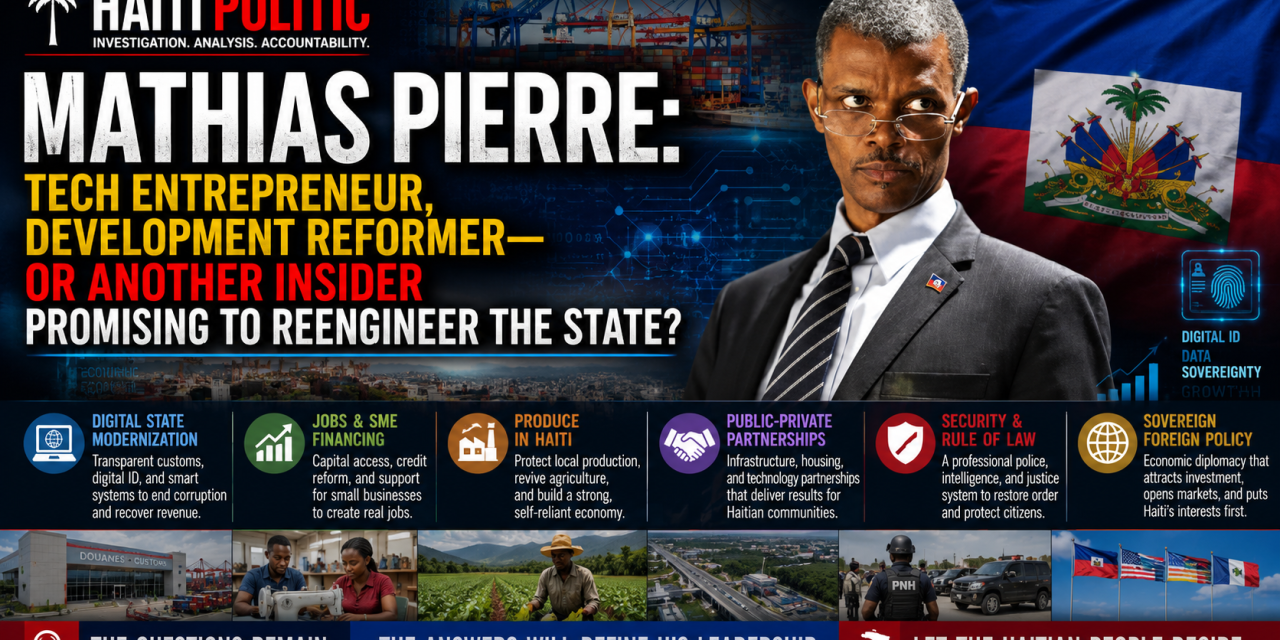
🇭🇹 Engineer. Technology entrepreneur. Author. SME advocate. Former presidential candidate. Former minister responsible for electoral affairs. Political-party leader.
Mathias Pierre presents a different profile from many figures competing for influence in Haitian politics.
His story begins not in Parliament, the military, or a traditional political dynasty—but in engineering, technology and entrepreneurship.
He founded what became the GaMa Group, built businesses around information technology and construction, promoted entrepreneurship, and publicly argued for years that Haiti’s development requires a stronger generation of Haitian business owners.
Then he crossed the line separating private-sector reformers from government officials.
In January 2021, Pierre was appointed Minister Delegate to the Prime Minister responsible for electoral questions and relations with political parties, placing him directly inside the Jovenel Moïse government during one of the most contentious periods of Haiti’s constitutional crisis.
That combination makes him worth examining.
Because Mathias Pierre isn’t simply asking Haitians to believe that entrepreneurship works.
His career asks a much harder question:
CAN THE DISCIPLINE OF BUILDING A BUSINESS BE USED TO REBUILD A STATE?
And if Pierre wants to represent a political alternative today, another question follows:
HOW MUCH RESPONSIBILITY SHOULD HE ACCEPT FOR A GOVERNMENT AND ELECTORAL PROCESS IN WHICH HE ALREADY PARTICIPATED?
This is not an endorsement.
It is not a condemnation.
It is an investigation of the record, the claims and the questions that remain.
Then Haitians can decide.
👨🏾💻 WHO IS MATHIAS PIERRE?
Pierre studied electrical engineering at the State University of Haiti’s Faculty of Sciences.
His own account of his entrepreneurial history says the idea for GaMa developed while he was at university and became a concrete business venture in 1998, as internet and information technology were expanding in Haiti.
His company did not remain a single computer shop.
By 2013, Pierre described the GaMa Group as encompassing businesses and initiatives including:
💻 GaMa Consulting;
🖥️ GaMa Enterprises;
🏠 KayTek real estate/construction;
📰 publishing/media activities;
🎓 entrepreneurship development;
and the nonprofit Fondation ETRE Ayisyen.
This matters politically because Pierre’s principal argument about Haiti has long revolved around one idea:
BUILD HAITIAN CAPACITY.
Not perpetual humanitarian assistance.
Not permanent NGO management.
Not simply importing everything Haiti consumes.
Build entrepreneurs.
Build companies.
Build skills.
Build housing.
Build technology.
Build a middle class.
That sounds attractive.
But governing Haiti requires considerably more than entrepreneurship.
🏗️ TEST #1 — DID HIS PRIVATE-SECTOR MODEL ACTUALLY PRODUCE RESULTS?
Pierre’s record contains tangible projects worth examining.
Following the 2010 earthquake, the Clinton Bush Haiti Fund announced a $1.08 million grant to GaMa Enterprises for a franchise-based housing initiative under the KayTek brand.
The project was intended to manufacture steel-frame housing kits while supporting construction employment and entrepreneurship.
That is a concrete accomplishment.
But because Pierre is now a political figure, Haiti Politic should ask for something more detailed.
How many houses were ultimately produced?
How many were sold?
At what average cost?
How many permanent Haitian jobs resulted?
How many entrepreneurs became franchise operators?
What percentage of materials were locally produced?
What happened after donor financing ended?
This should become a rule for every politician:
DON’T JUST SHOW US THE PROJECT. SHOW US THE OUTCOME.
💼 TEST #2 — HE KNOWS THE SME PROBLEM FIRSTHAND
One of the more interesting aspects of Pierre’s record is that he was complaining about Haiti’s financing problem long before becoming a government minister.
In a 2013 interview, he identified access to credit as one of the principal obstacles confronting Haitian businesses.
He also cited weak business regulation, unfair competition and inadequate support for entrepreneurs.
More than a decade later, those questions remain.
So now the burden shifts.
It is no longer enough for Mathias Pierre to diagnose the problem.
WHAT WOULD PRESIDENT PIERRE ACTUALLY DO ABOUT IT?
🏦 TEST #3 — THE HAITIAN CREDIT REVOLUTION
Pierre should answer:
Would his government establish an SME credit-guarantee fund?
Would the state guarantee part of qualifying loans?
Would Haiti create a development bank?
Would credit unions receive stronger capitalization?
Would movable assets be accepted as collateral?
Could entrepreneurs borrow against verified invoices?
Would women-owned businesses receive specialized financing?
Would agricultural cooperatives receive seasonal credit?
Would diaspora investors be allowed to co-guarantee loans?
Could fintech companies compete with traditional banks?
And most importantly:
Where does the money come from?
Ordering banks to provide artificially cheap credit is not a sustainable financial policy.
Banks must manage default risk.
So the real challenge is designing institutions that reduce the risk of lending.
That is where Pierre’s business experience should produce detailed answers.
💻 TEST #4 — CAN TECHNOLOGY ATTACK CORRUPTION?
This may be Pierre’s strongest potential policy territory.
Haiti loses enormous institutional capacity through systems that remain:
paper-based;
fragmented;
discretionary;
opaque;
and vulnerable to political interference.
Technology cannot eliminate corruption.
But technology can make certain forms of corruption harder to hide.
Imagine:
Every container receives a digital identifier.
Every customs declaration receives a timestamp.
Every tariff calculation is automatic.
Every payment is electronic.
Every exemption has an authorization number.
Every modification leaves an audit trail.
Every government contract has a searchable beneficial owner.
Every government payment can be reconciled against the Treasury.
That would not eliminate corruption.
But it would dramatically increase traceability.
So:
PRESIDENT PIERRE, WOULD YOU MAKE GOVERNMENT TRANSACTIONS TRACEABLE BY DEFAULT?
⚓ TEST #5 — DIGITAL CUSTOMS
A Pierre administration should be asked to publish a detailed Digital Customs Blueprint.
Not simply:
“We will modernize customs.”
Show the architecture.
Would Haiti implement:
electronic manifests before ships arrive?
automated tariff calculations?
risk-based cargo inspection?
container GPS tracking?
electronic seals?
automated license-plate recognition?
digital customs payments?
cross-border invoice verification?
AI-assisted anomaly detection?
public dashboards showing customs collections?
interoperability between customs, tax authorities, ports and the Treasury?
And:
WHO AUDITS THE SOFTWARE?
Because digitizing corruption without changing governance can simply produce digital corruption.
🔐 TEST #6 — WHO OWNS HAITI’S DATA?
This question becomes particularly important because Pierre served in government during controversy surrounding Haiti’s biometric national identification system.
In April 2021, Pierre publicly defended the national identification card associated with German biometrics company Dermalog, arguing that unique identification numbers and biometric controls would prevent citizens from obtaining multiple identities for voting purposes.
At the time, the National Identification Office reported that more than 4.3 million potential voters had been registered.
But technical capability is only half the question.
The other half is sovereignty.
🪪 THE DERMALOG QUESTIONS
President Pierre:
Who owns Haitian biometric data?
Where are the servers?
Who administers them?
Who possesses encryption keys?
Can a foreign contractor access raw biometric records?
Can Haitian intelligence agencies access them?
Can political officials?
How are access attempts logged?
Who independently audits the system?
What happens when the foreign contract expires?
Can Haiti operate the infrastructure without the vendor?
Can citizens challenge incorrect records?
Can biometric information be deleted?
What happens after a data breach?
A national ID system can strengthen sovereignty.
It can also create one of the most powerful surveillance databases Haiti has ever possessed.
The difference is governance.
🗳️ THEN COMES THE MOST DIFFICULT PART OF PIERRE’S RECORD
THE 2021 ELECTORAL CRISIS.
Pierre was not merely commenting on Haiti’s political conflict from television studios.
He was inside government.
On January 14, 2021, he was appointed minister delegate responsible for electoral affairs and relations with political parties.
The country was already bitterly divided over President Jovenel Moïse’s mandate.
Pierre publicly supported the position that Moïse’s presidential term expired in February 2022, rather than February 2021, arguing that the 2016 election constituted a distinct electoral process from the annulled 2015 process.
Opposition movements strongly rejected that interpretation.
This cannot simply be erased from his political biography.
⚖️ TEST #7 — WHAT DID HE LEARN FROM JOVENEL MOÏSE?
Pierre should answer directly:
What did the Moïse government get right?
What did it get wrong?
Were efforts to hold a constitutional referendum politically realistic?
Did the government sufficiently consult opposition parties?
Was the electoral timetable credible?
Were security conditions adequate?
Should elections have been attempted without broader political consensus?
Was the constitutional reform strategy too ambitious?
What warning signs did Pierre see from inside government?
Which warnings did he personally give President Moïse?
Were they accepted?
Were they ignored?
A reformer demonstrates independence not by pretending previous associations never existed—
but by explaining what he learned from them.
🚨 JULY 7, 2021
Then Haiti’s political crisis became something much darker.
President Jovenel Moïse was assassinated.
Pierre remained part of the government during the immediate succession crisis.
On CNN two days after the assassination, Pierre argued that Claude Joseph was the authority then in charge and referenced Article 149 while describing the government’s intention to proceed toward elections.
Haiti eventually did not hold those elections.
That history creates another test.
🗳️ TEST #8 — WHY DID THE ELECTION PLAN FAIL?
Pierre had publicly insisted before Moïse’s assassination that elections were an obligation rather than an option. Contemporary reporting records him arguing that preparations would be made to secure the process.
Yet elections never happened.
So Haitians deserve a postmortem.
What failed?
Security?
Political consensus?
Electoral institutions?
Financing?
The assassination?
International support?
The constitutional dispute?
Logistics?
All of the above?
And most importantly:
WHAT WOULD MATHIAS PIERRE DO DIFFERENTLY NOW?
Someone who previously managed electoral policy should possess unusually detailed answers.
🏛️ TEST #9 — THE PDCH QUESTION
The user-provided profile identifies Pierre as president of the Parti Démocrate-Chrétien Haïtien (PDCH).
Historical records show that a party bearing that name dates back to 1987.
However, readily available current public documentation on the party’s present structure, membership, leadership processes, finances and detailed contemporary platform is limited.
That means Haiti Politic should not simply repeat ideological labels without verification.
Instead, Pierre should provide the evidence.
Publish the PDCH platform.
Publish its constitution.
Publish its leadership structure.
Publish its finances.
Publish its departmental organizations.
Then voters can judge what today’s PDCH actually represents.
✝️ TEST #10 — WHAT DOES CHRISTIAN DEMOCRACY MEAN IN HAITI?
If PDCH presents itself as Christian Democratic, voters deserve policy rather than religious branding.
Christian Democracy internationally has often attempted to balance:
family and community;
private enterprise;
social responsibility;
human dignity;
democratic institutions;
and a social safety net.
But what does that mean in Haiti?
Would PDCH support:
universal primary education?
school vouchers?
public healthcare?
cash assistance to displaced families?
progressive taxation?
private-sector competition?
labor protections?
agricultural cooperatives?
social housing?
Religious language should never become a substitute for a national budget.
⚖️ AND ONE PRINCIPLE MUST BE ABSOLUTE
Haiti is a republic containing citizens of different religious beliefs.
Catholics.
Protestants.
Vodou practitioners.
Muslims.
People of other faiths.
People with no religion.
So if Christian Democratic principles inform Pierre’s politics, he should also state clearly:
WOULD HIS GOVERNMENT PROTECT THE FULL CIVIL AND POLITICAL RIGHTS OF HAITIANS WHO DO NOT SHARE HIS PARTY’S RELIGIOUS VALUES?
A president governs citizens—
not a congregation.
🏭 TEST #11 — PRODUCE IN HAITI
Pierre’s entrepreneurial history naturally raises a larger economic question.
Why does Haiti import so much of what Haitians consume?
Food.
Construction materials.
Household products.
Technology.
Manufactured goods.
Even when production is technically possible locally.
Pierre has spent years advocating entrepreneurship and Haitian productive capacity. His earlier public profile emphasized developing a new generation of Haitian entrepreneur-leaders rather than treating poverty solely through aid.
So:
WHAT WOULD A “PRODUCE IN HAITI” DOCTRINE ACTUALLY LOOK LIKE?
🌾 RICE, POULTRY AND AGRICULTURE
Would Pierre increase tariffs?
Maybe.
But protectionism carries risks.
If Haiti raises tariffs before Haitian production can meet demand, consumers can face higher prices.
So a credible policy requires sequencing.
For example:
irrigation first;
farm credit;
seed and fertilizer access;
farm machinery;
storage;
electricity;
security;
transportation;
agro-processing;
then carefully calibrated trade protection.
The objective cannot simply be:
Make imports expensive.
It must be:
MAKE HAITIAN PRODUCTION COMPETITIVE.
🏭 TEST #12 — TAX INCENTIVES WITH CONDITIONS
Pierre should also explain whether businesses receiving government tax incentives would have measurable obligations.
For example:
Create 500 jobs?
Train Haitian workers?
Export a percentage of production?
Purchase local inputs?
Remain operational for a minimum number of years?
Transfer technical knowledge?
Pay taxes after the exemption expires?
Publish beneficial ownership?
If the company fails those requirements:
Does Haiti recover the subsidy?
That is how investment policy becomes development policy.
💰 TEST #13 — THE INFORMAL ECONOMY
Pierre cannot build a modern economy while ignoring Haiti’s enormous informal sector.
But formalization cannot simply mean:
“Start taxing poor merchants.”
Instead, government must make formal status valuable.
Give businesses:
a digital identity;
mobile tax payment;
simplified registration;
access to credit;
insurance;
government procurement opportunities;
legal contracts;
commercial courts;
and retirement benefits.
Then ask for taxes.
Formalization should be an exchange.
The citizen gives the state revenue.
The state gives the citizen functioning institutions.
🔫 TEST #14 — TECHNOLOGY DOESN’T DEFEAT GANGS BY ITSELF
This is perhaps the greatest vulnerability of any technology-centered presidential argument.
A database cannot arrest a gang commander.
Blockchain cannot reopen a highway.
AI cannot substitute for legitimate state authority.
Software cannot protect a judge whose family is threatened.
Haiti’s security crisis is fundamentally about:
territory;
weapons;
money;
intelligence;
political protection;
institutional weakness;
and impunity.
So:
WHAT IS MATHIAS PIERRE’S SECURITY DOCTRINE?
🚔 THE SECURITY QUESTIONS
How many PNH officers should Haiti have?
How much should they earn?
How will they be vetted?
How will Haiti finance armored vehicles?
Who controls police intelligence?
How will the government monitor weapons entering ports?
How will gang assets be frozen?
How will prosecutors be protected?
How will prisons be rebuilt?
What happens to children recruited into gangs?
What happens to armed leaders?
What happens to businessmen financing gangs?
What happens to politicians financing gangs?
And:
Would PDCH permanently expel any member credibly shown to be financing an armed organization?
Technology matters.
But political courage matters more.
🌎 TEST #15 — WHERE IS THE MATHIAS PIERRE FOREIGN-POLICY DOCTRINE?
Pierre’s entrepreneurial background could produce a potentially interesting shift in Haitian diplomacy.
Haiti’s own embassy in Washington describes business diplomacy as using foreign relations to attract investment, expand markets for Haitian products, support Haitian entrepreneurs and negotiate economic opportunities.
That concept fits Pierre’s background remarkably well.
But it needs to become a national strategy.
Imagine evaluating Haitian embassies partly by:
investment generated;
export contracts facilitated;
diaspora capital mobilized;
scholarships obtained;
technology partnerships created;
and Haitian companies connected to foreign markets.
That would fundamentally change what Haiti expects from diplomacy.
💼 EMBASSIES AS ECONOMIC OUTPOSTS?
President Pierre:
Should every Haitian embassy have measurable economic-development targets?
How many investors did it recruit?
How many Haitian exporters did it help?
How many diaspora entrepreneurs did it connect?
How many university partnerships?
How much technology transfer?
How many vocational scholarships?
How much development financing?
Diplomacy should produce outcomes.
Not simply receptions.
🇺🇸 TEST #16 — WASHINGTON
Haiti cannot conduct serious foreign policy without dealing with the United States.
Washington influences:
security;
migration;
trade;
banking;
weapons trafficking;
sanctions;
development assistance;
and international financial institutions.
But Haiti’s historical mistake has often been treating Washington either as:
savior
or
enemy.
A serious government needs something more mature:
interest-based diplomacy.
Where interests align, cooperate.
Where they differ, negotiate.
Where Haiti’s sovereignty is threatened, push back.
Pierre should identify those red lines.
🇩🇴 TEST #17 — THE DOMINICAN REPUBLIC
Technology could also become useful in Haiti’s most important bilateral relationship.
Imagine a modern Haitian-Dominican border using:
electronic cargo manifests;
biometric legal-crossing systems;
automated customs;
shared anti-smuggling databases;
truck tracking;
digital work permits;
and monitored border markets.
But technology alone cannot solve:
migration disputes;
deportations;
water conflicts;
trade disagreements;
or anti-Haitian discrimination.
So Pierre needs both:
DIGITAL BORDER MANAGEMENT
and
POLITICAL DIPLOMACY.
🌎 TEST #18 — FOREIGN AID OR FOREIGN INVESTMENT?
Pierre’s career naturally aligns with the argument that Haiti must transition from dependency toward productive investment.
But this requires an important distinction.
Foreign investment is not automatically good.
A foreign company can extract profits without building domestic capacity.
So a Pierre government should answer:
What percentage of workers must be Haitian?
What local purchasing requirements apply?
What environmental rules?
What technology-transfer requirements?
What tax exemptions?
What dispute-resolution mechanisms?
What anti-corruption disclosures?
The objective is not simply:
“Come invest in Haiti.”
It is:
INVEST IN A WAY THAT MAKES HAITI STRONGER AFTER YOU LEAVE.
🌐 TEST #19 — THE DIASPORA AS INVESTORS
This could be another natural component of a Pierre presidency.
The diaspora contains:
engineers;
doctors;
software developers;
bankers;
construction professionals;
entrepreneurs;
professors;
investors;
and executives.
Why treat them primarily as remittance senders?
A technology-oriented government could create:
diaspora investment portals;
verified projects;
digital land registries;
investment guarantees;
diaspora bonds;
online company registration;
remote tax accounts;
and transparent procurement systems.
But diaspora investment will not arrive simply because a president asks for patriotism.
Trust must be engineered.
🧾 TEST #20 — OPEN GOVERNMENT BY DEFAULT
If Pierre truly believes technology can transform governance, he should make a radical commitment:
PUBLIC MONEY SHOULD BE PUBLICLY TRACEABLE.
Put online:
government contracts;
winning bidders;
beneficial owners;
contract amounts;
payments;
project completion percentages;
tax exemptions;
budget execution;
customs collections;
public payroll statistics;
government property;
and procurement amendments.
Then journalists, citizens and auditors can follow the money.
That would be a much stronger technological revolution than simply giving government agencies new computers.
📊 THE MATHIAS PIERRE TEST
| AREA | EXPERIENCE / POTENTIAL ASSET | QUESTION HAITIANS SHOULD ASK |
|---|---|---|
| Technology | Founded and developed technology businesses | Can private-sector digital expertise scale across dysfunctional state institutions? |
| Entrepreneurship | Long record advocating Haitian entrepreneurs and SMEs | Where is the financing architecture for small businesses? |
| Construction | GaMa/KayTek participated in post-earthquake housing initiatives | What were the measurable long-term results? |
| Digital government | Publicly defended biometric identification technology while in government | Who controls Haitian biometric data, and what independent safeguards exist? |
| Electoral experience | Former minister responsible for electoral questions | Why did the planned electoral process fail, and what would he change? |
| Moïse-era government | Direct executive-government experience | Can he clearly identify the administration’s failures as well as its successes? |
| PDCH | User identifies him as current party president | Current party structure, financing and detailed platform need greater public documentation |
| SMEs | Personally experienced financing constraints | How would government expand credit without destabilizing banks? |
| Local production | Longstanding entrepreneurship orientation | Can Haiti protect producers without increasing consumer prices? |
| Security | Technology could improve intelligence and border controls | Where is the operational plan for recovering territory? |
| Foreign policy | Business background could support economic diplomacy | Can embassies be converted into engines of investment, exports and technology transfer? |
| Diaspora | Entrepreneurial model fits diaspora-capital mobilization | What safeguards would make diaspora investors trust Haitian institutions? |
⚖️ THE CASE HIS SUPPORTERS CAN MAKE
Pierre’s supporters have several arguments worth considering.
He built businesses before seeking political power.
His entrepreneurial record predates his government career.
He has firsthand experience with the financing obstacles facing Haitian companies.
He has promoted technology and entrepreneurship for decades rather than discovering those subjects during an election campaign.
His companies participated in post-earthquake reconstruction initiatives.
And unlike politicians whose economic programs remain largely theoretical, Pierre can point to experience operating actual businesses.
Supporters may therefore argue:
HAITI HAS BEEN GOVERNED BY POLITICIANS FOR DECADES. WHY NOT TRY A BUILDER?
That argument deserves examination.
🚨 THE CASE HIS CRITICS CAN MAKE
Critics have equally legitimate questions.
Pierre cannot campaign entirely as an outsider.
He served directly inside the Jovenel Moïse government during a period of profound constitutional and political conflict.
He publicly defended the government’s interpretation of Moïse’s mandate.
He was responsible for electoral affairs during a period when elections ultimately did not occur.
He publicly defended the reliability of the biometric identification system being prepared for elections.
And Haiti’s problems cannot simply be treated as management failures awaiting better software.
The country faces armed territorial control, judicial collapse, corruption, political fragmentation and severe institutional distrust.
Critics can therefore ask:
IS MATHIAS PIERRE OFFERING A NEW POLITICAL MODEL—OR APPLYING BUSINESS LANGUAGE TO PROBLEMS THAT ARE FUNDAMENTALLY POLITICAL?
That question also deserves consideration.
🔥 30 QUESTIONS MATHIAS PIERRE SHOULD ANSWER
1. What were GaMa’s most important measurable economic accomplishments?
2. How many permanent jobs did your businesses create?
3. What were the final results of the KayTek housing initiative?
4. What did entrepreneurship teach you that government did not?
5. Would you establish a national SME credit-guarantee fund?
6. How would you reduce borrowing costs without ordering banks to make financially unsustainable loans?
7. Would Haiti establish a development bank?
8. What is your exact Digital Customs Blueprint?
9. Would every customs payment become electronic?
10. Would customs exemptions become publicly searchable?
11. Who should legally own and control Haiti’s biometric identity database?
12. Should foreign vendors ever have access to Haitian biometric information?
13. Will you support an independent cybersecurity audit of national identification infrastructure?
14. What did the Jovenel Moïse government get wrong?
15. What did you personally disagree with President Moïse about?
16. Why did Haiti fail to hold elections while you were responsible for electoral affairs?
17. What would you do differently today?
18. What is PDCH’s verified current membership and national organizational structure?
19. Will PDCH publish audited finances and major donors?
20. What does Christian Democracy mean in actual fiscal policy?
21. How will you guarantee equal government treatment regardless of religion?
22. Which Haitian industries deserve temporary trade protection?
23. How would you protect them without raising food prices for poor households?
24. What is your five-year strategy for the PNH and national security?
25. Would PDCH permanently expel members shown to finance gangs?
26. What are Haiti’s five strategic foreign-policy priorities?
27. Would Haitian ambassadors receive measurable investment and export targets?
28. How would you restructure relations with Washington and Santo Domingo around Haitian national interests?
29. What mechanism would transform diaspora savings into protected productive investment?
And finally:
30. IF TECHNOLOGY, ENTREPRENEURSHIP AND BETTER MANAGEMENT ARE YOUR ANSWERS—WHAT HAPPENS WHEN THE REAL PROBLEM IS POLITICAL POWER?
🇭🇹 THE CENTRAL QUESTION
Mathias Pierre’s political proposition deserves to be tested on its strongest claim:
Haiti can build its way out of dependency.
Build entrepreneurs instead of dependency.
Build digital government instead of opaque bureaucracy.
Build local production instead of importing everything.
Build investment relationships instead of permanent aid relationships.
Build a functioning tax system instead of constantly borrowing.
Build economic diplomacy instead of ceremonial diplomacy.
There is logic in that argument.
But Haiti’s history provides a warning.
THE STATE IS NOT A COMPANY.
Citizens are not customers.
Opposition parties are not competitors to be eliminated.
Courts are not corporate departments.
Police officers are not private security guards.
And democracy cannot be optimized like a supply chain.
A successful entrepreneur entering politics therefore faces a profound transformation:
He must move from controlling an organization to governing among institutions he does not control.
That may be Mathias Pierre’s ultimate test.
His business experience demonstrates that he knows something about building organizations.
His government experience demonstrates that he has already encountered Haiti’s political machinery.
Now Haitians should demand the bridge between the two.
Show the digital-state architecture.
Show the SME financing mechanism.
Show the security budget.
Show PDCH’s organization and finances.
Show the agricultural strategy.
Show the electoral reforms.
Show the foreign-policy doctrine.
And show exactly what he learned from serving in the Moïse-era government.
Then—
🇭🇹 LET THE HAITIAN PEOPLE DECIDE.
Pa sèlman mande si Mathias Pierre konn teknoloji.
Mande si teknoloji li a ka rann Leta transparan.
Pa sèlman mande si li te bati biznis.
Mande si politik li yo ka ede plizyè milye Ayisyen bati pa yo.
Pa sèlman mande si li vle chanje sistèm nan.
Mande sa li te aprann lè li menm li te andedan sistèm nan.
And above all:
DON’T ASK WHO CAN SAVE HAITI.
ASK WHO CAN BUILD INSTITUTIONS STRONG ENOUGH THAT HAITI NO LONGER NEEDS A SAVIOR.
🇭🇹 HAITI POLITIC — Investigation. Accountability. Debate.