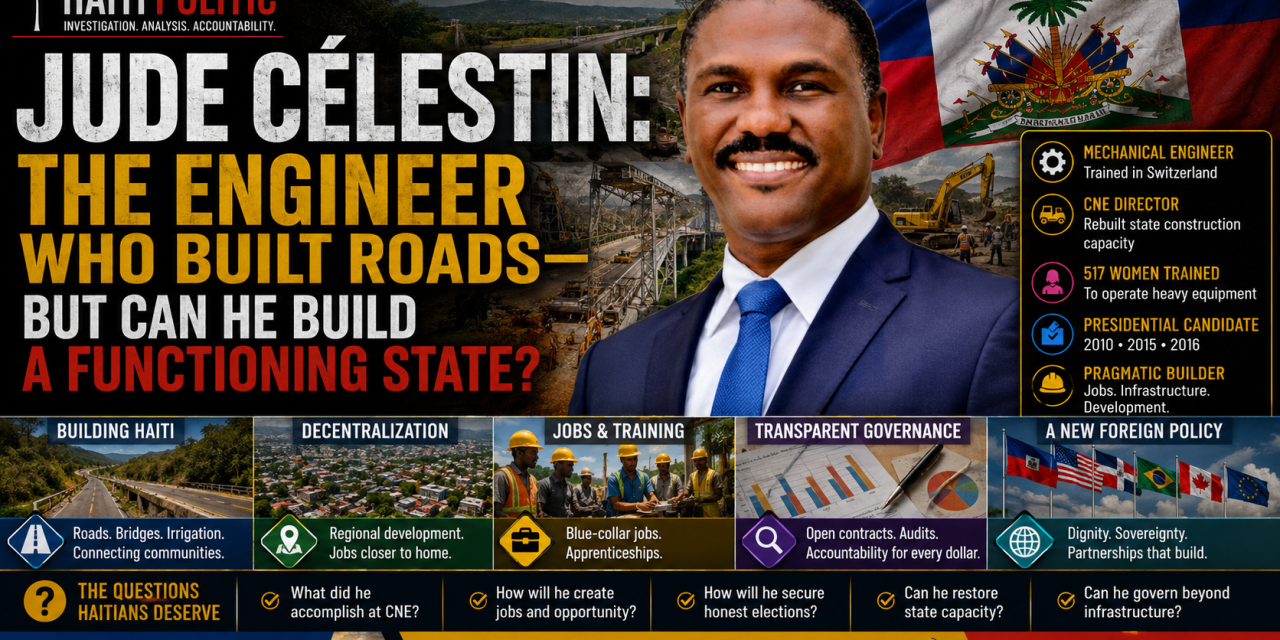
🇭🇹 Mechanical-engineering background. Former industrial manager. Former head of the Centre National des Équipements. Infrastructure adviser. Founder of LAPEH. Three-time presidential contender.
Jude Célestin occupies an unusual place in modern Haitian politics.
He is neither primarily known as a fiery populist nor as a career parliamentarian.
His political identity was built around something more concrete:
MACHINES. ROADS. BRIDGES. EQUIPMENT. INFRASTRUCTURE.
Before presidential politics, Célestin worked in industry and construction and eventually became director general of Haiti’s Centre National des Équipements (CNE), the state institution responsible for heavy public-works capacity. Biographical accounts credit his CNE tenure with restructuring the institution and, notably, training 517 women to operate heavy equipment.
He subsequently became an infrastructure adviser to President René Préval.
Then came national politics—and controversy.
Célestin became Préval’s preferred candidate in the disputed 2010 presidential election.
He returned under LAPEH in 2015.
Official 2015 results placed him second with 25.29%, qualifying him for a runoff against Jovenel Moïse. But the electoral process collapsed amid widespread allegations of irregularities, and that election was eventually annulled.
When Haiti held a new presidential election in November 2016, Célestin again ran. This time he finished second with 19.57%, behind Jovenel Moïse’s 55.60%.
That record presents Haitians with an interesting question.
JUDE CÉLESTIN HAS SPENT HIS CAREER AROUND BUILDING PHYSICAL INFRASTRUCTURE.
But Haiti’s greatest shortage today may be institutional infrastructure.
Can an engineer of roads become an engineer of the state?
This is not an endorsement.
It is not a condemnation.
It is an examination of his experience, record, vulnerabilities and unanswered questions.
Then—
🇭🇹 LET THE HAITIAN PEOPLE DECIDE.
👷🏾 WHO IS JUDE CÉLESTIN?
Célestin was born in Port-au-Prince in 1962.
After schooling in Haiti, he continued his education in Switzerland, where biographical accounts say he pursued mechanical engineering studies in Fribourg and Lausanne. He later completed human-resources-management coursework at INAGHEI and management seminars abroad.
One biographical point deserves precision.
Some profiles routinely describe Célestin simply as a mechanical engineer educated in Switzerland. However, other published accounts dispute whether he completed the Swiss engineering degree attributed to him. Even Wikipedia’s current French biography describes his mechanical-engineering studies as having been undertaken without obtaining the degree.
For a candidate whose political identity relies heavily on being an engineer, Célestin should settle the question himself:
Which institution did you attend?
What program?
What qualification did you receive?
Publish the academic documentation.
This should not be difficult.
🏭 BEFORE POLITICS: INDUSTRIAL MANAGEMENT
Célestin’s professional career reportedly included work at the Minoterie d’Haïti, beginning in 1985.
He held responsibilities involving production and mechanical operations and eventually became plant director.
He also established a mechanical/construction consulting company before moving into government.
That background matters because Haiti desperately needs political leaders who understand that economies do not run only on speeches and government ministries.
They run on:
production;
maintenance;
inventory;
logistics;
electricity;
equipment;
transportation;
workers;
engineering;
deadlines;
and cost control.
Then Célestin moved into the institution that would define his public identity.
THE CNE.
🚜 TEST #1 — WHAT DID JUDE CÉLESTIN ACTUALLY BUILD?
Célestin entered the Préval government in 1998 and eventually became director general of the Centre National des Équipements.
Accounts of his career associate his leadership with restructuring the CNE and expanding its public-works capacity.
This gives Célestin something many presidential candidates cannot claim:
direct operational experience managing heavy state infrastructure.
But political mythology should never substitute for audited performance.
So Haiti Politic would ask:
SHOW US THE CNE SCORECARD.
How many kilometers of roads were built?
How many rehabilitated?
How many bridges?
How many canals?
How much did projects cost per kilometer?
How many pieces of equipment were purchased?
How many remained operational five years later?
How many permanent jobs?
How much work occurred outside Port-au-Prince?
How many projects finished on schedule?
How many exceeded budget?
And what did independent audits conclude?
👷🏾♀️ TEST #2 — THE 517 WOMEN
One particularly interesting accomplishment attributed to Célestin’s CNE leadership deserves more attention.
Biographical accounts say the CNE trained 517 women in operating heavy machinery.
If documented, that is significant.
Heavy construction has traditionally been overwhelmingly male.
Training hundreds of women to operate machinery represents exactly the kind of practical workforce intervention Haitian governments should evaluate.
But again:
How many graduated?
How many obtained jobs?
How many remained in the industry?
What were their salaries?
How many became supervisors?
Could that model be expanded nationally?
A training program becomes transformative when training becomes employment.
🚧 TEST #3 — SHOULD HAITI REBUILD THE CNE?
This may be the most natural centerpiece of a Célestin presidency.
Haiti needs enormous physical reconstruction.
Roads.
Bridges.
Drainage.
Irrigation.
Government buildings.
Schools.
Hospitals.
Ports.
Markets.
Water systems.
But should the Haitian government itself possess a major construction capability?
Or should government primarily contract private firms?
Célestin knows this debate firsthand.
So:
WHAT SHOULD THE CNE BECOME?
🏗️ OPTION A — A POWERFUL STATE BUILDER
Rebuild the CNE with:
excavators;
bulldozers;
graders;
loaders;
cranes;
asphalt plants;
mobile workshops;
surveying technology;
engineering teams;
and regional equipment depots.
Advantages?
Government gains emergency construction capacity.
It can respond to hurricanes.
Clear roads after disasters.
Repair critical infrastructure.
Support municipalities.
Potentially reduce dependence on expensive contractors.
But there is a danger.
A powerful state construction company can become:
a political employment machine;
a source of patronage;
an opaque procurement vehicle;
or unfair competition against legitimate private contractors.
So safeguards matter.
🏢 OPTION B — CONTRACT EVERYTHING
Government could instead concentrate on:
planning;
standards;
procurement;
supervision;
and auditing,
while private contractors perform construction.
That could encourage competition and private investment.
But Haiti has repeatedly experienced another problem:
contracts without sufficient state capacity to supervise them.
A government unable to build anything itself may also struggle to determine whether contractors are overcharging it.
So perhaps the real answer is hybrid.
⚙️ TEST #4 — THE HYBRID CNE
President Célestin:
Would you rebuild the CNE as a strategic national engineering corps?
Let private companies compete for ordinary projects.
But maintain public capacity for:
disaster response;
emergency roads;
strategic bridges;
irrigation;
equipment support for municipalities;
and projects where private bidding fails.
Every CNE project could then publish:
budget;
equipment used;
fuel consumed;
workers employed;
completion percentage;
GPS coordinates;
photographs;
and engineering certification.
THE CNE SHOULD NOT SIMPLY RETURN.
It should return transparent.
🗺️ TEST #5 — HAITI NEEDS A NATIONAL INFRASTRUCTURE MAP
Célestin’s engineering background creates an opportunity.
Instead of announcing isolated projects politically, Haiti could develop a 20-year National Infrastructure Plan.
Map every:
national road;
departmental road;
bridge;
irrigation canal;
port;
airport;
hospital;
university;
electric substation;
water network;
industrial zone;
agricultural production basin;
and border crossing.
Then rank projects according to:
economic return;
population served;
security importance;
agricultural impact;
and disaster resilience.
That changes infrastructure from:
POLITICAL GIFTS
into
NATIONAL PLANNING.
Would Célestin commit to it?
🌾 TEST #6 — BUILD ROADS THAT PRODUCE MONEY
Not every road has equal economic value.
A road connecting two politically important neighborhoods may win votes.
A road connecting an agricultural basin to a market may increase national production for decades.
So Célestin should identify Haiti’s priority economic corridors.
For example:
farm → collection center → processing facility → highway → port.
Infrastructure should connect production.
Not simply pavement.
🚜 THE FARM-TO-MARKET TEST
Imagine an Artibonite farmer can produce more rice.
But:
the irrigation canal fails;
the road floods;
the truck breaks;
storage is unavailable;
electricity fails;
and imported rice reaches Port-au-Prince more cheaply.
The farmer loses.
Agricultural policy therefore requires infrastructure policy.
A Célestin government could integrate:
irrigation + roads + storage + processing + electricity + financing + markets.
That is where an engineering presidency could become economically interesting.
🏙️ TEST #7 — DECENTRALIZATION THROUGH INFRASTRUCTURE
Haiti cannot continue forcing everything toward Port-au-Prince.
Government.
Universities.
Hospitals.
Jobs.
Commerce.
Ports.
Administrative services.
The concentration has become economically and environmentally dangerous.
Célestin’s 2015 program emphasized employment, agriculture, human-capital development, institutional reform and reconstruction. Contemporary summaries also attributed to him a commitment to a new foreign policy.
But decentralization requires infrastructure.
So:
Which five regional growth poles would Célestin build first?
Cap-Haïtien?
Gonaïves?
Les Cayes?
Jacmel?
Hinche?
Port-de-Paix?
Which gets:
industrial parks?
universities?
hospitals?
regional government offices?
logistics centers?
airports?
digital infrastructure?
Give voters the map.
💼 TEST #8 — BLUE-COLLAR HAITI
One potential strength of Célestin’s political philosophy is that infrastructure can create employment for people who do not possess university degrees.
Haiti needs:
welders;
electricians;
plumbers;
masons;
machine operators;
surveyors;
mechanics;
carpenters;
solar technicians;
drivers;
construction supervisors;
and maintenance specialists.
A serious infrastructure program could create a national apprenticeship system.
Government pays contractors only if a percentage of workers are Haitian trainees.
Workers receive recognized credentials.
Projects become schools.
DON’T JUST BUILD THE BRIDGE.
BUILD THE WORKFORCE THAT CAN BUILD THE NEXT 100 BRIDGES.
💰 TEST #9 — WHO PAYS FOR ALL THIS?
This is where infrastructure politicians frequently become vague.
Roads are expensive.
Ports are expensive.
Electric grids are expensive.
Water systems are expensive.
So Célestin must answer:
Taxes?
Diaspora bonds?
Development banks?
Public-private partnerships?
Concessions?
World Bank?
IDB?
Caribbean Development Bank?
Private infrastructure funds?
Sovereign bonds?
Foreign governments?
Which projects generate revenue?
Which require subsidies?
How much debt can Haiti safely carry?
Engineering without financing is architecture on paper.
💵 TEST #10 — THE INFRASTRUCTURE FUND
A Célestin administration could propose a Haitian National Infrastructure Fund.
Potential funding streams:
fuel taxes;
airport fees;
port revenue;
telecommunications spectrum auctions;
diaspora bonds;
mining royalties where applicable;
development-finance institutions;
and private pension/institutional capital.
But one condition should be absolute:
POLITICIANS CANNOT SECRETLY SELECT CONTRACTORS.
Every project should disclose:
the feasibility study;
competitive bids;
beneficial owners;
final contract;
change orders;
payments;
completion milestones;
and independent audits.
🧾 TEST #11 — CAN AN ENGINEER FIGHT CONSTRUCTION CORRUPTION?
Infrastructure is one of the easiest places to hide corruption.
Why?
Because ordinary citizens do not know whether a road should cost:
$5 million
or
$15 million.
Contract amendments can multiply.
Quantities can change.
Materials can be downgraded.
Projects can remain unfinished.
So Célestin should propose an Open Infrastructure Standard.
Every citizen with a phone should be able to see:
PROJECT COST: $27.4 MILLION
CONTRACTOR: X
BENEFICIAL OWNER: Y
COMPLETION: 62%
MONEY PAID: 58%
ORIGINAL DEADLINE: X
CURRENT DEADLINE: Y
That would make infrastructure politically revolutionary.
🗳️ THEN WE ARRIVE AT THE MOST IMPORTANT POLITICAL PART OF CÉLESTIN’S CAREER
ELECTIONS.
Jude Célestin has experienced not one—but multiple—controversial presidential contests.
That history cannot be separated from any future argument that he represents democratic institutional reform.
🗳️ TEST #12 — THE 2010 ELECTION
Célestin entered the 2010 presidential race as the candidate associated with President René Préval’s INITE political platform.
The election occurred under extraordinary conditions following the catastrophic January 2010 earthquake and amid a cholera epidemic.
The OAS-CARICOM observation mission described the environment as extraordinarily difficult, noting Haiti’s already weak institutional capacity had been further devastated.
The initial results placed Célestin in the runoff.
But after intense controversy and an OAS technical review, the process ultimately proceeded without him.
That experience permanently linked Célestin to one of Haiti’s most contentious electoral episodes.
❓ TEST #13 — PRESIDENT CÉLESTIN, WHAT HAPPENED IN 2010?
Haitians deserve his complete account.
Did the electoral authorities manipulate results?
Was he unfairly removed?
Did international pressure override Haitian sovereignty?
What evidence does he possess?
What did René Préval tell him?
What did foreign diplomats tell him?
What institutional reforms should have followed?
Would he support publishing every relevant electoral archive still available?
Haiti cannot learn from disputed elections if political leaders only preserve the version that benefits them.
🗳️ THEN CAME 2015.
The official final results gave:
Jovenel Moïse — 32.76%
Jude Célestin — 25.29%.
That meant a runoff.
But Célestin and other opposition figures disputed the credibility of the election.
The runoff was repeatedly postponed.
The process eventually collapsed.
The 2015 presidential election was annulled and Haiti started again.
This created another extraordinary chapter in Célestin’s career.
He qualified for a presidential runoff—
and effectively refused to legitimize a process he considered compromised.
Supporters call that democratic courage.
Critics can ask whether prolonged electoral confrontation deepened instability.
Both questions deserve examination.
⚖️ TEST #14 — WHEN SHOULD A CANDIDATE REJECT AN ELECTION?
This question matters far beyond Jude Célestin.
Imagine Célestin becomes president.
His opponents lose an election and declare:
“Fraud. We reject the results.”
What standard would President Célestin use?
A statistical audit?
A recount?
A sample verification?
Court review?
International observation?
A threshold of irregularities?
At what point must a losing candidate accept defeat?
Democracy cannot survive if every loser automatically declares fraud.
But democracy also cannot survive if candidates are required to accept fraudulent results.
So Haiti needs objective standards.
Célestin is uniquely positioned to propose them.
🗳️ TEST #15 — 2016 GAVE HIM ANOTHER RESULT
Haiti reran the presidential contest on November 20, 2016.
The final result was decisive:
Jovenel Moïse — 55.60%
Jude Célestin — 19.57%
Jean-Charles Moïse — 11.04%
Maryse Narcisse — 9.01%.
The OAS reported that a verification of 12% of returns, ordered following challenges, did not identify irregularities capable of affecting the outcome.
That gives Célestin another question to answer:
WHAT DID YOU LEARN FROM LOSING?
Not what did Jovenel do.
Not what did foreign diplomats do.
Not what did the CEP do.
What did LAPEH do wrong?
📉 TEST #16 — WHY DID CÉLESTIN FALL FROM 25.29% TO 19.57%?
Was turnout the problem?
Campaign organization?
Political alliances?
Messaging?
Funding?
Voter fatigue?
Regional weakness?
The electorate’s desire for a first-round conclusion?
A leader capable of governing should be capable of evaluating his own failures.
That is managerial accountability.
🏛️ TEST #17 — WHAT EXACTLY IS LAPEH TODAY?
Célestin eventually built his own political vehicle:
Ligue Alternative pour le Progrès et l’Émancipation Haïtienne — LAPEH.
But Haiti’s chronic political problem is that parties frequently function as electoral vehicles for individuals rather than durable institutions.
So:
How many registered members?
How many departmental offices?
How are leaders elected?
How are candidates selected?
Who finances LAPEH?
Are accounts audited?
Does it publish donors?
Does it have a youth organization?
Women’s organization?
Municipal chapters?
Policy institute?
Can LAPEH survive politically without Jude Célestin?
HAITI NEEDS PARTIES—NOT PRESIDENTIAL LOGOS.
👴🏾 TEST #18 — THE RENÉ PRÉVAL LEGACY
Célestin cannot be understood without René Préval.
Préval remains one of the defining figures in his political ascent.
That association gives Célestin both an advantage and a vulnerability.
The advantage:
experience near the center of government.
The vulnerability:
being perceived as a product of established political networks rather than a genuine alternative.
So Célestin should answer:
What did Préval teach him?
What did Préval get right?
What did Préval get wrong?
Which elements of Prévalism should Haiti preserve?
Which should be abandoned?
EXPERIENCE BECOMES VALUABLE ONLY WHEN A POLITICIAN CAN CRITICALLY EXAMINE THE SYSTEM THAT PRODUCED HIM.
🔫 TEST #19 — ROADS DON’T MATTER IF GANGS CONTROL THEM
Now comes the modern reality.
The Haiti Célestin sought to govern in 2010 and 2016 is not the Haiti a president would inherit today.
Infrastructure itself has become a security issue.
A beautiful highway means little if:
gangs establish checkpoints;
truckers are kidnapped;
fuel shipments are hijacked;
construction crews cannot work;
equipment is stolen;
and contractors must pay armed groups.
So:
WHAT IS THE CÉLESTIN SECURITY DOCTRINE?
🚔 ENGINEER SECURITY LIKE INFRASTRUCTURE
An engineering mindset could actually help.
Treat security as a system.
Map:
gang-controlled corridors;
weapons-entry points;
police stations;
communications gaps;
ports;
border crossings;
fuel terminals;
critical roads;
electric substations;
hospitals;
and prisons.
Then sequence operations.
But policing is not mechanical engineering.
It requires:
intelligence;
constitutional authority;
community legitimacy;
prosecutors;
courts;
prisons;
financial investigations;
and human-rights safeguards.
Célestin must show that he understands the difference.
💰 TEST #20 — INFRASTRUCTURE AND GANG FINANCING
Major public-works projects generate money.
Gang-controlled territories create extortion risks.
So every infrastructure contract should require disclosure of:
security payments;
subcontractors;
beneficial owners;
transport expenses;
and unusual cash transactions.
Would Célestin cancel a project if evidence showed contractors were paying gangs?
Would the state provide security instead?
Would executives who knowingly finance armed groups be prosecuted?
Infrastructure reconstruction cannot accidentally become gang financing through public contracts.
🌎 NOW FOREIGN POLICY
Célestin’s 2015 program was described as including “a new foreign policy.”
That phrase is intriguing.
But it is insufficient.
Haiti has heard “new foreign policy” before.
What exactly would make Célestin’s different?
His strongest possible answer may come from his engineering mentality:
FOREIGN POLICY SHOULD BUILD THINGS.
Not simply relationships.
🌉 TEST #21 — INFRASTRUCTURE DIPLOMACY
Imagine Haitian diplomacy organized around specific national projects.
Haiti tells partners:
Japan: vocational training and resilient infrastructure.
Brazil: agriculture and construction.
India: pharmaceuticals and digital systems.
Taiwan or China, depending Haiti’s diplomatic choice: infrastructure and technology.
United States: security, trade and energy.
Canada: education, security and diaspora investment.
France/EU: infrastructure financing and technical education.
CARICOM: regional logistics and disaster resilience.
The important principle:
HAITI DEFINES THE PROJECT FIRST.
Then seeks the partner.
Not the reverse.
🇺🇸 TEST #22 — WASHINGTON WITHOUT DEPENDENCY
The United States will remain central to Haitian foreign policy.
Migration.
Trade.
Security.
Banking.
Diaspora.
Weapons trafficking.
Development assistance.
But Célestin should reject both extremes:
automatic obedience
and
performative hostility.
A Haitian government should say:
Here are our interests.
Here are yours.
Where they overlap, cooperate.
Where they differ, negotiate.
That is diplomacy.
🇩🇴 TEST #23 — ENGINEER THE BORDER
Few issues better fit Célestin’s background than Haiti’s physical border with the Dominican Republic.
A modern border requires:
roads;
legal crossing points;
customs facilities;
cargo scanners;
markets;
inspection stations;
immigration facilities;
digital manifests;
truck staging;
water management;
and surveillance.
So President Célestin:
What would a five-year Haiti–Dominican Border Infrastructure Plan look like?
Which crossings receive modernization first?
How much would it cost?
Who finances it?
Could both countries operate interoperable customs systems while preserving sovereignty?
💧 TEST #24 — WATER DIPLOMACY
The Haitian-Dominican relationship also includes shared rivers and watersheds.
Engineers understand something politicians sometimes ignore:
water does not recognize borders.
Haiti needs technical diplomacy involving:
hydrology;
irrigation;
watersheds;
flood control;
drought planning;
and agricultural demand.
Could Célestin push bilateral disputes away from nationalist shouting and toward transparent engineering data?
That would be a useful test of his governing style.
🌎 TEST #25 — CARIBBEAN INFRASTRUCTURE
Haiti should also ask whether it can become better integrated into Caribbean infrastructure.
Regional shipping.
Ferries.
Energy.
Telecommunications.
Disaster response.
Air transport.
Digital payments.
Ports.
Could Haiti eventually become a logistics bridge between the Caribbean, North America and northern South America?
Geography is an asset.
But geography without infrastructure is simply a map.
💵 TEST #26 — DIASPORA INFRASTRUCTURE BONDS
The diaspora could become one of the strongest financing partners for a Célestin infrastructure agenda.
But not through emotional appeals.
Offer an investment product.
Example:
HAITI INFRASTRUCTURE BOND
Project: Cap-Haïtien logistics corridor.
Amount: $150 million.
Independent trustee.
Quarterly reporting.
External audit.
Project account protected from general government spending.
Diaspora investors purchase bonds.
Revenue services debt.
Could it work?
Potentially.
But only if Haiti solves the hardest engineering problem of all:
TRUST.
🧠 TEST #27 — MAINTENANCE
Politicians love inaugurations.
Maintenance produces fewer television cameras.
Yet Haiti’s infrastructure problem is not only that the country fails to build enough.
It also fails to maintain what it builds.
So Célestin should establish a rule:
NO NEW INFRASTRUCTURE PROJECT WITHOUT A FUNDED MAINTENANCE PLAN.
Every road needs resurfacing.
Every bridge needs inspection.
Every machine needs parts.
Every canal needs cleaning.
Every building needs repairs.
Infrastructure without maintenance is delayed demolition.
An engineer should know this better than anyone.
📊 THE JUDE CÉLESTIN TEST
| AREA | EXPERIENCE / POTENTIAL ASSET | QUESTION HAITIANS SHOULD ASK |
|---|---|---|
| Engineering | Mechanical-engineering studies and industrial-management background | Will he publish documentation resolving questions about his academic qualification? |
| CNE | Former director general of Haiti’s state heavy-equipment agency | What were the independently verifiable costs and outcomes? |
| Women in Trades | Credited with training 517 women on heavy machinery | How many translated training into lasting careers? |
| Infrastructure | Extensive state public-works experience | Can CNE be rebuilt without becoming a patronage machine? |
| 2010 Election | Major presidential contender | What did the disputed process teach him about sovereignty and electoral legitimacy? |
| 2015 Election | Officially finished second at 25.29% | When is rejecting a flawed election democratically justified? |
| 2016 Election | Finished second with 19.57% | What did he learn from a decisive electoral defeat? |
| LAPEH | Built an independent national political vehicle | Is it a durable institution or primarily a Célestin organization? |
| Employment | Infrastructure could generate large-scale skilled and blue-collar work | Where is the financing and apprenticeship architecture? |
| Agriculture | Infrastructure-centered development could connect farms to markets | Which corridors receive priority? |
| Security | Engineering/logistics mindset could support strategic planning | Can he translate technical management into legitimate security governance? |
| Foreign Policy | Earlier program called for a new foreign policy | What specifically would change? |
⚖️ THE CASE HIS SUPPORTERS CAN MAKE
Célestin’s supporters have a credible argument.
Haiti has had enough politicians who know how to make speeches but cannot manage equipment, projects, workers or deadlines.
Célestin has substantial experience in industrial management and state infrastructure.
He managed the CNE.
He served as an infrastructure adviser.
His political program emphasized employment, agriculture and institutional development.
He reached the top two in the official 2015 presidential results.
And instead of accepting an electoral process he considered illegitimate simply because it gave him a place in the runoff, he participated in opposition to that process.
Supporters can therefore argue:
HAITI DOESN’T NEED ANOTHER PHILOSOPHER OF DEVELOPMENT. IT NEEDS SOMEBODY WHO KNOWS HOW TO BUILD.
That argument deserves consideration.
🚨 THE CASE HIS CRITICS CAN MAKE
Critics have substantial questions too.
Célestin emerged nationally through the political network surrounding René Préval.
His 2010 candidacy became entangled in one of Haiti’s most controversial elections.
His infrastructure reputation requires more independent, project-by-project evidence than campaign biographies provide.
His 2015 electoral confrontation may be viewed by supporters as principled resistance—but critics can ask about the institutional and economic costs of prolonged political deadlock.
And in the ultimately completed 2016 election, he lost decisively: 19.57% to Jovenel Moïse’s 55.60%.
Critics can therefore ask:
IS JUDE CÉLESTIN A TECHNOCRATIC ALTERNATIVE TO HAITI’S POLITICAL SYSTEM—OR ONE OF THE MOST EXPERIENCED PRODUCTS OF THAT SYSTEM?
That question also deserves consideration.
🔥 30 QUESTIONS JUDE CÉLESTIN SHOULD ANSWER
1. What exact engineering qualification did you obtain in Switzerland?
2. Will you publish the academic documentation?
3. What are the five greatest measurable accomplishments of your CNE tenure?
4. How many kilometers of roads were constructed or rehabilitated under your leadership?
5. What did they cost?
6. How many CNE machines remained operational after you left?
7. What happened to the 517 women reportedly trained to operate heavy equipment?
8. Should Haiti rebuild the CNE?
9. What work should CNE perform that private companies should not?
10. How would you prevent CNE from becoming a political patronage machine?
11. What are Haiti’s five highest-priority infrastructure corridors?
12. What would they cost?
13. How would you finance them?
14. Would every infrastructure contract and beneficial owner be publicly searchable?
15. Would every project require a funded maintenance plan?
16. What happened in the 2010 election from your perspective?
17. Did international pressure improperly influence your removal from the runoff?
18. Why did you reject the credibility of the 2015 electoral process?
19. What objective standard should determine when an election must be annulled?
20. What did LAPEH learn from your 2016 defeat?
21. Will LAPEH publish audited finances and major donors?
22. Can LAPEH survive politically without you?
23. What did René Préval get right?
24. What did René Préval get wrong?
25. What is your five-year security strategy?
26. How would infrastructure projects operate safely in territories threatened by armed groups?
27. What is your Haiti–Dominican border infrastructure plan?
28. What does the “new foreign policy” associated with your earlier program actually mean today?
29. How would you mobilize diaspora capital for infrastructure while protecting investors from corruption and political instability?
And finally:
30. YOU HAVE SPENT DECADES BUILDING OR PROMISING PHYSICAL INFRASTRUCTURE. WHAT MAKES YOU QUALIFIED TO REBUILD HAITI’S POLITICAL INSTITUTIONS?
🇭🇹 THE CENTRAL QUESTION
Jude Célestin offers Haiti a political proposition very different from the revolutionary rhetoric of Jean-Charles Moïse, the business-technocratic profile of Mathias Pierre, or the legal institutionalism of Jean-Henry Céant.
His potential argument is simpler:
BUILD THE COUNTRY.
Build roads.
Build bridges.
Build irrigation.
Build ports.
Build regional cities.
Build vocational schools.
Build productive corridors.
Create jobs through construction.
Connect farmers to markets.
Restore the state’s ability to execute projects.
There is considerable logic in that agenda.
But Haiti has already learned a painful lesson:
YOU CAN BUILD A ROAD THROUGH A BROKEN STATE.
Eventually the broken state destroys the road.
Without security, gangs control it.
Without maintenance, it deteriorates.
Without courts, contracts become meaningless.
Without transparent procurement, costs explode.
Without municipal government, drainage fails.
Without economic production, traffic carries imported goods rather than Haitian exports.
Without political legitimacy, infrastructure becomes another source of conflict.
So Célestin’s challenge is larger than construction.
He must prove he can engineer institutions.
Don’t simply show Haitians photographs of roads.
Show the audited cost.
Don’t simply promise bridges.
Show the financing.
Don’t simply promise jobs.
Show the apprenticeship system.
Don’t simply say the 2015 election was flawed.
Define the electoral safeguards that would apply even when you lose.
Don’t simply promise a “new foreign policy.”
Tell Haiti what changes with Washington, Santo Domingo, CARICOM, Africa and the diaspora.
And don’t simply ask Haitians to trust the engineer.
SHOW THEM THE BLUEPRINT.
Pa sèlman mande konbyen wout Jude Célestin ka konstwi.
Mande si li ka konstwi enstitisyon ki pral pwoteje wout sa yo.
Pa sèlman mande si li se yon enjenyè.
Mande pou plan an, bidjè a, delè a ak rezilta yo.
Pa sèlman mande si li ka bati Ayiti.
Mande si li ka bati yon Leta ki kapab kontinye bati apre li fin kite pouvwa.
Then—
🇭🇹 LET THE HAITIAN PEOPLE DECIDE.
HAITI POLITIC — Investigation. Accountability. Debate.