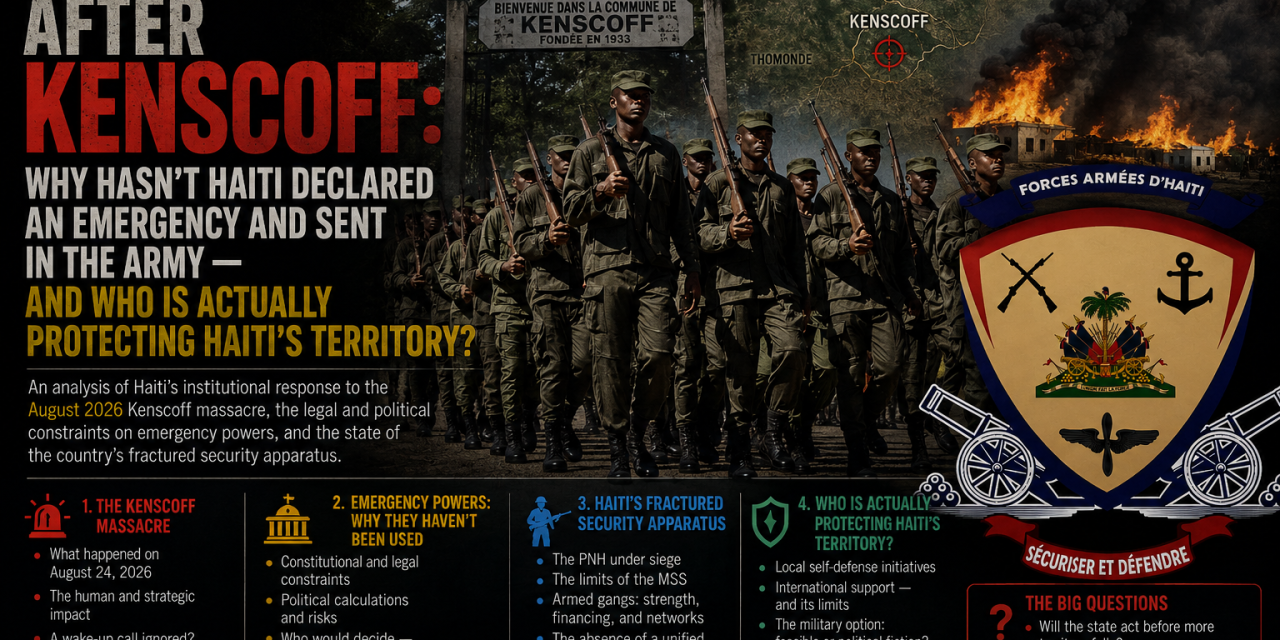
An analysis of Haiti’s institutional response to the August 2026 Kenscoff massacre, the legal and political constraints on emergency powers, and the state of the country’s fractured security apparatus
The Government’s Actual Response
In the hours after Viv Ansanm fighters overran the center of Kenscoff on the night of August 23–24, 2026, Haiti’s government issued a statement condemning what it called a heinous criminal attack, saying reinforcements were being deployed and that “Kenscoff will not be abandoned.” It said security forces had been ordered to pursue those responsible and asked the population to remain confident. Haiti’s Office of Citizen Protection separately issued its own statement decrying the massacre, describing dozens killed, including “numerous” young Haitians.
What that response did not include is worth naming directly: no declaration of a renewed national or local state of emergency specific to Kenscoff, and no announcement of an expanded domestic policing role for the Forces Armées d’Haïti (FAd’H), Haiti’s small national army. On the ground, per Kenscoff residents and reporting, it was the Haitian National Police (HNP) that responded and pushed gang members back out of the town center — not a joint police-military operation, and not an emergency mobilization beyond routine reinforcement.
That absence is not really the anomaly it might first appear to be. Haiti has already been operating under a state of emergency around Port-au-Prince since March 2024, repeatedly extended amid what the UN described at the time as Haiti’s healthcare system nearing collapse. In that sense, Kenscoff didn’t need a new emergency declaration — the country has effectively been governing under one, in some form, for over two years. The more precise question is why that standing emergency status hasn’t translated into the kind of extraordinary domestic military deployment the scale of the Kenscoff massacre might seem to warrant.
Why Not the Army: Three Structural Constraints
1. The FAd’H physically cannot do what a “send in the army” response would require. Haiti’s reconstituted army was only reestablished in 2017, after being fully disbanded in 1995 to prevent further military interference in civilian politics — itself a legacy of the coup-prone decades this publication has covered elsewhere. As of late 2025, the FAd’H numbered roughly 1,500 active personnel, with a government goal of expanding to 6,000 in the short term and 20,000 over four years — targets that remain aspirational, not current capacity. Multiple defense assessments describe the force bluntly: it lacks the equipment, personnel depth, logistics, and command structure for sustained combat operations, and its actual activity has centered on engineering, road clearing, infrastructure repair, border support near the Dominican Republic, and disaster response — not urban counter-gang combat. Deploying a force this small and this undertrained into an active gang-controlled combat zone would not meaningfully change the military balance on the ground, and risks losing the institution’s fragile rebuilding progress in a single badly executed engagement.
2. Political authority to order that kind of expansion is itself unsettled. The nine-seat Transitional Presidential Council that had governed Haiti since 2024 saw its mandate expire on February 7, 2026, with executive power passing to a Cabinet of Ministers led by Prime Minister Alix Didier Fils-Aimé. That transition was described by international observers as orderly, but it left Haiti governed by an interim administration with a limited, contested mandate — not the kind of clearly legitimated authority that typically makes dramatic, rights-affecting emergency measures (like expanded military policing powers) politically survivable. Adding to that fragility: Freedom House’s 2026 country assessment noted that Fils-Aimé himself, along with at least one former transitional council member, faced allegations during the year of colluding with criminal groups or interfering with law enforcement operations against them — allegations that, true or not, make any government-directed expansion of military authority a harder sell to a public already deeply skeptical of security-force integrity. Security forces have also reportedly used gunfire and tear gas against protesters and been linked to extrajudicial killings, further complicating public trust in expanding their domestic powers.
3. The international security response has already been restructured around the police, not the military. Rather than empower Haiti’s own army for expanded domestic policing, the international community’s actual strategy has moved toward reinforcing and replacing the multinational police mission. In September 2025, the UN Security Council adopted Resolution 2793, converting the Kenyan-led Multinational Security Support mission into a larger “Gang Suppression Force” (GSF) with expanded authority to combat and arrest gang members — a force expected to include military troops working alongside the HNP and, to a lesser extent, the FAd’H, but under a UN-backed multinational command structure rather than as an expansion of Haitian military domestic policing authority. Deployment was not expected to begin arriving until April 2026, with full deployment targeted for October — meaning that as of the August Kenscoff massacre, the reinforcement Haiti’s government said was “being deployed” was working within an already-strained, still-incompletely-staffed multinational framework, not a newly declared Haitian martial-law footing.
Who Is Actually Protecting Haiti’s Territory?
This is the harder and more consequential question, and the honest answer is: no single actor is, uniformly, across the country.
- The Haitian National Police (HNP) remains, on paper, the country’s central security institution, with approximately 10,000 active officers — but it is stretched across a country where gangs control an estimated 70 to 85 percent of Port-au-Prince alone, plus expanding rural territory. It was the HNP, not the FAd’H or any multinational force, that actually pushed gangs back out of central Kenscoff after the August attack — but as Kenscoff’s own mayor has said, the recurring failure isn’t the initial police response, it’s the absence of “consolidation”: a sustained presence that holds territory once retaken, rather than a force that clears an area and then withdraws, allowing gangs to return.
- The FAd’H provides limited support functions — engineering, logistics, perimeter security, border operations, and intelligence-sharing based on local terrain knowledge — but by design and by capacity, it is not currently structured or resourced to be a primary combat or domestic policing force, despite renewed U.S. non-lethal assistance (roughly $5 million announced for 2026, the first such support since the 1990s) aimed at gradual capacity-building.
- The UN-backed Gang Suppression Force, still mid-deployment as of the Kenscoff massacre, is intended to eventually provide the kind of sustained, better-resourced military-police hybrid presence that could address the consolidation problem — but its late 2026 timeline means it was not yet operationally positioned to prevent or immediately respond to the Kenscoff attack.
- Private military contractors, reportedly hired separately by the Haitian government according to Freedom House’s 2026 reporting, represent a fourth, less transparent thread in the security picture — one that raises its own accountability questions given Haiti’s history of irregular armed actors operating alongside, rather than fully under, formal state command.
- Viv Ansanm itself, by simple territorial fact, exercises more consistent day-to-day control over a larger share of Haiti’s populated territory — especially in Port-au-Prince and now expanding into Kenscoff and the approaches to Pétion-Ville — than any of the state or international forces combined. That is the blunt, uncomfortable answer to “who is actually protecting Haiti’s territory” in much of the country: functionally, no one is, in the sense of a monopoly on legitimate force that a stable state requires. Multiple actors hold overlapping, partial, and often temporary control, and it is that vacuum — not a single missing decree or a single missing deployment — that the Kenscoff massacre most starkly exposed.
The Bottom Line
Haiti’s government did not fail to call a new state of emergency after Kenscoff so much as it was already operating inside one it has not been able to translate into durable territorial control anywhere close to the scale required. Expanding the army’s domestic policing role is not simply a decision the government has declined to make — it runs into hard limits of institutional capacity, unresolved questions of political legitimacy, and a security strategy that international partners have deliberately routed through police-centered, multinational channels rather than a unilateral Haitian military expansion. The result, as Kenscoff residents experienced directly, is a security landscape defined less by any single force’s failure and more by the absence of any force capable of holding ground once it’s retaken — the same consolidation gap that has defined nearly every phase of Haiti’s gang crisis since 2021.