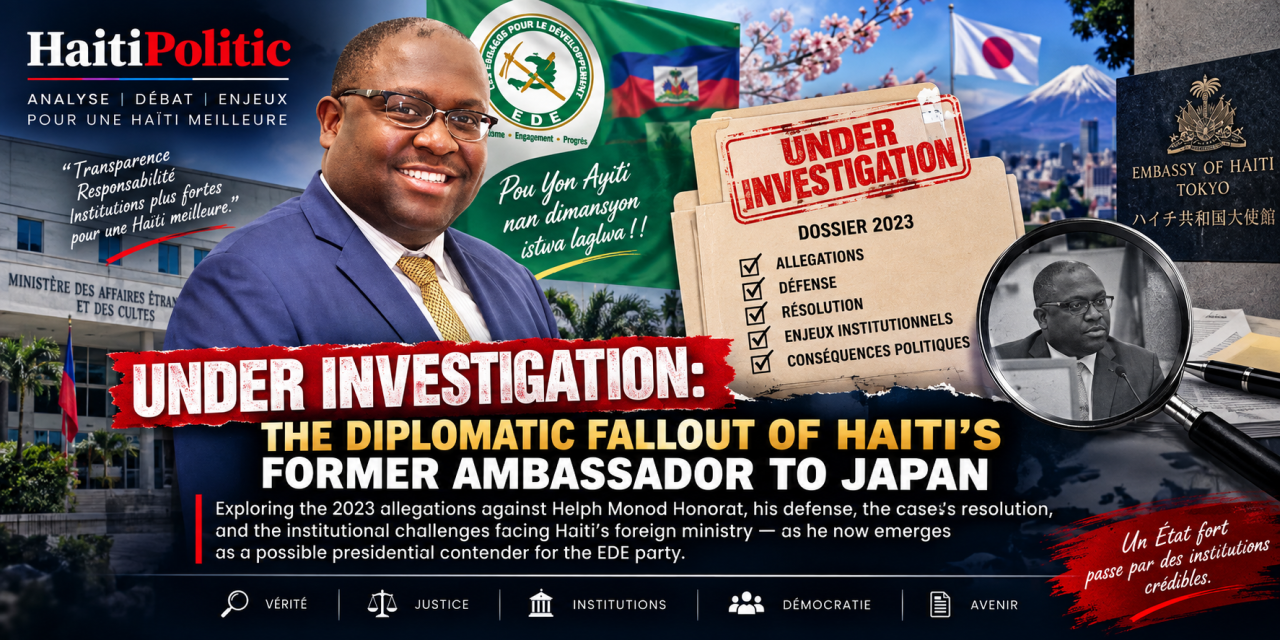
Exploring the 2023 allegations against Helph Monod Honorat, his defense, the case’s resolution, and the institutional challenges facing Haiti’s foreign ministry — as he now emerges as a possible presidential contender for the EDE party.
From Kobe to Tokyo: A Diplomat’s Rise
Helph Monod Honorat built his early public profile through academic and diplomatic ties to Japan, where he studied at Kobe University before being named Haiti’s Ambassador Extraordinary and Plenipotentiary to Japan in October 2020, under the administration of President Jovenel Moïse. Notably, Honorat took up the post as what Haitian outlets described at the time as an ambassador “de facto” — appointed without the Senate ratification the constitution formally requires, a procedural gap that was common practice during a period when Haiti’s Senate had largely ceased to function after most senators’ terms expired without new elections.
For roughly two and a half years, Honorat represented Haiti in Tokyo largely without major public controversy. That changed abruptly in 2023.
The Core Allegations
According to Le Nouvelliste’s original reporting, published May 4, 2023, Honorat had left Japan several days earlier without informing the embassy hierarchy, at a moment when he was already the subject of a Japanese police investigation into an allegation of sexual assault against a Japanese national — a complaint that, according to subsequent reporting, had been filed the previous year, on September 12, 2022, at the Akasaka police station in Tokyo, describing an alleged incident at a Tokyo hotel. The abrupt departure, which Le Nouvelliste reported put Haiti’s Chancellery “in a delicate situation,” reportedly took Honorat first to North America; separate Haitian reporting placed him in Canada in the days following the story’s publication.
The case escalated in profile because of the diplomatic mechanics involved: Japanese authorities, with INTERPOL’s involvement, coordinated directly with Haiti’s Direction Centrale de la Police Judiciaire (DCPJ), which sent investigators to Japan in March 2023 to participate in Honorat’s questioning — an unusually direct instance of Haitian and Japanese law enforcement cooperating on a case involving a sitting diplomat, whose position ordinarily carries some degree of jurisdictional immunity that can complicate a host country’s ability to pursue criminal proceedings directly.
The Defense — and the Case’s Actual Resolution
Honorat’s public response was immediate and consistent. Speaking to Radio Télé Métronome shortly after the story broke, he confirmed that a Japanese woman had filed a complaint against him but firmly denied the underlying allegation, saying he was awaiting the conclusion of the Japanese police investigation into the matter.
In formal reply letters subsequently published by Le Nouvelliste under the header “Précisions de l’ex-ambassadeur Helph Monod Honorat,” Honorat pushed back specifically on the characterization that he had embarrassed the Chancellery. He stated he held deep respect for the institutions of the Republic, that he had not been aware of any clause requiring him to inform the embassy before traveling, and that when the Ministry of Foreign Affairs did contact him, he confirmed his travel and, according to his account, fully intended to cooperate and return.
What neither the user-provided outline nor most casual retellings of this story capture, and what any fair account owes readers, is how the matter was actually resolved: according to Rezo Nòdwès reporting from May 24, 2023, Japanese prosecutors in Tokyo formally closed the case against Honorat — “classé sans suite” — citing a lack of solid evidence. That decision followed formal interviews conducted on March 22 and 23, 2023, involving DCPJ and INTERPOL investigators, which reportedly revealed significant discrepancies between the diplomat’s account and the complainant’s. Haitian authorities nonetheless recalled Honorat from his post before the investigation’s conclusion, ending his diplomatic mission — a decision that reflected political and reputational caution by the Chancellery independent of the eventual prosecutorial outcome. No criminal charges were ultimately filed against Honorat in connection with the allegation.
This resolution matters enormously for how the case should be read today. It does not erase that a serious allegation was made and formally investigated by two countries’ law enforcement agencies. But it also means that, as a matter of legal record, Honorat was investigated and the matter closed for insufficient evidence, not prosecuted, convicted, or formally found to have committed any offense.
Systemic Context: A Chancellery Under Strain
Honorat’s case did not unfold in isolation. The same month his story broke, Haiti’s diplomatic corps was absorbing an entirely separate scandal: Ambassador Bocchit Edmond, Haiti’s top diplomat in Washington, was fired in May 2023 after joint U.S. and Haitian government investigations uncovered a passport kickback scheme at the Washington embassy, in which staff allegedly demanded exorbitant bribes from Haitians abroad seeking expedited passport issuance. Reporting at the time noted that only three of roughly twelve employees in the embassy’s passport unit were properly accredited with the U.S. State Department, and Haitian commentary connected the episode to a longer, documented history of financial irregularities in passport-fee handling across multiple Haitian missions, including earlier allegations involving diplomatic staff in the Claude Joseph-era foreign ministry.
Taken together, the Honorat and Edmond cases — a sexual assault investigation involving a sitting ambassador and a bribery scheme inside the flagship Washington embassy, breaking within days of each other — painted a picture of a foreign ministry with limited real-time oversight of its overseas missions, reliant on ad hoc crisis response (public recalls, firings, and reactive statements) rather than institutional safeguards capable of catching problems before they became international news.
Immunity, Accountability, and What Remains Unresolved
Honorat’s case also illustrates a structural tension in diplomatic law that extends well beyond Haiti: diplomatic immunity is designed to protect the functioning of international relations, not to shield diplomats from accountability, but in practice it can meaningfully slow a host country’s ability to pursue a criminal matter through its own courts, pushing resolution instead toward political recall, informal cooperation between law enforcement agencies, or — as happened here — a prosecutorial decision to close the file for lack of sufficient evidence rather than a public trial that might have settled the underlying factual dispute more definitively.
That ambiguity is likely to follow Honorat into whatever comes next. The matter was never resolved by a court weighing evidence in open proceedings; it ended in a prosecutorial declination, which leaves both his denial and the original complaint technically unadjudicated in the fullest sense, even though no charges were filed.
Let the Haitian People Decide
Honorat now appears positioned as a possible presidential candidate, with Les Engagés pour le Développement (EDE) signaling that its National Political Bureau will soon announce its chosen standard-bearer, alongside campaign material already circulating under Honorat’s name and ambassadorial title. Whether Haitian voters view a closed, no-charges investigation as a resolved matter of the past, or as a lingering credibility question deserving further public explanation from Honorat before he asks for the country’s highest office, is not a question this article can answer for them. What voters are entitled to going into that judgment is the complete record: a serious allegation was made and investigated by two nations’ law enforcement, Honorat consistently and publicly denied it, and Japanese prosecutors ultimately closed the case without filing charges, citing insufficient evidence. Haitians weighing his candidacy deserve all three of those facts together, not any one of them in isolation.
This article is based on contemporaneous reporting from Le Nouvelliste, Rezo Nòdwès, Radio Télé Métronome, and the Washington Diplomat, covering events from February through May 2023, along with Les Engagés pour le Développement’s September 2026 public statements regarding its presidential candidacy. Helph Monod Honorat has consistently denied the allegation described in this article, and Japanese prosecutors closed the underlying case without filing charges.