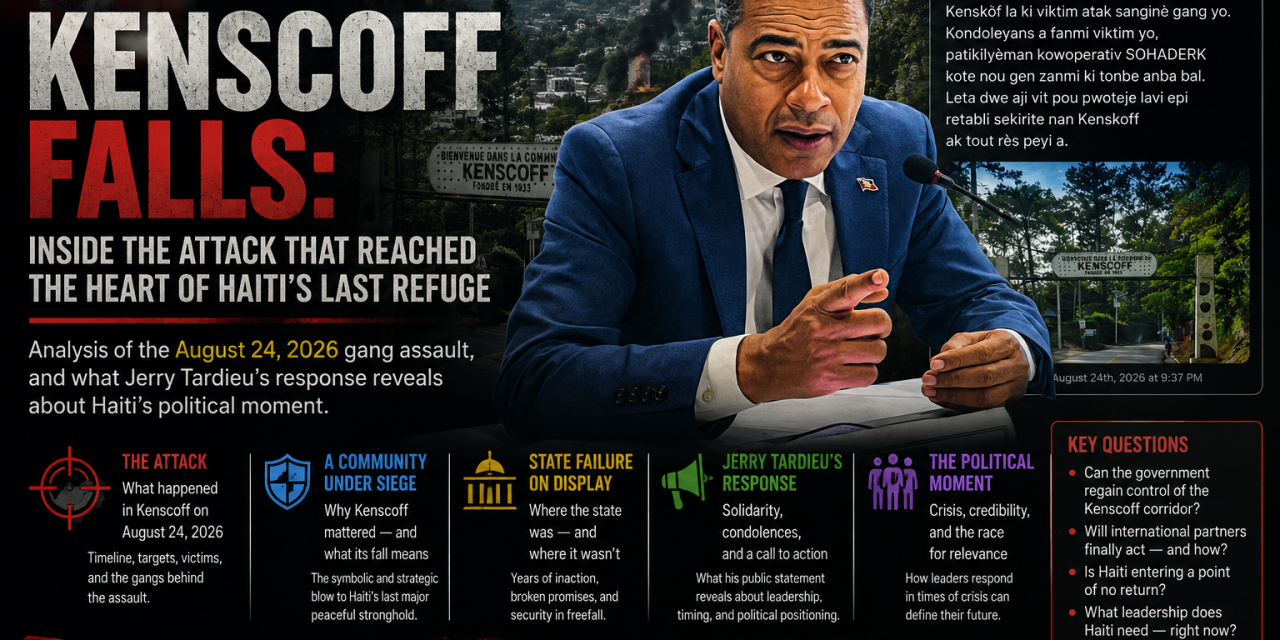
Analysis of the August 24, 2026 gang assault, and what Jerry Tardieu’s response reveals about Haiti’s political moment
What Happened
Late on the night of August 23 into the early hours of August 24, 2026, fighters from the Viv Ansanm gang coalition — designated a foreign terrorist organization by the United States government — launched a coordinated assault that, for the first time, reached the geographic center of Kenscoff, a hillside farming commune in the mountains above Port-au-Prince. Kenscoff Mayor Jean Massillon confirmed armed men raided the community, burning homes and killing residents, while communication and access problems left the final death toll unclear in the immediate aftermath. Within a day, wire reports citing local media put the number killed at roughly 40, with the mayor and others cautioning that the count was likely to rise as bodies continued to be recovered.
The assault was notable for where it struck: near the mayor’s office, close to a police substation, and reaching homes and a church, including property connected to Dr. Jean “Bill” Pape, a physician who runs a well-known Haitian NGO serving HIV and tuberculosis patients. That geography matters. Kenscoff has functioned for generations as an escape valve from Port-au-Prince — a cooler, agricultural highland where farmers grew produce that helped feed the capital, and where wealthier Haitians built second homes. Gangs reaching its administrative and civic center signals not just another massacre but the collapse of one of the last geographic buffers between organized criminal territorial control and the institutions that still nominally govern the country.
This was not an isolated event. Massillon told reporters he had spent 20 months warning that Kenscoff was in danger, and it was the second major incursion into the commune since a multi-day massacre there in early July. Human rights monitors have documented at least 10 gang-related massacres nationally in just the first half of 2026, concentrated in Artibonite, Kenscoff, and the Central Plateau, with more than 2,000 people killed in those incidents alone. Between January and March 2025 alone, a U.N. report tied at least 262 deaths and 66 injuries to gang attacks in Kenscoff specifically — meaning the August 24 attack is the continuation of an 18-month campaign, not a new front.
Why Now
The timing carries its own significance. Haiti is moving toward presidential and legislative elections scheduled for December 13, 2026, with local elections and a potential runoff set for February 21, 2027 — the country’s first national vote since 2016. Armed groups already control an estimated 85 percent of the capital and major roads nationally, and more than 1.4 million people remain internally displaced. A UN-backed Gang Suppression Force has announced plans to deploy into areas including Cité Soleil and Artibonite, but human rights organizations monitoring the violence have said publicly that the government’s security response has failed to produce meaningful improvement. An attack of this scale, reaching this close to formal state infrastructure, functions as a direct challenge to the credibility of holding a national election on schedule — raising the question of how millions of displaced, blockaded, or kidnapping-fearful Haitians are meant to reach a polling place at all.
Jerry Tardieu’s Tweet in Context
Jerry Tardieu — a Harvard-trained entrepreneur, former congressman for Pétion-Ville (2016–2020), and a declared candidate positioning himself for Haiti’s presidency — posted a message of solidarity with Kenscoff residents shortly after the attack, expressing condolences to victims’ families, specifically naming the SOHADERK cooperative, which lost members in the killings, and calling on the state to act quickly to protect lives and restore security in Kenscoff and “all the rest of the country.”
The tweet is consistent with the public positioning Tardieu has built over the past year: in campaign travel through the Haitian diaspora, he has repeatedly framed public security as Haiti’s number one governing priority, describing the country’s current condition in blunt terms — a “ghost state” and a “constitutional desert” with no elected officials currently in office anywhere in the country. His message on Kenscoff reads as continuous with that framing: an appeal for state action layered over an implicit critique that the state’s current capacity is not equal to the crisis.
What the tweet does not do — and this is worth noting analytically rather than critically — is commit to any specific policy mechanism: no mention of a security plan, a timeline, resourcing for the Gang Suppression Force, or how a Tardieu government would differ operationally from the current transitional authorities’ approach. That is typical of a solidarity post in the immediate aftermath of an atrocity, but it leaves open the substantive question voters and rivals alike are likely to press him on as the December election approaches: what, specifically, changes under his leadership.