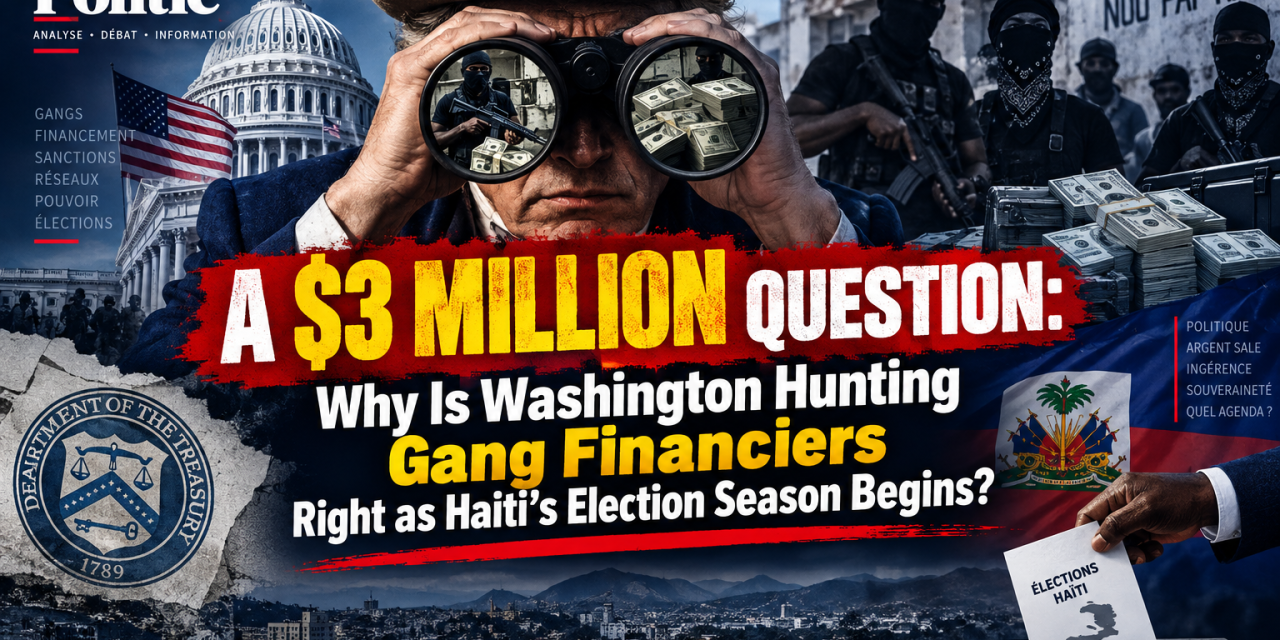
The U.S. Embassy in Haiti’s tweet offering up to $3 million and possible U.S. relocation for information on the financial networks behind Viv Ansanm and Gran Grif looks, on its face, like a straightforward counterterrorism measure — and in large part, it is. But the announcement’s actual origin date, its specific targeting of “financiers” and “donors” rather than gang triggermen, and its re-promotion during the exact week Haiti’s candidacy filing window opened deserve a more careful look than a routine security bulletin usually gets, given Washington’s long and complicated history of shaping outcomes inside Haiti’s political system.
What the Program Actually Is
The Rewards for Justice offer isn’t new — the State Department first announced it on March 25, 2026, nearly six months before this week’s embassy repost. Viv Ansanm and Gran Grif were formally designated Foreign Terrorist Organizations and Specially Designated Global Terrorists in May 2025. The reward specifically solicits information on businesses, bank accounts, and investments controlled by the two groups; financial contributions from “donors and financial facilitators”; suspicious transactions run through financial institutions and exchange houses; and front companies used to launder gang proceeds. As the South China Morning Post noted when the program launched, this represents a deliberate shift in U.S. tactics — previous bounties targeted individual gang commanders by name; this one targets the money and the people who move it.
That distinction matters enormously, because unlike a bounty on a known gang leader, a financier-focused reward is inherently open-ended about who might end up named. And Haiti’s own documented history makes clear that gang financiers are not always confined to the criminal underworld.
The Uncomfortable Precedent Already on the Record
Consider Gran Grif’s own origin story, as described in the State Department’s own reward notice: the gang was created around 2016 by Prophane Victor, at the time a sitting Haitian legislator, who armed young men in Petite Rivière de l’Artibonite specifically to secure both his territorial control and his own election that year. This is not a hypothetical concern about gangs and electoral politics intersecting — it is the literal founding story of one of the two organizations this reward targets. Separately, Haiti’s political system has already produced a documented case this year of a former deputy, Arnel Bélizaire, sanctioned by both Canada and the United States specifically for allegedly using elite political status to protect armed gangs. A reward program explicitly designed to expose “donors and financial facilitators” behind Viv Ansanm and Gran Grif is, by its own stated design, hunting for exactly the kind of political-criminal overlap Haiti’s recent history shows is real and not marginal.
Why the Timing Deserves Scrutiny
None of that makes the reward program illegitimate — disrupting terrorist financing that has killed thousands of Haitians and displaced over a million more is a defensible policy goal on its own terms, and gang violence has directly targeted American citizens in Haiti as well, giving Washington its own independent security interest separate from Haiti’s internal politics. But the embassy’s decision to re-amplify this specific message during the same week Haiti’s CEP opened its candidacy filing window, in the final stretch before December 13 elections, is worth asking about directly rather than accepting as coincidental scheduling.
A financier-focused bounty program, soliciting anonymous tips with a $3 million incentive attached, creates a mechanism through which anonymous informants — including, potentially, rival politicians, business competitors, or foreign intelligence sources with their own agendas — can attempt to implicate specific Haitian political or business figures in gang financing, with the U.S. government as the sole arbiter of which tips get investigated, which get rewarded, and which surface publicly. In a country where over 280 parties and platforms are actively competing for position ahead of December’s vote, a foreign government holding that kind of investigative leverage over allegations of gang financing is not a neutral instrument — it is a lever that touches the same political landscape voters are about to render judgment on, whether or not any single tip is ever acted upon.
This Fits a Pattern, Not an Aberration
Washington’s involvement in shaping Haiti’s political outcomes did not begin with this reward program. The 1994 U.S.-led intervention that restored Aristide came bundled with IMF and World Bank-backed economic conditions that reshaped Haiti’s domestic policy for a generation. U.S. diplomatic pressure has been a recurring, acknowledged factor in multiple subsequent transitions, including public State Department criticism of Privert’s 2016–2017 mandate extension. A financial-intelligence-gathering campaign aimed at exposing which Haitian elites bankroll armed groups — running in parallel with, not separate from, an active national election — extends that pattern into a new and more technically sophisticated form: influence exercised not through troops or aid conditions, but through control over which corruption and gang-financing allegations get investigative weight and public visibility, at the exact moment Haitian voters are trying to sort out which candidates and parties deserve their trust.
The Fair Case for the Program
It would be unfair to end without acknowledging the strongest counter-argument: Haiti’s own government has publicly welcomed international assistance in disrupting gang finances, the CNDDR and FDPH programs launched this same month depend on exactly this kind of international security cooperation, and Haitian civil society has spent years demanding that the international community stop treating gang violence and elite impunity as separate problems. If this program genuinely surfaces credible evidence implicating political financiers of Viv Ansanm or Gran Grif, that would arguably be one of the more consequential accountability tools Haiti’s crisis has seen — precisely because, as the Bélizaire and Prophane Victor cases show, the elite-gang financing nexus is real, documented, and has gone largely unaddressed by Haiti’s own institutions.
The Question That Remains
Whether this program functions as a genuine accountability tool or as an instrument of foreign leverage over Haiti’s election season likely depends entirely on execution: how transparently any resulting allegations are handled, whether due process is extended to anyone named, and whether the timing of any public disclosures is driven by evidentiary readiness or by political convenience relative to Haiti’s own electoral calendar. Haitians — and anyone watching Washington’s role in this election cycle — are entitled to ask the U.S. Embassy directly: is this program’s current visibility about disrupting terrorist financing on its own investigative timeline, or about shaping what voters know, and about whom, three months before they go to the polls?
This article is based on U.S. Department of State Rewards for Justice program announcements (originally issued March 25, 2026), U.S. Embassy Haiti public statements, and documented history of gang-political connections in Haiti, including the founding of the Gran Grif gang and the 2023 and 2025 sanctions against former deputy Arnel Bélizaire. It reflects analysis and critical questions about policy timing and implications, not an allegation that any specific individual has been named or implicated by this program.