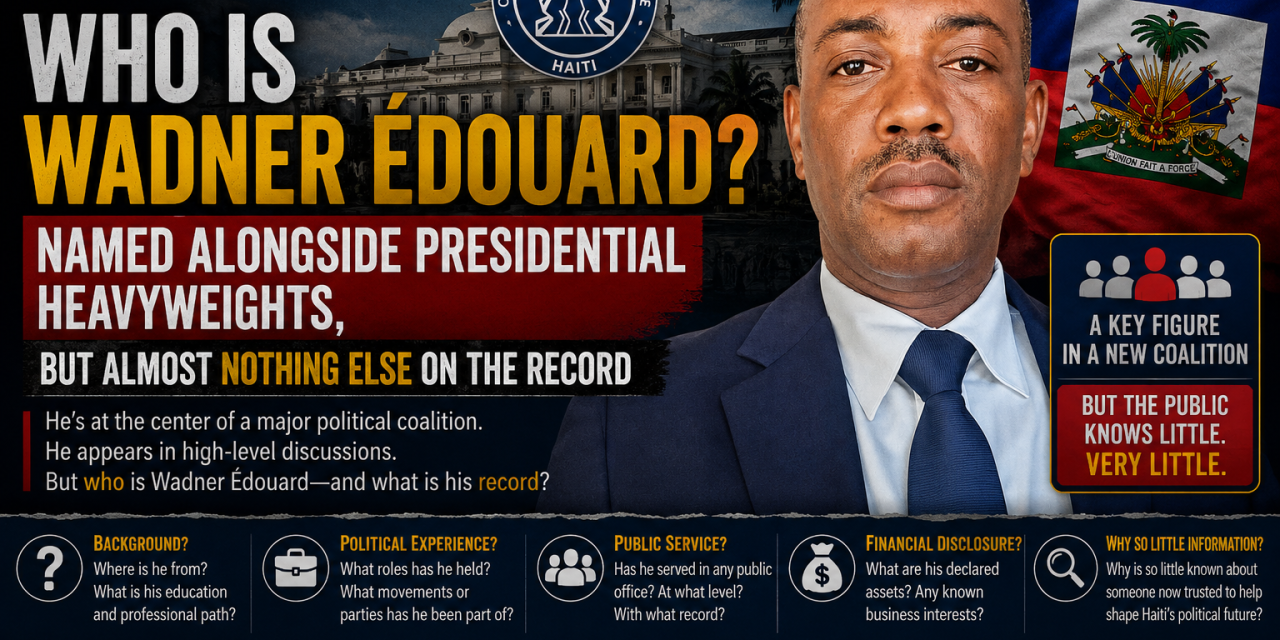
He’s floated as a potential presidential contender in the same breath as a former president and a former head of state. So why is there so little else about him?
📌 THE HEADLINE
Haiti’s electoral council approved 15 political coalitions on August 8, 2026, covering 208 parties total. SOLÈY, led by Wadner Édouard as coordonnateur général, unites 13 political parties — one of the larger coalitions in this cycle, trailing only VIKTWA’s 52 parties and on par with MYÈL and Coppos-Haïti et Alliés. Yet the man leading it is one of the least publicly documented figures in this entire series.
🔍 THE FACTS
A striking mention — and almost nothing else. The single most substantive thing we found about Wadner Édouard isn’t biographical: a Haiti Press Network report on the 2026 electoral landscape names him among a short list of figures “pressentis” (seen as likely contenders) for a presidential run, in the same breath as:
- Jacky Lumarque — respected rector of Université Quisqueya and a 2015 presidential candidate
- Jocelerme Privert — Haiti’s former provisional president (2016)
- Jerry Tardieu — a well-known former deputy and founder of the En Avant political movement
- Michel Joseph “Sweet Micky” Martelly — Haiti’s former President (2011–2016)
- Edzer Emile
That’s notable company for a name with essentially no other public footprint. Being named alongside a former head of state and a respected university rector suggests SOLÈY is being read by at least some observers as a serious vehicle — even as its own leader remains largely undocumented.
Beyond that: very little. Repeated searches turned up no confirmed information on Wadner Édouard’s profession, education, prior political roles, business background, or public activity before SOLÈY’s emergence in 2026. No elected office on record, no prior party leadership, no government post — and, as with several other figures in this series, no corruption allegations either, simply because there isn’t enough of a public record to allege anything against.
The coalition itself. SOLÈY was confirmed by the CEP on August 8, 2026 as one of 15 approved groupements. At 13 member parties, coordinating it is a genuinely substantial task, whatever Édouard’s personal background turns out to be.
🧾 WHAT THIS RECORD ACTUALLY SHOWS
- A real gap between apparent political weight and public documentation. Being floated as a presidential-tier contender by at least one outlet, while having almost no independently verifiable biography, is an unusual combination in this series — it suggests either a genuinely low media profile despite real organizing capacity, or speculative reporting running ahead of what’s actually confirmed about him.
- A large coalition led by an undocumented figure. 13 parties under one banner requires real coordination, negotiation, and trust — capacities that exist somewhere in Édouard’s background even if the public record doesn’t yet show where they came from.
- An open question, not a closed one. Unlike most other profiles in this series, there simply isn’t enough here to weigh “experience” against “accomplishments” in any concrete way — the file itself is the finding.
🏛️ THE SYSTEM HE’S STEPPING INTO
Haiti has had no functioning elected Parliament since January 2023. Into that vacuum, 208 parties across 15 coalitions are now positioning for 2026, and SOLÈY — whatever its leader’s personal story turns out to be — is already being discussed in the same breath as some of Haiti’s most recognizable political names.
🤔 SO — SERIOUS CONTENDER OR NAME WITHOUT A FILE?
The skeptical take:
If a coalition leader being floated for the presidency has essentially no checkable public record, voters are being asked to extend trust based on reputation and speculation rather than documented experience. That’s a real accountability gap, not a minor oversight — especially at this scale of political ambition.
The other take:
A thin media footprint doesn’t necessarily mean a thin real one. Plenty of capable organizers, businesspeople, and community leaders in Haiti operate without an extensive press trail. Being taken seriously enough to be mentioned alongside a former president is itself a data point worth weighing, even without a full biography attached to it yet.
Both are honest responses to a case that’s genuinely different from the rest of this series: more buzz than biography.
🗳️ THE BOTTOM LINE
Wadner Édouard presents the most unusual profile examined in this investigative series — treated as potentially presidential-tier by at least one outlet, while remaining almost entirely undocumented as an individual, and now leading one of 2026’s larger 13-party coalitions. That gap between apparent stature and available record is itself the story. Whatever SOLÈY ends up proposing, Haitian voters deserve a fuller public accounting of who is actually leading it before any speculation about his prospects can be meaningfully evaluated.
The file is genuinely incomplete. That incompleteness — not a verdict — is what this article can responsibly offer.