A Tweet That Says It All
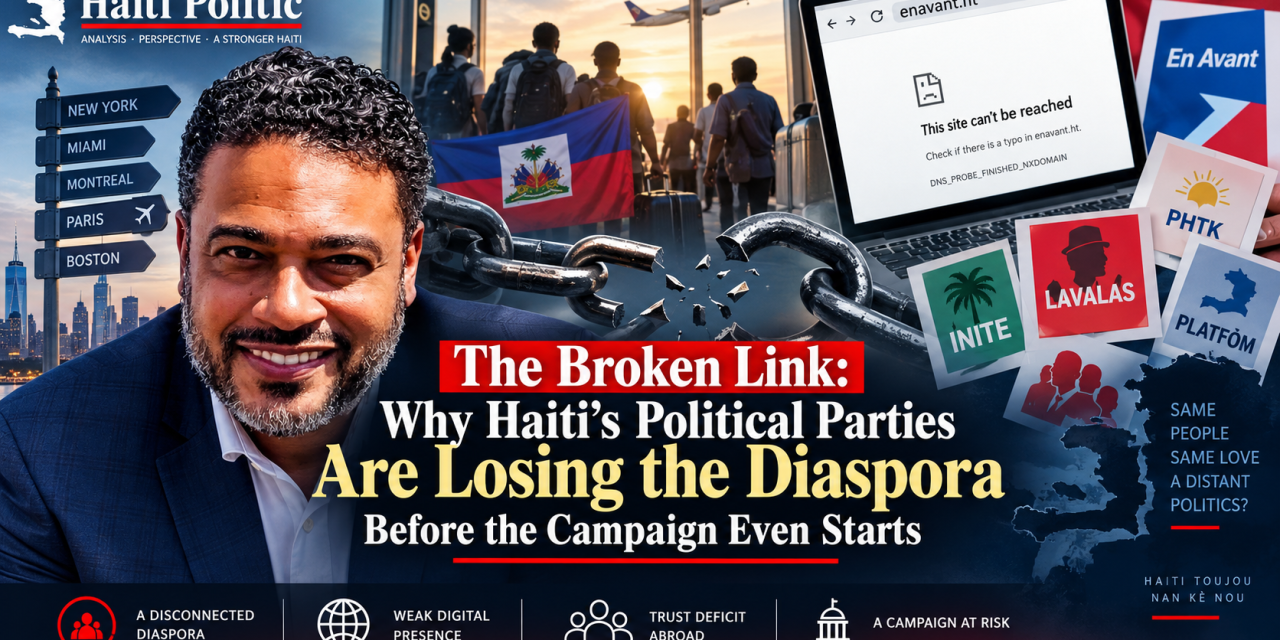
It started as a simple, almost mundane complaint. A Haitian social media user, trying to check in on the party En Avant, tried to visit its website — enavant.ht — and got nothing but a dead end: “This site can’t be reached… DNS_PROBE_FINISHED_NXDOMAIN.” The user noted that the party does have a working .org domain, but the .ht address either fails outright or simply forwards to it, with no real explanation. Then came the more pointed question, tagging the party’s spokesperson directly: “Why haven’t I heard you talk about En Avant lately?”
It’s a small, almost technical complaint — a broken domain, a redirect nobody bothered to clean up. But it captures, in miniature, a much larger structural problem in Haitian politics: the near-total absence of a functioning, trustworthy digital presence among the country’s political parties, at the exact moment millions of Haitians abroad are trying to decide who, if anyone, deserves their support ahead of the country’s first general election in a decade.
The Scale of the Problem, in Numbers
This is not a new phenomenon, and it is not anecdotal. A 2019 study by the investigative outlet AyiboPost examined a sample of 83 registered Haitian political parties and found that only two had an updated website, and only eleven maintained an “active” Facebook page. That means, even by the most basic measure — does this party have anywhere online where a citizen can go to learn what it stands for — roughly 87% of the parties studied failed the test.
The problem has, if anything, gotten more acute since then, simply by virtue of scale: more than 300 political parties and platforms registered with Haiti’s Provisional Electoral Council (CEP) ahead of the country’s scheduled December 2026 general elections — the first presidential and legislative vote in a decade. If the 2019 ratio holds anywhere close to true today, that means the country could be heading into a historic election with hundreds of registered parties that have no meaningful, reliable way for an ordinary citizen — let alone someone living thousands of miles away — to find out who they are, what they believe, or how to reach them.
Why This Is a Distinct, Acute Problem for the Diaspora
For Haitians living on the island, the absence of a party website is an inconvenience — frustrating, but partially offset by local rallies, radio call-in shows, word of mouth, and physical party offices people can walk past. For the Haitian diaspora — an estimated several million people across the United States, Canada, France, and beyond, whose remittances (roughly $3–4 billion annually) constitute one of the largest single financial lifelines to the Haitian economy — none of those offline channels are available. For the diaspora, digital presence isn’t a supplement to political engagement — it is the entire channel.
That creates a specific, compounding set of problems:
- No way to vet a platform before supporting it. A diaspora member who wants to know a party’s actual position on security, the economy, or the electoral process has, in most cases, no official document to consult — no published platform, no mission statement, no policy page. They are left to piece together a party’s positions from scattered interviews, secondhand social posts, or rumor.
- No verified point of contact. Without a working website or an actively maintained, verifiable social account, there is no reliable way to reach a party to ask a question, request information, or — as in the viral post above — get an explanation for months of public silence from a party’s own spokesperson.
- Wide-open exposure to impersonation and fraud. Where an official channel doesn’t exist or isn’t clearly identifiable, the vacuum tends to get filled — by rumor, by out-of-date information, or by bad actors impersonating a party or candidate to solicit “donations” or spread disinformation, with diaspora members largely unable to distinguish real communications from fake ones.
- Erosion of trust that compounds over election cycles. A diaspora member who tries once to find reliable information on a party, hits a broken domain or an abandoned Facebook page, and gives up is unlikely to try again next cycle — meaning each election’s digital neglect makes the next one’s diaspora outreach even harder.
- Real money left on the table. Diaspora communities are frequently the most willing and able segment of a party’s potential base to contribute financially and to advocate publicly abroad — but only if they can first verify that a party is legitimate, active, and worth backing. A broken website isn’t just a communications failure; it’s a fundraising and mobilization failure.
What a Baseline Digital Presence Should Actually Look Like
None of what’s missing here requires sophisticated technology or significant budget — which is precisely what makes its absence so telling. At minimum, a Haitian political party or candidate serious about engaging the diaspora ahead of the 2026 election should maintain:
- A working, owned website — not a broken domain, not an endless redirect, but a functioning site the party actually controls and updates.
- A clearly published mission, vision, and political platform — in plain language, ideally in both Kreyòl and French (and English, given the size of the U.S. and Canadian diaspora), laying out concrete positions rather than slogans.
- Active, verifiable social media accounts — consistently branded, regularly updated, and where possible verified, so that diaspora members can distinguish the real account from impersonators.
- Visible, responsive contact information — a real email address or contact form that gets answered, and ideally a named press or diaspora-engagement contact, not just a name tagged in a tweet that goes unanswered for months.
- Basic transparency on funding and structure — who leads the party, how it’s funded, and how decisions get made, information that matters enormously given how many Haitian parties are built around a single founder rather than an accountable institution.
- A specific diaspora engagement plan — recognizing that diaspora supporters can’t attend a rally in Pétion-Ville or Cap-Haïtien, and need dedicated virtual town halls, regular updates, and a clear path to contribute time or money.
The Bottom Line
The exchange captured in that tweet — a citizen unable to reach a party’s website, unable to get an answer from its spokesperson, reduced to publicly asking “where did you go?” — is not a minor technical glitch. It’s a symptom of a political culture in which too many parties treat public communication as optional, even as they ask the public, including a diaspora with real money and real political weight to offer, for votes, money, and trust. Heading into Haiti’s first general election in a decade, with well over 300 parties on the ballot competing for attention, the parties that bother to fix their broken links — literally and figuratively — will have a real, structural advantage with a diaspora audience that has, for years, had almost nowhere reliable to look.