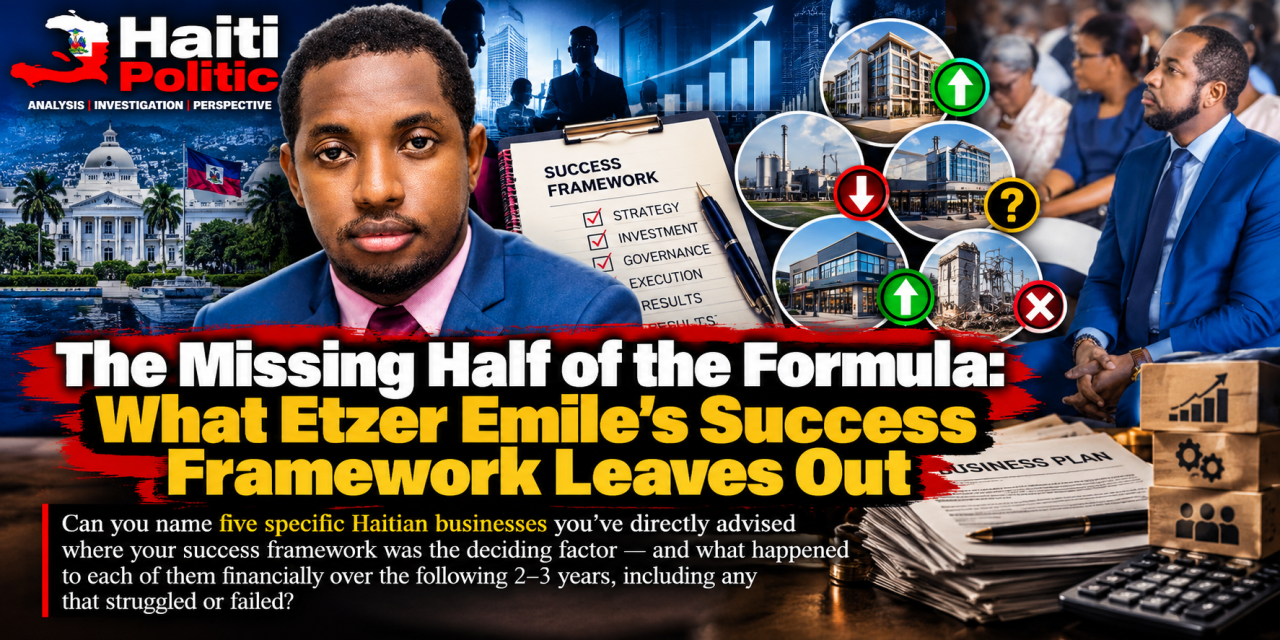
At the Sommet des Millionaires du Royaume, the economist told entrepreneurs that success starts with matching what they want to do to what the market will buy. It’s a real starting point — but in Haiti’s current economy, it’s only half the equation.
It’s election season in Haiti, and the economists are back on stage alongside the politicians. At the Sommet des Millionaires du Royaume, economist Etzer Emile offered aspiring entrepreneurs a starting principle: business success begins with a kind of alignment — what you want to do, matched against what the market will actually buy. Find that intersection, he suggested, sit with the question for months if you have to, and you’ve found your footing. It’s clean advice, and it’s not wrong as a starting point. It’s also, on its own, a fraction of the picture.
Where the Framework Holds Up
There’s real economic logic behind matching personal drive to market demand. Businesses that survive their founders’ first burnout are usually ones where the founder had enough conviction to push through the inevitable rough stretch — and that conviction is easier to sustain when the work itself means something to the person doing it. As a starting filter for “what should I even try to build,” it’s reasonable, well-established entrepreneurship theory, not a fringe idea.
Where It Runs Thin
The trouble is what the framework leaves outside the frame entirely — and in Haiti’s current environment, what’s outside the frame is often the deciding factor in whether a business survives its first year.
- Macroeconomic conditions. Haiti’s gourde has faced sustained depreciation and high inflation in recent years, and access to formal credit remains extremely limited for small and midsize businesses. A founder can have perfect product-market fit and still get crushed by currency instability that erodes margins faster than any pricing strategy can adjust to.
- Market timing and access. “What the market wants” is not a fixed target — it shifts based on purchasing power, which itself depends on security conditions, fuel availability, and whether goods can physically move between regions. A business plan that made sense in a neighborhood with open roads and functioning banks can become unviable within months if a gang blockade cuts off supply routes, a genuine, recurring risk given how much of Port-au-Prince’s commercial areas have been affected by armed-group control in recent years.
- Institutional and environmental stability. Formal registration, contract enforcement, property rights, and physical security are not motivational variables — they’re structural preconditions. A founder with flawless personal alignment to their business idea still needs a bank that’s open, a court system that can enforce a contract, and a storefront that isn’t in gang-contested territory.
None of this makes the “find your alignment” starting point false. It makes it insufficient as a complete theory of business success.
That gap matters most in a room full of aspiring entrepreneurs who may walk away believing the internal work — motivation, patience, self-reflection — is the hard part, when in Haiti’s current environment, the external constraints are frequently the harder and more decisive ones.
What Would Make the Case Stronger
The honest test of any success framework isn’t the framework itself — it’s the track record behind it. Rather than take the idea apart in the abstract, the more useful move is to ask the economist to show his work.
Five Accountability Questions for Etzer Emile
Questions Haiti Politic believes deserve direct, on-the-record answers — not to attack credentials, but to test whether the framework holds up against real outcomes.
- 1. Can you name five specific Haitian businesses you’ve directly advised where your success framework was the deciding factor — and what happened to each of them financially over the following 2–3 years, including any that struggled or failed?
- 2. For those businesses, how much of their outcome do you attribute to founder alignment and personal drive versus factors outside their control — currency depreciation, fuel access, security conditions, or credit availability?
- 3. Of the entrepreneurs you’ve mentored, how many operate in gang-affected or access-contested areas of Port-au-Prince, and has your advice changed for founders operating under those conditions specifically?
- 4. Your framework emphasizes internal reflection — what you want to do with your life. For a founder who nails that reflection but faces a currency collapse or a blocked supply route, what concrete guidance do you give beyond the alignment principle?
- 5. Given Haiti’s current inflation and limited access to formal credit, what role do you believe macroeconomic policy and institutional reform should play in entrepreneurship advice — and do you think framing success primarily around personal alignment risks placing too much responsibility on individual founders for outcomes shaped by conditions they don’t control?