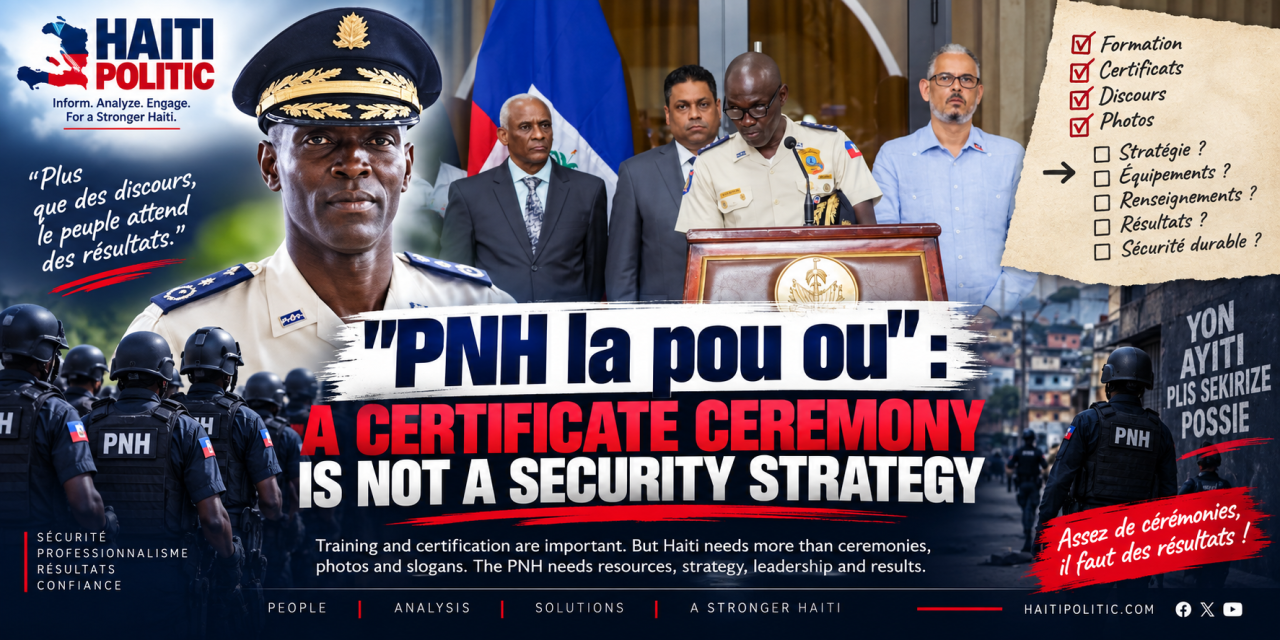
On Monday, PNH Director General André Jonas Vladimir Paraison took to social media to highlight a certificate ceremony for 150 school-based mental health facilitators, organized with the Ministry of Education (MENFP). The post came with two lines meant to resonate emotionally: “PNH la pou ou! PNH la pi prè ou!” — “The PNH is for you! The PNH is closer to you!”
It is a good program, in principle. Mental health support in schools is a real and long-neglected need in a country where an entire generation of children has grown up under the psychological weight of gang violence, displacement, and institutional collapse. No one should begrudge the 150 facilitators who earned their certificates, or dismiss the value of the training itself.
But the framing of the post — and the slogan attached to it — deserves scrutiny.
A Slogan That Doesn’t Match the Moment
“PNH la pi prè ou” is a message of proximity and reassurance. It is the kind of language a police institution uses when it wants the public to feel protected. The problem is timing and substance: this messaging is being deployed around a school mental-health ceremony, not around the security failures that are actually driving the demand for that mental health support in the first place.
Haitians are not primarily anxious because school counselors are in short supply. They are anxious because entire neighborhoods remain under gang control, because displacement continues, and because basic physical security — the PNH’s core mandate — remains in crisis in large parts of the country. A ceremony video with an institutional slogan risks looking like an attempt to fill the DG’s public communications calendar with a feel-good story, rather than a substantive accounting of what the PNH is doing about the conditions creating the trauma these facilitators are being trained to address.
Awareness Is Not the Same as Accountability
There is nothing wrong with a police institution publicizing a partnership with the Ministry of Education. But when the head of the national police uses his public platform primarily to showcase ceremonial events, Haitians are entitled to ask a harder question: what is the PNH doing, concretely and measurably, about the security conditions that make mental health support for schoolchildren necessary in the first place?
A certificate ceremony is not evidence of institutional progress on security. It is, at most, one small and welcome initiative sitting alongside a much larger and unresolved crisis. Presenting it under a slogan of proximity and protection — without corresponding public accounting on gang activity, response times, or protection of schools themselves — risks turning a legitimate program into a public-relations substitute for the security results the population is actually waiting for.
What Would Make This Credible
If the PNH wants “PNH la pi prè ou” to mean something beyond a hashtag, the institution should pair announcements like this one with concrete, verifiable updates on:
- What security measures protect schools where these 150 facilitators will now be working
- What data exists on gang-related disruption of the school year, and what the PNH is doing about it
- How this mental-health initiative connects to a broader, publicly stated security plan — not just a training certificate
Until then, the gap between the slogan and the daily reality on the ground will keep undermining messages like this one — no matter how genuinely well-intentioned the underlying program is.
Haiti does not need more reassuring language from its institutions. It needs results it can measure. A ceremony is not a substitute for either.