Haiti Politic — September 20, 2026
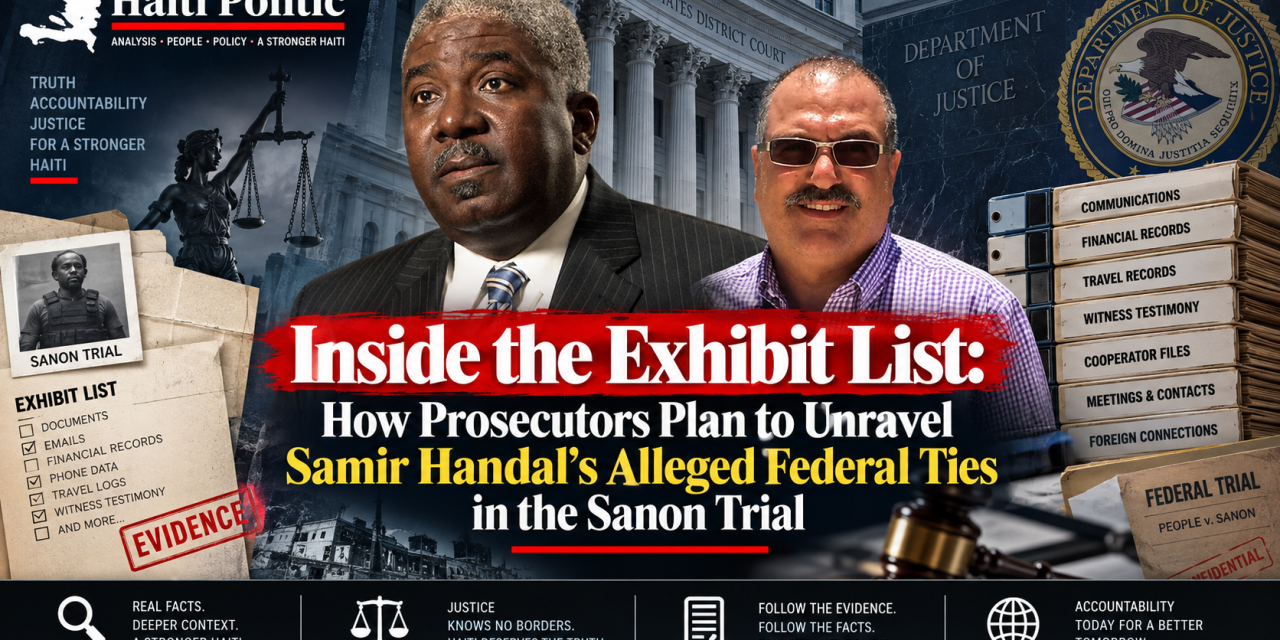
As the federal case against Christian Sanon — the last of the original major defendants in the Jovenel Moïse assassination conspiracy still awaiting a U.S. trial — moves toward its final pretrial stages in the Southern District of Florida, a newly filed government exhibit list offers a revealing preview of one specific battle prosecutors are preparing to fight in front of the jury: discrediting any suggestion that Samir Handal, the Jordanian-Haitian businessman tied to the house where Moïse was killed, held genuine federal government credentials.
The exhibit list, decoded
The docket for United States v. Christian Sanon, Case No. 1:22-cr-20104-JB, before Judge Jacqueline Becerra, shows prosecutors Sean McLaughlin and Altanese Phenelus filing successive exhibit lists as trial approached — one on August 20, 2026 (ECF No. 1833) and an updated one on September 9, 2026 (ECF No. 1867), alongside corresponding witness lists and notices of intent to use business and summary-records evidence. Buried within one of those exhibit lists is a cluster of six entries, numbered 56A through 56F, all concerning a single figure: Samir Handal.
The entries are unusually pointed for what is otherwise a routine evidentiary filing:
- 56A — A photograph of Samir Handal, presumably for witness identification.
- 56B — Certified Florida DAVID records (the state’s driver and vehicle identification database), likely to establish Handal’s identity and residency.
- 56C — Certified confirmation of the lack of a U.S. Department of State employment record.
- 56D — Certified confirmation of the lack of an FBI employment record.
- 56E — Certified confirmation of the lack of a U.S. Department of Defense/War employment record.
- 56F — Certified confirmation of the lack of a DEA employment record.
Four separate certified-negative-records requests, from four different federal law enforcement and defense agencies, aimed at one man, is not something prosecutors typically bother assembling unless they expect a claim of federal affiliation to surface at trial — whether through witness testimony, a defense argument, or evidence the defense intends to introduce. In federal criminal practice, this kind of “negative records certification” is a standard, deliberate tool: rather than simply denying a claim in argument, prosecutors obtain sworn certifications from each agency’s records custodian stating, in effect, “we have no record this person ever worked here,” and enter that certification into evidence so jurors hear it as documented fact rather than rebuttal rhetoric.
Who is Samir Handal, and why his federal ties matter to this case
Handal is not a defendant in the Sanon case. He is, by most public accounts, a real estate businessman — described variously as Jordanian-Haitian, Palestinian-Haitian, and in at least one account a former UN employee — who rented the Pèlerin 5 property where Moïse was assassinated to Christian Sanon in the months before the killing. His name surfaced early in the investigation when Haitian police reported finding it on multiple passports, including several Haitian and Palestinian documents, recovered from Sanon’s residence.
Handal left Haiti for Miami shortly after the assassination and was interviewed by the FBI multiple times during his time there; he told investigators he had simply rented the house to Sanon for a few months and denied involvement in the killing. He was never charged in the United States. In November 2021, while transiting through Istanbul en route to visit his mother, Turkish authorities detained him on an Interpol Red Notice issued at Haiti’s request. A Turkish court held him for roughly eight months before ordering his release in July 2022, finding that Haiti had presented insufficient evidence to justify extraditing him back to face charges there.
None of that public record confirms exactly what claim about State Department, FBI, DOD, or DEA affiliation the government now anticipates having to rebut at trial — the exhibit list itself doesn’t explain the underlying theory, and the motions that would typically spell it out appear to fall among several docket entries in this same period marked simply “restricted/sealed until further notice.” What the exhibit list does confirm, unambiguously, is that prosecutors consider the question of Handal’s (non-)federal employment significant enough to build a dedicated evidentiary package around it, covering essentially every U.S. agency whose name might plausibly be invoked to suggest government sanction, protection, or insider access.
The broader pattern this fits
That evidentiary move doesn’t exist in a vacuum. Earlier in this same case, the government filed — and largely won — a motion in limine “to Preclude Public Authority Defenses” (ECF No. 1315), aimed at preventing defendants from arguing at trial that they believed their actions were authorized or sanctioned by a government authority. That motion reflects a recurring undercurrent in the broader Moïse assassination prosecutions: from the earliest arrests in 2021, several defendants and cooperating witnesses have advanced versions of a narrative suggesting the operation carried some claim of official legitimacy — that the Colombian commandos believed they held an arrest warrant, that certain participants believed they had U.S. government blessing, or that figures around the plot held credentials suggesting insider federal access. Prosecutors have consistently and successfully worked to strip that framing out of the trial record, arguing it has no evidentiary basis and would improperly invite jury sympathy or confusion about legal authorization.
Read against that backdrop, the Handal exhibit cluster looks like the same defensive maneuver executed at the evidentiary level rather than the argument level: rather than relying solely on a legal ruling barring a “public authority” narrative, prosecutors appear to be building a factual record — certified, agency-by-agency — that forecloses any claim, from any witness or defense theory, that Handal carried genuine federal credentials of any kind.
What comes next
With witness and exhibit lists filed on both August 20 and September 9, 2026, and a status conference already held before Judge Becerra on August 24, the docket suggests Sanon’s long-delayed trial — repeatedly postponed over the years, most recently due to health issues — is now entering its final pretrial phase. Sanon’s case has always carried unusual weight in the broader prosecution: he’s the figure federal investigators have identified as the central U.S.-based defendant with direct ties to the plot’s origins, and, unlike Badio and the Colombian commandos only recently extradited from Haiti, he has been in American custody and working through this docket for years.
Whether the Handal-related exhibits ultimately reach the jury — and whether Handal himself is called to testify, given his history of FBI interviews but no U.S. charges — will depend on rulings still to come. But the exhibit list alone tells a clear story about prosecutorial strategy: if any claim of federal government affiliation attached to Samir Handal surfaces in this courtroom, prosecutors intend to have four separate federal agencies on record, in writing, saying it isn’t true.