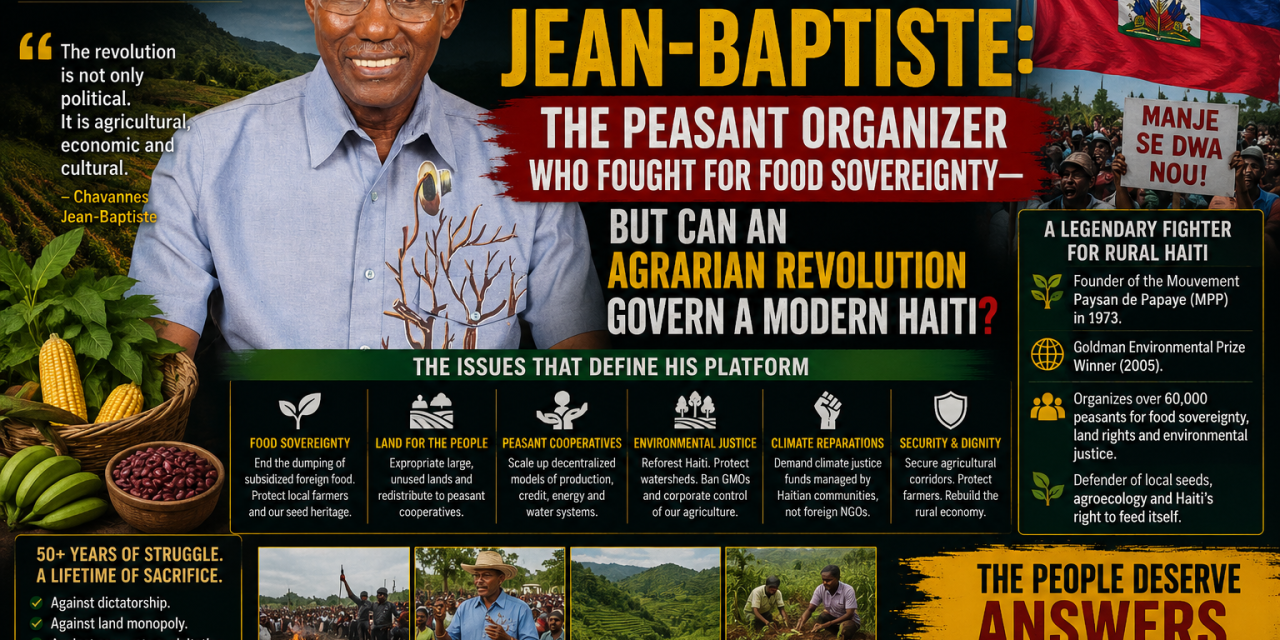
For more than half a century, Chavannes Jean-Baptiste has argued that Haiti cannot truly be sovereign while it cannot adequately feed itself.
He is not primarily a product of Parliament, the ministries of Port-au-Prince, or Haiti’s traditional business establishment. He is an agronomist, environmental activist and founder of the Mouvement Paysan Papaye (MPP), established in Haiti’s Central Plateau in 1973. Today, MPP describes work spanning agroecology, rural engineering, alternative energy, preventive health, social and solidarity economics, education and legal assistance. Partner organizations have reported membership exceeding 60,000 people.
His international reputation is substantial. Jean-Baptiste received the Goldman Environmental Prize in 2005 for leadership promoting sustainable agriculture, food security and resistance to deforestation.
But Haiti Politic’s question is not whether Jean-Baptiste has spent decades organizing farmers.
That record is established.
The harder question is:
Can a philosophy developed in Haiti’s countryside become a realistic governing strategy for an entire country facing gangs, unemployment, food insecurity, weak institutions, urbanization and enormous dependence on international trade?
🌱 THE ACCOMPLISHMENT: BUILDING ORGANIZATION WHERE THE STATE WAS WEAK
Jean-Baptiste’s strongest argument may be something many presidential aspirants cannot easily claim:
He built an institution that survived.
MPP began with only a handful of rural participants during the Duvalier era and developed into an extensive peasant movement centered on collective organization and rural development. Its programs have included agricultural production, environmental protection, water management, training, microcredit and social services.
That matters.
Haiti has seen political parties emerge around elections and disappear afterward. MPP, by contrast, dates to 1973.
But running a peasant organization—even a successful one—is fundamentally different from governing Haiti.
A president must administer customs, diplomacy, police, taxation, ports, monetary policy, courts, infrastructure and relations with international financial institutions.
Can the MPP organizational model scale that far?
🌾 QUESTION 1: CAN HAITI ACHIEVE FOOD SOVEREIGNTY WITHOUT CREATING A FOOD-PRICE CRISIS?
Jean-Baptiste has spent decades challenging Haiti’s dependence on imported food and advocating greater investment in domestic agriculture.
At MPP’s 2013 congress, Jean-Baptiste and the movement pushed for comprehensive agrarian reform and substantially greater national-budget commitments to agriculture and environmental rehabilitation.
The principle is powerful:
Haiti should produce more of what Haitians consume.
But presidential policy requires confronting the transition.
If a government suddenly imposes steep tariffs or quotas on imported rice, poultry, flour and other staples before Haitian farmers can replace those supplies, prices could rise sharply for poor urban families.
🎤 QUESTIONS FOR CHAVANNES JEAN-BAPTISTE
What exactly is your transition plan?
How high would agricultural tariffs become?
Which products would receive protection first?
How many years would Haitian farmers receive to increase production?
And what mechanism would prevent food sovereignty from becoming food inflation for families in Port-au-Prince, Cap-Haïtien and other cities?
🌎 QUESTION 2: THE MONSANTO PROTEST—PRINCIPLE OR WARNING ABOUT POLICY?
Jean-Baptiste attracted international attention after the 2010 earthquake when MPP opposed Monsanto’s donation of hybrid corn and vegetable seeds.
Thousands of farmers marched from Papaye toward Hinche, and protesters publicly burned some hybrid seeds. Jean-Baptiste argued that imported hybrid seeds threatened local seed autonomy and could increase farmers’ dependence on corporations.
One important distinction often disappears in retellings of this episode:
The disputed Monsanto donation involved hybrid seeds; reporting at the time said Monsanto assured Haitian authorities that the donated seeds were not genetically modified.
That distinction matters when evaluating future policy.
🎤 THE QUESTION
Would a Jean-Baptiste government scientifically evaluate agricultural biotechnology case by case?
Or would ideological opposition determine national agricultural policy?
Protecting Haitian biodiversity is legitimate.
But so is asking:
Who decides which technologies Haitian farmers may use—the government, scientists, cooperatives, or individual farmers themselves?
🧑🏿🌾 QUESTION 3: LAND REFORM—HOW FAR WOULD HE GO?
Jean-Baptiste’s movement has consistently argued that food sovereignty requires genuine agrarian reform and secure access to productive land.
That raises one of the biggest questions of a potential Jean-Baptiste presidency.
🎤 WOULD HIS GOVERNMENT REDISTRIBUTE LAND?
If so:
Which land?
Unused state property?
Large abandoned estates?
Disputed holdings?
What constitutes “unused”?
Who determines ownership when titles conflict?
Would owners receive compensation?
And what independent judicial process would prevent agrarian reform from becoming politically motivated confiscation?
Haiti desperately needs clearer land tenure.
But redistribution without reliable cadastral records and independent courts could create another generation of disputes.
Jean-Baptiste needs to explain the legal architecture—not merely the revolutionary principle.
💰 QUESTION 4: WHO PAYS FOR THE AGRARIAN REVOLUTION?
MPP’s model encompasses far more than planting crops. Its work includes water, rural energy, environmental programs, training, social economy initiatives and legal assistance.
Scaling that nationally would require billions of gourdes.
So Haiti Politic asks:
🎤 SHOW US THE NUMBERS.
How much of Haiti’s national budget should go to agriculture?
Would subsidies be financed through higher customs duties?
Would major importers face higher taxation?
Would agricultural cooperatives receive subsidized credit?
Would Haiti establish a national agricultural development bank?
Would foreign investors be permitted to own large agricultural operations?
A philosophy becomes a government program only when the financing is explained.
🌳 QUESTION 5: CAN ENVIRONMENTALISM BECOME ECONOMIC POLICY?
Here Jean-Baptiste possesses unusually relevant experience.
His environmental work has connected agriculture with soil preservation, reforestation, water management and sustainable farming—work recognized by the Goldman Environmental Prize.
For Haiti, this isn’t simply environmental activism.
Deforestation and watershed degradation affect agriculture, flooding, drinking water and disaster vulnerability.
A Jean-Baptiste administration could therefore bring something genuinely different:
treating environmental restoration as economic infrastructure.
But again comes the difficult question:
Who finances it?
Could Haiti negotiate international climate financing while ensuring Haitian institutions and communities control implementation?
Could diaspora investment finance watershed restoration?
Could farmers receive payments for maintaining forests?
Those are areas where his environmental credibility could potentially become a distinctive foreign-policy asset.
🚨 QUESTION 6: FOOD SOVEREIGNTY MEANS NOTHING IF FARMERS CANNOT REACH THEIR FIELDS
The greatest challenge to any agrarian program today is brutally simple:
security.
Agricultural reform cannot function where armed organizations extort producers, seize roads or prevent commodities from reaching markets.
🎤 SO WHAT IS JEAN-BAPTISTE’S SECURITY DOCTRINE?
Would he support international security assistance?
What role would the Haitian National Police play?
Would Haiti rebuild military capacity?
How would agricultural corridors be protected?
And how would rural communities participate in security without creating uncontrolled armed groups?
Jean-Baptiste’s decades of grassroots organizing demonstrate mobilization capacity.
They do not automatically demonstrate command of a national security apparatus.
That distinction deserves serious scrutiny.
🌐 QUESTION 7: WHAT WOULD “PEASANT DIPLOMACY” LOOK LIKE?
This may be the most interesting foreign-policy question.
Haiti’s diplomacy has traditionally revolved around Washington, Ottawa, Paris, the United Nations, international lenders and major donors.
Jean-Baptiste’s political worldview suggests another possible emphasis:
food sovereignty, climate justice, South-South cooperation and stronger relationships between Haiti and agricultural movements internationally.
That could give Haiti a different diplomatic identity.
But sovereignty does not mean isolation.
🎤 THE FOREIGN-POLICY TEST
Would Jean-Baptiste renegotiate Haiti’s agricultural trade relationships with the United States?
How would he approach CARICOM?
What relationship would he pursue with the Dominican Republic?
Would Haiti remain aligned with the IMF and World Bank?
Could he confront agricultural globalization while still attracting investment and maintaining export markets?
A government can challenge dependency without pretending Haiti can disconnect from the world economy.
📱 QUESTION 8: CAN A PEASANT MOVEMENT WIN THE DIGITAL GENERATION?
Jean-Baptiste’s political language comes from land, cooperatives, seeds, farmers and ecological sovereignty.
Millions of younger Haitians are thinking about something else:
technology. Jobs. Internet access. Migration. Entrepreneurship. Digital payments. Universities. Artificial intelligence. Remote work.
That creates a generational challenge.
Can an agrarian political philosophy become a modern development philosophy?
Could agricultural cooperatives become technology-enabled businesses?
Could Haitian farmers use satellite weather information, digital marketplaces, mobile banking, drones and modern logistics?
The strongest version of Jean-Baptiste’s argument would not be:
“Haiti must return to the past.”
It would be:
“Haiti can modernize without abandoning the people who feed it.”
⚖️ HAITI POLITIC ASSESSMENT
| AREA | THE CASE FOR HIM | THE QUESTION HE MUST ANSWER |
|---|---|---|
| Grassroots leadership | More than five decades of rural organizing | Can grassroots organization scale into national administration? |
| Agriculture | Exceptional practical credibility on agroecology and food sovereignty | Can protectionism increase production without sharply raising food prices? |
| Environment | Internationally recognized environmental leadership | Can ecological policy produce jobs and revenue at national scale? |
| Political independence | Career largely built outside traditional Port-au-Prince political machinery | Can he assemble a parliamentary and national governing coalition? |
| Foreign policy | Could introduce climate, agricultural and sovereignty-centered diplomacy | Can Haiti assert autonomy while maintaining crucial trade and international partnerships? |
| Security | Strong community-organizing experience | What is his credible strategy against heavily armed criminal organizations? |
| Modern economy | Cooperative economics offers an alternative development model | Where do technology, manufacturing, services and private investment fit? |
🔎 THE HAITI POLITIC VERDICT: NO VERDICT YET.
Chavannes Jean-Baptiste deserves serious examination because his résumé differs dramatically from that of Haiti’s revolving political establishment.
He has spent more than 50 years organizing rather than merely campaigning.
He has built a movement.
He has defended farmers.
He has made food sovereignty and environmental protection central political questions.
And international recognition of his environmental work is real.
But activism is not automatically governance.
Haiti needs agriculture—but also ports, banks, telecommunications, factories, universities, policing, diplomacy, courts and functioning cities.
So the central question is larger than whether Chavannes Jean-Baptiste understands rural Haiti.
🇭🇹 Can the man who spent half a century organizing Haiti from the soil upward transform that philosophy into a government capable of governing the entire republic?
You decide.
HAITI POLITIC
Investigation. Analysis. Accountability.
The truth. The people. The future.