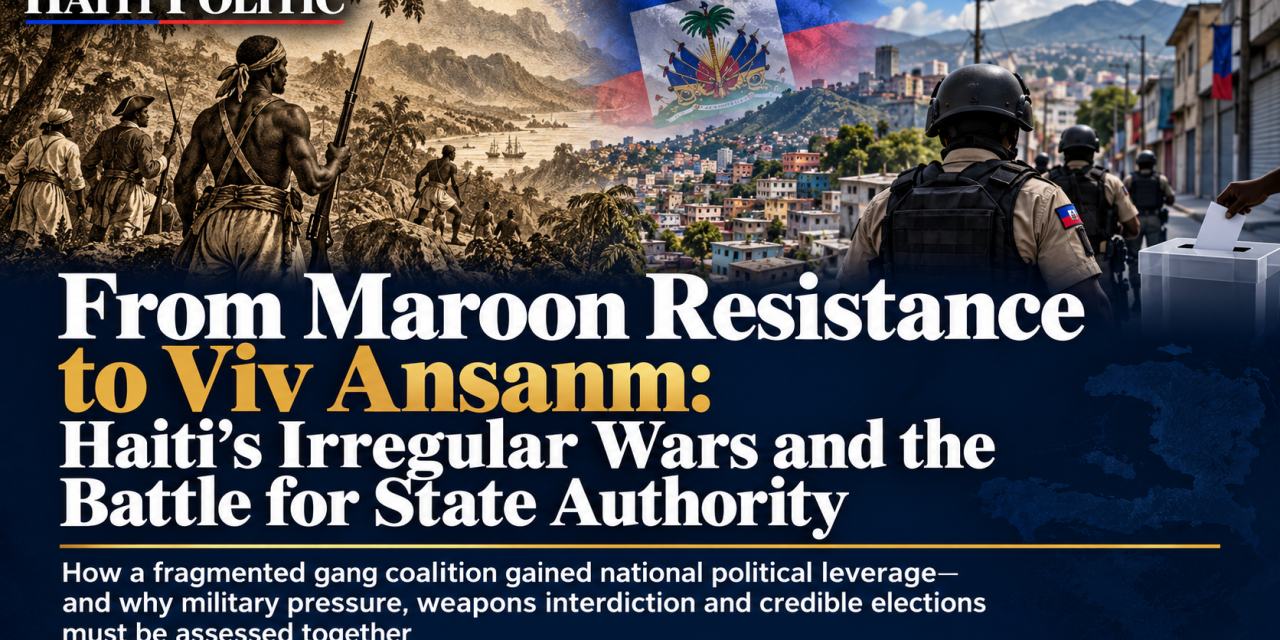
How a fragmented gang coalition gained national political leverage—and why military pressure, weapons interdiction and credible elections must be assessed together
Haiti Politic | Historical and Strategic Analysis | October 26, 2026
The disappearance of four Salvadoran aviation technicians after an October 18 attack in Croix-des-Bouquets has brought Haiti’s security crisis into a new diplomatic confrontation. The men were serving with the international Gang Suppression Force, or GSF. Their vehicle was attacked and burned, and search operations followed.
The incident illustrates a broader problem: armed groups can disrupt national politics and international commitments without possessing the institutions or legitimacy needed to govern a country.
Haiti has an extraordinary history of irregular warfare. Its revolution transformed the Atlantic world; resistance to U.S. occupation shaped the meaning of national sovereignty. But those histories should not be collapsed into a single tradition that automatically legitimizes today’s armed coalitions.
Viv Ansanm’s capacity for coordination deserves serious analysis. Calling that capacity “tactical brilliance” risks substituting admiration for the harder questions: what is demonstrably coordinated, how durable is the organization, and what does its power mean for the people living under it?
Three eras, different political projects
1. Marronage and the Haitian Revolution, 1791–1804
Marronage—escape from slavery and the creation of lives beyond plantation control—predated the 1791 uprising. A peer-reviewed historical dataset records 12,857 enslaved individuals described in Saint-Domingue’s runaway advertisements between 1766 and 1791. This documents the scale of resistance, although not every escape was an act of organized warfare.
Historians debate how directly maroon communities and networks contributed to the revolution. Treating all marronage as one continuous military organization would erase that debate.
The revolution itself combined irregular conflict, organized armies, diplomacy and shifting alliances. Historian David Geggus emphasizes the overlap between local revolutionary struggles and European imperial warfare. Independence emerged through a political and military transformation, not through one timeless guerrilla formula.
Its significance lies in the destruction of colonial slavery and the creation of an independent state. That emancipatory objective is central to any comparison with later armed movements.
2. The Cacos and U.S. occupation, 1915–1934
The occupation lasted from 1915 to 1934. The principal Caco armed campaigns did not continue at the same intensity throughout those nineteen years. U.S. naval historical material places the suppression of the main insurrection by mid-1920, following the death of Charlemagne Péralte in 1919 and the subsequent campaign against its leadership.
The Cacos’ place in Haitian national memory rests on resistance to foreign domination. Their rural organization and uneven struggle against a materially stronger occupying force make them important to the history of asymmetric conflict.
Yet military suppression and political legitimacy are separate historical questions. Ending a rebellion did not settle whether the occupation was justified.
3. Contemporary criminal armed coalitions
Today’s conflict involves territorial coercion, commercial predation, political connections and challenges to public authority.
“Criminal insurgency” is a useful analytical description where armed organizations seek leverage over government as well as illicit income. It does not establish a unified revolutionary program or settle the conflict’s legal classification.
The U.S. designated Viv Ansanm a foreign terrorist organization in 2025, with the designation effective upon publication on May 5. The UN separately listed the coalition under its Haiti sanctions regime in July 2025.
Historical comparison should examine organization and political purpose together. A claim to defend sovereignty cannot itself establish a mandate to rule.
Four pillars of Viv Ansanm’s rise
Factional unification: cooperation without complete merger
The UN traces Viv Ansanm’s formation to September 2023 through an alliance of the rival G9 and G-Pèp blocs, followed by its reactivation in February 2024.
UNODC describes a federated configuration in which gangs pool resources and coordinate against Haitian and international forces while retaining substantial autonomy and competing among themselves.
The consequential change was the ability of formerly rival organizations to act together on matters affecting the state. That is a significant organizational development. It does not establish that every operation is ordered by a single headquarters.
Public spokespeople, local commanders and participating gangs may have different levels of authority and different objectives. Analysts should therefore distinguish collective messaging from demonstrated command.
Militia-type development: more resources, uneven organization
UNODC documents increasingly sophisticated firearms, greater territorial organization and stronger connections to illicit markets.
The resulting picture is one of uneven militarization. Some groups have accumulated capabilities beyond those normally associated with street gangs, but the public record does not justify describing the entire coalition as a standardized national army.
Access to money, ammunition and replacement personnel helps explain persistence. It does not, on its own, prove professional discipline or coherent command.
Arrests and weapons seizures should consequently be evaluated alongside changes in recruitment, financing and the ability of communities to live without coercion.
Infrastructure disruption: national consequences from local violence
The UN sanctions narrative records coordinated attacks on prisons, public buildings and the international airport during the 2024 crisis.
The strategic significance is the effect on public authority. When travel, public services and ordinary commerce become unreliable, citizens experience a government’s weakness directly.
Such disruption can create political leverage without producing an alternative administration capable of delivering rights, services or accountable justice. Civilian suffering is part of the mechanism through which that leverage is imposed.
Gang populism and information warfare
International Crisis Group documents anti-elite rhetoric, social-media messaging, publicized distributions of assistance and efforts to present gang leaders as defenders of disadvantaged communities. It also describes intimidation of critical journalists and ambitions to secure political influence and amnesty.
The analytical question is whether apparent support reflects consent, dependency, fear or a combination.
A video of assistance cannot measure public legitimacy. Nor can the size of an online audience establish the freedom of residents to disagree.
A credible assessment must include the voices of people who cannot safely speak on camera.
Internal fractures and rural expansion
The image of a seamless coalition is contradicted by recent evidence. The UN Panel of Experts reports violent divisions within Viv Ansanm and competition over territory and revenue. It records 613 people killed and 375 injured in clashes in Cité Soleil and the Cul-de-Sac plain between March 6 and July 31, 2026. Those figures concern that violence; they are not a count of GSF casualties.
The same report describes gang relocation, expansion into other departments and renewed occupation of areas after security operations.
These developments complicate claims of either total gang unity or imminent collapse. Local setbacks can coexist with continuing violence elsewhere. Fragmentation may expose competition, but it can also produce retaliatory attacks and further displacement.
Rural communities are not peripheral to the crisis. Their safety, farming activity and access to markets are essential measures of whether a national security effort is succeeding.
The Croix-des-Bouquets flashpoint
The October 18 incident must be treated as an evolving case rather than a completed account of a coalition-directed operation.
Associated Press reporting placed the attack in an area controlled by Chèn Méchan, near 400 Mawozo territory, while noting that neither group had claimed responsibility. El Salvador subsequently sent special forces to assist the search.
That reporting does not establish who issued the order or whether a centralized Viv Ansanm command directed the attack.
On October 24, President Nayib Bukele said recovered remains were not those of the missing Salvadorans. Reporting on that dispute does not provide an independently settled forensic account of their fate.
The incident’s strategic impact is clearer than its unresolved details: a single attack has generated international pressure, additional deployments and a highly charged public narrative.
Those consequences demonstrate political impact. They do not establish victory in the broader conflict.
Escalation needs a reliable scorecard
The GSF’s April–August progress report records four occasions on which its helicopters came under attack. The report also acknowledges continuing gang retaliation against communities.
The October ambush adds another serious confrontation. But the sources reviewed do not supply a consistent, current incident series from which to calculate a reliable percentage increase in attacks on the GSF.
Reports of rising national violence, clashes among gangs and attacks on international personnel should not be combined into one statistic. They measure different things.
The weapons: an international supply problem
The UN Panel of Experts documents a shift toward 5.56 mm semi-automatic rifles and growing quantities of 7.62 mm rifles, alongside handguns and other firearms. It also reports limited circulation of .50-calibre rifles and evidence of privately made firearms. These findings concern Haiti’s gang environment; they are not a verified, complete inventory of Viv Ansanm’s arsenal.
UNODC identifies the United States as the predominant foreign source and describes supply connections involving Florida, the Dominican Republic, Jamaica and other Caribbean hubs. It also identifies diversion from legally held private-security stocks.
Three broad supply patterns deserve public scrutiny: international illicit imports, regional transit and diversion from authorized holdings. This is a transnational enforcement and accountability problem.
A weapon’s manufacturing origin does not by itself establish an authorized government transfer. Likewise, ammunition markings are a starting point for tracing, not a complete chain of custody.
The appropriate public questions concern export investigations, financial intermediaries, documented seizures, stockpile accounting and prosecutions. An embargo’s effectiveness should be judged by implementation rather than announcements alone.
The GSF’s limitations: deployment and durability
The GSF’s first progress report acknowledges localized improvements while identifying constraints in staffing, logistics, mobility and institutional arrangements. Its detailed deployment table lists 1,213 uniformed personnel as of August 31, against a ceiling of 5,500. These are dated figures, not a current headcount.
A force can record operational activity while communities remain insecure after it leaves. Durable security also depends on functioning police, courts, detention arrangements, public services and civilian confidence.
Operational performance should therefore be assessed through sustained civilian access and institutional recovery, alongside arrests and seizures.
Treating civilian protection as secondary would damage the very public authority the mission is intended to support.
Elections: an open-ended delay requires a precise explanation
The electoral timetable has been disrupted, but the official record is more specific than the phrase “elections cancelled indefinitely.”
A CEP notice extends candidate registration and supporting-document submissions to October 31, postpones the campaign period and says new campaign dates will appear in an updated calendar. It cites consultations, changes to the electoral decree and technical and operational requirements.
On October 20, the CEP announced consultations on revising the calendar. Chatham House’s October 14 analysis likewise reported that a replacement election date had not yet been announced.
Insecurity is a major obstacle, but these documents do not establish that it is the sole cause of every adjustment or that elections have been permanently abandoned.
Armed coercion nevertheless affects the substance of an election: who can register, campaign, travel, report independently or vote without intimidation. Displacement can exclude communities even when registration technically remains open.
An election held under intimidation can reproduce coercive power. An open-ended transition without public benchmarks can also deepen distrust.
The public deserves measurable conditions for progress, transparent explanations of delays and regular opportunities to assess whether those conditions are improving.
What Haiti’s history actually teaches
Haiti’s history demonstrates that materially weaker actors can profoundly alter political outcomes. It also demonstrates why the political purpose of armed action matters.
The liberation of enslaved people, resistance to occupation and a contemporary system of criminal coercion cannot be assigned the same meaning simply because each involves unequal forces.
Viv Ansanm’s coordination and resilience are serious security challenges. Assessing them rigorously requires examining criminal revenue, political influence, organizational fractures and the experience of civilians.
The decisive test for Haiti’s government and its partners is whether people can regain freedom of movement, livelihoods, protection and political voice. Those outcomes are a more meaningful measure of sovereignty than any armed actor’s claim to speak for the nation.
Reporting note: This article combines historical scholarship, official documents and attributed reporting available through October 26, 2026. Strategic interpretations are analysis, not claims of access to operational intelligence. Responsibility for the October 18 attack and the missing technicians’ fate remain unresolved in the sources reviewed. No interviews or field visits were conducted.