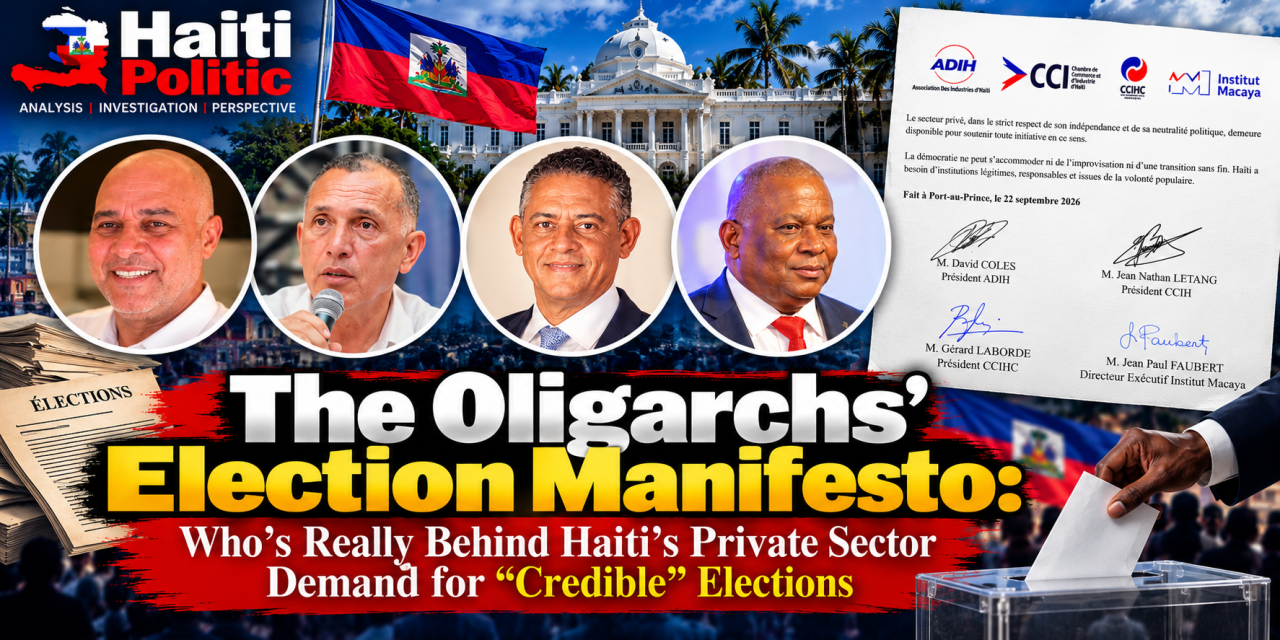
On September 22, 2026, four of Haiti’s most powerful private-sector institutions — the Association des Industries d’Haïti (ADIH), the Chambre de Commerce et d’Industrie d’Haïti (CCIH), the Chambre de Commerce et d’Industrie Haïtiano-Canadienne (CCIHC), and the Institut Macaya — published a joint “Note de Presse” calling for a credible, inclusive, and secure electoral process. Read on its own, the document is almost unremarkable: it asks for security conditions permitting free campaigning and voting, access to registration for displaced populations, independence and transparency from electoral authorities, and faster deployment of the Force de Répression des Gangs (FRG). It closes with a line that could be lifted from any pro-democracy civil society statement anywhere: “Democracy cannot accommodate either improvisation or an endless transition.”
But this note doesn’t arrive in a vacuum. It arrives at a moment when Haiti’s private sector, as a class, occupies more direct control over the machinery of the Haitian state than at almost any point in recent history — Prime Minister Alix Didier Fils-Aimé is himself a businessman, and Laurent Saint-Cyr, the former president of the American Chamber of Commerce in Haiti, now sits as Conseiller-Président at the head of the Transitional Presidential Council. Understanding what this note actually means requires knowing who signed it, what the institutions behind those signatures have actually done — and how many times Haiti has already heard this exact message before.
The Four Signatories
David Coles, President of ADIH. Coles was elected president of the Association des Industries d’Haïti at its general assembly on June 24, 2026, after previously serving as the association’s vice-president for the agro-industrial sector. ADIH itself is one of Haiti’s oldest business associations, founded in 1980 and recognized as a public utility since 1989, representing roughly 100 manufacturers and crediting itself with providing jobs to more than 60,000 Haitians. Institutionally, ADIH has a long and well-documented history of positioning itself as a political actor, not merely an economic one: in 1986 it called on the Duvalier government to exercise “tolerance and moderation” amid social upheaval; after the 1991 coup that brought General Raoul Cédras to power, it managed escrow accounts for tax collection from foreign corporate entities until 1994; and in 2004 it publicly characterized the second overthrow of President Jean-Bertrand Aristide as a positive development. It has also, in coordination with Bill Clinton, successfully lobbied the U.S. government for the trade preference laws (HOPE, HOPE II, HELP) that its assembly-manufacturing member companies depend on.
Jean Nathan Létang, President of CCIH. Létang leads the Chambre de Commerce et d’Industrie d’Haïti, the national federation that describes itself as the highest representative body of Haiti’s private sector, originally instituted by presidential decree in 1907. He previously headed the departmental Chambre de Commerce et d’Industrie du Sud, and has been a visible signatory on multiple recent formal accords — including a January 2026 customs-facilitation protocol signed alongside the Minister of Economy and Finance and ADIH’s leadership, and a May 2025 agreement bringing $380 million in Chilean investment into southern Haiti.
Gérard Laborde, President of CCIHC. Laborde has led the Chambre de Commerce et d’Industrie Haïtiano-Canadienne for several years — he was already signing joint patronal statements on customs policy as CCIHC’s president back in 2023, alongside the presidents of AmCham, CFHCI, and ADIH. In prior public remarks, Laborde has specifically called for greater transparency within employer chambers, including CCIHC and ADIH, and has pressed the Haitian state to “play its role correctly.” He has also been active in corporate social responsibility initiatives tied to member companies, including announcing a Digicel-backed internship partnership for vocational graduates.
Jean-Paul Faubert, Executive Director of Institut Macaya. Of the four organizations on this note, Institut Macaya has by far the most documented and scrutinized recent history — and it’s worth walking through carefully, because it’s the clearest evidence-based link between “the private sector” and direct political power in Haiti today. According to reporting from the Center for Economic and Policy Research (CEPR), Ayibopost, and RHINews, Institut Macaya was born out of meetings held in Florida during the summer of 2022 — at precisely the moment Washington was openly discussing sanctions in response to escalating gang violence in Haiti. It describes itself as an 18-member private-sector think tank. Faubert is not its founding director; he succeeded an earlier executive director who had previously led a similarly-framed 2014 initiative called Haïti Chérie, which was publicly presented as a gathering of the “young economic generation” but which reporting describes as a vehicle that mainly channeled political influence. Individuals tied to that earlier Haïti Chérie network — Allan Zuriak, Sherif Abdallah, Marc-Antoine Acra, and Steeve Khawly, alongside Reuven Bigio and Christopher Handal, who remain involved with Macaya today — have, per CEPR’s reporting, seen three of that group (Abdallah, Acra, and Khawly) subsequently sanctioned by Canada. Faubert himself, before joining Macaya, spent fifteen years at Alternative Insurance Company under Olivier Barreau, an early Macaya backer who has since left the organization and may himself be a future electoral candidate. Under Faubert, Macaya has engaged in direct Washington lobbying — hiring American consultant Andrew Cheatham and spending roughly $30,000 in the first two months of that contract alone, timed to coincide with Laurent Saint-Cyr’s ascension to the head of the Transitional Presidential Council. Faubert has himself publicly acknowledged the sector’s problem: “It’s clear the private sector has a bad reputation both locally and internationally… It’s not through words that we will change that, it is through action.”
What This Means — and What It Doesn’t
It’s worth being precise here, because two different critiques are getting blended together, and only one of them is actually supported by the evidence.
The unsupported version is that these four specific individuals — Coles, Létang, Laborde, or Faubert — are personally implicated in gang financing or the sanctions-worthy conduct some of their institutional predecessors and associates have faced. None of the four has been named in any sanctions designation or documented reporting tying them personally to that conduct, and fairness requires saying so plainly.
The supported version is more damning in a different way: it’s a track record. For over four decades, Haiti’s leading business associations — ADIH chief among them — have organized primarily around one strategic objective: preserving preferential U.S. trade access (HOPE, HOPE II, HELP, CBTPA) for a low-wage assembly and textile export sector that has never meaningfully diversified Haiti’s economy, built domestic industrial capacity, or reduced the country’s dependence on imported goods and foreign remittances. That’s not a conspiracy claim — it’s ADIH’s own stated advocacy history. The same organizations now signing notes about “credible elections” and “institutions issued from the popular will” have spent decades lobbying Washington far more consistently and successfully than they’ve lobbied for Haitian industrial policy, education, infrastructure, or a functioning tax base. Institut Macaya’s founding is the starkest recent example: born in Florida in 2022 specifically in response to the threat of U.S. sanctions, its most tangible recent activity has been hiring an American consultant to manage its Washington messaging — not a documented domestic investment, job-creation, or development initiative on anything close to the same scale. Measured against ADIH’s own claim of 60,000 jobs created since 1980, against a Haitian labor force of several million, the private sector’s decades-long economic “output” looks considerably smaller than its political footprint.
The Pattern: A Ritual That Repeats Every Time Elections Approach
This September 22 note isn’t a one-off. It’s at least the third near-identical statement from the same cluster of business associations in 2026 alone. On June 9, 2026, CCIH, ADIH, and AmCham Haïti issued an unusually firm call to Prime Minister Fils-Aimé’s government and the Provisional Electoral Council to resolve their standoff over a contested electoral decree — a dispute the CEP itself viewed as an encroachment on its independence. The very next day, June 10, the same patronal associations reversed tone and welcomed that decree, praising its emphasis on “integrity, transparency, impartiality, inclusion, and modernization.” Three months later, the same institutions are back with the September note — using nearly identical language: “crédible,” “inclusif,” “sécuritaire,” warnings against elections reduced to a “simple formality,” and calls to end a “transition without a deadline.” Same vocabulary, same signatories’ orbit, different month.
That repetition is itself the story — and it’s not just this outlet noticing it. Rezo Nòdwès published a pointed analysis on September 24 arguing that this note amounts to the private sector — now literally running the transitional government — describing the “state of progress” of an electoral process it controls. The piece lays out the specifics: voter registration barely above 10% of the eligible electorate (roughly 650,000 registered as of mid-September, per the CEP itself), a calendar already pushed back once, the decree fight between the Primature and CEP unresolved for months, and — most pointedly — the continued, largely unaddressed laundering of kidnapping ransom money through the same economy this private sector claims to represent. The analysis’s core accusation is that the formal private sector voices concern over insecurity only when it threatens its own interests — airport access, national roads — while staying conspicuously quiet about the illicit financial flows that everyone in Haiti’s business community knows are corrupting the ground on which any election will be run.
The conflict-of-interest problem is structural, not incidental: Prime Minister Fils-Aimé is himself a former private-sector figure who rose to the premiership with backing from business circles, including AmCham specifically, and previously ran for Senate under the Vérité banner — meaning the executive branch currently responsible for organizing “credible” elections is led by someone whose own political rise came directly out of the sector now publishing notes demanding that credibility. He is both referee and player in the same game.
Put together with Institut Macaya’s founding — a network born in 2022 specifically to manage the threat of U.S. sanctions, now spending its resources on Washington messaging rather than documented domestic investment — the pattern that emerges isn’t a sector sounding a disinterested alarm about democracy. It’s a sector that reliably issues a public statement of concern every time an election cycle’s credibility is genuinely at risk of slipping beyond its own influence, timed to protect its access to whatever government comes next, while its own conduct — on illicit finance, on economic diversification, on the conflicts of interest running through its own alumni now in office — goes largely unexamined in the same notes.
The Bottom Line
None of this means Haiti doesn’t need credible, secure, inclusive elections — it desperately does, and nothing in this piece disputes that the underlying demands in the September 22 note are reasonable on their face. What it means is that the messengers deserve exactly the scrutiny they’re asking Haiti’s electoral institutions to submit to. A sector that helped put its own alumni atop both the Primature and the Transitional Presidential Council, that issues near-identical “credibility” notes on a roughly quarterly cycle without visible follow-through, and that has stayed notably silent on the illicit money flows corrupting the same political economy it operates in, is not a neutral referee calling for fair play. It’s a player calling the fouls selectively — and Haitians reading this note are entitled to notice the difference.