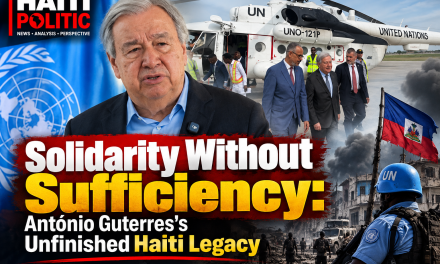

An investigative analysis of the August 2026 Kenscoff attack, the armed groups behind it, and nearly seventy years of political violence timed to Haiti’s moments of transition
The Massacre
Between the night of August 23 and the early hours of August 24, 2026, fighters aligned with the Viv Ansanm gang coalition — designated a foreign terrorist organization by the United States — pushed into the geographic center of Kenscoff, a mountain farming commune above Port-au-Prince long regarded as one of the last relatively safe refuges near the capital. Kenscoff Mayor Jean Massillon confirmed that armed men burned homes and killed residents, and said the full toll was impossible to establish immediately given how badly the attack disrupted access and communication. Within a day, wire services citing local media placed the confirmed dead at roughly 40, a number local officials warned would likely climb as recovery efforts continued.
The victims were concentrated in a community mayor Massillon said he had spent 20 months warning was in danger. Among those affected: members of the SOHADERK farming cooperative, and property connected to Dr. Jean “Bill” Pape, a physician whose Haitian NGO treats HIV and tuberculosis patients — meaning the attack struck not only homes but institutions that serve the wider region’s basic welfare. Survivors described searching for bodies in the streets at dawn; one farmer told the Associated Press he lost fourteen family members, with others still unaccounted for. The assault reached near the mayor’s office and a police substation — a detail that matters, because it signals gang forces are no longer content to control peripheral, ungoverned space. They are now willing to fight at the doorstep of what remains of local government itself.
This was not Kenscoff’s first ordeal. The commune’s first major assault came on January 27, 2025; a multi-day massacre followed in early July 2026; and a UN report tied at least 262 deaths and 66 injuries in the commune to gang violence between January and March 2025 alone. Nationally, human rights monitors have documented at least 10 gang-related massacres in just the first six months of 2026, concentrated in Artibonite, Kenscoff, and the Central Plateau, killing more than 2,000 people. August’s attack on Kenscoff is best understood not as an isolated atrocity but as the latest escalation in an 18-month campaign to seize the last defensible high ground near the capital.
Who Is Behind It
The armed coalition responsible, Viv Ansanm (“Living Together”), emerged from the merger of Haiti’s two dominant gang federations — the G9 an Fanmi e Alye and the rival GPèp coalition — under the increasingly public leadership of Jimmy “Barbecue” Chérizier. Chérizier’s trajectory is itself instructive: a former Haitian National Police officer dismissed in 2018 over his alleged involvement in extrajudicial killings, he founded G9 in 2020 as a coalition explicitly aligned with the government of then-President Jovenel Moïse, who is widely reported to have supplied the group with weapons, funding, and effective immunity in exchange for suppressing opposition and maintaining control over fuel distribution and extortion networks in poor neighborhoods.
That state-gang relationship collapsed after Moïse’s assassination in July 2021, but the capacity it built did not disappear — it simply became autonomous. Chérizier now casts himself as a revolutionary opposed to Haiti’s political and economic elite, while continuing to run the extortion, kidnapping, and territorial-control apparatus his G9 network built under state patronage. Viv Ansanm now controls an estimated 85 percent of Port-au-Prince and has extended its reach into rural communes like Kenscoff, turning a once-informal alliance of urban street gangs into something closer to a rival territorial authority — what one security analysis has termed less a criminal insurgency than the gangs functioning as an armed praetorian guard once loyal to the elite, now operating on their own account.
The Pattern: Violence and Transition Since 1957
Haiti’s current crisis is extreme, but it is not without precedent — and understanding the pattern requires going back to 1957, when François “Papa Doc” Duvalier took power with military backing after a period of post-Magloire instability and multiple provisional governments. Duvalier quickly built the Tontons Macoutes, an irregular paramilitary and secret police force loyal to him personally rather than to any state institution, which he used to suppress rivals, terrorize the population, and counterbalance the formal armed forces. That structural choice — arming an irregular, personally loyal force outside the formal chain of command as a substitute for institutional authority — is the thread that connects 1957 to Kenscoff in 2026.
The pattern has recurred at nearly every subsequent transition:
- 1971 and 1986 — Power passed from “Papa Doc” to “Baby Doc” Duvalier in 1971, and the Macoute apparatus of violence continued for another 15 years until a popular uprising (déchoukaj, “uprooting”) forced Jean-Claude Duvalier into exile in February 1986. What followed was not stability but a string of short-lived provisional and military governments through 1990 — each transition its own window of vulnerability.
- 1991 — Jean-Bertrand Aristide won Haiti’s first genuinely democratic election with 67 percent of the vote, took office in February 1991, and was overthrown within seven months by an army coup — triggering years of military-regime repression before UN intervention restored him.
- 2004 and after — Aristide’s second removal from power in 2004 was followed by the rise of armed groups (chimères) that had operated in his political orbit, and by an unresolved national debate over disarmament that has never been fully completed in the two decades since.
- 2021 — Moïse’s assassination eliminated Haiti’s last elected head of state and left the country, as declared presidential candidate Jerry Tardieu has put it publicly, a “constitutional desert” with no elected officials remaining in office anywhere in government. That vacuum has now persisted for more than five years, through the 2026 date on which national elections are finally scheduled.
A U.S. government historical assessment of this period observed plainly that the decades following Haiti’s founding “enshrined the use of violent force to achieve political objectives, punish political opponents, and ensure economic dominance by a tiny elite” — and that Haiti has never developed the civic culture, meaning a widespread acceptance of rule of law backed by institutions strong enough to enforce it, needed to displace violence as the default mechanism of political competition.
Why the Pattern Repeats
Three structural dynamics explain why violence in Haiti so reliably clusters around moments of political transition rather than remaining constant:
1. Armed groups have consistently been built as tools of incumbents, not as independent criminal enterprises from the start. From the Tontons Macoutes under Duvalier to the chimères under Aristide to G9 under Moïse, Haiti’s ruling power in each era has found it expedient to arm an irregular force loyal to itself rather than fully invest in accountable state security institutions. That force outlives the regime that created it. When the patron falls — through death, exile, or ouster — the armed group doesn’t disband; it becomes a freelance power center competing to fill the resulting vacuum, exactly as G9 and its successor Viv Ansanm did after Moïse’s assassination.
2. Elections and transitions are the moments when the state’s monopoly on legitimate authority is most contested — which is precisely when non-state armed actors have the most incentive to demonstrate that they, not the state, control the ground. An attack that reaches a mayor’s office and a police substation, as the Kenscoff assault did, functions as a message: state authority is nominal, not real, in the territory contested. With Haiti’s first national election since 2016 scheduled for December 2026, gangs asserting territorial dominance ahead of the vote serves both a practical purpose (leverage over whichever government emerges) and a symbolic one (demonstrating the state cannot guarantee the basic security a credible election requires).
3. Disarmament has never been completed, and international intervention has repeatedly proven temporary. Every previous international security intervention in Haiti — including UN peacekeeping missions after 1994 and again after 2004 — succeeded in temporarily curbing armed groups’ ability to dominate the use of force, but those gains did not hold once international forces drew down. The current UN-backed Gang Suppression Force, which has announced plans to deploy into Cité Soleil and Artibonite, faces the same structural test that has defeated every predecessor: clearing territory is achievable; holding it after departure has not been.
What Haiti Needs
Drawing directly from this 68-year pattern, several structural interventions — distinct from another short-term security surge — are what analysts, Haitian officials, and international assessments have pointed to as necessary to actually break the cycle rather than pause it:
- Consolidation, not just clearing operations. Kenscoff’s own mayor has said explicitly that police have repeatedly pushed back gang incursions only for the area to fall again once forces withdraw — what he called the missing piece of “consolidation,” meaning a sustained security presence that holds territory rather than a raid that temporarily displaces it.
- A credible, resourced national police and justice system independent of any single political patron. The recurring failure mode since 1957 has been governments arming irregular loyalist forces instead of building professional institutions accountable to law rather than to whoever currently holds power. Breaking that pattern requires the opposite: an HNP and judiciary insulated from being any future president’s personal instrument.
- A disarmament, demobilization, and reintegration program with real economic alternatives. Haiti’s gangs recruit heavily from a population with few other paths to income; previous disarmament efforts have failed in part because they offered no sustainable alternative livelihood, allowing fighters to remobilize under new banners.
- International support structured for the long term, not a drawdown-prone deployment. Every past intervention’s central failure has been durability. A force present long enough to allow Haitian institutions to actually rebuild — rather than one calibrated to a donor nation’s political attention span — is what multiple security assessments argue is required to prevent the gains from evaporating again.
- An election capable of producing a government seen as legitimate by Haitians themselves, not just by the international community. Given that armed groups have consistently justified their existence, in part, as a response to what they call corrupt and unaccountable politicians, a transparent, credible December 2026 vote — with real efforts to secure polling access for the 1.4 million internally displaced — is a precondition for any government that follows to have the standing needed to actually govern the territory it nominally leads.
None of these are quick fixes, and Haiti’s history since 1957 offers a caution against expecting any single intervention — a new leader, a foreign force, an election — to end the cycle on its own. Each of those has been tried, and each has produced a temporary calm before violence reasserted itself at the next transition. What Kenscoff demonstrates is less that Haiti has failed to interrupt gang violence, and more that it has never yet interrupted the underlying incentive structure that produces new armed groups every time political power changes hands.