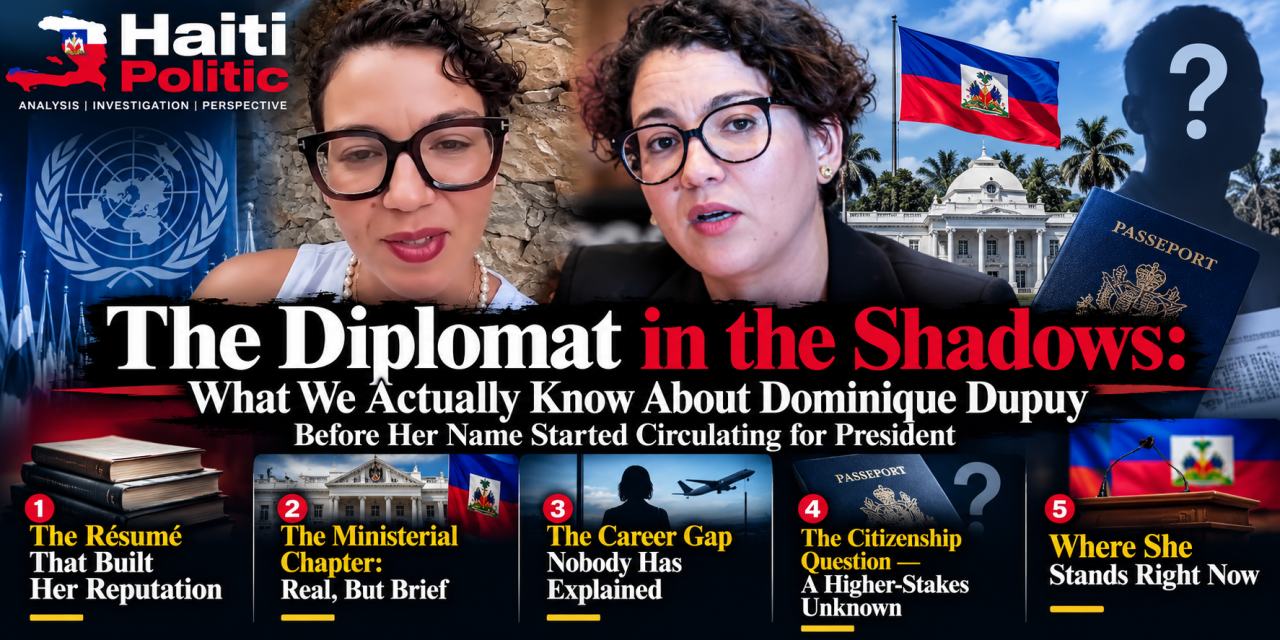
As Haiti’s political class jockeys for position ahead of the 2026 elections — with the Provisional Electoral Council reporting seven registered presidential candidacies as of September 21, and figures like Wilner Joseph (VIKTWA) and Gary Bodeau (REKONSILYE) already formally in the race — one name keeps surfacing in political conversation without yet appearing on that official list: Dominique Dupuy. The 36-year-old former Foreign Minister has spent recent weeks doing everything a candidate does except announce a candidacy — registering to vote in Cap-Haïtien in August, publicly urging citizens to do the same, and, just days ago, releasing a video statement invoking something she calls “Chimen Limyè” — “path of light” — while declining to say whether it’s a movement, a platform, or simply a personal philosophy she’ll reveal “when the moment comes.”
Before Haitians decide whether that moment matters, it’s worth laying out, plainly and completely, what her actual record shows — the genuine accomplishments, the thinner patches, and two unresolved questions voters deserve to have answered before any campaign goes further.
The Résumé That Built Her Reputation
Dupuy’s public career began with a direct political appointment: in November 2020, President Jovenel Moïse named her Haiti’s Permanent Delegate to UNESCO in Paris. She held that post for nearly four years, and it’s genuinely the strongest part of her record. She filed Haiti’s formal UNESCO candidacy for soup joumou in March 2021 and carried it through to a successful inscription on the Intangible Cultural Heritage list in December 2021 — though it’s worth being precise that the underlying heritage documentation and national inventory work behind that dossier had been developing for years before her appointment; she inherited and completed a project rather than originating it from scratch. She went on to file additional heritage candidacies — Bois Caïman, Konpa/Compas, a joint cassava nomination with Cuba, Honduras, the Dominican Republic and Venezuela — and in November 2023 was elected by fellow UNESCO member states as Vice-President of the organization’s Executive Board for the Latin America and Caribbean group, the first Haitian to hold that role. That’s a real, externally validated diplomatic accomplishment — it required other countries’ delegations to vote for her, not just Haitian government favor.
The Ministerial Chapter: Real, But Brief
In June 2024, under Prime Minister Garry Conille, Dupuy was named Minister of Foreign Affairs, Religious Affairs, and Haitians Living Abroad. She held the post for barely five months, until November 16, 2024, when the Conille government itself was replaced. Her appointment, like nearly every ministerial appointment in Haiti’s transitional governments since 2023, was never ratified by a Senate — because Haiti hasn’t had a functioning elected Senate to ratify anything.
What’s documented from that window: her ministry intervened to help 12 stranded Haitians, including three infants, stuck at Guayaquil airport in Ecuador after a canceled flight and expired visas left them in limbo — a concrete, verifiable act of consular assistance. Beyond that, her own office’s 100-day communiqué cited appointing 33 women to leadership positions within the ministry and general language about strengthening anti-corruption efforts and international relations — claims that are her own office’s characterization, not independently documented outcomes with named results attached. Five months is a short runway to build a ministerial legacy, and that brevity is a fair mitigating factor. But it also means voters weighing her presidential viability are working with a genuinely thin sample of how she performs running an actual government institution, as opposed to representing Haiti at a single UN agency.
The Career Gap Nobody Has Explained
Dupuy’s education is fully documented: a diploma in social sciences from Cégep Vanier in Montreal (2008), an exchange semester at Lancaster University studying forced-migration trauma (2011), and a bachelor’s degree in international development from McGill University (2012). What comes next — and what should come next in any normal biography — is a professional record. It isn’t there. Not in her English or French Wikipedia entries. Not in half a dozen sympathetic Haitian press profiles that otherwise catalog her UNESCO and ministerial record in granular detail. And not on her own LinkedIn profile, which shows only her McGill education, no listed employers, just two connections, and no recent activity — an unusually bare professional footprint for someone who went on to represent her country at a major UN agency and later serve in her national cabinet.
That means there are eight years — from her 2012 graduation to her November 2020 appointment — with no publicly documented professional history at all. To be fair, an absence of documentation is not proof of wrongdoing, and it’s entirely possible she held roles that simply never generated press coverage or an online record. But it is a legitimate and unusually large blank spot in the biography of someone now being discussed for the presidency.
The Citizenship Question — A Higher-Stakes Unknown
There is a second, more consequential open question, and it has a longer paper trail than many realize.
On March 24, 2024 — the same day Dupuy announced her abrupt withdrawal from the Transitional Presidential Council after less than a week on it — Radio Télévision Caraïbes reported that her Haitian-Canadian status was among the factors swirling around her turbulent, short-lived tenure, alongside discriminatory remarks reportedly made about her age. The outlet’s own language was careful: “elle serait haïtiano-canadienne” — “she would reportedly be Haitian-Canadian” — the conditional tense Haitian press uses specifically to flag an unconfirmed claim. That claim has now circulated in credible Haitian media for more than two years without, as far as the public record shows, ever being directly confirmed or denied by Dupuy herself, and without documentary proof — a citizenship certificate, a court record — surfacing publicly either way.
This isn’t a matter of curiosity. If true, it would collide directly with Haitian constitutional law. Article 15 of the 1987 Constitution states that dual Haitian and foreign nationality is not admitted under any circumstances. Article 13 goes further: Haitian nationality is lost the moment a citizen acquires naturalization in a foreign country. Read together, if Dupuy did formally naturalize as Canadian — as opposed to simply holding residency or a study/work visa during her Montreal years — the constitutional text says she would have automatically forfeited her Haitian nationality at that moment, which would be fatal to any future presidential bid.
It isn’t fully that simple, though, and the complication matters. A political fight over exactly this question dates back to 2005–2006, when Dumarsais Siméus, a naturalized American, sought to run for president, prompting President René Préval to signal openness to constitutional reform permitting dual nationality. A 2011 constitutional amendment did attempt to address the issue. But — echoing other contested amendments in Haiti’s recent constitutional history — the validity and proper promulgation of that 2011 amendment package has itself been disputed by Haitian legal scholars for years. The honest answer is that it remains genuinely unsettled, as a matter of Haitian constitutional law, whether dual nationality is barred outright or conditionally tolerated today — meaning even confirming the underlying citizenship fact wouldn’t fully resolve the eligibility question on its own.
What can be said plainly: this is a credible, previously reported allegation from a mainstream Haitian outlet, tied to a specific constitutional provision with real disqualifying force, and it has gone unaddressed by Dupuy in public for over two years. Any voter — or any rival candidate — taking her potential candidacy seriously has a legitimate basis to demand a direct answer before this goes any further.
Where She Stands Right Now
As of this week, Dupuy has not filed a presidential candidacy with the CEP. Her most recent public statement, released in mid-September, was carefully hedged: she said she wants to avoid her name being associated with certain unnamed political figures whose backgrounds she questions, or with anyone tied to illicit enrichment cases, and framed her eventual direction only as “Chimen Limyè,” declining to specify whether that’s a party, a coalition, or simply a personal standard. That combination — active positioning paired with formal non-declaration — is a familiar pre-candidacy posture in Haitian politics, and it leaves her, for now, adjacent to the race rather than officially in it.
The Honest Verdict
Dupuy brings real assets to any future candidacy: a multilingual, internationally fluent profile; a genuine, peer-validated diplomatic track record at UNESCO; and a public image, carefully cultivated, of technocratic competence in a political class where that’s in short supply. But the case for her isn’t as complete as her admirers present it, and isn’t as empty as a hostile framing would suggest either. Her ministerial record is real but brief and thinly documented. Her most-cited signature achievement, soup joumou, is one she completed rather than conceived. The eight-year gap before her diplomatic career began remains unaccounted for in the public record. And hanging over all of it is a two-year-old, still-unanswered question about whether she even holds the exclusive Haitian nationality the constitution demands of anyone seeking its highest office. None of this disqualifies her outright — but it does mean the “impressive parcours” framing that’s followed her through Haitian press coverage needs to be paired, from here forward, with direct answers to the harder questions her record still leaves open.