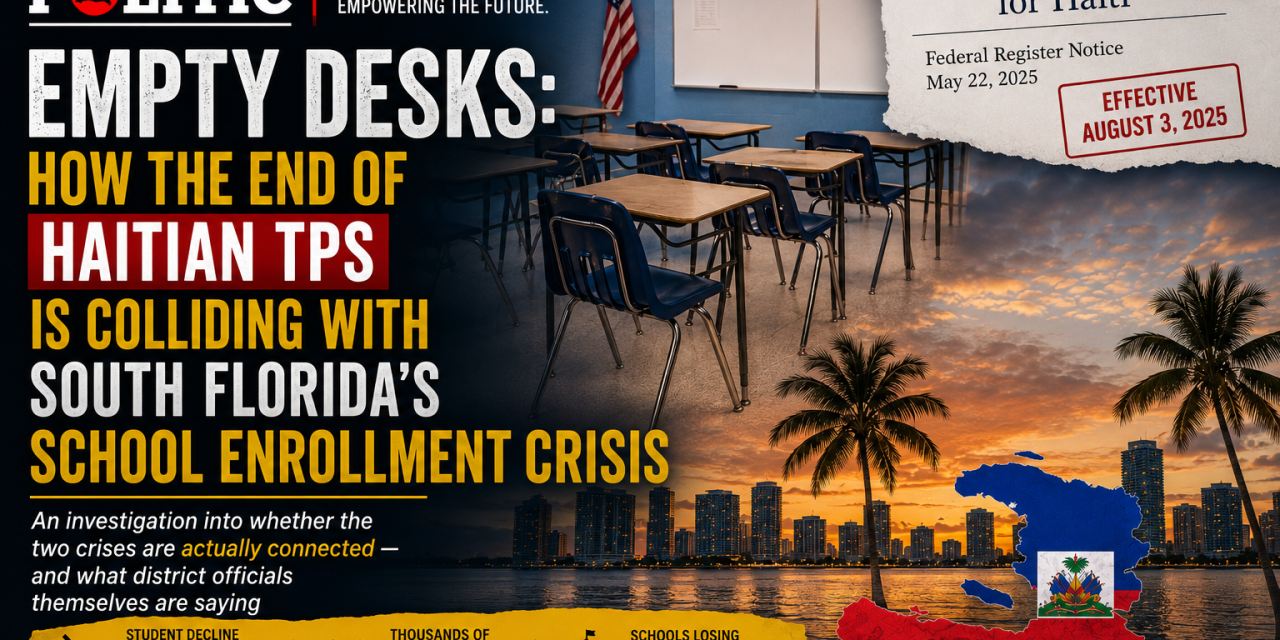
An investigation into whether the two crises are actually connected — and what district officials themselves are saying
South Florida’s public schools were already losing students before Haiti’s Temporary Protected Status designation ended this summer. The question this investigation set out to answer is whether those two facts are actually connected, or merely coincidental timing. Based on on-the-record statements from three separate school district superintendents, enrollment data spanning multiple budget cycles, and confirmed staffing losses tied directly to TPS expiration, the answer is: yes, demonstrably — though it is compounding a decline that predates the TPS crisis, not single-handedly causing it.
The Numbers, District by District
Broward County, the nation’s sixth-largest school district, opened the 2026-27 school year on August 10 with 11,000 fewer students than the same day the previous year — a gap superintendent Howard Hepburn said translates to roughly $100 million in lost funding, since Florida school budgets are tied directly to student headcount. Broward is home to the largest concentration of Haitian TPS holders of any district in the country — Florida holds an estimated 113,000 Haitian TPS holders statewide, more than any other state — and Hepburn has been explicit and public about the connection. At a district budget hearing in late July, he identified the TPS termination as “one of my biggest or largest concerns right now,” and the district’s own long-range projections now estimate 25,700 fewer students by the 2030-31 school year, on top of an enrollment decline that has already been “playing out for two decades,” according to WLRN’s reporting. The district faces a nearly $100 million current shortfall as a direct result.
Palm Beach County tells a strikingly similar story. Superintendent Mike Burke confirmed the district lost 19 employees directly as a result of TPS expiration — a mix of bus drivers, food service workers, custodians, substitute teachers, and one full-time teacher — because, per district policy, all employees must be legally authorized to work in the U.S. Burke told the Palm Beach Post his district doesn’t yet know precisely how enrollment will be affected, but the timing compounds an existing problem: enrollment was already down roughly 7,900 students the prior year and projected to fall by another 3,000 this year, even before the TPS decision received final court approval on August 5. The Florida Public Services Union has estimated as many as 2,000 Haitian students in Palm Beach County alone could be directly affected by the TPS changes.
Orange County, in Central Florida — not South Florida geographically, but home to an estimated 350,000 Haitian residents, one of the largest concentrations in the country — lost nearly 50 employees, mostly support staff, tied to the same TPS termination. The district’s enrollment drop was steeper still: 6,600 fewer students at the start of the 2025-26 school year, including roughly 2,500 immigrant students who had previously attended OCPS schools, contributing to a $41 million budget deficit that forced the reassignment of more than 100 classroom teachers and the elimination of over 200 district-level positions.
Two Distinct Mechanisms, Not One
What the district-level data makes clear is that TPS termination is hitting South Florida’s schools through two separate channels simultaneously, and it’s worth being precise about the distinction because they carry different implications:
1. Direct staffing losses. This is the most immediately quantifiable effect, and it’s not in dispute — districts have confirmed exact numbers. Palm Beach lost 19 employees outright; Orange County lost nearly 50. Federal law requires every school district employee to be legally authorized to work in the U.S., and TPS-based work authorization is exactly the kind of legal status that lapsed when Haiti’s designation ended on July 27, 2026. Bus drivers, food service workers, classroom aides, and substitute teachers — often filled disproportionately by Haitian immigrants in South Florida’s labor market — were let go as a direct, mechanical consequence of the policy change, not a downstream ripple effect.
2. Enrollment decline — which is real, significant, and harder to attribute with precision. Here the picture is more layered. Broward’s Hepburn and Palm Beach’s Burke have both explicitly and publicly named TPS termination as a driver of enrollment concern going forward. But it’s also true that South Florida’s school enrollment has been declining for other, longer-running reasons that predate the TPS crisis entirely: rising cost of living pushing families out of the region, the expansion of Florida’s Family Empowerment Scholarship program (which shifts students from public to private/charter options), and broader demographic shifts. Notably, Palm Beach County’s own official statement attributed its enrollment losses to “demographic changes in our region, the rising cost of living… and the expansion of the Family Empowerment Scholarship program” — without naming TPS directly in that specific framing, even as the same district simultaneously confirmed its TPS-driven staffing losses. Miami-Dade’s superintendent, in a separate account, attributed enrollment miscalculations to “fewer immigrant families moving to South Florida” — a framing about reduced in-migration rather than existing families leaving, which is a subtly different phenomenon than deportation-driven departure.
What the Investigation Could Not Confirm
It’s important to state plainly what remains genuinely uncertain, based on the public record as of this reporting:
- No district has published data definitively separating “TPS-attributable” enrollment loss from other causes. Superintendents have named TPS as a concern and a contributing factor, but none have produced a specific figure like “X students left specifically because their families lost TPS status.” The $100 million Broward shortfall, for instance, reflects the full 11,000-student gap — not an isolated TPS-attributable subset of it.
- It is not established whether enrollment-declining families are leaving Florida, leaving the country, or simply not enrolling out of fear — pulling children from school due to fear of immigration enforcement, even when the family remains in the area, is a distinct phenomenon from actual departure, and both would show up identically in headcount data. Broward’s Hepburn addressed this directly, telling families that Broward schools remain, in his words, one of the safest environments for students, and that law enforcement has not removed a student from a Broward school under the current immigration enforcement environment — a statement aimed specifically at countering fear-driven non-enrollment rather than actual relocation.
- The timing overlap is strong but not, by itself, proof of a single cause. TPS formally ended July 27, 2026, just two weeks before Broward’s and Palm Beach’s school years began — a tight enough window that district officials themselves flagged it as significant. But an enrollment decline “playing out for two decades,” in Hepburn’s own words, means any single-year TPS effect is landing on top of a pre-existing structural trend, not creating the trend from nothing.
The Bottom Line
The claim that South Florida’s enrollment crisis is “related to” the TPS crisis is not speculative — it’s confirmed by the school officials closest to the data, on the record, across three separate districts. What the investigation does not support is a stronger causal claim that TPS termination is the primary or sole driver of the region’s enrollment losses. The more accurate picture is one of compounding crises: a decades-long enrollment decline driven by cost-of-living pressure and school-choice policy shifts, now intersecting with a sudden, sharp, and precisely quantifiable staffing shock from TPS termination, plus a less precisely measurable but district-acknowledged enrollment effect that superintendents themselves are still trying to isolate as the 2026-27 school year unfolds. Whether that enrollment effect grows sharper in the months ahead — as more Haitian families navigate the practical consequences of losing legal status — is, per the districts’ own admissions, still an open and closely watched question rather than a settled one.