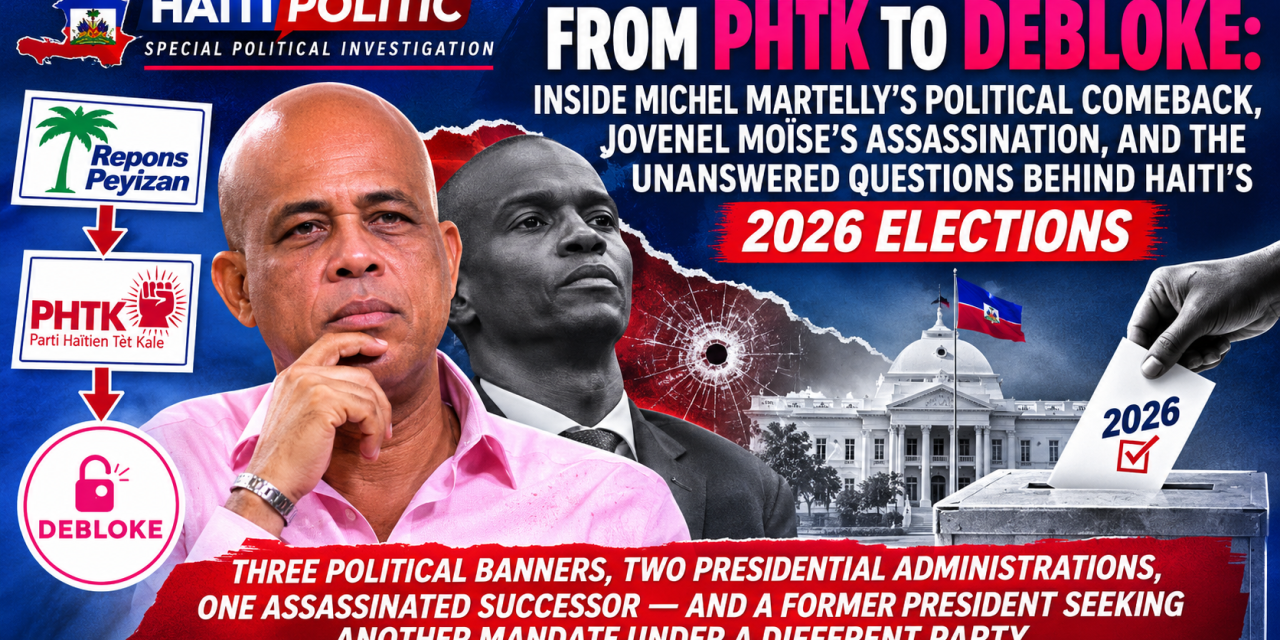
THREE POLITICAL BANNERS, TWO PRESIDENTIAL ADMINISTRATIONS, ONE ASSASSINATED SUCCESSOR — AND A FORMER PRESIDENT SEEKING ANOTHER MANDATE UNDER A DIFFERENT PARTY
HAITI POLITIC | SPECIAL POLITICAL INVESTIGATION
November 9, 2026
INTRODUCTION — THE PRESIDENT WHO CHANGED HIS POLITICAL BANNER
Michel Joseph Martelly is attempting something few former Haitian presidents have accomplished: returning to the presidency after completing a five-year mandate.
But his political comeback raises an important question.
Why is the former president seeking another mandate under DEBLOKE instead of the Parti Haïtien Tèt Kale (PHTK), the political organization associated with his administration and the election of his chosen successor, Jovenel Moïse?
The question becomes more consequential when three developments are considered together.
First, PHTK did not register under its own name for the 2026 electoral process.
Second, Martelly registered for the presidency under DEBLOKE, a coalition that includes former PHTK members.
Third, the political movement associated with Martelly has never fully escaped the consequences of the assassination of President Jovenel Moïse on July 7, 2021.
Add to this Martelly’s international sanctions, questions surrounding his constitutional eligibility, and the revised electoral rules adopted shortly before his registration.
The result is a political comeback that requires examination beyond campaign speeches and party slogans.
Is DEBLOKE a new political project, an expansion of Martelly’s former political network, or an effort to reorganize that network under a different electoral identity?
The available evidence establishes the political transition. It does not yet establish Martelly’s private reasons for making it.
PART I — BEFORE PHTK, THERE WAS REPONS PEYIZAN
1. MARTELLY DID NOT ORIGINALLY BECOME PRESIDENT UNDER PHTK
One of the most overlooked facts in Martelly’s political history is that he did not win his first presidential election under PHTK.
During the 2010–2011 electoral cycle, Martelly ran under Repons Peyizan.
He entered the presidential race as a popular musician without previous elected office experience.
His campaign presented him as an alternative to Haiti’s established political class.
Following a controversial electoral process, Martelly won the runoff and became president on May 14, 2011.
His presidency ended on February 7, 2016.
During his administration, the political movement associated with him developed into PHTK.
The party subsequently became the principal electoral organization supporting his chosen successor.
This history matters because DEBLOKE is not Martelly’s first change of political vehicle.
Repons Peyizan brought Martelly to the presidency. PHTK became associated with his governing movement. DEBLOKE is now carrying his attempt to return.
A change in electoral organization is not necessarily evidence of ideological inconsistency. However, repeated changes make it important to examine whether the candidate’s policies, leadership network, and political commitments have also changed.
PART II — THE CREATION OF PHTK AND THE RISE OF JOVENEL MOÏSE
2. MARTELLY’S POLITICAL SUCCESSOR
By the time Haiti approached the 2015 presidential election, Martelly could not immediately seek another consecutive term.
Haiti’s Constitution prohibits consecutive presidential mandates.
Martelly therefore supported businessman Jovenel Moïse as the PHTK presidential candidate.
Moïse, previously known for his agricultural business activities, entered national electoral politics with the support of Martelly’s political movement.
The 2015 election became highly controversial.
Following disputes over the electoral process, a new presidential election was held in 2016.
Moïse won and assumed the presidency on February 7, 2017.
This marked an important development.
PHTK had become the political organization associated with two consecutive Haitian presidencies.
Martelly had completed his mandate, but the political movement he helped establish remained connected to executive power.
A Congressional Research Service report on Haiti under Martelly documents the disputed 2015 electoral process and the nomination of Moïse as the PHTK candidate.
THE QUESTION OF POLITICAL CONTINUITY
Was Moïse’s presidency intended to continue Martelly’s political program?
To what extent did Moïse maintain the same political alliances?
Which officials, financial priorities, and institutional practices continued from one administration to the next?
And where did Moïse develop an independent political direction?
These questions are important because the relationship between Martelly and Moïse cannot be reduced to the fact that they belonged to the same political organization.
A president may be elected through a party while subsequently developing disagreements with its founders or other leaders.
The extent of those disagreements must be established through documented decisions and statements.
PART III — JULY 7, 2021: THE ASSASSINATION THAT CHANGED PHTK’S POLITICAL ENVIRONMENT
3. JOVENEL MOÏSE’S DEATH AND THE FUTURE OF HIS PARTY
On July 7, 2021, President Jovenel Moïse was assassinated at his private residence.
His death occurred during a period of intense political conflict, deteriorating security, and institutional instability.
The assassination removed the sitting president associated with PHTK.
It also left Haiti without an elected presidential successor ready to assume office through an ordinary constitutional transition.
For PHTK, the consequences extended beyond the loss of its president.
The assassination raised questions about the future of the political organization, its leadership, and its relationship with former officials.
Could PHTK remain politically unified without Jovenel Moïse?
And what role would Martelly play in determining its future?
THE INTERNAL-DIVISION QUESTION
Subsequent country-information reporting documented uncertainty and divisions within PHTK following Moïse’s assassination.
That provides a factual basis for examining whether the party’s internal organization weakened after 2021.
However, there is an important distinction.
Evidence of political fragmentation does not establish that the assassination directly caused PHTK’s decision not to register in 2026.
The connection remains an investigative hypothesis.
To establish it, researchers would need party resolutions, internal communications, leadership records, and testimony from officials involved in the registration decision.
4. DID MARTELLY AND MOÏSE SHARE THE SAME POLITICAL VISION?
This is another important question.
Martelly selected Moïse as his preferred presidential successor.
But political sponsorship does not necessarily mean two leaders agree on every policy or governing decision.
An investigation should compare the two administrations in several areas:
Public security: How did each administration respond to armed groups and institutional weaknesses?
Public finances: What policies governed public investment, infrastructure contracts, and financial oversight?
Elections: How did each administration address electoral disputes and the renewal of democratic institutions?
Foreign relations: What role did international partners play in supporting government programs and political negotiations?
Political appointments: Which officials served under both administrations, and what responsibilities did they hold?
Such comparisons could establish the extent of political continuity.
They could also identify meaningful differences.
But without documentary evidence, it would be inappropriate to claim that a disagreement between Martelly and Moïse explains either the assassination or PHTK’s subsequent political decisions.
PART IV — WHY DID PHTK NOT REGISTER FOR THE 2026 ELECTIONS?
5. THE MOST IMPORTANT UNANSWERED QUESTION
PHTK’s absence from the 2026 electoral registration process is central to understanding Martelly’s move to DEBLOKE.
The party associated with two presidential administrations did not appear as a participating organization under its own name.
Election monitoring published in September and October 2026 identified PHTK’s absence from the registered political groupings.
That absence creates several questions.
Did PHTK voluntarily decline to participate?
Did its leadership object to the electoral framework?
Was there disagreement within the organization?
Did its officials prefer to participate through another coalition?
Or did administrative requirements contribute to its decision?
PHTK’S STATED OBJECTIONS
PHTK president Liné Balthazar has publicly questioned the conditions surrounding the electoral process.
His reported concerns included electoral security and the credibility of elections under Haiti’s current institutional circumstances.
Those objections provide a possible explanation for nonparticipation.
But they do not, by themselves, establish every reason behind the party’s decision.
THE CONTRADICTION
If PHTK considered the electoral conditions inadequate, why did Martelly proceed under DEBLOKE?
There are several possibilities.
Martelly may have disagreed with PHTK’s leadership about participation.
DEBLOKE may have offered a broader coalition structure.
PHTK may have preferred to remain outside the process while individuals associated with it participated through other organizations.
Or the decision may reflect a combination of political and organizational considerations.
The public record does not yet establish which explanation is correct.
The most useful evidence would be PHTK’s formal decision concerning registration and a statement from Martelly explaining his relationship with that decision.
PART V — DEBLOKE: A NEW COALITION WITH FAMILIAR POLITICAL CONNECTIONS
6. WHO IS BEHIND MARTELLY’S NEW ELECTORAL VEHICLE?
DEBLOKE emerged as a political coalition before Martelly formally registered as a presidential contender.
Reporting identifies former PHTK members among individuals associated with the coalition.
This establishes continuity between parts of the former PHTK political network and Martelly’s new electoral organization.
On October 16, 2026, Martelly registered online under DEBLOKE.
On October 23, he appeared at the Provisional Electoral Council’s offices to submit the required candidacy documents.
Associated Press reporting confirmed that DEBLOKE included former PHTK members.
THE COALITION QUESTION
DEBLOKE representatives have described the organization as an alliance involving multiple political parties.
Accounts attributed to coalition officials refer to eleven participating organizations and an internal process for selecting Martelly as the presidential candidate.
Those claims deserve documentary verification.
The coalition should publish its constituent parties, leadership structure, statutes, and selection procedures.
The distinction is important.
A coalition containing former PHTK members is not necessarily legally or organizationally identical to PHTK.
Likewise, the presence of familiar political figures does not automatically establish that DEBLOKE has the same platform.
The question is what DEBLOKE has changed beyond the electoral banner.
PART VI — POLITICAL REBRANDING OR A NEW VISION?
7. WHAT DOES DEBLOKE OFFER THAT PHTK DID NOT?
Political parties sometimes reorganize to build alliances, respond to leadership disputes, or develop new platforms.
Those are legitimate political strategies.
But voters need information to distinguish organizational change from substantive policy change.
Martelly’s move raises questions about several areas of governance.
SECURITY
What specific security reforms does DEBLOKE propose?
How would those reforms differ from policies pursued during Martelly’s presidency?
What responsibilities would belong to the Haitian National Police, the justice system, and international partners?
ECONOMIC DEVELOPMENT
What measurable economic objectives would DEBLOKE establish?
How would it finance infrastructure, agriculture, employment, and public services?
What lessons would Martelly draw from the results of his first administration?
PUBLIC FINANCES
What financial oversight measures would DEBLOKE implement?
Would it support independent auditing of major public contracts?
How would its proposals strengthen accountability before the CSCCA and other institutions?
INSTITUTIONAL REFORM
What would DEBLOKE do to strengthen Parliament, the judiciary, and electoral administration?
How would it address the institutional weaknesses that developed during the administrations associated with PHTK?
FOREIGN POLICY
What would change in Haiti’s relationships with the United States, the United Nations, CARICOM, the Organization of American States, and other international partners?
Would DEBLOKE propose different arrangements for security assistance and development financing?
These policy questions provide a more concrete test of political continuity than the party’s name alone.
PART VII — THE INTERNATIONAL SANCTIONS PROBLEM
8. MARTELLY’S POLITICAL COMEBACK TAKES PLACE UNDER INTERNATIONAL SCRUTINY
Martelly’s attempt to return to the presidency is complicated by sanctions imposed by foreign governments.
On August 20, 2024, the United States Treasury imposed financial restrictions on Martelly under Executive Order 14059.
The Treasury determined that he met the applicable criteria concerning activities or transactions contributing, or posing a significant risk of contributing, to the international proliferation of illicit drugs.
The restrictions include specified limitations on transactions involving U.S. financial institutions and U.S.-jurisdiction foreign exchange.
These sanctions are administrative measures, not criminal convictions.
Canada has also imposed sanctions on Martelly, while European measures have added to the international scrutiny surrounding his political activities.
Martelly has denied allegations against him.
DOES DEBLOKE CHANGE HIS SANCTIONS STATUS?
No automatic change follows from joining a different political party.
Sanctions imposed on an individual remain applicable according to their governing legal instruments.
DEBLOKE’s existence does not, by itself, cancel those restrictions.
This creates important questions about campaign financing, financial disclosures, and compliance with applicable laws.
But the available evidence does not establish that DEBLOKE was formed to circumvent sanctions.
That allegation would require specific evidence concerning the coalition’s purpose and financial operations.
PART VIII — THE ELECTORAL DECREE AND THE TIMING OF MARTELLY’S RETURN
9. THE OCTOBER 2026 RULE CHANGE
Another significant development occurred shortly before Martelly’s registration.
On October 9, 2026, the Associated Press reported that Haiti’s electoral authorities had removed a requirement affecting candidates sanctioned by foreign governments.
The revised framework continued to distinguish such sanctions from those imposed by the United Nations.
The change meant that sanctions imposed by individual foreign governments would not automatically disqualify candidates under the removed requirement.
Martelly registered online on October 16.
He subsequently submitted his documents on October 23.
THE CHRONOLOGY
August–September 2026: DEBLOKE is active in electoral politics, while PHTK remains absent from the registered organizations.
October 9: The revised electoral framework concerning foreign sanctions is reported.
October 16: Martelly registers online under DEBLOKE.
October 23: Martelly submits his candidacy documents.
The sequence is relevant.
However, timing alone does not establish that the electoral decree was modified specifically for Martelly.
Nor does it establish that DEBLOKE was created for the purpose of benefiting from that modification.
Those questions would require evidence concerning the decision-making process behind the decree.
PART IX — CAN MARTELLY LEGALLY SERVE A SECOND TERM?
10. THE CONSTITUTIONAL QUESTION
Haiti’s amended Constitution allows a former president to serve one additional, nonconsecutive presidential term after a five-year interval.
Article 134-3 prohibits a third term.
Martelly served from May 2011 to February 2016.
Consequently, the five-year interval requirement does not, by itself, appear to prevent him from seeking a second mandate.
But presidential eligibility involves additional conditions.
Article 135 includes requirements concerning nationality, civil and political rights, habitual residence, five consecutive years of residence in Haiti before the election, and applicable public-finance discharge obligations.
THE RESIDENCY ISSUE
Martelly’s reported residence outside Haiti raises questions about how the constitutional residency requirements apply to his candidacy.
The appropriate electoral authorities must examine the relevant evidence and legal requirements.
A presidential candidate’s registration is not equivalent to final qualification.
As of this article’s date, the sources reviewed do not establish a final CEP determination approving Martelly’s eligibility.
DEBLOKE can sponsor his candidacy, but it cannot eliminate constitutional requirements.
PART X — CAN MARTELLY DEFEND HIS FIRST MANDATE WHILE DISTANCING HIMSELF FROM PHTK?
11. THE QUESTION OF POLITICAL ACCOUNTABILITY
A former president seeking another mandate must explain the relationship between past performance and future proposals.
For Martelly, that includes his own presidency and the subsequent administration of his chosen successor.
Changing political organizations does not erase either administration’s historical record.
But it also does not automatically establish that Martelly has abandoned his previous policies.
The relevant questions are more specific.
Which policies from 2011–2016 does Martelly continue to support?
Which policies does he now believe should be changed?
What does he consider the principal achievements of his first presidency?
What mistakes does he acknowledge?
How does DEBLOKE’s proposed program differ from PHTK’s previous political commitments?
And how does he explain his relationship with the political movement that brought Jovenel Moïse to power?
THE FLIP-FLOP QUESTION
Some political observers may interpret repeated changes of electoral affiliation as evidence of inconsistency.
Others may see them as coalition-building in a changing political environment.
Neither interpretation can be established solely from the names of the organizations involved.
A meaningful assessment requires comparing Martelly’s documented statements, policies, alliances, and governing record across the three political periods.
There is no representative polling evidence in the sources reviewed establishing how Haitian voters currently interpret the move.
The important issue is whether Martelly can demonstrate continuity in his stated principles while explaining any changes in policy or political alliances.
PART XI — DID JOVENEL MOÏSE’S ASSASSINATION MARK THE BEGINNING OF PHTK’S DECLINE?
12. A POLITICAL HYPOTHESIS THAT REQUIRES EVIDENCE
Moïse’s assassination is an unavoidable part of PHTK’s history.
The party lost the sitting president who had succeeded Martelly.
Haiti subsequently experienced prolonged institutional instability.
Reports described uncertainty within the political organization.
Five years later, PHTK did not register for the 2026 electoral process, while Martelly pursued a candidacy under DEBLOKE.
These developments create a legitimate question about long-term political consequences.
Did Moïse’s assassination accelerate the fragmentation of PHTK?
That possibility deserves investigation.
But three different issues must remain separate.
Political consequences: The assassination may have affected the party’s leadership and alliances.
Political responsibility: Former officials can be questioned about security failures, governance decisions, and institutional accountability.
Criminal responsibility: Participation in the assassination conspiracy requires specific evidence and applicable legal proceedings.
The first two questions do not establish the third.
The fact that Moïse was assassinated while serving as a PHTK president does not establish that PHTK or Martelly participated in the crime.
A credible investigation must avoid treating political association as proof of criminal conduct.
PART XII — WHO CONTROLS DEBLOKE?
13. FOLLOW THE ORGANIZATION, NOT JUST THE CANDIDATE
One of the most useful investigative approaches is to examine DEBLOKE’s internal organization.
The coalition’s leadership, constituent parties, financing, and candidate-selection procedures may reveal more about its political character than its public messaging.
Several questions deserve attention.
Who founded DEBLOKE?
Which organizations formally joined it?
Which former PHTK officials occupy leadership positions?
Who selected Martelly as its presidential candidate?
What internal rules govern coalition decisions?
Who controls campaign expenditures?
Does PHTK formally support DEBLOKE?
Are there agreements between the two organizations?
Without those documents, the exact organizational relationship remains uncertain.
A coalition can include former members of another party without being legally controlled by that party.
That distinction must be established through records rather than assumed.
PART XIII — TEN QUESTIONS MARTELLY HAS NOT YET FULLY ANSWERED
1. WHY DEBLOKE?
Mr. Martelly, why did you choose DEBLOKE rather than PHTK, the organization associated with your presidency and Jovenel Moïse’s election?
2. WHAT HAPPENED TO PHTK?
Did you support PHTK’s decision not to register for the 2026 electoral process?
3. WHAT CHANGED AFTER JOVENEL MOÏSE’S ASSASSINATION?
Did the assassination contribute to disagreements within PHTK concerning leadership, strategy, or the party’s future?
4. WHAT IS YOUR CURRENT RELATIONSHIP WITH LINÉ BALTHAZAR?
Do you and PHTK’s leadership agree on participation in the electoral process?
5. WHO CONTROLS DEBLOKE?
Will the coalition publish its constituent parties, statutes, leadership records, and presidential nomination procedures?
6. WHAT DISTINGUISHES YOUR SECOND-MANDATE PROPOSAL FROM YOUR FIRST?
Which policies would continue, and which would change?
7. HOW DO YOU ASSESS YOUR FIRST ADMINISTRATION?
What measurable achievements and shortcomings from 2011–2016 should voters consider?
8. WHAT IS YOUR POSITION ON JOVENEL MOÏSE’S POLITICAL LEGACY?
Which policies of his administration do you support, and which would you revise?
9. HOW WILL YOU ADDRESS THE SANCTIONS AND ELIGIBILITY QUESTIONS?
What documentation establishes compliance with applicable constitutional and electoral requirements?
10. WHAT DOES DEBLOKE REPRESENT BEYOND A NEW NAME?
What specific commitments distinguish the coalition from PHTK, and how would the public measure their implementation?
PART XIV — THE DOCUMENTS THAT COULD REVEAL THE FULL STORY
14. WHAT HAITI POLITIC SHOULD INVESTIGATE NEXT
A definitive explanation of Martelly’s transition from PHTK to DEBLOKE requires more than public commentary.
Four categories of documents are particularly important.
PHTK’s internal records: Party leadership decisions, resolutions, meeting minutes, and correspondence concerning the 2026 electoral process.
DEBLOKE’s founding documents: Coalition statutes, registration records, constituent parties, and candidate-selection procedures.
CEP records: Official registration lists, candidacy decisions, and any communications concerning PHTK or Martelly.
Campaign finance information: Available disclosures concerning political contributions, expenditures, and financial relationships among participating organizations.
These records could help determine whether the change reflects an internal disagreement, an expanded coalition, or another political strategy.
Until they are obtained, explanations about hidden motives remain hypotheses.
HAITI POLITIC | FINAL ANALYSIS
FROM REPONS PEYIZAN TO PHTK TO DEBLOKE: WHAT HAS REALLY CHANGED?
Michel Martelly’s political journey now spans three electoral organizations.
He first became president under Repons Peyizan.
His political movement subsequently developed into PHTK, which supported Jovenel Moïse’s election.
Moïse’s assassination in 2021 transformed Haiti’s political environment and raised difficult questions about the future of the party associated with his presidency.
PHTK did not register for the 2026 electoral process.
Martelly, meanwhile, registered under DEBLOKE, a coalition containing former members of his previous political organization.
His return also coincides with international sanctions, constitutional eligibility questions, and changes to Haiti’s electoral framework.
These are documented developments.
But they do not, individually or collectively, establish a single hidden explanation for his choice.
The evidence supports investigating whether DEBLOKE represents a broader political coalition, a reorganization of PHTK-associated figures, or a substantive change in Martelly’s political program.
The distinction matters because party names are not substitutes for governing records.
Martelly’s first presidency remains part of his political history.
So does his role in supporting Jovenel Moïse’s rise to power.
And so does his relationship with PHTK.
A second presidential campaign provides an opportunity to explain those relationships, account for past decisions, and present measurable proposals for the future.
THE CENTRAL QUESTION
MR. MARTELLY, IF PHTK WAS THE POLITICAL ORGANIZATION ASSOCIATED WITH YOUR PRESIDENCY AND THE ELECTION OF JOVENEL MOÏSE, WHY ARE YOU NOW SEEKING ANOTHER MANDATE UNDER DEBLOKE?
WHAT CHANGED — THE PARTY, THE POLITICAL ALLIANCES, THE GOVERNING PROGRAM, OR ALL THREE?
And one further question deserves an answer:
WHAT HAPPENED INSIDE PHTK BETWEEN JOVENEL MOÏSE’S ASSASSINATION IN 2021 AND THE PARTY’S ABSENCE FROM THE 2026 ELECTORAL PROCESS?
Those questions cannot be resolved by slogans, speculation, or political accusations.
They require documents, direct explanations from the people involved, and a careful examination of the historical record.
The Haitian public deserves to understand the relationship between the political movement that governed the country and the coalition now seeking another presidential mandate.
HAITI POLITIC
Independent Political Analysis | Elections | Government Accountability | Investigative Journalism
Editorial note: This investigation distinguishes verified developments from possible political explanations. It does not allege that Martelly or PHTK participated in Jovenel Moïse’s assassination. It also does not establish that DEBLOKE was created to circumvent sanctions or electoral requirements. Those conclusions would require evidence beyond the sources presently available.
#HaitiPolitic #MichelMartelly #PHTK #DEBLOKE #JovenelMoise #HaitiElections #HaitiPolitics #PoliticalAccountability