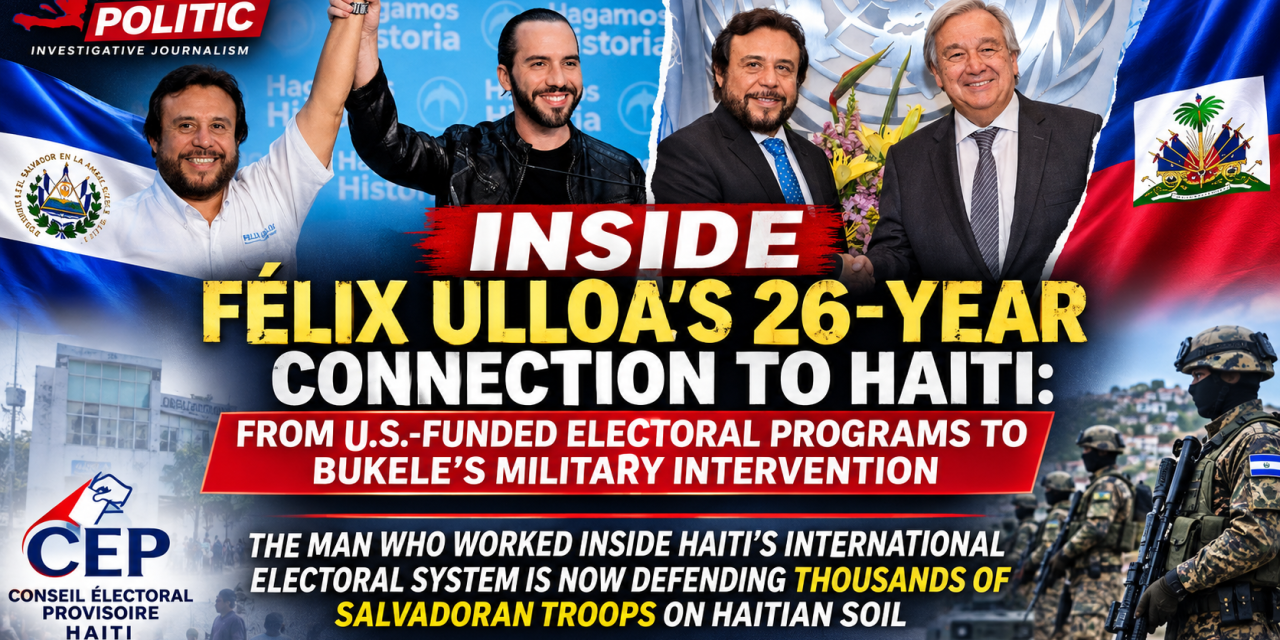
THE MAN WHO WORKED INSIDE HAITI’S INTERNATIONAL ELECTORAL SYSTEM IS NOW DEFENDING THOUSANDS OF SALVADORAN TROOPS ON HAITIAN SOIL
From René Préval’s first presidency and the controversial elections of 2000 to the OAS–UN electoral arrangements of 2004–2006, Félix Ulloa has a documented history in Haiti’s political institutions. Now, as El Salvador expands its military presence ahead of Haiti’s 2027 elections, questions are emerging about foreign influence, military command, political neutrality, and the future of Haitian sovereignty.
HAITI POLITIC | SPECIAL INVESTIGATION
November 9, 2026
THE QUESTION BEHIND EL SALVADOR’S INTERVENTION
Why is Félix Ulloa so interested in Haiti?
The Salvadoran vice president has recently emerged as one of the most prominent defenders of President Nayib Bukele’s military deployment to Haiti.
Ulloa says the Salvadoran operation is legitimate, authorized through a bilateral agreement, and intended to help confront armed gangs and recover four missing Salvadoran personnel.
He has also invoked Haiti’s historical assistance to Simón Bolívar as a reason for Latin American solidarity.
But a review of Ulloa’s professional history reveals something that deserves closer examination.
Félix Ulloa was involved in Haiti’s electoral system long before he became El Salvador’s vice president.
His professional activities in Haiti began during René Préval’s first administration, continued through the political upheavals surrounding Jean-Bertrand Aristide’s presidency, and included work connected to international electoral assistance during the 2004–2006 transition.
Now, more than two decades later, Ulloa represents a government deploying thousands of soldiers to Haiti as the country prepares for another presidential election.
The historical connection is documented.
Whether it has any relationship to El Salvador’s present political objectives remains an unanswered question.
For Haiti Politic, the central issue is straightforward:
How does a former international electoral adviser become a leading political defender of a foreign military operation in the same country where he once helped support electoral institutions?
And what safeguards will prevent that military involvement from influencing Haiti’s next political transition?
PART I — THE HISTORY
1. FÉLIX ULLOA WAS WORKING IN HAITI DURING RENÉ PRÉVAL’S PRESIDENCY
Félix Ulloa’s professional connection to Haiti dates to at least 2000.
An archival publication maintained by the ACE Electoral Knowledge Network identifies Ulloa as the National Democratic Institute’s senior resident director in Haiti.
It states that he had been managing NDI programs in the country since 2000.
This is significant because René Préval was president at the time.
Préval’s first administration lasted from February 7, 1996, until February 7, 2001.
Haiti held controversial legislative elections in May 2000 and presidential elections in November of that year.
Jean-Bertrand Aristide won the presidential election and assumed office in February 2001.
The period was marked by disputes over electoral procedures, opposition participation, and international recognition of the results.
Ulloa’s arrival therefore coincided with a particularly sensitive period in Haiti’s democratic development.
His background also made him a relevant figure in international electoral assistance.
Before joining NDI, he served as a magistrate of El Salvador’s Supreme Electoral Tribunal from 1994 to 1999.
He subsequently worked with international organizations involved in electoral administration, political parties, and democratic institutions.
But one important distinction must be made:
Working in Haiti during Préval’s presidency does not establish that Ulloa worked for Préval or supported his political movement.
The unanswered questions concern the institutions and political organizations with which Ulloa actually worked.
Which Haitian parties participated in NDI programs?
Which CEP officials received technical assistance?
What projects were implemented?
Who financed those projects?
And what reports were submitted to donors?
These are questions that should be answered through NDI and donor records.
Documentary reference: ACE Electoral Knowledge Network, biographical profile of Félix Ulloa.
2. THE USAID–NDI CONNECTION: WHO FINANCED THE ELECTORAL PROGRAMS?
The National Democratic Institute is a U.S.-based nonprofit organization involved in democracy assistance, political-party development, civic participation, and election-related programs.
Historically, USAID has been an important source of funding for NDI programs internationally.
NDI has also received funding from other U.S. government institutions, foundations, and international donors.
The relationship matters because USAID is a U.S. government agency, while NDI is an independent organization that implements programs through grants and cooperative agreements.
Receiving USAID funding does not mean every NDI activity is directly controlled by the U.S. government.
Nevertheless, funding arrangements can shape program objectives, reporting requirements, and institutional priorities.
For Haiti, the relevant question is whether the electoral-assistance projects Ulloa managed were financed by USAID.
We know that NDI has implemented USAID-supported democracy and electoral programs in Haiti.
What has not yet been established is the specific source of funding for each project Ulloa personally directed beginning in 2000.
That distinction is important.
Haiti Politic should obtain the original grant agreements, project descriptions, financial reports, and evaluations.
These records could establish what NDI was authorized to do, which institutions participated, and what results the projects were expected to produce.
They could also clarify whether Ulloa’s responsibilities included political-party training, election observation, civic education, or institutional assistance.
3. A MAJOR DISCOVERY: ULLOA WAS CONNECTED TO THE INTERNATIONAL ELECTORAL SYSTEM AFTER ARISTIDE’S DEPARTURE
The investigation becomes more revealing when we examine 2004.
Following Aristide’s departure from power in February 2004, Haiti entered another political transition.
The United Nations established MINUSTAH, while the Organization of American States participated in electoral assistance.
The international community became deeply involved in supporting the organization of elections.
A document from Mexico’s federal electoral institute identifies Félix Ulloa as an OAS electoral consultant participating in an international electoral-administration workshop held November 22–26, 2004.
The document lists representatives of Haiti’s CEP alongside officials from MINUSTAH, the OAS, and electoral institutions from other countries.
Ulloa appears among the international electoral officials.
This is direct documentary evidence of his involvement in the international electoral-assistance network operating during Haiti’s post-Aristide transition.
It establishes more than a general professional interest in Haiti.
It places Ulloa within a specific institutional setting involving the CEP, OAS, and international electoral specialists.
However, the document does not establish that he selected candidates, controlled the CEP, or determined election results.
The investigative question is what authority, if any, Ulloa exercised in these arrangements.
Was he providing technical advice?
Was he participating in policy discussions?
Did he help design electoral procedures?
Did he maintain relationships with Haitian political parties?
Those questions require additional records.
Documentary reference: Instituto Federal Electoral, Taller Internacional de Administración Electoral, November 2004.
4. ULLOA’S OWN 2006 REPORT DESCRIBES THE INTERNATIONAL MANAGEMENT OF HAITI’S ELECTIONS
In March 2006, Félix Ulloa published an analysis titled:
Las Elecciones de Febrero 2006 en Haití
The report examined the elections that returned René Préval to the presidency.
Its importance lies partly in Ulloa’s description of how international institutions supported the electoral process.
According to his account, the United Nations provided technical electoral assistance, while the OAS handled important responsibilities related to voter registration and national identification.
He also described the role of international donors in financing the process.
His report identified contributions including:
-
Canada: approximately C$17 million.
-
European Union: €10 million.
-
United States: US$9.4 million.
-
Haitian government: US$2.9 million.
Other contributors included Japan, Brazil, Mexico, Spain, Chile, France, and CARICOM.
Ulloa reported that the initial electoral budget was approximately US$48 million and eventually reached around US$60 million.
The figures are historical amounts reported in his 2006 analysis, not current expenditures.
The report also discussed institutional difficulties within the CEP and the role of international technical assistance.
This document is especially important because Ulloa was not merely observing Haiti’s elections from abroad. He was writing from professional experience within the international electoral-assistance environment.
His account provides a firsthand perspective on the system through which international organizations, donors, and Haitian institutions worked together.
It also raises a question that remains relevant today:
After more than two decades of international electoral assistance, why does Haiti continue to face such severe institutional difficulties organizing elections?
That question cannot be answered simply by attributing responsibility to foreign organizations.
Haiti’s political instability, armed violence, institutional weaknesses, and decisions by successive governments have also contributed.
But the effectiveness of international assistance deserves independent evaluation.
Documentary reference: Félix Ulloa, Las Elecciones de Febrero 2006 en Haití, March 2006.
PART II — THE RETURN OF FÉLIX ULLOA
5. FROM INTERNATIONAL ELECTORAL ADVISER TO VICE PRESIDENT OF EL SALVADOR
Ulloa eventually became vice president alongside Nayib Bukele following El Salvador’s 2019 presidential election.
His responsibilities have included constitutional reform initiatives, regional diplomacy, and representation of the Salvadoran government internationally.
He is therefore not simply a former election specialist commenting on Haiti.
He is now a senior representative of a foreign government conducting military operations on Haitian territory.
That transformation creates an unusual historical connection.
In 2000, Ulloa was working in Haiti through an international democracy-assistance organization.
In 2004, he was participating in an OAS-related electoral-assistance environment.
In 2006, he was analyzing the international organization and financing of Haitian elections.
In 2026, he is defending Salvadoran military operations in Haiti.
The same individual has participated in two very different forms of international engagement with Haiti: electoral assistance and government diplomacy surrounding military intervention.
That continuity deserves investigation.
But it is not proof that the two activities are part of one political strategy.
6. WHY DID BUKELE SEND THOUSANDS OF SOLDIERS TO HAITI?
The immediate explanation involves an attack on Salvadoran personnel.
On October 18, 2026, four Salvadoran aviation technicians disappeared following an attack in gang-controlled territory near Port-au-Prince.
The personnel had been supporting the UN-backed Gang Suppression Force.
Bukele responded by announcing a major operation to locate the missing Salvadorans and confront the armed groups responsible.
By late October, approximately 2,000 Salvadoran soldiers had reportedly arrived in Haiti.
The deployment included military personnel and equipment intended to support operations against armed groups.
The Salvadoran government characterized the operation as a rescue and security mission.
Haitian Prime Minister Alix Didier Fils-Aimé publicly acknowledged cooperation with El Salvador.
The security context is serious.
Armed groups have controlled substantial territory, displaced civilians, disrupted economic activity, and prevented normal public administration in parts of Haiti.
Supporters of international security assistance argue that Haiti requires additional operational capacity to restore security.
Critics question whether foreign military deployments can produce sustainable results without strengthening Haitian institutions.
Both perspectives deserve examination.
The immediate security threat is real.
But that does not eliminate the need to scrutinize the mission’s legal authority, operational command, financing, and duration.
7. THE TWO SALVADORAN MISSIONS: WHO ACTUALLY COMMANDS THE TROOPS?
One of the most important developments came from explanations by U.S. Secretary of State Marco Rubio and representatives of the Gang Suppression Force.
Rubio distinguished between the UN-backed security mission and a separate Salvadoran operation conducted through an agreement with Haitian authorities.
He indicated that Washington supports the multinational mission but is not actively participating in the separate Salvadoran operation.
He also raised concerns about the need for coordination among the different forces operating in Haiti.
Without adequate coordination, armed units operating in the same territory could mistakenly identify one another as hostile forces.
Subsequent explanations from GSF representatives clarified that Salvadoran personnel operate under different command arrangements.
Some are assigned to the multinational force.
Others operate under a bilateral arrangement and remain under Salvadoran command.
This creates important questions.
Who has ultimate operational authority?
What happens when the priorities of Salvadoran commanders differ from those of Haitian authorities?
Who investigates civilian casualties?
Who authorizes airstrikes?
Who determines when the operation ends?
And what mechanisms prevent the separate forces from interfering with one another?
A bilateral agreement may provide a legal basis for foreign assistance, but its existence does not automatically resolve questions of operational accountability.
The Haitian government should publish the relevant provisions or provide a sufficiently detailed public explanation.
PART III — THE 2027 ELECTION QUESTION
8. THE TIMING: THOUSANDS OF FOREIGN SOLDIERS ARRIVE AS HAITI POSTPONES ITS ELECTIONS
On October 28, 2026, Haiti’s electoral authorities announced a revised electoral calendar.
The first round of presidential and legislative elections is scheduled for July 18, 2027.
A second round is scheduled for October 4, 2027.
The announcement occurred during the same period as El Salvador’s expanded military deployment.
This timing raises a legitimate issue.
What role, if any, will Salvadoran troops have in creating or maintaining the security conditions for Haiti’s elections?
Security operations can influence electoral conditions in several ways.
They can affect access to polling locations, freedom of movement, the return of displaced voters, and the ability of candidates to campaign.
They can also affect whether electoral officials can operate in areas previously controlled by armed groups.
These effects do not necessarily amount to political interference.
Improved security could benefit voters across the political spectrum.
However, the presence of foreign troops makes clear safeguards essential.
The mission should not favor political parties, candidates, or electoral outcomes.
Its activities should be transparent and subject to appropriate Haitian oversight.
9. IS FÉLIX ULLOA TRYING TO INFLUENCE HAITI’S NEXT GOVERNMENT?
This is the most sensitive question in the investigation.
Ulloa’s historical experience in Haitian elections is documented.
His current position in the Salvadoran government is documented.
El Salvador’s military deployment is documented.
The approaching 2027 elections are documented.
But these facts do not establish that Ulloa or Bukele intends to install a particular Haitian government.
To establish such an allegation, investigators would need evidence of political coordination or interference.
For example:
Did Ulloa meet with Haitian presidential candidates to discuss electoral support?
Did Salvadoran officials offer financial assistance to political parties?
Were military operations coordinated with political campaign activities?
Did any bilateral agreement grant El Salvador influence over electoral administration?
Have Salvadoran officials attempted to influence the composition of the CEP?
Are there communications showing an intention to favor a particular political faction?
Haiti Politic has not established evidence of those activities.
The question should nevertheless remain part of a broader investigation into foreign influence and electoral safeguards.
A previous professional relationship with Haitian electoral institutions is not itself improper.
Nor does a military deployment automatically imply an intention to determine election results.
The relevant issue is whether the current operation remains limited to its declared security objectives.
10. WASHINGTON, NDI, USAID, AND THE SALVADORAN CONNECTION
Another question concerns the United States.
NDI historically implemented USAID-supported programs in Haiti.
Ulloa previously worked for NDI.
The United States supports the UN-backed Gang Suppression Force.
Bukele maintains a close diplomatic relationship with the Trump administration.
And Washington has acknowledged awareness of El Salvador’s separate military operation.
These are distinct relationships.
They do not establish a coordinated U.S.–Salvadoran plan to influence Haiti’s elections.
Nevertheless, they provide a basis for examining how different international institutions interact.
The investigation should distinguish three separate structures.
The electoral-assistance structure: International organizations and donors supporting Haitian elections.
The multinational security structure: The UN-backed GSF assisting Haitian security forces.
The bilateral security structure: Salvadoran personnel operating through arrangements between Haiti and El Salvador.
The institutions have different mandates, funding arrangements, and accountability mechanisms.
The question is whether sufficient safeguards exist to prevent their activities from creating inappropriate political influence.
That is particularly important when the same country is simultaneously preparing elections and conducting major security operations.
PART IV — THE HISTORY USED TO JUSTIFY INTERVENTION
11. WHY IS ULLOA INVOKING ALEXANDRE PÉTION AND SIMÓN BOLÍVAR?
Ulloa has invoked Haiti’s historical assistance to Simón Bolívar while discussing Latin American solidarity with Haiti.
The historical reference is legitimate.
In 1815–1816, Haitian President Alexandre Pétion provided refuge and assistance to Bolívar during the struggle for South American independence.
Haiti’s contribution to Latin American liberation remains an important chapter in regional history.
But historical gratitude and contemporary military authorization are different matters.
Pétion’s support for Bolívar did not create a permanent legal entitlement for foreign governments to conduct military operations in Haiti.
Nor does the historical relationship establish that Salvadoran troops should participate in Haiti’s electoral or political affairs.
There is also an important historical distinction.
Bolívar’s campaigns were primarily associated with the liberation of territories in northern and western South America.
El Salvador’s independence followed a different Central American historical process.
Ulloa may be invoking a broader principle of Latin American solidarity rather than claiming a direct historical debt.
If so, that argument should be evaluated according to the actual assistance being provided.
Historical solidarity is meaningful when it respects the sovereignty and political independence of the country receiving assistance.
It should not substitute for transparent agreements and measurable results.
12. DESSALINES AND PÉTION ARE NOT SUBSTITUTES FOR POLICY
Haiti’s revolutionary history is frequently invoked in political speeches.
Jean-Jacques Dessalines represents the struggle for independence and the creation of the Haitian state.
Alexandre Pétion is remembered, among other things, for assisting Bolívar.
These historical figures are central to Haiti’s national identity.
But references to them do not answer contemporary policy questions.
When a foreign official invokes Haiti’s revolutionary history to explain military cooperation, the public is entitled to ask what that cooperation will accomplish.
Will it strengthen the Haitian National Police?
Will it improve judicial investigations?
Will it help restore public services?
Will it protect civilians?
Will it create lasting Haitian capacity?
And will the foreign forces eventually withdraw under clearly defined conditions?
The historical argument should be judged separately from the operational results.
A reference to Pétion may express solidarity.
It does not establish that a military operation is effective, lawful in every respect, or free from political consequences.
PART V — THE UPCOMING DIPLOMATIC MEETING
13. ULLOA AND FILS-AIMÉ: WHAT WILL BE DECIDED IN EL SALVADOR?
Recent reporting indicates that Ulloa expects discussions with Haitian Prime Minister Alix Didier Fils-Aimé during a planned November 16–17 visit to El Salvador.
The reported discussions concern the future of the Salvadoran military presence in Haiti.
As of November 9, those meetings have not yet taken place.
This is an important diplomatic development.
If the governments intend to discuss extending or redefining the deployment, the Haitian public should know what issues are on the agenda.
Will the troop deployment remain temporary?
Will the number of Salvadoran personnel change?
Will the bilateral mission continue after the missing personnel are recovered?
What operational responsibilities will remain under Salvadoran command?
Will there be a formal timetable for withdrawal?
Will the mission have any responsibilities connected to electoral security?
And will the agreement be submitted to appropriate Haitian legal or institutional review?
These are reasonable questions for both governments.
PART VI — THE QUESTIONS FÉLIX ULLOA SHOULD ANSWER
14. FIFTEEN QUESTIONS FOR THE SALVADORAN VICE PRESIDENT
1. You began managing NDI programs in Haiti in 2000. Which Haitian political parties and electoral institutions participated in those programs?
2. Which donors financed the projects you personally managed, and did any receive USAID funding?
3. What were your responsibilities during the disputed Haitian elections of 2000?
4. What was the scope of your work as an OAS electoral consultant during the 2004–2006 transition?
5. Did you work directly with members of the Haitian CEP, and what institutional relationships resulted?
6. Have you maintained professional or political relationships with Haitian officials or political parties from that period?
7. What role did you personally play in negotiating El Salvador’s current military arrangements with Haiti?
8. Will El Salvador publish the bilateral military agreement?
9. Who has ultimate command authority over Salvadoran troops operating outside the GSF framework?
10. What rules govern the use of force, civilian protection, and investigations into alleged misconduct?
11. Will Salvadoran forces remain in Haiti through the July 2027 presidential election?
12. Have Salvadoran officials met with prospective Haitian presidential candidates concerning the country’s political transition?
13. Does El Salvador intend to provide any electoral assistance, political-party support, or institutional advice to Haiti?
14. What specific assistance does El Salvador intend to provide to strengthen the Haitian National Police and other Haitian institutions?
15. What measurable conditions will determine when the Salvadoran military mission ends?
These questions do not presume wrongdoing.
They are intended to establish the limits of the mission and the extent of Ulloa’s current involvement.
PART VII — WHAT THE DOCUMENTS ESTABLISH
15. A 26-YEAR TIMELINE
2000 — René Préval’s first presidency
Félix Ulloa begins managing NDI programs in Haiti during a period of contested elections and political tensions.
2001 — Jean-Bertrand Aristide returns to office
Aristide assumes the presidency following the November 2000 election.
2004 — International electoral assistance expands
After Aristide’s departure, MINUSTAH and the OAS become important participants in Haiti’s electoral-assistance arrangements.
A Mexican electoral institute document identifies Ulloa as an OAS electoral consultant.
2006 — René Préval returns to the presidency
Ulloa publishes an analysis of Haiti’s elections describing international financing, technical assistance, and institutional challenges.
2019 — Ulloa becomes vice president of El Salvador
He takes office alongside Nayib Bukele.
October 2026 — Salvadoran personnel disappear in Haiti
Four Salvadoran aviation technicians go missing following an attack.
October 28–29, 2026 — Major Salvadoran deployment
El Salvador announces and begins an expanded deployment involving approximately 2,000 soldiers.
October 28, 2026 — Haiti announces a revised electoral calendar
The first round of presidential and legislative elections is scheduled for July 18, 2027.
November 2026 — Ulloa defends the intervention
He describes the deployment as a bilateral security operation and discusses the possibility of further negotiations with Haitian authorities.
November 16–17, 2026 — Planned diplomatic discussions
Ulloa expects to discuss the future of the Salvadoran deployment with Haitian Prime Minister Alix Didier Fils-Aimé.
HAITI POLITIC CONCLUSION
FROM ELECTIONS TO MILITARY INTERVENTION: WHAT DOES FÉLIX ULLOA WANT FOR HAITI?
Félix Ulloa’s connection to Haiti is not new.
It began long before Nayib Bukele entered the Salvadoran presidency.
Ulloa worked in Haiti’s international electoral-assistance environment during the Préval and Aristide years.
He participated in OAS-related electoral activities during the 2004 transition.
He wrote about the international management and financing of Haiti’s 2006 elections.
Today, he represents a government conducting military operations in Haiti as the country prepares for another political transition.
That history makes Ulloa an important figure to examine when assessing El Salvador’s current relationship with Haiti.
But it does not establish that he is attempting to install a Haitian government.
The evidence supports a narrower, more precise conclusion:
Ulloa possesses longstanding professional knowledge of Haiti’s electoral institutions, and he now holds a senior political position in a government whose military activities may affect the security environment surrounding the 2027 elections.
That combination creates legitimate questions about transparency, neutrality, and institutional safeguards.
There is also a broader historical concern.
For decades, international organizations have assisted Haiti with elections, security, financing, and institutional reform.
Yet the country continues to experience severe political instability and recurring dependence on external assistance.
This history deserves examination without assuming that every international organization has the same objectives or that foreign involvement alone explains Haiti’s difficulties.
The central question is whether today’s security arrangements will leave Haiti with stronger institutions and greater political independence—or another unresolved dependence on external actors.
Ulloa’s invocation of Alexandre Pétion and Latin American solidarity should be assessed in that context.
Historical gratitude cannot replace public accountability.
Military cooperation cannot replace Haitian political sovereignty.
And international assistance cannot substitute for institutions capable of serving the Haitian population independently.
THE QUESTION HAITI POLITIC LEAVES WITH FÉLIX ULLOA:
YOU WORKED WITH HAITI’S INTERNATIONAL ELECTORAL SYSTEM MORE THAN TWO DECADES AGO. TODAY, YOUR GOVERNMENT HAS THOUSANDS OF SOLDIERS IN HAITI AS THE COUNTRY PREPARES FOR ANOTHER ELECTION. WHAT GUARANTEES CAN YOU PROVIDE THAT EL SALVADOR’S MILITARY ROLE WILL REMAIN SEPARATE FROM HAITI’S POLITICAL FUTURE?
The answer should come through public agreements, verifiable operational limits, transparent financing, and clear commitments to Haitian control.
Haiti’s elections must be decided by Haitian voters—not by the military presence, financial influence, or political preferences of foreign governments.
HAITI POLITIC
Independent Investigative Journalism | Politics | Security | Electoral Sovereignty
Editorial disclosure: This investigation documents Félix Ulloa’s historical involvement in international electoral assistance and his current diplomatic role in El Salvador’s intervention. It does not establish that Ulloa, Bukele, NDI, USAID, or the OAS has developed a plan to install a particular Haitian government. Allegations of electoral interference would require additional documentary evidence.
#HaitiPolitic #FelixUlloa #NayibBukele #ElSalvador #Haiti #NDI #USAID #OAS #CEP #HaitiElections2027 #GSF #HaitiSovereignty #InternationalIntervention