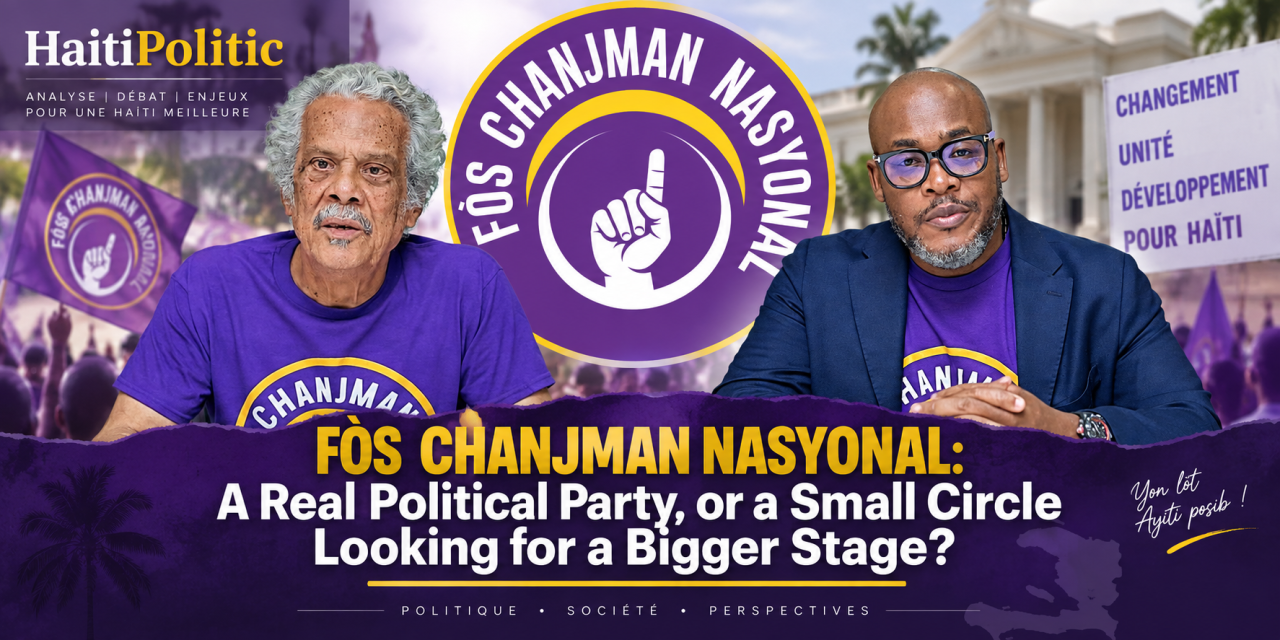
Haiti’s crowded 2026 political landscape has produced dozens of new parties and platforms in the run-up to elections, and Fòs Chanjman Nasyonal (FCN) is one of the more recently visible entrants. It has a headquarters, a slogan, a founders’ list of two dozen names, and — as of this writing — a Facebook page with 132 followers. That gap between institutional trappings and actual public following is worth examining closely, because it goes to the heart of the question this article sets out to answer honestly: is FCN a genuine grassroots political force, or a small, well-connected circle positioning itself for relevance rather than having earned it?
Overview: What FCN Actually Is
Fòs Chanjman Nasyonal was created in December 2024 and formally launched at a public ceremony on July 26, 2025, at the Acajou room of the Hôtel Karibe in Pétion-Ville — a launch reported at the time as drawing members, sympathizers, and national and international representatives. The party’s slogan, “Nou ka Alèz Lakay Nou” (“We can be at ease in our own home”), frames its pitch as a break from Haiti’s traditional political class. Its published mission statement commits to building “a just, dignified, and united Haiti” through social equity, governance transparency, inclusion, and sustainable development. FCN inaugurated a physical headquarters in Pétion-Ville in March 2026, and has since organized visible mobilization events, including a September 12, 2026 rally in Delmas.
The party’s founders’ list, published on its own website, names 24 people, led alphabetically-adjacent by Guy Philippe Auguste D’Meza and Jean Junior Rémy, alongside Isabella Hilarion, Jean Gardy Forge, Marie Alice Vanessa Legros, and nearly twenty others — a broad enough list to suggest genuine organizational ambition, though breadth of a founders’ list is not, by itself, evidence of broad public support.
Key Figures: Background and Role
Auguste D’Meza enters FCN with a public profile built almost entirely in the media and academic commentary space rather than executive institution-building. As early as 2021, he was appearing on Haitian television — notably the program “Haïti, Sa k ap Kwit” on Télé 20 — as a professor offering structural proposals for resolving Haiti’s governance crises, at one point arguing that a crisis-resolution government should be formed around trusted “notables” rather than handed to the political opposition. That pattern — thoughtful, credentialed commentary on what Haiti’s leadership should look like, without direct executive responsibility for delivering it — appears to define most of his public record prior to FCN’s founding. One additional data point deserves a caveat rather than a confident claim: a 2022 World Vision report references an “Auguste D’Meza from the Ministry of Education” touring rebuilt schools after the August 2021 earthquake. Whether this is the same Auguste D’Meza who co-founded FCN, or a different official who happens to share the name, could not be confirmed for this article, and readers should treat that connection as unverified rather than established fact.
Jean Junior Rémy, who serves as FCN’s Secretary General and acting president (président a.i.), is a more publicly active face of the party day to day — he was the one who addressed the crowd at the September 12 Delmas rally and confirmed to the press that FCN was in talks with Jean Ernest Muscadin about carrying the party’s banner in the presidential race. Rémy is also known throughout the Haitian and diaspora music industry by his nickname, “Moschino” — a detail this article examines in more depth below, because it turns out to be the more substantive part of his public record.
Political Position
FCN presents itself as an anti-establishment reform party, explicitly positioning against “traditional political practices” in Haiti. Its stated priorities — transparency, social equity, inclusion of the diaspora, sustainable development — track closely with the boilerplate reform language used by nearly every new Haitian party of the past decade, which makes them difficult to evaluate as distinguishing commitments absent a concrete policy platform.
The more telling signal of FCN’s actual political position may be tactical rather than ideological: rather than running one of its own 24 founders as its presidential standard-bearer, the party has spent September actively courting Jean Ernest Muscadin — a security official known for hardline anti-gang operations, whose leadership style has drawn both public support for results-oriented toughness and outside criticism over methods — to carry FCN’s colors into the presidential race. As of this writing, Muscadin has not confirmed any such arrangement. A party recruiting an outside security figure with an existing public profile, rather than fielding a founder as its own presidential candidate, suggests FCN may be short on homegrown political star power and is seeking to borrow legitimacy and name recognition rather than generate it internally.
Have D’Meza and Rémy Built Anything Else?
This is the question the user specifically asked us to investigate, and the honest answer cuts in an unexpected direction: of the two men, Rémy has the more concrete, sustained institution-building record — just not in politics.
Auguste D’Meza’s documented public record is overwhelmingly that of a commentator and academic voice — television appearances, philosophy-society discussion panels (he appeared at an Association Culturelle Café Philo Haïti event on anti-corruption and institutional credibility in 2018), and op-ed-style media interventions on governance. Commentary and teaching are legitimate and valuable public contributions, but they are fundamentally different from building and operating an institution with staff, budgets, deliverables, and accountability to a constituency or customer base. Based on what’s publicly documented, there is no clear evidence D’Meza has built or run an organization of that kind prior to FCN.
Jean Junior Rémy, by contrast, has a real and fairly long operating record — under the name by which the Haitian and diaspora public actually knows him.
Junior Moschino: A Real Track Record, in a Different Field
Under the name Junior Moschino (also credited as Rémy Junior Moschino or Junior Moschino Rémy), FCN’s Secretary General has been a fixture in the Haitian Music Industry for well over fifteen years. He was already a recognized Montreal-based Haitian music promoter at the time of the January 2010 earthquake, when he served as a key source confirming the deaths of Port-au-Prince music industry figures, including Kreyòl La’s manager Joubert Charles, and tracking the status of numerous Haitian artists in the disaster’s immediate aftermath — evidence of an already-established professional network at that point in his career.
In 2020, when singer-songwriter Hervé “Shabba” Anthénor left the long-running band Djakout #1 to found a new group, Moschino stepped in as EKIP’s manager from its inception, guiding the band through its debut single “Bingo,” its first album cycle, subsequent lineup changes (including the 2026 addition of new vocalists EmmyNix and D-Singer), and a high-profile public rivalry with competing bands T-Vice and Djakout #1 that played out across Haitian entertainment media. Separately, Moschino founded TicketZone, an event-ticketing company that entered the Haitian market by merging his original “Ticketpam” concept with a Montreal-based ticketing partner — a genuine business venture with real commercial infrastructure behind it, not just a promotional title.
Taken together, this is a legitimate, sustained record of institution-building: a music-management operation and a ticketing company, both of which required financing, staffing, client relationships, and years of continuous operation to survive in a notoriously difficult industry. It’s a different kind of institution than a school, a hospital, or a government ministry — but it is a real one, considerably more concrete than D’Meza’s primarily commentary-based public record.
Is Junior Moschino a Good Fit to Manage a Political Party?
Here, the honest answer is genuinely mixed, and worth laying out for readers rather than resolving definitively.
The case for fit: Managing EKIP through a competitive, reputation-driven, and often openly hostile media environment required exactly the skills a party secretary general needs in Haiti’s combative political culture — marketing instinct, rapid-response media management, coalition-building among strong personalities, and a demonstrated ability to generate public buzz and turnout around events, as seen in EKIP’s social-media-driven single launches and packed hotel performances. Organizing a political rally and organizing a concert draw on overlapping logistical and promotional muscles.
The case against fit: Running a political party — let alone competing for or supporting a presidential candidacy — requires competencies that artist management and ticketing don’t obviously provide: policy development, coalition governance across ideologically distinct partners, fundraising within campaign-finance rules, and administrative command of a nationwide organizational structure spanning departments and communes. Nothing in Moschino’s public record demonstrates experience in those areas, and his most visible public conflicts (the EKIP–T-Vice–Djakout feuds) reflect entertainment-industry rivalry dynamics rather than governance credibility.
Whether entertainment-industry promotional skill translates into effective national political management is precisely the kind of question Haitian voters will have to judge for themselves as FCN’s campaign unfolds.
Let the Numbers Speak: Popular Party or NGO Looking for Power?
Strip away the launch ceremony, the headquarters inauguration, and the media appearances, and one plain data point remains: FCN’s official Facebook page, as screenshotted for this article, shows 132 followers. For a party that launched at a hotel ballroom over a year ago, has since opened a physical headquarters, and is actively courting a nationally recognized security figure for its presidential ticket, that is a strikingly small documented public footprint — smaller, in fact, than the “4.9K friends” personal Facebook followings of both D’Meza and Rémy individually, which suggests whatever public interest exists is currently attached to the two men personally rather than to FCN as an institution.
That gap doesn’t prove FCN is merely a vanity project or an NGO-style structure dressed up as a party — plenty of genuinely emerging political movements start with thin social media footprints before building real grassroots infrastructure on the ground, particularly in a country where in-person organizing often matters more than online engagement. But it is a fair, verifiable fact for Haitian voters to weigh against FCN’s public messaging about representing a national “force for change”: so far, the numbers suggest a small, connected circle of founders with real individual track records — one mostly in commentary, one substantively in entertainment business — trying to convert personal networks into a national movement, rather than a movement that has already proven it exists independent of its founders’ personal followings.
This article is based on public reporting from FCN’s own published materials, alongside publicly viewable social media profile data current as of September 2026. Readers are encouraged to follow FCN’s campaign directly to form their own updated judgment as the party’s public activity develops.