Two events, one day apart, have exposed the first visible fault line inside REKONSILYE, the ten-party political platform that had, until this week, presented a unified front ahead of Haiti’s next electoral cycle. On Thursday, September 10, 2026, REKONSILYE’s founding members gathered in Pétion-Ville and, after what the party itself described as “particularly animated” internal discussions, designated Gary Bodeau — the former President of the Chamber of Deputies — as the platform’s presidential candidate. The very next day, Friday, September 11, founding member Beckenbauer Renard submitted his resignation letter to party leadership, effective immediately, citing only personal reasons.
REKONSILYE’s official position is that the two events are unconnected. Renard’s letter, according to reporting on the resignation, makes no reference whatsoever to Bodeau’s nomination. Taken at face value, that should settle the matter. But the timing — a contentious candidate selection followed within twenty-four hours by the departure of a founding member, from a platform that had spent the previous two weeks projecting unity — is exactly the kind of coincidence that Haitian political observers are trained not to take at face value, particularly given who Beckenbauer Renard is and where he came from politically.
Following the Bouclier Thread
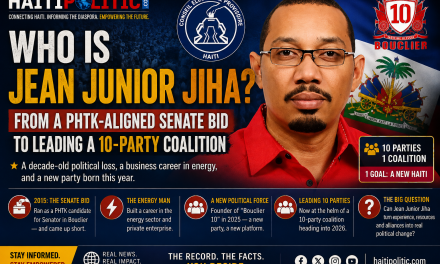
To understand why Renard’s exit matters beyond a single resignation letter, it helps to trace where REKONSILYE’s leadership actually came from. Jean Junior Jiha, the platform’s president, is not a newcomer to Haitian electoral politics: he previously ran as a Bouclier candidate for the Senate seat representing the Centre department, campaigning under the leadership of Steeve Khawly, the businessman who carried the Bouclier banner as its presidential candidate in the 2015 election. Beckenbauer Renard has the same lineage — he ran for deputy under Bouclier’s red-and-white banner in the same era, campaigning alongside Khawly and Jiha at rallies in places like Hinche.
In other words, a meaningful slice of REKONSILYE’s current leadership is a reconstituted version of the old Bouclier political network, more than a decade after that party’s original presidential bid fell short. That history matters here because it means Renard wasn’t a peripheral figure recruited late to REKONSILYE’s cause — he was part of the same founding political generation as Jiha, with years of shared campaign history predating the new platform entirely. A resignation from someone with that pedigree, at that specific moment, carries more institutional weight than an ordinary member stepping back.
Why Gary Bodeau Was Always Going to Be a Hard Sell Internally
The description of the founders’ meeting as “particularly animated” before Bodeau’s designation is itself a signal worth taking seriously; consensus picks don’t usually require that kind of language in official reporting. And Bodeau brings baggage that REKONSILYE’s leadership would have had to litigate internally before settling on him.
Gary Bodeau served as President of Haiti’s Chamber of Deputies from January 2018 to January 2020. On April 5, 2023, the U.S. Department of the Treasury’s Office of Foreign Assets Control sanctioned Bodeau under Executive Order 13818, the U.S. government’s global anti-corruption sanctions authority, over what OFAC described as his extensive involvement in corruption in Haiti — specifically, according to the agency’s designation, efforts to influence the outcome of Haitian political appointments. That sanction has never been lifted, and it makes Bodeau one of the more internationally scrutinized figures in Haitian politics to headline a major party ticket in years.
For a platform like REKONSILYE — one whose own president, Jean Junior Jiha, has spent recent weeks publicly demanding neutrality from the transitional government and criticizing the appearance of insider influence around rival platform VIKTWA’s candidate Wilner Joseph — nominating a U.S.-sanctioned former official as its own standard-bearer is a difficult position to defend on the very anti-corruption, good-governance terrain REKONSILYE has tried to claim for itself. It is not hard to imagine that tension being exactly what made the founders’ meeting “animated,” and exactly the kind of internal disagreement that could plausibly sit behind a resignation letter that officially cites only “personal reasons.”
The Charitable Reading, and Why It’s Not the Only One
None of this proves Bodeau’s nomination drove Renard out. Founding members resign from Haitian political organizations for all kinds of reasons that have nothing to do with any single candidacy — business obligations, family circumstances, unrelated disputes over party structure or the CEP’s own contested 30,000-member registration requirement, which Jiha himself has publicly criticized as irregular. Renard’s letter says what it says, and there is no public statement from him contradicting the “personal reasons” framing or explicitly tying his departure to Bodeau.
But the burden REKONSILYE now carries is a communications one as much as a factual one. A platform built explicitly around the idea of “reconciliation” and a clean break from Haiti’s cycle of compromised leadership just handed its presidential nomination to a sanctioned former Chamber president, and lost a founding member with deep roots in the platform’s own political lineage within a day of doing so. Whether or not those two facts are causally connected, REKONSILYE’s leadership will need to answer for both of them separately as the campaign moves forward — because Haitian voters, watching a platform that promised something different from the status quo, are entitled to ask whether Bodeau’s sanctions record and Renard’s sudden exit are really the coincidence the party’s official statement says they are.
This article is based on REKONSILYE’s public statements, contemporaneous Haitian press reporting, and U.S. Treasury OFAC’s public sanctions designation of Gary Bodeau. Beckenbauer Renard’s resignation letter cites personal reasons only; no link to Gary Bodeau’s nomination has been officially established by either party, and any connection between the two events remains speculative.