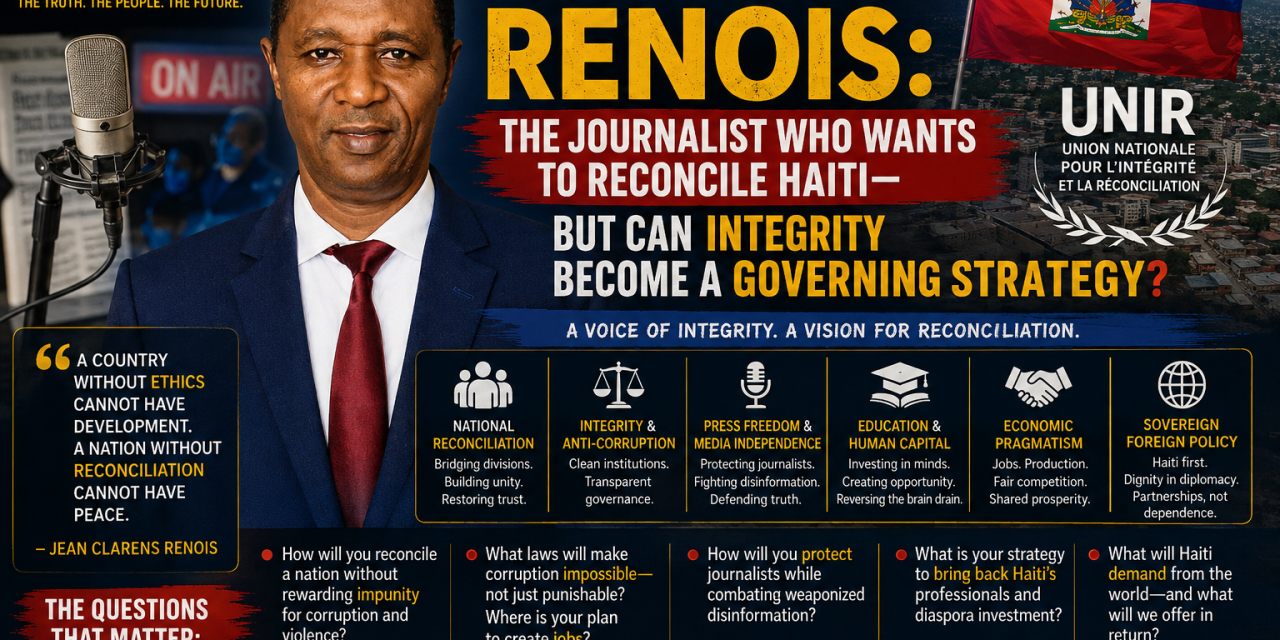
Journalist. Communicator. Political leader. Presidential candidate. Advocate of integrity and national reconciliation.
Jean Clarens Renois offers a political profile that differs from many of the figures who have dominated Haiti’s recent political history. Rather than emerging primarily from parliament, the business establishment, or the traditional machinery of the state, Renois built much of his public identity through journalism and public communication before entering electoral politics.
He became a presidential candidate under UNIR — Union Nationale pour l’Intégrité et la Réconciliation. Official electoral documentation from 2015 lists UNIR and Renois among the political organizations approved to participate in that electoral cycle.
But HaitiPolitic’s question is not whether Jean Clarens Renois can communicate.
The question is whether a communicator can govern.
And beyond that:
Can integrity, dialogue and reconciliation succeed in a political system where armed power, economic interests, institutional weakness and foreign influence frequently matter more than political principles?
Here is the case for Haitians to examine.
🔎 1 | FROM JOURNALISM TO PRESIDENTIAL POLITICS
Renois entered electoral politics with something valuable in a country suffering from extraordinary distrust of its institutions: a public identity associated with journalism rather than conventional political office.
His candidacy was nevertheless far from electorally dominant.
During the disputed 2015 presidential election, published results credited Renois with roughly 0.57% of the vote. Contemporary polling likewise placed him well outside the leading group nationally, although support varied considerably by locality.
He also participated in a major 2015 presidential town hall devoted to economic development and investment alongside candidates including Jean-Charles Moïse, Charles Henry Baker and Mathias Pierre. The event specifically sought to connect presidential contenders with Haiti’s diaspora and force them to discuss economic policy rather than campaign personalities.
That history produces the first major question surrounding a renewed Renois political project:
Can credibility outside government be converted into the machinery necessary to govern government?
Being able to diagnose Haiti’s failures is one skill.
Building a parliamentary coalition, controlling ministries, enforcing customs laws, reforming public procurement, confronting organized crime and negotiating with foreign governments is another.
🕊️ 2 | “RECONCILIATION” SOUNDS GOOD. WHAT DOES IT ACTUALLY MEAN?
The name of Renois’ political organization makes an enormous promise:
Integrity and Reconciliation.
Few Haitians would dispute the need for either.
But reconciliation becomes considerably more complicated when applied to Haiti’s present reality.
Who exactly should reconcile with whom?
Political rivals?
Business competitors?
Former presidents and opposition movements?
Victims and perpetrators?
The diaspora and domestic political establishment?
And what happens when reconciliation encounters criminal accountability?
A government cannot reconcile its way out of every conflict.
🎤 HAITIPOLITIC WOULD ASK RENOIS:
Where is the boundary between reconciliation and impunity?
If individuals credibly implicated in corruption, political violence, kidnapping networks or gang financing offer to participate in a national political settlement, would your government negotiate with them?
Or prosecute them?
That distinction could determine whether “national reconciliation” becomes a genuine institution-building strategy—or simply another elite political pact.
📰 3 | THE JOURNALIST’S TEST: WOULD PRESIDENT RENOIS PROTECT JOURNALISTS INVESTIGATING HIM?
This may be one of the most important tests of his political philosophy.
A journalist entering the presidency should understand better than almost anyone why governments dislike scrutiny.
So HaitiPolitic would ask:
Would President Jean Clarens Renois accept the same investigative journalism that journalist Jean Clarens Renois expected governments to tolerate?
Would journalists receive stronger legal protections?
Would government contracts become searchable?
Would ministers’ asset declarations become accessible?
Would reporters investigating corruption receive institutional protection?
Would presidential press conferences permit adversarial questioning?
And would opposition media receive the same access as friendly outlets?
Those aren’t symbolic questions.
They test whether Renois’ journalistic principles could survive presidential power.
⚖️ 4 | TURN “INTEGRITY” INTO SOFTWARE, LAW AND ENFORCEMENT
Every Haitian politician can promise honesty.
A serious integrity program requires something much less glamorous:
systems.
For example, a Renois administration could be challenged to explain whether it would support:
- searchable public procurement and government-contract databases;
- beneficial-ownership disclosure for companies receiving state contracts;
- enforceable asset declarations for senior officials;
- digital customs and tax collection;
- stronger investigative independence for institutions such as the ULCC;
- transparent presidential and political-party campaign financing;
- protection for whistleblowers and investigative journalists.
Without mechanisms like these, “integrity” remains a campaign value rather than a governing architecture.
So the question to Renois should be straightforward:
What would your administration make impossible for a corrupt president to hide?
📱 5 | PRESS FREEDOM VS. THE AGE OF POLITICAL DISINFORMATION
Renois would face a media environment radically different from the traditional radio era.
Today’s political battlefield includes Facebook, YouTube, TikTok, WhatsApp, livestreaming and diaspora influencers.
False information can spread nationally before a ministry issues its first statement.
But government attempts to fight “fake news” can quickly become censorship.
That creates a particularly important question for someone coming from journalism:
How would you combat deliberate political disinformation without giving the Haitian government the power to decide what journalism is true?
A credible answer needs to protect both national security and dissent.
💼 6 | THE BIG ECONOMIC QUESTION: WHERE ARE THE JOBS?
Integrity alone does not create employment.
Reconciliation does not automatically reduce food prices.
Better political communication does not rebuild roads.
If Renois wants to present UNIR as a governing alternative, voters should demand measurable economic commitments.
How many formal jobs?
How much electricity?
Which agricultural regions?
Which ports?
Which vocational sectors?
Which industries?
How will SMEs obtain financing?
What happens to customs monopolies?
How will competition policy work?
And where will the money come from?
Haiti has heard enough national visions.
Voters have every right to demand spreadsheets.
🧠 7 | HAITI’S BRAIN DRAIN MAY BE A NATIONAL-SECURITY CRISIS
One of Haiti’s most damaging exports isn’t coffee, textiles or mangoes.
It is human capital.
Doctors leave.
Engineers leave.
Professors leave.
Entrepreneurs leave.
Nurses leave.
Software developers leave.
Students leave—and many never return.
A Renois administration centered on civic reconstruction should therefore explain exactly how it would persuade skilled Haitians abroad to invest knowledge and capital back into the country.
Would returning professionals receive temporary tax incentives?
Could diaspora Haitians compete transparently for public-service positions?
Would dual-nationality barriers to political participation be reconsidered?
Could diaspora investment funds finance municipalities rather than disappearing through central-government structures?
Haiti doesn’t simply need its diaspora’s money.
It needs its diaspora’s knowledge.
🌎 8 | WHAT WOULD “RENOIS FOREIGN POLICY” ACTUALLY BE?
This is where the investigation becomes especially important.
For decades, Haitian foreign policy has too often been reactive.
Washington acts.
Ottawa acts.
Paris acts.
CARICOM responds.
The United Nations intervenes.
The Dominican Republic changes policy.
International financial institutions establish conditions.
And Haiti reacts.
A Renois presidency should therefore be challenged to articulate a doctrine rather than simply promise better diplomatic relationships.
HaitiPolitic would ask:
What is the Jean Clarens Renois Doctrine?
Would Haiti’s foreign policy prioritize:
United States and Canada?
CARICOM?
Dominican-Haitian relations?
African diplomacy?
Latin America?
European investment?
Taiwan—or recognition of the People’s Republic of China?
Most importantly:
What does Haiti want from the world besides assistance?
Trade?
Security cooperation?
Technology?
Agricultural investment?
University partnerships?
Diaspora capital?
Infrastructure financing?
Diplomacy becomes meaningful when Haiti knows what it is negotiating for.
🇩🇴 9 | THE DOMINICAN REPUBLIC TEST
Every serious Haitian presidential candidate eventually confronts the same unavoidable foreign-policy relationship:
Haiti and the Dominican Republic.
Migration.
Trade.
Border security.
Agriculture.
Water.
Deportations.
Smuggling.
Labor.
Citizenship disputes.
Environmental management.
The two countries can disagree profoundly, but geography isn’t negotiable.
Renois’ reconciliation philosophy therefore faces perhaps its most practical international test here:
Can dialogue defend sovereignty without becoming weakness?
And can nationalism defend Haiti without destroying economically necessary cooperation?
A president needs both principles and leverage.
🛡️ 10 | RECONCILIATION CANNOT SUBSTITUTE FOR SECURITY
No national development program works if armed groups can close highways, ports, neighborhoods and commercial corridors.
Schools cannot operate normally.
Investment disappears.
Agriculture cannot reach markets.
Tourism collapses.
Professionals emigrate.
Government loses territory.
So Renois should face one of the hardest questions in Haitian politics:
If dialogue fails, what is your security doctrine?
How large should the Haitian National Police become?
How would officers be vetted?
How would intelligence capabilities be rebuilt?
How would weapons trafficking be attacked financially?
What role should international security assistance play?
What happens to gang members who surrender?
What happens to political and business sponsors?
Reconciliation without justice risks impunity.
But security without law risks authoritarianism.
A presidential candidate must explain how to avoid both.
🗳️ 11 | THE ELECTORAL REALITY CHECK
Renois has already faced voters.
In 2015 his national result was small, despite his visibility and reputation. Contemporary electoral reporting placed his share at around 0.57%.
That should not automatically disqualify a future candidacy.
Political environments change.
But it raises an unavoidable strategic question:
What has UNIR built since then that didn’t exist in 2015?
Where are the municipal organizations?
Where are the legislative candidates?
Where are the poll watchers?
Where are the rural coordinators?
Where are the women’s organizations?
Where are the youth chapters?
Where is the financing?
Where are the diaspora structures?
Presidential politics cannot consist entirely of television interviews and social-media visibility.
Elections are won commune by commune.
✝️ 12 | AN OVERLOOKED PART OF THE 2015 STORY
Renois’ 2015 campaign also intersected with Haiti’s Protestant political networks.
A mediation process initially selected him as a presidential representative for a broad Protestant sector. But that designation became contested: another gathering subsequently backed Jean-Chavannes Jeune, while the Conference of Haitian Pastors publicly objected to the entire idea that Haiti’s Protestant community should have a single presidential candidate.
That episode offers a useful lesson.
Even communities that appear politically cohesive from the outside can be deeply fragmented internally.
A national reconciliation candidate therefore has to prove something difficult:
Can he build consensus among people who do not already agree with him?
📊 HAITIPOLITIC ASSESSMENT
| Area | Potential Strength | Question Mark |
|---|---|---|
| Communication | Extensive public-communication experience | Communication isn’t executive administration |
| Integrity Brand | UNIR explicitly places integrity at the center of its identity | Needs enforceable anti-corruption mechanisms |
| Reconciliation | Potential alternative to Haiti’s politics of permanent confrontation | Consensus cannot become immunity from accountability |
| Media Experience | Could strengthen transparency and government communication | Must demonstrate tolerance for hostile scrutiny while in power |
| Foreign Policy | Communication background could support diplomatic coalition-building | Needs a defined doctrine and measurable national interests |
| Electoral Viability | Previous presidential experience and national visibility | His 2015 electoral showing demonstrated a limited national base |
| Institution Building | Emphasis on civic responsibility could support democratic reform | Must demonstrate capacity beyond commentary and advocacy |
🔥 THE QUESTIONS JEAN CLARENS RENOIS SHOULD ANSWER BEFORE ASKING HAITI FOR THE PRESIDENCY
1. What exactly does “national reconciliation” mean—and who does not qualify for it?
2. Would politicians and businessmen credibly implicated in gang financing be prosecuted even if their support were necessary for your parliamentary majority?
3. Will every major government procurement contract be publicly searchable?
4. Would you protect journalists investigating corruption inside your own presidency?
5. What are UNIR’s first five economic reforms, and how much would each cost?
6. What is your measurable five-year plan for rebuilding the Haitian National Police?
7. What is your policy toward international security assistance?
8. What would your administration demand from Washington, Ottawa, Paris and the United Nations instead of simply requesting aid?
9. What is your long-term strategy for relations with the Dominican Republic?
10. What incentives would bring Haitian professionals and diaspora investment back into the country?
11. How would you finance decentralized education outside Port-au-Prince?
12. What political infrastructure has UNIR built since your previous presidential campaign that demonstrates you can actually win—and govern?
🧭 HAITIPOLITIC VERDICT: THE PEOPLE DECIDE
Jean Clarens Renois presents an intriguing proposition.
Haiti has experienced presidents from the military establishment, populist movements, business circles and traditional political organizations.
A journalist-turned-political leader offers another model:
government through integrity, communication and reconciliation.
But those words cannot be the conclusion of the investigation.
They are where the investigation begins.
The real test is whether Renois can transform:
Integrity → enforceable institutions
Reconciliation → political stability
Journalism → government transparency
Communication → diplomatic leverage
Civil society → electoral organization
Ideas → budgets
Dialogue → decisions
And ultimately:
principles → power capable of governing without becoming corrupted by power.
Jean Clarens Renois has spent much of his public career communicating about Haiti.
If he again asks Haitians for executive authority, the electorate has the right to ask something considerably harder:
🇭🇹 CAN THE JOURNALIST WHO EXPLAINED HAITI’S PROBLEMS ACTUALLY BUILD THE STATE THAT SOLVES THEM?
You decide.
#HaitiPolitic #JeanClarensRenois #UNIR #Haiti #HaitiPolitics #HaitiElections #ForeignPolicy #NationalReconciliation #PressFreedom #AntiCorruption #HaitianDiaspora #Democracy #Ayiti