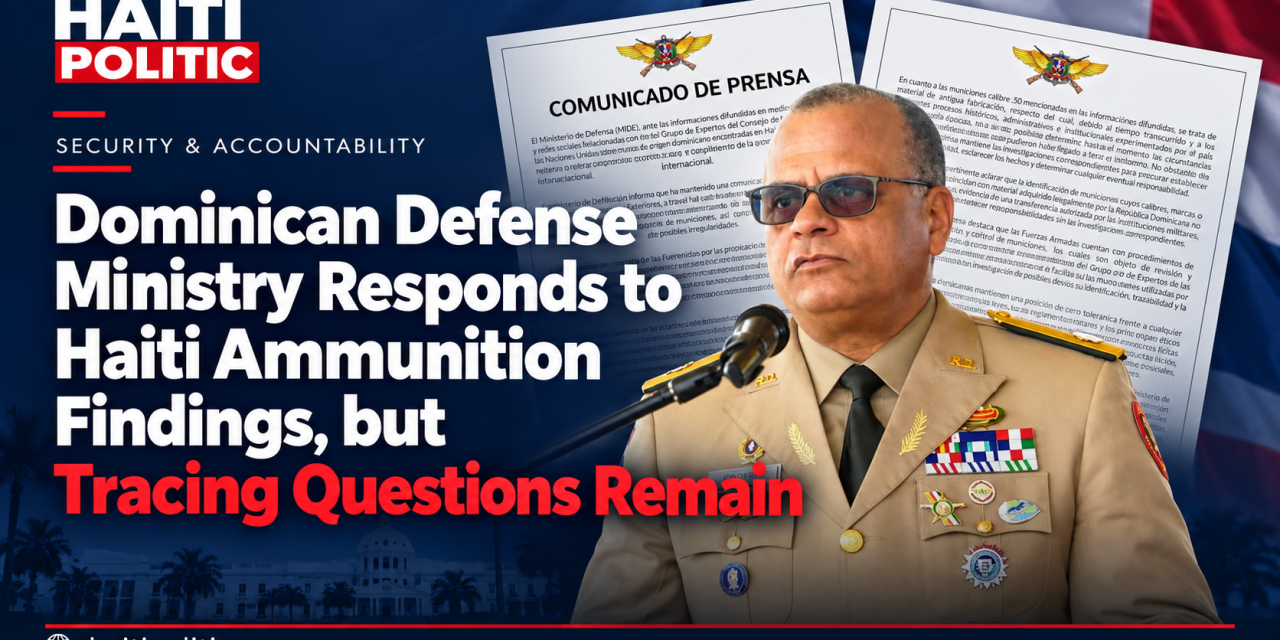
The ministry cites an army officer’s arrest and ongoing investigations, while acknowledging it has not established how older .50-caliber ammunition reached Haiti.
The Dominican Republic’s Ministry of Defense has responded to findings about Dominican-origin ammunition in Haiti, citing a prosecution involving an army officer and pledging continued investigations. Its statement, published by the Dominican presidency on October 8, leaves unresolved the route by which older .50-caliber ammunition reached Haitian territory.
The two-page release addresses coverage of the United Nations Security Council’s Panel of Experts report. It says military authorities have cooperated with investigators through the Ministry of Foreign Affairs and provided information about ammunition purchases, distribution, controls and suspected irregularities.
An officer’s arrest, not a conviction
According to the ministry, Dominican Army personnel arrested a second lieutenant and a Haitian citizen in December 2025 while they were allegedly transporting 1,516 cartridges of different calibers on a motorcycle in La Tinaja, San Juan province.
The officer remains in pretrial detention while proceedings continue, the ministry said. The release does not identify either detainee, provide a case number or announce a conviction. It also does not establish that the seized rounds were destined for a particular Haitian gang.
The ministry presented the case as evidence that authorities had taken action against suspected misconduct and said it had previously communicated the incident through official channels.
The unresolved route of older ammunition
On the .50-caliber rounds discussed in media coverage, the ministry said the ammunition was manufactured long ago. It cited the passage of time and historical, administrative and institutional changes as obstacles to reconstructing how the material may have reached Haiti.
It nevertheless said investigations continue to establish traceability and determine any responsibility. That acknowledges a gap in the available tracing information; it does not establish who transferred the ammunition.
Annex 18 of the UN report identifies Dominican-made .50-caliber rounds from the 1950s among ammunition associated with 400 Mawozo. It also notes earlier exports of such surplus ammunition to the U.S. civilian market and says the chain of custody remains unclear. Dominican manufacture alone therefore does not establish a recent transfer from Dominican military stocks.
Newer ammunition raises a separate question
The report also describes ERD-marked ammunition made by Colombia’s Indumil under 2022 contracts with Dominican military institutions. The panel said it had not yet received additional information identifying the units assigned the relevant lots or clarifying further investigations. Those newer rounds present a tracing issue distinct from the older .50-caliber ammunition.
Separately, the report records 908,001 items, mostly ammunition, diverted from Dominican National Police stocks. It does not establish that all those items reached Haiti or were used by 400 Mawozo.
What the ministry’s response establishes—and leaves open
The ministry argues that matching calibers, markings or characteristics do not, by themselves, prove a transfer authorized by military institutions. It also cites ammunition marking as a control measure and promises accountability for unlawful individual conduct, regardless of rank, while respecting due process.
Those distinctions matter. An allegation against an officer is not a finding against an entire institution. But the absence of proof of an authorized transfer does not answer whether ammunition was stolen, sold unlawfully or diverted through failures in stockpile control.
The release supplies no detailed inventory reconciliation, findings identifying the intermediaries involved, or timetable for publication of the tracing results. It also does not explain whether the December arrest accounts for any of the specific ammunition lots examined by the UN panel.
For Haitian readers, the outstanding questions concern the ammunition’s movement: who held it, when it left authorized custody, who transported it and who received it. The statement promises cooperation and enforcement. It does not yet provide a complete account of that chain.