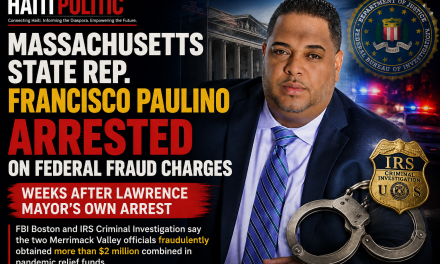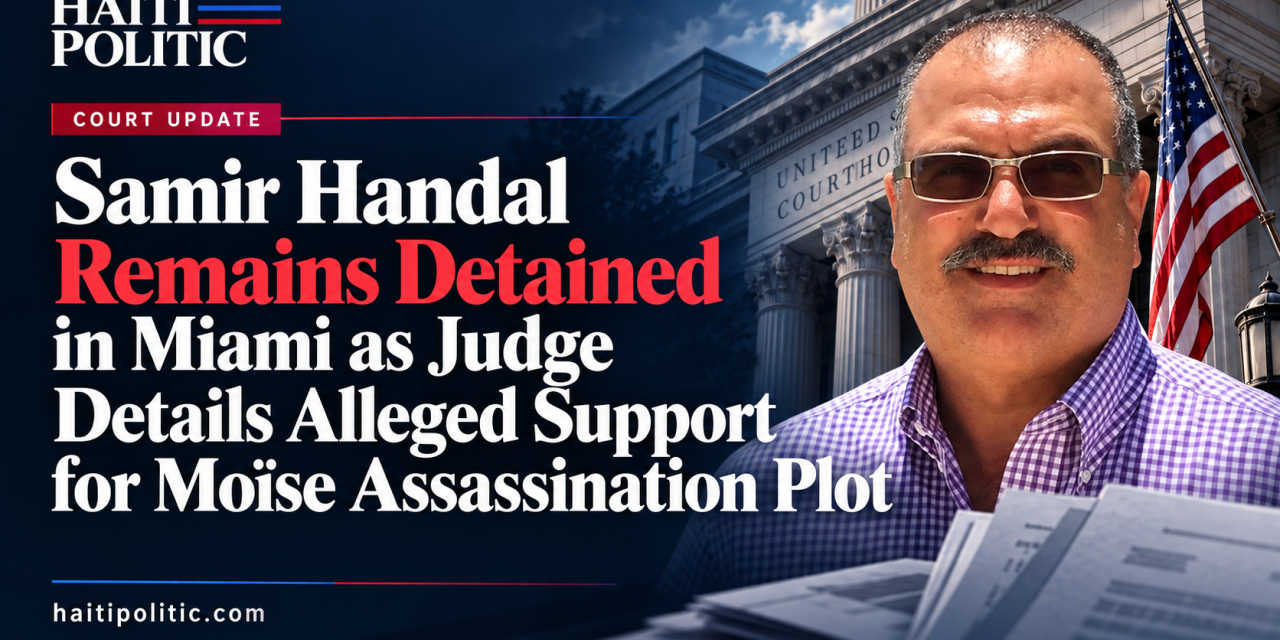
An October 9 order cites lodging, cash, equipment and international ties; a separate ruling grants partial assistance with defense costs and requires a $2,000 court payment.
Samir Handal remains in federal custody after a Miami magistrate judge issued a written detention order detailing the evidence the government presented about his alleged support for the plot to assassinate Haitian President Jovenel Moïse.
The October 9 order, signed by U.S. Magistrate Judge Eduardo I. Sanchez, concludes that no combination of release conditions would reasonably ensure Handal’s appearance in court or protect the community. It formalizes the detention decision announced after a September 28 hearing.
Handal was also arraigned on three counts on October 9 before U.S. Magistrate Judge Enjolique A. Lett. Local 10 reported that he pleaded not guilty to all three charges. The docket extract reviewed by Haiti Politic records the arraignment but does not itself specify the plea.
The proceedings are part of United States v. Palacios Palacios, et al., case No. 1:22-cr-20104-JB, assigned to U.S. District Judge Jacqueline Becerra. Handal is identified as defendant 33.
What the government alleges
The detention order identifies three charges: conspiracy to provide material support and resources for a violation of the federal law prohibiting certain overseas killing or kidnapping conspiracies, resulting in death; providing that material support, resulting in death; and conspiracy to kill and kidnap a person outside the United States.
According to the judge’s account of the evidence presented at the detention hearing, cooperating co-conspirators identified Handal as providing lodging at his Port-au-Prince home, staff to cook and clean, meeting space at a nearby office, $3,000 for food, fuel, radios, a shotgun and ammunition to Christian Emmanuel Sanon and other participants in the alleged plot.
The order describes Sanon as approximately $4 million in debt to Handal and seeking Haiti’s presidency after Moïse’s assassination. It also says the government presented evidence of text messages about Sanon’s rise to power and a potential Middle Eastern ambassadorship for Handal.
Sanchez further cited visits by Handal to the home where Sanon was staying while Colombian mercenaries were present, and what the order characterizes as Handal’s admission to law enforcement of advance knowledge of a planned coup.
These are the court’s descriptions and assessments of evidence for a pretrial release decision. They do not constitute a conviction or establish that the government has proved the charges beyond a reasonable doubt. The debt and discussions of an ambassadorship likewise should not be treated as a conclusively established motive.
Why the judge rejected release
The order expressly acknowledges that Handal is a U.S. citizen with family ties to the Southern District of Florida. Nevertheless, Sanchez found that other circumstances created a serious flight risk.
Those circumstances included recent international travel using passports from three nations, family in several foreign countries, foreign property holdings whose full extent had not been disclosed to the court, and a purported residence held in an unexplained trust. The judge also cited alleged false statements to investigators about knowledge of the coup and deletion of text messages.
The order refers to Handal’s need for continuing medical treatment and the prospect of a life sentence if convicted as additional factors in its flight-risk analysis. It does not impose a sentence.
Sanchez found that the government met the preponderance-of-the-evidence standard on flight risk and the clear-and-convincing-evidence standard on community danger. Neither is the trial standard for proving guilt.
The $2,000 payment is not bail
At the separate October 9 arraignment, Lett found Handal partially indigent for costs and ordered him to pay $2,000 into the court’s Criminal Justice Act treasury by January 11, 2027.
That ruling concerns assistance with defense costs. It is not a bond, a criminal fine or an order permitting release upon payment. The supplied minute entry does not identify every expense that will be covered, and it does not establish that all defense representation will be publicly funded.
The docket lists retained lead attorney Paul Domenic Petruzzi and attorney Beatriz D. Vazquez, both of whom filed appearances on October 8.
Discovery and the next scheduled hearing
Lett granted Handal’s request for a Haitian Creole interpreter for the duration of the case and issued a standing discovery order. A Haitian Creole interpreter attended the approximately 25-minute hearing.
The order requires the parties to review and comply with the court’s criminal discovery rules within 14 days. It also sets a 28-day filing period for motions on matters not covered by that order and reiterates prosecutors’ continuing duty to disclose evidence favorable to the defense.
The docket additionally lists an October 5 motion concerning a coordinating discovery attorney and an October 7 government motion for a protective order. The supplied extract does not show a ruling on either motion.
The next hearing specifically scheduled for Handal in that extract is a January 11, 2027, 10 a.m. status conference before Lett concerning partial indigency and the CJA payment. It is not a trial date. No Handal-specific trial date, verdict or sentence appears in the supplied records.
Reporting basis: This update is based on the supplied CM/ECF docket report, generated October 10, 2026, and Document 2117, the four-page detention order entered October 9. The not-guilty plea is separately attributed to Local 10’s October 9 reporting. Handal is presumed innocent unless and until proved guilty.