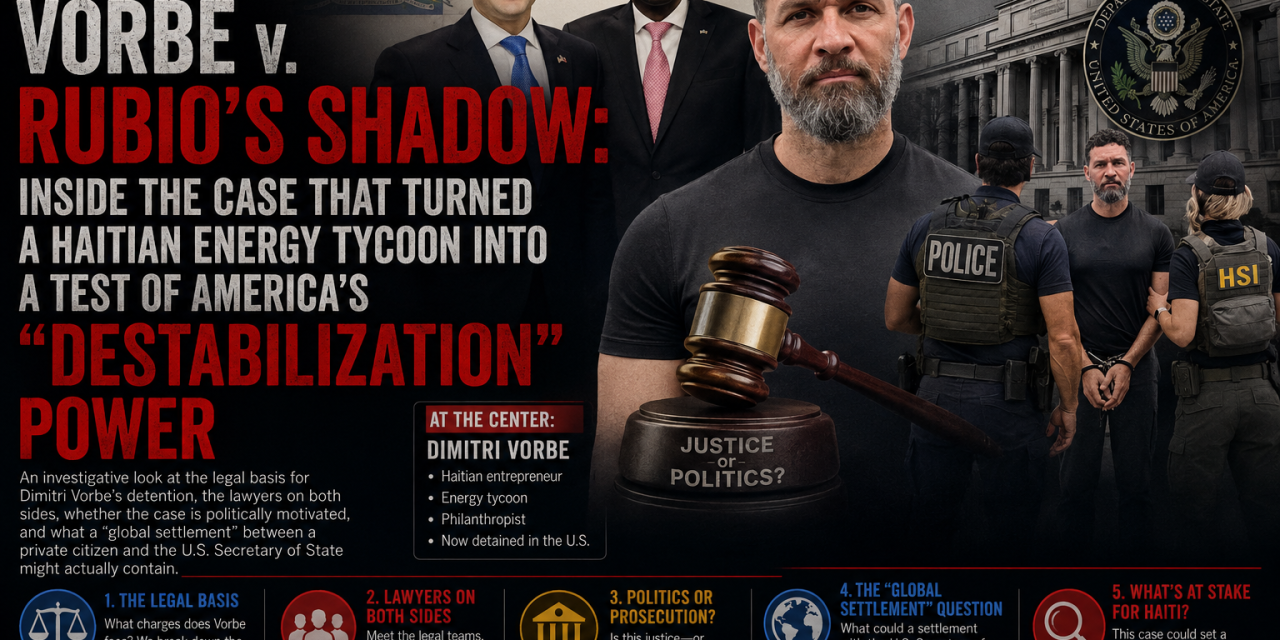
An investigative look at the legal basis for Dimitri Vorbe’s detention, the lawyers on both sides, whether the case is politically motivated, and what a “global settlement” between a private citizen and the U.S. Secretary of State might actually contain
On September 23, 2025, ICE agents arrested Dimitri Albert Edouard Vorbe outside his Miami-area home. Eleven months later, on August 25, 2026, he walked free — but is expected to leave the United States in the coming days, according to Le Nouvelliste, which cited his brother. In between, his case became one of the most closely watched immigration proceedings in the Haitian diaspora, testing a legal authority rarely used this way: a Secretary of State’s power to declare a private individual’s mere presence in the U.S. a foreign policy threat.
The Legal Basis: A Determination, Not an Indictment
Unlike a typical criminal case, Vorbe was never charged with a crime in the United States. Instead, ICE’s own press release states plainly that he was arrested “for violating the Immigration and Nationality Act and contributing to the destabilization of Haiti.” The specific mechanism: the U.S. Department of State — under Secretary of State Marco Rubio — determined that Vorbe’s “presence or activities in the United States would have potentially serious adverse foreign policy consequences,” providing the legal basis for removability. Officials alleged he “engaged in a campaign of violence and gang support that contributed to Haiti’s destabilization.”
It is critical to state precisely what this means and doesn’t mean. This is a foreign-policy-based inadmissibility determination, not a criminal conviction, indictment, or even a public criminal complaint. As of the most recent reporting available, Miami Herald and multiple other outlets confirm that no evidence supporting the gang-support allegation has been made public, and a review of Florida court records found no formal criminal charges filed against Vorbe in connection with the claim. His attorneys have contested the government’s case throughout.
Is This Politically Motivated? The Case for “Yes”
Several documented facts support the argument that personal and political history, not solely objective evidence, put Vorbe in the government’s sights:
A pre-existing feud with Haiti’s own government. Vorbe was, for years, engaged in open conflict with Haitian authorities — not a bystander swept up incidentally. He is vice president of Société Générale d’Énergie S.A. (SOGENER), his family’s energy company, which held a controversial 2007 power-purchase agreement with the Haitian state. President Jovenel Moïse’s administration accused SOGENER of exploiting that contract, seized its assets in 2020, and froze Vorbe family property under an order from Haitian Judge Mathieu Chanlatte — Haiti’s government at the time alleged corruption stemming from a 2005-2007 deal that, per the Moïse administration’s own accounting, saw Haiti pay Sogener $1.5 billion while receiving an average of only four hours of reliable power daily. CEPR research director Jake Johnston has been quoted characterizing both Vorbe and fellow detainee Réginald Boulos as “the two members of the elite, the oligarchs that Jovenel went after” — meaning Vorbe had already been publicly targeted by Haiti’s own government, under a different legal theory, years before the U.S. detained him under this one. Notably, Haiti’s opposition parties at the time characterized the 2020 Sogener seizure itself as a political maneuver — meaning the “is this political” question has been asked about actions against Vorbe by two different governments, under two different legal theories, across two different administrations.
Vorbe was also, separately, a vocal government critic. Multiple sources describe him as an outspoken critic of Haitian government corruption, including PetroCaribe fund mismanagement, and note a public clash with former Prime Minister Laurent Lamothe. A person who spent years publicly clashing with Haiti’s political establishment then became the subject of a U.S. determination alleging he was secretly supporting the violent gangs that establishment has been fighting — a genuine tension worth naming, though not by itself proof of bad faith on the U.S. government’s part.
The timing and pattern. Vorbe’s arrest came one day after the State Department sanctioned two former Haitian lawmakers — Arnel Bélizaire and Antonio “Don Kato” Chéramy — whom multiple outlets describe as having political ties to Vorbe. It also followed, by two months, the arrest of Réginald Boulos under a nearly identical “destabilization” theory. Haitian Times has characterized this as a broader pattern: a U.S. campaign using sanctions and immigration detention as tools to pressure Haiti’s business and political elite generally, rather than case-by-case criminal enforcement based on individualized evidence.
The Case for “No” — This Reflects a Genuine, Broader Policy
The countervailing evidence is also real. The “destabilization” designation Vorbe faces is not a bespoke tool invented for him. It’s part of a documented, publicly announced State Department campaign: Rubio personally announced the designation of the Viv Ansanm and Gran Grif gang coalitions as Foreign Terrorist Organizations in May 2025, explicitly stating that “the age of impunity for those supporting violence in Haiti is over” and warning that “individuals and entities providing material support or resources” to those gangs could face “criminal charges and inadmissibility or removal.” Treasury’s OFAC has separately sanctioned more than 30 Haitian politicians and business figures under parallel authorities for corruption, gang financing, or destabilization — Vorbe is one name on a considerably longer list, not a uniquely singled-out target. If the policy itself is applied consistently across Haiti’s elite regardless of their political alignment (Vorbe was a Moïse critic; others sanctioned include former Moïse-era officials), that cuts against a narrative of Vorbe being personally targeted for his politics specifically, and toward a broader, if aggressive, anti-elite enforcement posture.
The honest conclusion: the record supports concluding this is not a narrowly personal vendetta invented for Vorbe alone — it fits a documented, publicly announced policy applied to dozens of Haitian elites. But it also supports concluding that Vorbe’s specific selection within that broader campaign cannot be fully separated from his pre-existing, high-profile conflict with Haiti’s own government — meaning “politically motivated” and “part of a legitimate broader policy” are not mutually exclusive here. Both can be true simultaneously.
The Lawyers: A Case That Outgrew Its Own Legal Team
The docket reflects just how resource-intensive this fight became. Vorbe was represented, across the case’s life, by:
- Eduardo Xavier Pereira (Coral Gables) — lead attorney
- Maitte Barrientos, Catholic Charities Legal Services — lead attorney
- Kelly Catherine Walker (Washington, D.C.)
- Mark Andrew Prada, Prada Dominguez, PLLC — lead attorney
- Patrick Taurel, Grossman Young & Hammond (admitted pro hac vice from Washington, D.C.)
- Anthony Richard Dominguez, Prada Dominguez, PLLC
Six named attorneys across four firms — including a nonprofit legal aid provider (Catholic Charities) alongside private immigration litigation specialists — represented one petitioner in a habeas case. That breadth is itself notable: it suggests either a legal fight complex enough to require a genuinely multi-firm team, a client with the resources to assemble one, or both.
What Could the “Global Settlement Agreement” Actually Contain?
The case’s final public docket entries show the parties — Vorbe’s team and the government defendants, including the ICE Field Office Director, USCIS’s Vermont Service Center, and the Secretary of State — jointly moved to stay proceedings pending a “global settlement agreement,” with the court vacating the order that had barred Vorbe’s transfer or removal. What actually happened next, per Le Nouvelliste’s August 25 reporting, gives the clearest available clue: Vorbe was released from custody, but is expected to leave the United States in the coming days.
Based on that outcome, the pattern in this case’s own history (a separate settlement negotiation in May 2026 reportedly involved a proposed transfer to the Dominican Republic rather than Haiti, before that arrangement apparently fell through), and standard practice in similar national-security-adjacent immigration settlements, a “global settlement agreement” of this kind would plausibly include some combination of:
- Voluntary departure from the U.S. within a defined window, in lieu of continued contested removal proceedings — consistent with reporting that Vorbe is expected to leave shortly
- A destination other than Haiti — given the extreme security conditions there and the earlier-reported Dominican Republic option, a third-country departure remains plausible, though not confirmed
- Dismissal or withdrawal of Vorbe’s underlying legal claims — including any remaining habeas or conditions-of-confinement claims — in exchange for his release, a standard trade in this type of settlement
- Non-admission of guilt by either side — allowing the government to avoid formally proving the destabilization allegation in court, and allowing Vorbe to avoid a judicial finding against him
- Possible confidentiality provisions covering the settlement’s specific terms, which is why, as of this report, the underlying agreement’s exact text has not been made public
All of the above is informed inference from the documented outcome and comparable cases, not confirmed fact. The settlement’s actual terms have not been published, and this report treats that reconstruction as analysis, not established reporting.
Sources: ICE press release (September 2025), CEPR, Le Nouvelliste, Haitian Times, U.S. Department of State press statements (Marco Rubio, May 2, 2025; Tommy Pigott, September 22, 2025), U.S. Treasury/OFAC. This report distinguishes documented facts from informed speculation throughout, particularly regarding the unpublished settlement terms.