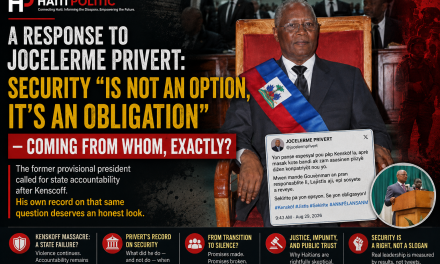
The Canadian designation is real, and its allegations are serious. Whether the former provisional president can stand for election in Haiti is a separate legal question. Whether voters trust him is theirs.
Haiti Politic | September 28, 2026
Jocelerme Privert’s name appears in Canada’s Haiti sanctions regulation. Canada added the former provisional president on February 15, 2023, to a section headed “Individuals — Acts of Significant Corruption.” He remains in the regulation reviewed for this article. That is an official designation, but it is neither a Haitian criminal conviction nor a ruling by Haiti’s Provisional Electoral Council (CEP) on his eligibility.
Canada’s published explanation says it had reason to believe that the two people added in that amendment—Privert and Salim Succar—had engaged in significant corruption and used their influence or resources to protect or support criminal gangs. It mentions drug smuggling while discussing the pair, but does not publish an itemized account assigning each alleged act to Privert individually. The designation restricts dealings with listed people by persons in Canada and Canadians abroad; Canada also described the two as inadmissible to Canada.
Privert rejects the allegations. In a statement published on February 17, 2023, he called Canada’s claims false, denied any collusion with armed gangs, and said his opposition to gang violence had been public. His denial deserves to be reported alongside Canada’s action. Neither statement, standing alone, settles the underlying factual dispute in a Haitian court.
What determines eligibility in Haiti?
The answer depends first on which office Privert seeks. For the presidency, Article 135 of Haiti’s amended Constitution requires Haitian nationality by origin and no other nationality at registration; an age of at least 35; civil and political rights and no specified criminal conviction; ownership of property and habitual residence in Haiti; five consecutive years’ residence before the election; and a discharge for the management of public funds when applicable. Articles 91 and 96 set different ages, residence periods, and property or professional requirements for deputies and senators. A Canadian sanctions designation does not appear among those constitutional conditions.
Privert’s previous time in office raises another constitutional question. Article 149.1 says that a provisional president under the constitutional vacancy provisions is deemed to have completed a presidential term. Article 134.3 requires a five-year interval before another term and prohibits a third. Privert served as provisional president in 2016–17. If he seeks the presidency, electoral authorities should explain how they characterize that service under the 2016 political arrangement and apply both articles to it. His provisional presidency should not be treated as proof of a permanent ban or automatic approval without that analysis.
The CEP publishes the June 2, 2026 electoral decree and its July 2 amendment as the framework for candidacies. On September 16, it extended registration and document filing to October 9 while discussing a possible further change to the decree. Filing papers is not the same as receiving a final eligibility decision. No final CEP ruling on a Privert candidacy is established by the sources reviewed for this article.
Canada’s autonomous sanctions must also be distinguished from United Nations Security Council sanctions. An electoral provision addressing a UN list cannot simply be read as though it covers every designation made by Canada. Haitian authorities must apply the decree in force when they decide a candidacy and explain the legal basis for their decision.
Questions voters should ask
Privert should address Canada’s published allegations in detail and say what evidence he offers in response. If he has requested removal from the Canadian list, he can disclose the status of that request. Should he seek the presidency, he should also make available the records needed to assess residence, nationality, property ownership, and any required discharge.
The CEP, for its part, should explain how it applies the constitutional rules on provisional presidential service and whether any current electoral provision gives this Canadian designation a direct effect on eligibility. Its decision should be public and reasoned.
Canada’s sanction warrants serious scrutiny. It does not, by itself, prove that Haitian law disqualifies Privert or that he satisfies every other requirement. The competent Haitian electoral bodies must decide legal eligibility on the evidence. Voters can then decide what his response, his record, and Canada’s designation mean for their confidence in him.