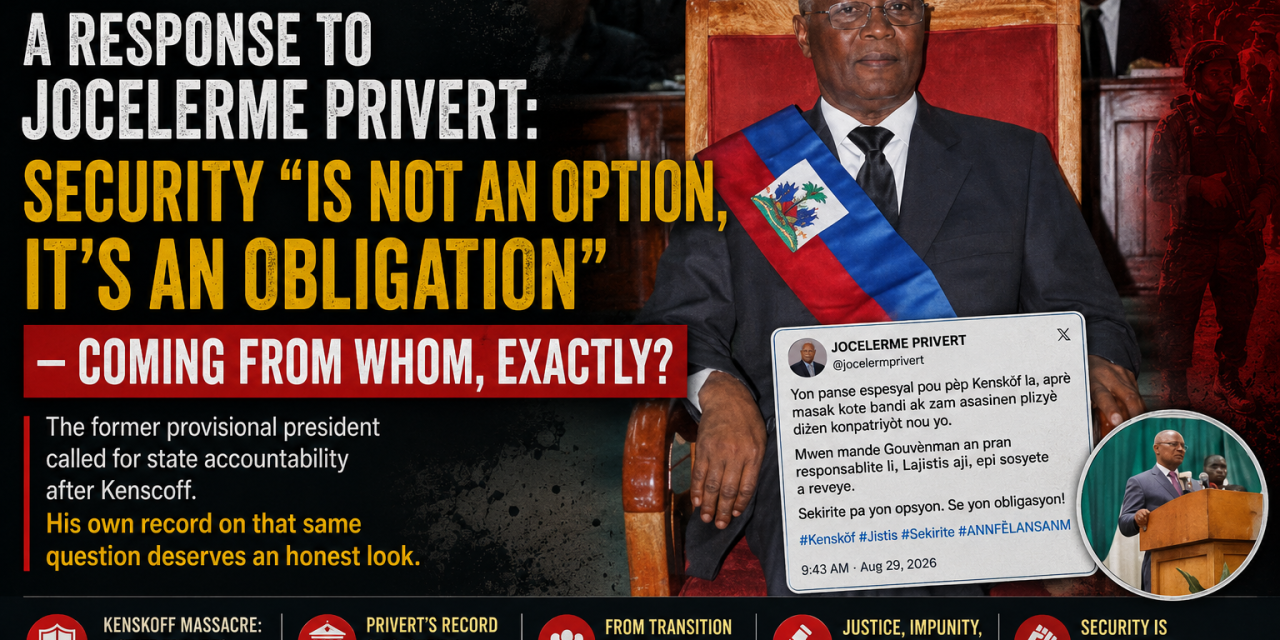
The former provisional president called for state accountability after Kenscoff. His own record on that same question deserves an honest look.
Former interim president Jocelerme Privert posted a message of solidarity for Kenscoff on X this week. Translated from Haitian Creole, it read: a special thought for the people of Kenscoff, after a massacre in which armed bandits assassinated dozens of our compatriots. He called on the government to take responsibility, for justice to act, and for society to wake up. Security, he wrote, is not an option — it’s an obligation. He closed with the hashtags #Kenskòf #Jistis #Sekirite #ANNFÈLANSANM (“Let’s do it together”).
As a statement of principle, it’s unobjectionable — nearly identical in substance to what Etzer Émile and Jerry Tardieu said in their own Kenscoff posts, which this outlet has already examined. The more interesting question is what it means coming specifically from Jocelerme Privert, a man whose own three-decade career sits at the center of exactly the accountability questions he’s now demanding of others.
Who Is Making This Demand
Privert is not a peripheral figure commenting from the sidelines. He served as Haiti’s Minister of Economy and Finance (2001-2002) and then Minister of the Interior and Territorial Communities (2002-2004) under President Jean-Bertrand Aristide, President of the Haitian Senate (2016), and ultimately as Haiti’s interim president from February 2016 to February 2017 — a position from which he oversaw a security apparatus during one of the country’s own fraught democratic transitions. He is, in other words, someone who has personally held the exact levers of state responsibility he’s now invoking.
That record includes an episode directly relevant to a call for “justice” and government “responsibility”: in April 2004, weeks after Aristide’s ouster, Privert was arrested and accused of involvement in the La Scierie massacre in Saint-Marc, where dozens of people were killed in February 2004 amid clashes between armed Aristide loyalists and local opposition residents. He spent 26 months in prison before being released. It is important to state the outcome accurately and fairly: no one was ever convicted in the La Scierie case, courts ultimately found insufficient evidence to prosecute him, and an independent UN human rights expert, Louis Joinet, characterized the incident as a clash between two rival armed groups rather than a one-sided, orchestrated massacre. Privert has consistently and publicly maintained his innocence, and the record supports treating the accusations against him as unproven rather than established. Still, the case means Privert has personal, direct experience of what it feels like to be on the other side of a Haitian public demanding “justice” after mass violence — which makes his current framing worth examining, not dismissing.
The Substance Gap
Set the history aside, and the same critique this outlet raised about Émile’s and Tardieu’s posts applies here with equal force, arguably more so given Privert’s institutional experience: “the government must take responsibility” is a demand almost impossible to disagree with and almost impossible to act on as stated. Privert served as Haiti’s chief executive for a full year. He knows, better than most public commentators, precisely what “the government taking responsibility” for a security failure actually requires operationally — police deployment numbers, budget allocation, coordination with whatever international force is available, prosecutorial follow-through. He named none of it. “Justice must act” is similarly a demand any Haitian official from any era could have made about any massacre since 1957, without committing to a single specific reform.
Given that Privert governed during a period when Haiti still had a functioning, if fragile, national police command structure — conditions considerably more intact than what Haiti’s current transitional authorities are working with — a former president weighing in now is arguably better positioned than almost anyone else commenting publicly to say something more specific: what he would have done differently with the resources he once had, or what concrete capability the current government is missing that his own administration once possessed.
The Fair Counterpoint
In fairness to Privert, a few things temper this critique. First, a former head of state offering a solidarity statement on social media is a different genre than a policy proposal, and it’s reasonable that he wouldn’t attempt to relitigate Haiti’s entire security strategy in a four-sentence post. Second, precisely because his own La Scierie case remains legally unresolved and contested, Privert may be exercising a certain caution about wading too specifically into “justice must act” territory, given how that exact phrase was once turned against him. Third, unlike a sitting official, Privert holds no current formal power to direct security policy — his post is closer to citizen commentary than a governing proposal, even if his biography gives it unusual weight.
The Bottom Line
Jocelerme Privert is right that security in Haiti is an obligation, not an option. He is also one of a small number of living Haitian politicians who has personally experienced, from the accused’s chair, exactly how quickly “justice must act” can become a instrument turned against an individual on thin evidence — and exactly how long “the government taking responsibility” can remain an empty phrase when a government presided over disorder within its own ranks. That dual experience should make him one of Haiti’s more specific, credible voices on what state accountability after a massacre actually requires. On the evidence of this post, he chose the safer, vaguer register instead.
This is an opinion and analysis piece responding to a public statement by former Haitian interim president Jocelerme Privert (@jocelermprivert) on X. It presents his tweet in translated and paraphrased form and situates it against his documented public record, including the La Scierie case, which remains legally unresolved and should be treated as such.