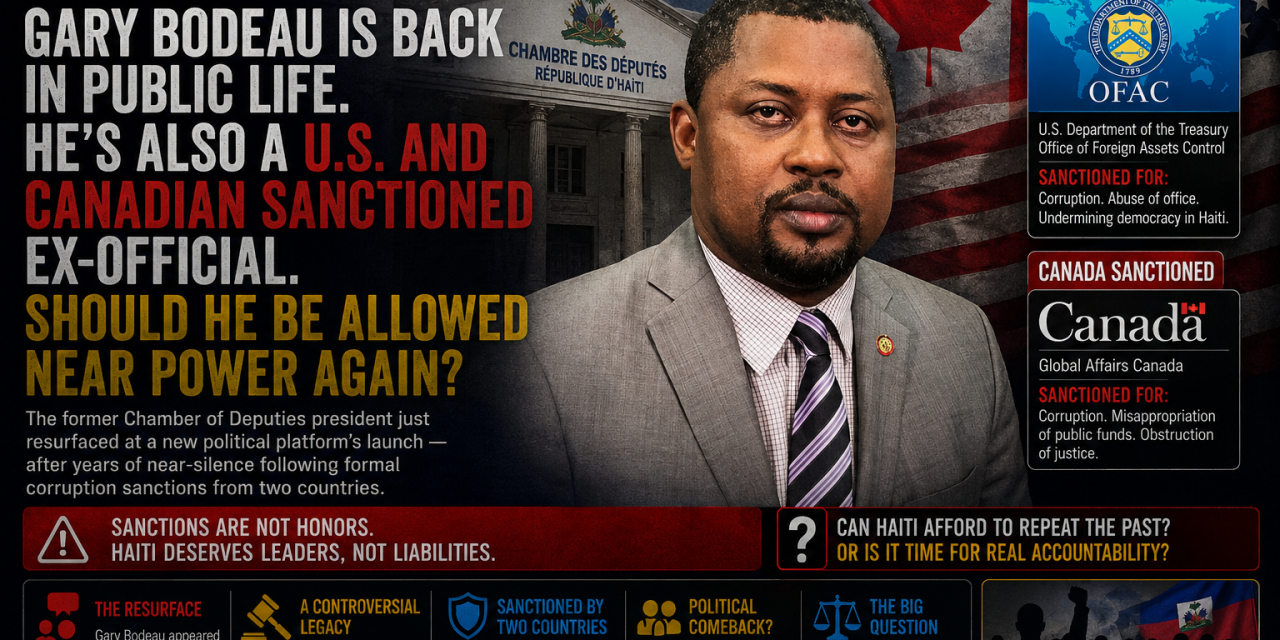
The former Chamber of Deputies president just resurfaced at a new political platform’s launch — after years of near-silence following formal corruption sanctions from two countries
🧵 THE COMEBACK
On Thursday, August 27, 2026, Gary Bodeau — former president of Haiti’s Chamber of Deputies — broke a long period of public silence to speak with journalists following his participation in the official launch of a new political platform called “REKONSILYE.” According to Juno7’s reporting, Bodeau weighed in on the upcoming elections, Prime Minister Alix Didier Fils-Aimé’s governance, the country’s security crisis, and youth political engagement. He said elections shouldn’t be organized to satisfy any single group — invoking both the international community, which he described as a partner, and the transition’s current authorities. It was his first substantial public re-engagement after a lengthy stretch of media discretion.
⚖️ THE RECORD HE’S RETURNING WITH
Bodeau, born November 18, 1977, in Port-au-Prince, represented Delmas in the Chamber of Deputies and served two terms as its president — first elected January 10, 2018, and reelected unopposed (104 votes, zero against) in January 2019, making him the chamber’s dominant figure for its full 2018-2020 legislative session. Le Nouvelliste’s own 2018 profile described him as a strategist unafraid to challenge Haiti’s political old guard, and detailed how he maneuvered to bring down Fritz Jean, Jocelerme Privert’s first prime ministerial pick, in 2016 — an early sign of the coalition-building skill that would eventually carry him to the chamber’s top post.
That skill is precisely what U.S. and Canadian authorities later cited as corruption. On April 5, 2023, the U.S. Treasury’s Office of Foreign Assets Control (OFAC) formally sanctioned Bodeau under Executive Order 13818, for what the designation called extensive involvement in corruption. The specific findings, per OFAC’s own public designation:
- In 2018, Bodeau paid Haitian officials to secure their votes while seeking ministerial appointments
- He solicited a large bribery payment worth hundreds of thousands of dollars from senior government officials in exchange for his political support
- In 2019, he offered to deliver a successful Chamber of Deputies vote for a prospective ministerial nominee in exchange for millions of dollars, to be distributed through individual payments to Chamber members
- Haitian businessmen reportedly provided between 500-600 million gourdes (roughly $6.2-7.4 million) to Chamber members specifically to influence a ministerial confirmation vote, with Bodeau involved in organizing the payments ahead of the floor session
Canada sanctioned him separately in November 2022, months before the U.S. action — Bodeau publicly reacted to those sanctions at the time, per HaitiLibre’s reporting, though he has consistently rejected the underlying allegations.
🤔 WHAT THIS MEANS FOR A POTENTIAL CANDIDACY
Here’s the central tension an honest investigation has to sit with: Bodeau has not been criminally convicted in a court of law for these allegations — OFAC and Canadian sanctions are executive-branch financial and travel designations, not judicial findings of guilt, and Bodeau disputes the claims against him. That distinction matters and should be stated plainly. But it’s also true that these aren’t vague accusations from a rival politician or an anonymous source — they are the formal, specific findings of two G7 governments’ sanctions bodies, naming dollar figures, dates, and mechanisms. That’s a materially different evidentiary weight than an unverified allegation, even without a courtroom conviction attached to it.
Whether that record legally bars Bodeau from running in Haiti’s 2026-2027 elections is a separate question from whether voters should want him to. Haiti’s electoral framework, including the CEP’s current registration requirements this outlet has covered extensively, does not appear to include an automatic disqualification tied to foreign sanctions absent a domestic conviction — meaning the barrier to a Bodeau candidacy, if there is one, is more likely to be political and reputational than strictly legal.
🎯 WHAT HE’D BRING TO THE TABLE
In fairness to a complete picture: Bodeau’s supporters and his own public framing point to real institutional experience — two terms leading Haiti’s lower chamber, a demonstrated capacity to build legislative coalitions (however that capacity was allegedly monetized), and, per his own recent comments, a stated commitment to elections that serve the country broadly rather than any single faction. His “REKONSILYE” platform appearance suggests an attempt to reposition himself within a reconciliation-oriented political frame, explicitly invoking dialogue between the international community and Haiti’s transitional authorities.
Critics would counter that “experience” is precisely the problem: Bodeau’s two years running the Chamber are the same two years OFAC says he spent monetizing ministerial confirmation votes — meaning his most substantial governing credential and his most serious corruption allegations describe the exact same period in office.
LET THE PEOPLE DECIDE: Gary Bodeau has genuine institutional experience at the highest levels of Haiti’s legislature, and he has not been convicted of any crime in a court of law. He has also been formally sanctioned by two G7 governments, each citing specific, detailed findings of vote-buying and bribery solicitation during his exact tenure as Chamber president — allegations he denies. As Haiti’s political class works to reconstitute itself ahead of December’s elections, and as new platforms like REKONSILYE bring back familiar faces under new banners, voters and observers will have to decide for themselves whether Bodeau’s legislative experience represents a genuine asset for a political system in crisis, or whether his return represents exactly the kind of “recycled elite” pattern that critics say has kept Haiti’s political system from actually reforming itself. Both readings are available from the same public record. The judgment belongs to Haitians.
Sources: Wikipedia (Gary Bodeau; Cholzer Chancy), U.S. Department of the Treasury/OFAC designation (April 5, 2023), Le Nouvelliste. This report distinguishes formal sanctions findings from criminal convictions throughout; Bodeau has publicly denied the allegations against him, and no domestic Haitian criminal conviction related to these claims has been documented in available public records.