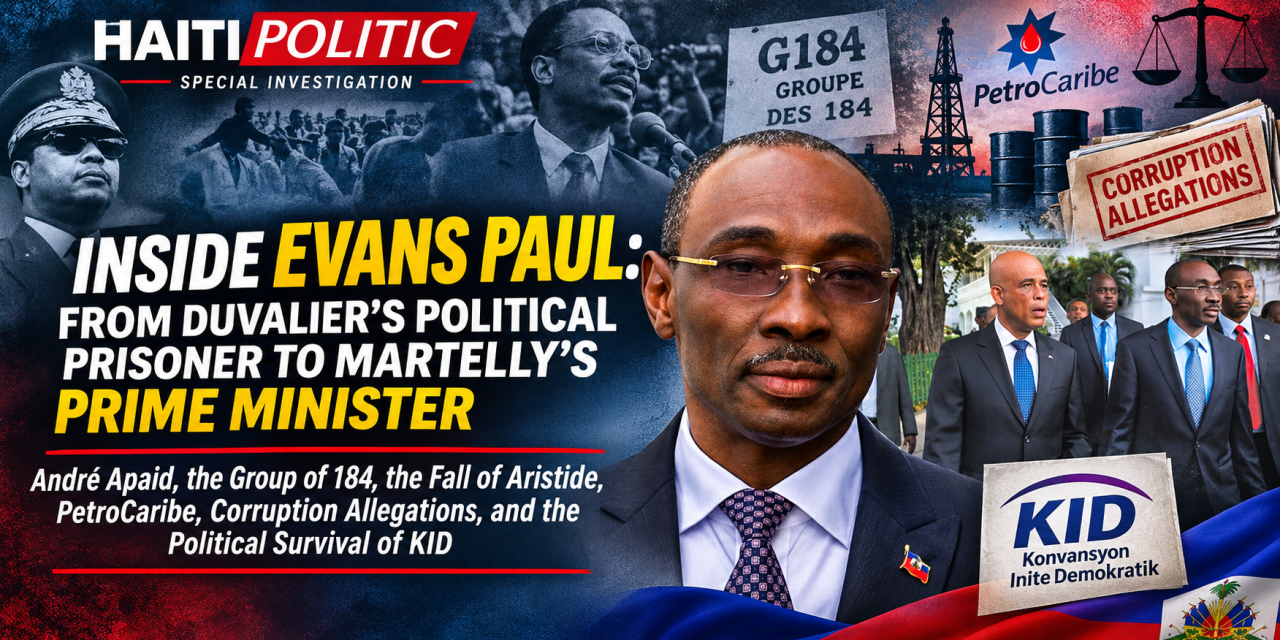
André Apaid, the Group of 184, the Fall of Aristide, PetroCaribe, Corruption Allegations, and the Political Survival of KID
HAITI POLITIC — SPECIAL INVESTIGATION
November 14, 2026
For four decades, Evans Paul has occupied different positions in Haiti’s political struggles: opponent of dictatorship, victim of military repression, ally of Jean-Bertrand Aristide, participant in the opposition to Aristide, and eventually prime minister under Michel Martelly. His political party, KID, remains active in 2026, even as questions persist about his alliances, government record, financial interests, and involvement in corruption-related judicial proceedings.
INTRODUCTION: FOUR DECADES IN HAITIAN POLITICS
Evans Paul, widely known as K-Plim, has been a recognizable figure in Haitian politics since the final years of the Duvalier dictatorship.
His political career spans the governments of Jean-Claude Duvalier, Henri Namphy, Prosper Avril, Jean-Bertrand Aristide, René Préval, Michel Martelly, and several transitional administrations.
Few politicians from the anti-Duvalier democratic movement have remained publicly active across so many political eras.
Yet Paul’s history presents a series of questions about political alliances, constitutional government, and public accountability.
How did a political activist who helped bring Jean-Bertrand Aristide to power in 1990 become part of the opposition movement demanding Aristide’s departure in 2004?
What was his relationship with businessman André Apaid, the influential leader of the Group of 184?
Why did Michel Martelly appoint Paul prime minister in December 2014, when Haiti was approaching a constitutional crisis?
What became of Paul’s political party, Konvansyon Inite Demokratik (KID)?
And what do the PetroCaribe and Centre National des Équipements investigations reveal about the scrutiny surrounding his time in public office?
Haiti Politic examines these questions through the available historical, institutional, and judicial reporting.
The documentary record establishes several important facts. Other questions, particularly those involving personal financial relationships, remain unresolved.
I. THE DUVALIER YEARS: THE MAKING OF K-PLIM
Evans Paul was born on November 26, 1955, in Port-au-Prince.
His childhood unfolded under François Duvalier, who governed Haiti from 1957 until 1971, followed by the dictatorship of his son, Jean-Claude Duvalier.
According to Haiti-Référence, Paul’s father, Alphonse Paul, disappeared in 1958. The biographical account describes his father as politically sympathetic to the movement associated with Daniel Fignolé.
Paul developed an interest in theater, radio broadcasting, and political activism.
During the 1970s, he worked in radio and became associated with cultural initiatives that addressed Haiti’s social and political conditions.
His nickname, K-Plim, emerged from his broadcasting and artistic activities.
In 1977, he founded Konbit Pitit Kay, a theater organization that used artistic expression to address social questions.
Under Duvalier, cultural and journalistic activities could carry serious political consequences.
October 1980: Arrest and torture
On October 16, 1980, Paul was arrested at Port-au-Prince airport after returning from New York.
He had interviewed former Haitian President Paul Eugène Magloire, who was living in exile.
Amnesty International documented his detention and mistreatment.
Paul was held incommunicado and subjected to severe abuse.
He was subsequently released without charges.
His imprisonment became part of the documented history of political repression under Jean-Claude Duvalier.
This episode establishes an important fact about Evans Paul’s early political life: he was not simply a later politician claiming an anti-dictatorship background. His persecution under the Duvalier regime was documented by international human rights organizations.
II. 1986: THE FALL OF DUVALIER AND THE BIRTH OF KID
Jean-Claude Duvalier fled Haiti on February 7, 1986.
His departure created new opportunities for political organizations that had operated under authoritarian restrictions.
Evans Paul helped establish Komite Inite Demokratik (KID) in 1986.
The organization later adopted the name Konfederasyon Inite Demokratik before becoming Konvansyon Inite Demokratik in 1995.
KID emerged from the broader movement demanding constitutional government, political participation, and democratic reforms.
The organization initially operated as a political pressure group rather than a conventional electoral party.
Over time, it developed into a political organization capable of participating in national elections.
For Paul, KID became the institutional foundation of a political career that would extend far beyond the anti-Duvalier movement.
But the party’s history would also reflect the changing alliances and divisions of Haitian politics.
III. PROSPER AVRIL: ANOTHER PERIOD OF POLITICAL REPRESSION
Following Duvalier’s departure, Haiti experienced repeated military-led transitions.
General Prosper Avril governed from 1988 until 1990.
During this period, Paul again became a target of political repression.
On November 1, 1989, he was arrested alongside Jean-Auguste Mesyeux and Marino Étienne.
The three men became known as the Prisoners of All Saints Day.
They were detained and subjected to abuse.
Their treatment later became the subject of litigation in the United States.
The Center for Constitutional Rights documented the case, including a substantial damages judgment against Avril.
Paul’s experience under both Duvalier and Avril formed an important part of his political identity.
He had personally experienced imprisonment under authoritarian governments.
That history makes his subsequent positions on constitutional authority, political transitions, and executive power particularly relevant to any examination of his career.
IV. EVANS PAUL AND JEAN-BERTRAND ARISTIDE: FROM ALLIES TO ADVERSARIES
The 1990 presidential election marked a major turning point in Haiti’s political history.
Jean-Bertrand Aristide emerged as the candidate of a broad popular movement demanding political change.
Evans Paul supported Aristide’s presidential campaign.
He participated in the political organization surrounding Aristide’s electoral victory.
Paul also won election as mayor of Port-au-Prince.
At that moment, both men were associated with Haiti’s transition from dictatorship and military rule toward elected government.
The September 1991 coup
On September 30, 1991, Haiti’s military overthrew Aristide.
Paul opposed the military takeover.
In October 1991, he was arrested and beaten by soldiers.
Amnesty International documented the incident.
Once again, Paul became a victim of military repression.
The relationship deteriorates
Following Aristide’s return to power in 1994, divisions emerged among the political organizations that had supported the democratic movement.
Paul increasingly distanced himself from Aristide.
By the early 2000s, he had become associated with the political opposition to Aristide’s second presidency.
This transformation is one of the most consequential developments in his career.
The politician who helped Aristide reach the presidency in 1990 later participated in an opposition movement seeking to end Aristide’s presidency.
Political disagreements are not inherently contradictory in a democracy.
However, the circumstances surrounding the 2004 crisis raise important questions about how political opposition interacted with foreign governments, business interests, and armed groups.
V. THE ANDRÉ APAID CONNECTION: BUSINESS POWER MEETS POLITICAL OPPOSITION
Between 2001 and 2004, Haiti experienced escalating confrontation between Aristide’s government and opposition organizations.
Two important political formations emerged during this period.
The first was the Convergence Démocratique, which brought together political parties opposed to Aristide.
The second was the Group of 184, commonly known as G184.
The Group of 184 was led publicly by businessman André Apaid Jr., a prominent figure in Haiti’s manufacturing sector.
Although the two formations were organizationally distinct, they operated within the same broader opposition environment.
Evans Paul was associated with the political opposition, while Apaid became one of the most visible representatives of the civil society and business-led movement.
February 25, 2004: The photograph that documents their cooperation
A photograph credited to Thony Bélizaire shows Evans Paul participating in an opposition press conference with André Apaid, Micha Gaillard, and Marie-Denise Claude on February 25, 2004.
The photograph was taken four days before Aristide left Haiti.
Its historical significance is straightforward.
Evans Paul and André Apaid were publicly cooperating within the anti-Aristide opposition immediately before the events of February 29, 2004.
Their association was political and visible.
However, a photograph does not establish that they shared business ownership, transferred money to one another, or coordinated armed operations.
Those questions require separate evidence.
Who financed the Group of 184?
The Group of 184 brought together business associations, civic organizations, and other sectors of Haitian society.
Human Rights Watch documented the involvement of wealthy business interests in the coalition.
The organization also described financial support for political communication and mobilization activities.
This raises an important question about the relationship between business financing and political organization.
Did members of the Group of 184 provide financial assistance to the political parties participating in the opposition?
More specifically, did André Apaid or businesses associated with him provide direct financial support to Evans Paul or KID?
Haiti Politic has not established documentary evidence of a direct financial transfer from Apaid to Paul.
Their political cooperation is documented. A personal financial relationship remains unverified.
That distinction is essential.
VI. THE UNITED STATES, IRI, AND THE 2004 OPPOSITION
The international dimension of the anti-Aristide movement has been the subject of extensive reporting.
The International Republican Institute, a U.S.-based democracy assistance organization, conducted programs involving Haitian political actors.
A 2004 investigation published by Salon examined IRI’s activities and reported that the organization received USAID funding for Haiti programs.
An IRI representative acknowledged that the organization had provided advice during the formation of the Group of 184.
The investigation also described meetings involving Haitian opposition figures in the Dominican Republic and the United States.
These findings establish that foreign-funded democracy assistance programs interacted with Haitian opposition organizations.
But the existence of such programs does not automatically establish that every opposition leader received money personally.
Nor does it prove that the United States directly controlled every political decision made by the opposition.
The February 2004 negotiations
As Haiti’s crisis intensified, American and international representatives pursued negotiations involving Aristide and opposition leaders.
A proposed power-sharing arrangement became part of the diplomatic effort.
Aristide’s government and opposition representatives disagreed over the conditions for resolving the crisis.
The negotiations failed to prevent the collapse of the political situation.
Aristide left Haiti on February 29, 2004, amid an armed rebellion and intense international pressure.
The circumstances of his departure remain politically contested.
Some accounts emphasize the armed rebellion and the loss of political support.
Aristide and his supporters have argued that foreign intervention forced him from office.
The civilian opposition’s activities must also be distinguished from the armed operations carried out by former military personnel and insurgent groups.
Evans Paul’s responsibility
The available record establishes that Paul participated in the civilian opposition movement.
It does not establish that he commanded the armed insurgents who fought against Aristide.
Nevertheless, the political relationship between Evans Paul, André Apaid, and other opposition leaders remains an important subject for historical investigation.
What did Evans Paul know about the negotiations involving foreign diplomats, and what position did he take on the proposed political settlement?
That question deserves an answer grounded in diplomatic records, contemporaneous interviews, and the testimony of participants.
VII. AFTER ARISTIDE: THE 2006 PRESIDENTIAL ELECTION
Following Aristide’s departure, Haiti entered another transitional period.
Evans Paul remained active in politics.
He participated in the 2006 presidential election but attracted only a small share of the national vote.
René Préval ultimately won the presidency.
The election illustrated an important distinction between political experience and electoral support.
Paul had previously helped organize Aristide’s successful presidential campaign.
He had served as mayor of Port-au-Prince.
He had become a nationally recognized opposition leader.
Yet those credentials did not translate into a successful presidential campaign of his own.
KID nevertheless remained politically active.
The party continued to participate in electoral alliances and legislative contests.
VIII. THE INTERNAL STRUGGLES OF KID
KID’s history was not limited to external political alliances.
The party also experienced internal disagreements over leadership.
By 2007, some members were publicly challenging Evans Paul’s continued leadership.
Reports described calls for organizational renewal after more than two decades under his direction.
André Michel, who had been associated with KID and its electoral alliance, was among those involved in disputes over the party’s leadership.
These disagreements raised questions about internal party democracy and leadership succession.
KID had emerged from a movement demanding democratic participation.
But its organizational history also reflected the difficulty many Haitian political parties face in establishing leadership transitions and durable institutions independent of their founders.
The party survived these disputes.
Evans Paul remained its most recognizable political figure.
IX. THE MARTELLY CONNECTION: FROM OPPOSITION POLITICIAN TO PRIME MINISTER
In December 2014, Haiti faced a serious political crisis.
President Michel Martelly’s administration had failed to resolve longstanding disputes over legislative elections.
Prime Minister Laurent Lamothe resigned amid mounting political pressure.
On December 25, 2014, Martelly selected Evans Paul as his next prime minister.
The appointment represented a significant political realignment.
Paul had spent much of his career opposing governments.
He was now preparing to lead the government of a president facing criticism over delayed elections and the approaching expiration of Parliament’s mandate.
Why Evans Paul?
Martelly’s decision can be understood within the political circumstances of late 2014.
Paul brought experience in political negotiations and longstanding relationships across Haiti’s political landscape.
His appointment also offered the possibility of incorporating an established opposition figure into the executive branch.
However, the precise political negotiations behind the appointment remain insufficiently documented.
Did Martelly offer KID specific positions or policy commitments?
Were business leaders or foreign diplomats involved in discussions supporting Paul’s appointment?
Did Evans Paul negotiate a formal political agreement before accepting the position?
These questions cannot be answered conclusively without additional records.
January 2015: Parliament ceases functioning
Paul assumed office on January 16, 2015.
By then, Parliament had become dysfunctional after the expiration of legislative mandates.
The ordinary parliamentary confirmation process for Paul’s appointment had not been completed.
A United Nations report documented the political negotiations and institutional breakdown surrounding his nomination.
Martelly subsequently governed by decree.
Paul therefore entered the premiership during an exceptional constitutional situation.
The crisis had developed before his appointment, but his government became responsible for helping restore functioning elected institutions.
The central accountability question is what Evans Paul’s administration accomplished toward resolving the electoral and constitutional crisis.
X. THE 2015 ELECTIONS: A GOVERNMENT UNDER PRESSURE
The organization of elections became a central responsibility of Paul’s government.
Legislative elections were held in August 2015.
Further voting took place in October.
The process was marked by allegations of irregularities, violence, and disputes over results.
United Nations reporting documented serious security problems and electoral disturbances.
The government, electoral authorities, and security institutions each had different responsibilities.
The Provisional Electoral Council was responsible for administering elections.
The executive branch was responsible for providing institutional support, including public security and resources.
Paul’s administration therefore had a role in the broader electoral process.
But responsibility for specific incidents cannot automatically be attributed to the prime minister without evidence.
KID’s electoral performance
Despite the controversy surrounding the elections, KID obtained representation in Parliament.
Historical party records indicate that KID emerged with seven deputies and two senators following the 2015–2016 electoral process.
This demonstrated that the party retained organizational capacity.
It also meant that Evans Paul was simultaneously serving as prime minister while his political organization participated in the electoral system.
The relationship between party interests and executive responsibilities deserves scrutiny, particularly where government resources and electoral administration are concerned.
No specific misuse of those resources by Paul is established merely by this overlap.
XI. FEBRUARY 2016: MARTELLY DEPARTS WITHOUT AN ELECTED SUCCESSOR
Michel Martelly’s presidential term ended on February 7, 2016.
The electoral process had not produced an inaugurated successor.
A political agreement eventually led to Jocelerme Privert becoming provisional president.
Evans Paul’s premiership ended during the subsequent transition.
The result was another period of provisional government.
For Paul, the episode represented a significant moment in a career that had begun with demands for democratic elections and constitutional government.
He had participated in the movement that brought Aristide to power through the 1990 election.
Twenty-five years later, he had served as prime minister during an electoral process that failed to produce a completed presidential transition before the incumbent’s departure.
The two circumstances were not identical.
Nevertheless, the comparison raises legitimate questions about institutional performance and political accountability.
XII. PETROCARIBE: EVANS PAUL’S NAME ENTERS THE INVESTIGATION
After Paul left office, allegations concerning Haiti’s management of PetroCaribe funds became an increasingly prominent political issue.
PetroCaribe was a Venezuelan petroleum financing arrangement that provided Haiti with resources intended to support public investment and development.
Questions about the management of those resources eventually led to parliamentary investigations and audits.
The 2016 Senate investigation
The U.S. Department of State’s 2016 Human Rights Report documented that Senator Youri Latortue called for an investigation into PetroCaribe management.
The officials targeted included former prime ministers Jean-Max Bellerive, Garry Conille, Laurent Lamothe, and Evans Paul.
Some officials challenged the investigation as politically motivated.
Being named in a parliamentary investigation does not establish that Evans Paul personally embezzled PetroCaribe money.
The allegations must be evaluated against the specific transactions and decisions associated with his period in office.
What did Evans Paul say about PetroCaribe?
In a 2019 interview discussed by the Caribbean Investigative Journalism Network, Paul described weaknesses in PetroCaribe’s management.
He criticized the absence of a consistent development strategy and the tendency for priorities to change between administrations.
He also raised questions about contracts involving foreign companies and the use of PetroCaribe resources.
His comments are relevant because they provide his own account of the program’s administrative problems.
However, they do not replace an independent examination of decisions made while he was prime minister.
The missing financial trail
An investigation should identify PetroCaribe-funded projects approved, modified, or disbursed during Paul’s premiership.
It should also determine which ministries were responsible, what procurement procedures were used, and whether the Court of Auditors identified irregularities involving those specific transactions.
The wider PetroCaribe scandal involved multiple administrations and years of spending.
Attributing all disputed expenditures to any single prime minister would misrepresent the chronology.
XIII. THE CNE CORRUPTION INVESTIGATION: A MORE DIRECT JUDICIAL CONTROVERSY
In January 2024, Evans Paul’s name appeared in a major corruption-related judicial investigation.
The case concerned the Centre National des Équipements (CNE), the government institution responsible for heavy equipment used in public works and emergency operations.
Investigative judge Al Duniel Dimanche issued warrants involving numerous former senior officials.
The list included former presidents Michel Martelly and Jocelerme Privert, along with former prime ministers Laurent Lamothe, Evans Paul, Jean-Michel Lapin, and Jean-Henry Céant.
The Associated Press reported that the investigation concerned alleged misappropriation of CNE funds or equipment.
The accusations involved possible misuse of public resources.
April 2024: Evans Paul appears before a judge
On April 12, 2024, Paul appeared before investigative judge Merlan Bélabre.
Contemporary reporting described his appearance as testimony in the CNE investigation.
Paul denied involvement in the alleged misconduct.
He stated that he had not handled CNE matters during his administration.
He also expressed willingness to cooperate with the judicial process.
The proceedings therefore establish three facts.
First, Paul was named in corruption-related judicial actions.
Second, he appeared before an investigative judge.
Third, he denied wrongdoing.
The available evidence does not establish that Evans Paul was convicted of corruption in the CNE case.
The latest final judicial disposition has not been independently verified for this investigation.
Why the CNE case matters
The CNE is responsible for resources that serve important public purposes.
Heavy machinery is essential for road maintenance, construction, and disaster response.
Misuse of such equipment can undermine public services.
For that reason, allegations concerning the CNE warrant careful judicial investigation.
But accountability requires examining specific acts and evidence, not treating every person named in a broad investigation as guilty.
XIV. OTHER CORRUPTION ALLEGATIONS: THE ONA QUESTION
In 2016, a public accusation alleged that public resources associated with Haiti’s National Old-Age Insurance Office, ONA, had been used to benefit Evans Paul.
The allegation concerned purported repairs to a private residence.
However, the available material does not establish the underlying financial transactions through authenticated payment records or an official judicial finding.
The accusation therefore remains unsubstantiated in this investigation.
A responsible inquiry would seek the original complaint, relevant ONA disbursement records, any applicable audit findings, and Paul’s response.
Without those documents, the allegation should not be presented as proven corruption.
XV. DOES EVANS PAUL OWN BUSINESSES IN HAITI, THE UNITED STATES, OR CANADA?
Evans Paul’s personal business interests represent another area requiring documentary examination.
Biographical accounts have described him as an entrepreneur and promoter of Haitian handicrafts and visual arts.
However, those descriptions do not identify a specific company or establish its ownership structure.
Haiti
The available biographical record indicates involvement in entrepreneurial and cultural activities.
But this investigation has not authenticated a current Haitian corporate registration establishing Paul’s ownership of a specific commercial enterprise.
United States
No U.S. company has been independently verified as belonging to the former Haitian prime minister.
Corporate records involving individuals with similar names cannot safely be attributed to him without additional identifiers.
Canada
Likewise, no Canadian corporation has been independently verified as belonging to Evans Paul.
The absence of an identified registration is not proof that he has never owned shares, held investments, or participated in a private company.
The financial disclosure question
A more reliable investigation would begin with Paul’s declarations of assets when entering and leaving the premiership.
Those records could help identify declared property, financial interests, and business holdings.
They would also provide a basis for examining whether any interests overlapped with government contracts or political associates.
At present, the available evidence does not establish that Evans Paul and André Apaid jointly owned a business.
Their political cooperation is documented. Shared commercial ownership is not.
XVI. EVANS PAUL AND ANDRÉ APAID: DID THE RELATIONSHIP CONTINUE UNDER MARTELLY?
The relationship between Paul and Apaid is historically significant because it connects political organization and business influence during the 2004 crisis.
Both men participated in the opposition to Aristide.
Apaid represented influential business interests.
Paul represented established political opposition networks.
The question is whether those relationships continued after Aristide’s departure.
Did Apaid maintain political influence over KID?
Did business figures associated with the Group of 184 support Paul’s later political activities?
Were companies associated with the same networks awarded government contracts during Paul’s premiership?
And did any of those relationships influence his appointment under Martelly?
These questions are relevant to understanding continuity in Haiti’s political networks.
But no verified evidence reviewed here establishes a corrupt financial arrangement between Evans Paul and André Apaid.
A credible investigation must examine contracts, financial disclosures, corporate ownership records, and documented communications before drawing such conclusions.
XVII. WHAT HAPPENED TO KID?
Nearly four decades after its founding, Konvansyon Inite Demokratik remains part of Haiti’s political landscape.
But the party’s role has changed.
KID began as a democratic pressure group.
It later supported Aristide.
It became part of the opposition to Aristide.
It participated in electoral alliances.
Its leader eventually became prime minister under Martelly.
In 2026, the party continued to participate in coalition politics.
August 2026: KID joins REKONSILYÉ
In August 2026, KID joined the political platform REKONSILYÉ.
The coalition sought to bring together political organizations participating in Haiti’s electoral process.
The move placed KID within another broad political alliance.
September 2026: KID breaks with REKONSILYÉ
The alliance did not last.
In September 2026, KID announced its withdrawal from REKONSILYÉ’s electoral process.
Reports identified Evans Paul and Dr. Enold Joseph with the party’s leadership.
KID accused the platform of undemocratic and disloyal political maneuvers.
The party demanded that its name and emblem no longer be used by the coalition.
The withdrawal occurred amid wider internal disagreements within REKONSILYÉ.
Reports also described disputes surrounding the selection of Gary Bodeau as the coalition’s presidential candidate.
KID’s departure therefore formed part of a broader political disagreement over the platform’s direction.
Is KID still a functioning political party?
The evidence indicates that KID continued to exist in 2026.
However, its current membership, finances, local organization, and independent electoral strength remain unclear.
Its 2015 legislative results demonstrate historical electoral capacity.
They do not establish comparable support in 2026.
The question is whether KID continues to operate as an independent political institution or relies primarily on coalitions and the public profile of its longstanding leadership.
That question requires current membership records, party financial reports, and verified electoral filings.
XVIII. EVANS PAUL IN 2026: POLITICAL COMMENTARY AND CONTINUED PUBLIC ACTIVITY
Evans Paul has remained publicly engaged in Haiti’s political debates.
Statements attributed to him in September 2026 addressed kidnapping, insecurity, education, and the state’s responsibility to protect citizens.
His public commentary emphasized the right to life and the need for effective state institutions.
These positions are consistent with themes that have appeared throughout his political career.
However, public statements must be distinguished from the results of an individual’s record in office.
Paul has held significant political responsibilities.
He has been mayor of Port-au-Prince.
He has led a political party.
He has participated in major opposition movements.
And he has served as prime minister.
His public arguments about state responsibility can therefore be examined alongside the actions and results of the institutions he previously led.
XIX. THE CENTRAL QUESTION: POLITICAL PRINCIPLES OR CHANGING ALLIANCES?
Evans Paul’s career presents an important case study in Haiti’s post-Duvalier political history.
He opposed Jean-Claude Duvalier.
He suffered repression under Prosper Avril.
He supported Aristide.
He opposed the 1991 military coup.
He later became an opponent of Aristide.
He cooperated politically with André Apaid’s opposition movement.
He participated in presidential and legislative politics.
He accepted the premiership under Michel Martelly.
And in 2026, his political party continued to negotiate and withdraw from electoral coalitions.
These transitions do not automatically establish opportunism or wrongdoing.
Political alliances can change because of policy disagreements, constitutional disputes, electoral strategy, or evolving political circumstances.
But a politician’s explanations for those changes are relevant to public accountability.
What principles remained constant?
What policy disagreements justified each major realignment?
What political agreements were negotiated?
And what measurable results followed?
The answers should come from Paul’s statements, party records, government decisions, and independent documentation.
XX. FIFTEEN QUESTIONS EVANS PAUL SHOULD ANSWER
1. THE DUVALIER YEARS
How did your experience as a political prisoner influence your understanding of constitutional government and political power?
2. ARISTIDE’S 1990 CAMPAIGN
What specific role did you play in organizing Aristide’s successful presidential campaign?
3. THE BREAK WITH ARISTIDE
What events or policy disagreements caused you to become an opponent of the president you once supported?
4. ANDRÉ APAID
When did your political cooperation with André Apaid begin, and what agreements existed between your respective organizations?
5. GROUP OF 184 FINANCING
Did you or KID ever receive financial assistance from Apaid, his businesses, or other members of the Group of 184?
6. THE 2004 CRISIS
What role did you play in negotiations involving the Convergence Démocratique, Group of 184, CARICOM, and foreign diplomats?
7. THE ARMED REBELLION
What did you know about the activities of armed opposition groups before Aristide’s departure?
8. IRI AND USAID
Did you personally participate in IRI-sponsored political programs, and did KID receive any funding through foreign democracy assistance organizations?
9. THE MARTELLY APPOINTMENT
Why did you accept Michel Martelly’s offer to become prime minister in December 2014?
10. THE POLITICAL AGREEMENT
What commitments were negotiated between you, Martelly, and other political actors before your appointment?
11. THE 2015 ELECTIONS
What specific actions did your government take to prevent electoral violence and restore public confidence in the process?
12. PETROCARIBE
Which PetroCaribe-funded expenditures were approved or administered during your premiership, and what documentation supports those decisions?
13. THE CNE INVESTIGATION
What is the current legal status of the CNE proceedings involving you, and can you provide the relevant judicial documents?
14. BUSINESS AND ASSET DISCLOSURES
Did you file declarations of assets when entering and leaving office, and would you support making the legally disclosable portions available for public examination?
15. THE FUTURE OF KID
After four decades, what distinguishes KID’s political program from the coalitions it has joined, and what institutional reforms does the party propose for Haiti?
CONCLUSION: EVANS PAUL AND THE UNFINISHED ACCOUNTING OF HAITI’S POLITICAL TRANSITIONS
Evans Paul’s political history cannot be reduced to a single alliance, administration, or controversy.
He was a documented victim of authoritarian repression.
He participated in the movement that helped establish elected government after the Duvalier dictatorship.
He later became part of the opposition to a president he had previously supported.
He cooperated politically with business leaders involved in the anti-Aristide movement.
He served as prime minister under Michel Martelly during a serious constitutional and electoral crisis.
His name subsequently appeared in corruption-related investigations, including PetroCaribe scrutiny and the CNE judicial proceedings.
He has denied involvement in the alleged CNE misconduct, and this investigation has not established a final corruption conviction against him.
His party, KID, remains politically active, although its present organizational strength is uncertain.
Taken together, these facts illuminate a broader issue in Haiti’s political history: the relationship between political movements, individual leaders, business interests, foreign involvement, and the institutions responsible for public accountability.
The relevant question is not whether a politician has changed political allies.
It is whether those alliances were transparent, whether public responsibilities were fulfilled, and whether government decisions can withstand independent examination.
For Evans Paul, the historical record is extensive. The accounting of political agreements, public expenditures, and institutional results remains incomplete.
After four decades in public life, the documents needed to answer those questions should be central to any serious assessment of his political legacy.
SOURCES AND DOCUMENTARY REFERENCES
Historical biography and political background
Haiti-Référence — Biographical record of Evans Paul.
National Alliance for the Advancement of Haitian Professionals — Evans Paul biography.
Center for Constitutional Rights — Paul v. Avril, documenting legal action arising from political repression.
Amnesty International — Reports concerning Evans Paul’s detention and mistreatment under Haitian military and authoritarian governments.
The 2004 crisis and the André Apaid connection
Human Rights Watch — Haiti: Recycled Soldiers and Paramilitaries on the March, February 27, 2004.
Kim Ives, Haiti Liberté / Canada-Haiti Information Project — What Wikileaked U.S. Cables Reveal About Guy Philippe and Evans Paul, July 27, 2016. This is an interpretive investigation; its characterizations should be distinguished from the underlying diplomatic records.
Salon — The Other Regime Change, July 2004, examining IRI, the Group of 184, and U.S. involvement in Haiti’s political crisis.
The Martelly administration
United Nations Security Council — Report S/2015/157, documenting the December 2014 political negotiations and January 2015 parliamentary crisis.
Institute for Justice & Democracy in Haiti — January 2015 briefing on Haiti’s electoral and constitutional situation.
PetroCaribe and corruption investigations
U.S. Department of State — 2016 Country Reports on Human Rights Practices: Haiti.
Caribbean Investigative Journalism Network — PetroCaribe Country Report: Haiti.
Associated Press — January 8, 2024, reporting on judicial warrants involving former Haitian presidents and prime ministers.
Gazette Haiti — April 13, 2024, reporting on Evans Paul’s appearance before the investigating judge in the CNE case.
KID and the 2026 electoral process
NAGO News — September 21, 2026, reporting KID’s withdrawal from REKONSILYÉ.
RL News Haiti — September 16, 2026, reporting internal disagreements surrounding REKONSILYÉ’s presidential selection.
TELEPAM — September 2026 reporting on KID’s departure from the coalition.
HAITI POLITIC — SPECIAL INVESTIGATION
Research note: This article distinguishes established historical events, attributed allegations, and questions requiring further documentation. It does not establish criminal guilt, undisclosed business ownership, or a corrupt financial relationship between Evans Paul and André Apaid. The latest judicial status of the CNE proceedings and the full extent of Paul’s business holdings remain unverified.