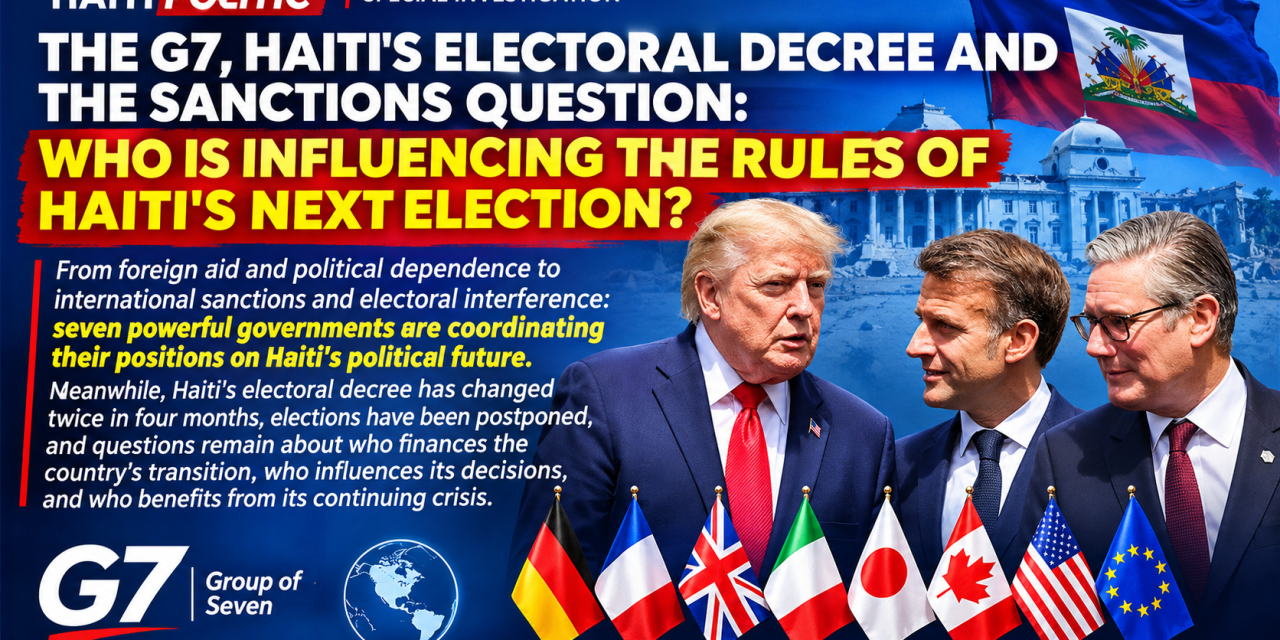
From foreign aid and political dependence to international sanctions and electoral interference: seven powerful governments are coordinating their positions on Haiti’s political future. Meanwhile, Haiti’s electoral decree has changed twice in four months, elections have been postponed, and questions remain about who finances the country’s transition, who influences its decisions, and who benefits from its continuing crisis.
By Haiti Politic | Special Investigation
November 11, 2026
INTRODUCTION: WHO REALLY INFLUENCES HAITI’S POLITICAL FUTURE?
PORT-AU-PRINCE, HAITI — Haiti’s political transition is increasingly shaped by overlapping relationships involving foreign governments, international organizations, security missions, financial institutions, and domestic political authorities.
On November 11, 2026, the French Embassy in Haiti circulated a declaration following the November 9–10 meeting of G7 foreign ministers in Paris.
The statement addressed Haiti’s security, elections, international sanctions, humanitarian situation, and economic recovery.
It called for the full and impartial implementation of Haiti’s electoral decree while expressing concern about the participation of sanctioned individuals in the political process.
The declaration came after Haiti’s June 2, 2026, electoral decree had undergone two formal revisions, on July 2 and October 6.
The electoral calendar was subsequently adjusted.
The first electoral round is now scheduled for July 2027.
These developments raise questions extending far beyond election dates.
Who is influencing Haiti’s electoral rules? Who finances the political transition? What conditions accompany international assistance? And are Haitian authorities making decisions independently or under pressure from governments and institutions that control critical financial and security resources?
The answers require examining not only the electoral decree but also the broader relationship between foreign assistance, political influence, institutional dependence, and corruption.
Haiti has received international assistance for decades.
Yet persistent insecurity, weak public institutions, political instability, and recurring allegations of corruption continue to undermine confidence in governance.
This does not establish that international assistance caused those problems or that foreign governments deliberately maintain them.
It does, however, justify examining how aid is administered, who receives contracts, how political decisions are influenced, and whether international programs strengthen Haitian institutions or perpetuate dependence.
For Haiti Politic, the central issue is accountability.
When foreign governments finance security operations, support political transitions, participate in electoral assistance, and advocate positions concerning candidate eligibility, Haitians deserve to know where international cooperation ends and political influence begins.
1. WHAT IS THE G7, AND WHY IS IT INVOLVED IN HAITI?
The Group of Seven comprises Germany, France, the United Kingdom, Italy, Japan, Canada, and the United States.
The European Union also participates in its meetings.
The G7 is an informal forum through which major advanced economies coordinate international policies.
It is not a governing authority over Haiti.
It cannot independently rewrite Haiti’s Constitution, amend an electoral decree, appoint Haitian officials, or determine who qualifies for the presidency.
Nevertheless, its members possess considerable diplomatic and financial influence.
Several provide assistance to Haiti’s security institutions, humanitarian programs, development projects, and electoral preparations.
They also participate in international organizations whose decisions affect Haiti.
The United States, France, and the United Kingdom are permanent members of the United Nations Security Council.
Canada, the United States, France, and other G7 governments have imposed sanctions on individuals associated with Haiti’s political and security crises.
G7 members also participate in international financial institutions that provide financing and policy advice to Haitian authorities.
These overlapping roles create influence without necessarily establishing direct control.
The G7 does not possess legal authority to govern Haiti, but coordinated policies adopted by its members can significantly affect Haiti’s political environment.
The question is whether that influence strengthens Haitian institutions or creates relationships in which financial assistance becomes a source of political leverage.
2. THE G7’S NOVEMBER DECLARATION: SECURITY, ELECTIONS, SANCTIONS, AND ECONOMIC POLICY
The November 2026 declaration addressed several interconnected issues.
The G7 supported international security assistance, including the Gang Suppression Force.
It called for strengthening the Haitian National Police and Armed Forces.
It acknowledged the postponement of elections until July 2027.
It supported impartial implementation of Haiti’s electoral decree.
It expressed concern about sanctioned individuals participating in politics.
It also welcomed international economic cooperation, including a World Bank framework involving Haitian authorities.
The breadth of the declaration is significant.
The G7 was not discussing a single humanitarian program or diplomatic initiative.
Its statement covered multiple areas central to Haiti’s governance.
These included public security, political participation, electoral administration, international financing, and economic reform.
The G7’s involvement does not prove that its members control these decisions.
But it demonstrates that powerful foreign governments are coordinating positions on several matters that Haitian institutions must ultimately address.
When international governments simultaneously discuss security, elections, sanctions, and economic reform, the Haitian public has a legitimate interest in understanding how those policies interact.
3. HAITI’S ELECTORAL DECREE: TWO FORMAL REVISIONS IN FOUR MONTHS
The official electoral record identifies the following sequence:
| Date | Action |
|---|---|
| December 1, 2025 | Earlier electoral decree published |
| June 2, 2026 | New electoral decree issued |
| July 2, 2026 | First formal amendment to the June decree |
| October 6, 2026 | Second formal revision |
| October 28, 2026 | Updated electoral calendar announced |
The June decree established the framework governing candidate registration, political-party participation, electoral administration, voting, tabulation, and disputes.
The July amendment followed consultations between the government and the Provisional Electoral Council (CEP).
The October revision followed additional discussions with political actors and was accompanied by extensions to candidate registration deadlines.
The CEP also acknowledged an earlier decree published in December 2025.
The confirmed count of two amendments therefore applies specifically to the June 2026 decree.
Why do these revisions matter?
Electoral rules determine who can participate in political competition.
They establish the documents candidates must submit, the conditions political parties must satisfy, and the procedures used to resolve disputes.
Changes may be necessary to correct technical problems or accommodate legitimate administrative difficulties.
But they can also affect the relative position of political actors.
The key questions are:
Who requested each modification?
Which provisions changed?
Were the changes applied equally?
Did any political organization receive preferential treatment?
And did international advisers recommend or review any of the amendments?
The public record establishes that consultations occurred.
It does not fully identify the origin and justification of every substantive change.
A complete article-by-article comparison of the June, July, and October decrees is necessary to determine their political and legal consequences.
4. THE SANCTIONS QUESTION: CAN FOREIGN GOVERNMENTS INFLUENCE WHO BECOMES A CANDIDATE?
One of the most consequential elements of the G7 declaration concerns sanctioned individuals.
The ministers expressed concern about their participation in Haiti’s political process.
However, the statement did not identify specific Haitian politicians.
Nor did it explain whether the concern referred exclusively to United Nations sanctions or also included sanctions imposed independently by the United States, Canada, and other governments.
That distinction is essential.
United Nations sanctions, American sanctions, and Canadian sanctions operate under different legal frameworks.
A person sanctioned by one government is not necessarily sanctioned by another.
Sanctions also do not automatically establish criminal guilt.
The consequences for electoral eligibility depend on applicable Haitian law.
The October decree requires closer examination
The relevant provisions of Haiti’s October 6 electoral decree should be compared directly with the June and July texts.
The comparison must establish whether the legal treatment of international sanctions changed.
If the decree distinguishes between UN sanctions and sanctions imposed by individual countries, the practical consequences could be significant.
The CEP should clarify which sanctions are relevant to candidate eligibility, which authority verifies them, and what appeal procedures are available.
The G7’s public position does not establish that foreign governments directed those rules.
Nevertheless, when foreign governments impose sanctions and simultaneously express concern about the electoral participation of sanctioned individuals, the relationship between sanctions policy and Haitian electoral law deserves careful scrutiny.
5. THE HISTORICAL PRECEDENT: THE OAS AND HAITI’S 2010–2011 PRESIDENTIAL ELECTION
Questions about international electoral influence are not new.
During Haiti’s disputed November 2010 presidential election, preliminary results placed Mirlande Manigat first, Jude Célestin second, and Michel Martelly third.
The initial results would have advanced Manigat and Célestin to the runoff.
Following allegations of irregularities and political protests, an Organization of American States verification mission examined the vote tabulation.
Its recommendations contributed to changes in the electoral outcome.
Martelly ultimately advanced to the runoff against Manigat.
He subsequently won the presidency.
The OAS intervention generated controversy.
Supporters argued that the review helped address irregularities.
Critics questioned its methodology and the extent of international influence over Haiti’s electoral institutions.
The United States and other international actors also exerted diplomatic pressure during the dispute.
Hillary Clinton, then U.S. secretary of state, visited Haiti in January 2011.
The documented record supports examining the role of U.S. and OAS pressure.
It does not, by itself, establish that Clinton personally selected Martelly.
Why the history matters today
The 2010–2011 controversy illustrates how international intervention can become consequential during an electoral dispute.
It also demonstrates why Haitians may question the independence of electoral decisions when foreign governments and international organizations become deeply involved.
However, historical intervention is not proof that the same actors are manipulating the current electoral process.
The appropriate lesson is that international electoral assistance must be transparent, and decisions affecting Haitian candidates must remain accountable to Haitian law and institutions.
6. PETERSON PIERRE-LOUIS, THE CEP, CANADA, AND THE OAS MEETING IN SANTO DOMINGO
Peterson Pierre-Louis, president of the CEP, has participated in international discussions concerning Haiti’s electoral preparations.
These include an August 2026 mission to Canada concerning diaspora voting arrangements.
He also traveled to Santo Domingo for the November 11–13 Inter-American Meeting of Electoral Management Bodies, organized through cooperation between Dominican electoral authorities and the OAS.
The conference addresses electoral technology, political financing, artificial intelligence, disinformation, and institutional resilience.
Such cooperation can provide useful technical knowledge.
But Haiti’s history with the OAS creates a particular need for transparency.
The CEP should disclose the objectives, financing, and outcomes of its international missions.
It should also clarify whether discussions with international partners concern Haiti’s electoral decree, candidate eligibility, or election timetable.
The fact that Pierre-Louis traveled to Canada and attended an OAS-associated meeting does not establish improper coordination.
What matters is whether international advice is documented and whether final electoral decisions remain within the authority of Haitian institutions.
7. FROM FOREIGN AID TO POLITICAL DEPENDENCE: WHO CONTROLS THE MONEY, WHO INFLUENCES THE GOVERNMENT, AND WHO PROFITS FROM HAITI’S CRISIS?
This is a central issue in Haiti’s relationship with international institutions.
For decades, foreign governments and international organizations have financed humanitarian assistance, public administration, security programs, development initiatives, and institutional reforms in Haiti.
Some programs have provided essential services.
Others have faced criticism concerning effectiveness, oversight, sustainability, and the limited capacity left within Haitian institutions.
The concern is not simply that foreign aid exists.
It is whether the structure of international assistance creates political dependence while providing insufficient transparency about how resources are distributed.
A. Foreign aid can create political leverage
Governments receiving substantial international assistance may face pressure to adopt policies favored by donors.
That influence can take several forms.
Financial assistance may be linked to institutional reforms.
Budget support may depend on economic conditions.
Security assistance may involve operational agreements.
Diplomatic recognition and cooperation may affect political negotiations.
These arrangements are not necessarily improper.
Donors may attach conditions intended to prevent corruption, protect human rights, or improve financial management.
But the arrangements can become controversial when conditions affect decisions that should be determined through Haitian constitutional and democratic processes.
The central question is whether assistance supports Haitian institutions or gives foreign governments disproportionate influence over Haitian policy.
B. The problem of governments dependent on foreign support
Critics sometimes describe Haitian administrations as puppet governments when they believe those administrations depend more on foreign diplomatic and financial support than on domestic democratic legitimacy.
The term is politically charged.
To establish that a government is acting under foreign direction, an investigation would need evidence showing that foreign officials controlled or improperly dictated particular decisions.
Foreign assistance, diplomatic meetings, or political alignment alone would not establish that conclusion.
However, dependence can still be examined through measurable indicators.
For example:
How much of a government’s operating budget depends on foreign financing?
Which public programs depend on international contractors?
What conditions accompany international financial support?
How are major policy decisions negotiated?
Are agreements submitted to appropriate Haitian institutions for review?
Do citizens have access to the relevant contracts and financial records?
These questions can reveal the extent of dependence without assuming that every relationship constitutes foreign control.
C. Foreign aid and corruption risks
International assistance can create opportunities for corruption when financial controls are weak.
Risks may arise through inflated procurement contracts, conflicts of interest, improper payments, inadequate auditing, or preferential treatment of politically connected businesses.
Corruption may involve Haitian officials, foreign contractors, intermediaries, or combinations of these actors.
But such conduct must be established through evidence.
The existence of a foreign-funded contract does not prove corruption.
Likewise, the existence of corruption within a program does not necessarily establish that the donor government intended it.
A credible investigation must identify the actual transactions, responsible organizations, beneficiaries, and oversight failures.
D. Who receives the money?
One of the most important questions concerns the distribution of international assistance.
A funding announcement may identify a substantial commitment to Haiti.
But that amount does not necessarily represent money transferred directly to the Haitian government.
Funds may be administered through international organizations, humanitarian agencies, foreign contractors, nonprofit organizations, or other implementing partners.
Each arrangement has different accountability requirements.
For Haiti Politic, the financial investigation should distinguish:
Money pledged: Funds publicly promised by donors.
Money committed: Funds formally allocated through agreements.
Money disbursed: Funds actually paid.
Money spent in Haiti: Expenditures that directly support activities or beneficiaries within the country.
Money paid to foreign contractors: Payments for services, administration, equipment, logistics, and other expenses.
Money reaching Haitian institutions: Funding transferred to or spent directly through Haitian public bodies.
Without these distinctions, the public cannot accurately evaluate the financial consequences of international assistance.
E. Security contracts and the business of international intervention
Security operations require substantial resources.
These may include aircraft, armored vehicles, communications systems, fuel, medical services, accommodation, training, and logistics.
Some services may be supplied by private contractors.
This creates legitimate questions about procurement and oversight.
Which companies receive contracts?
Who owns those companies?
Were the contracts awarded competitively?
Are any contractors connected to political officials?
How are prices established?
Who verifies that services were delivered?
Which institution investigates allegations of fraud?
The presence of private contractors does not establish wrongdoing.
But where public funds and national security are involved, transparency is particularly important.
F. Does foreign assistance strengthen Haiti or perpetuate dependence?
A useful measure of international assistance is whether Haitian institutions become more capable of operating independently.
For security assistance, this means evaluating improvements in Haitian police capacity, equipment, training, investigations, and public protection.
For electoral assistance, it means evaluating whether the CEP develops reliable systems, trained personnel, and transparent procedures.
For economic assistance, it means assessing whether Haitian institutions can sustain programs after external funding ends.
For public administration, it means examining whether accountability systems become stronger.
The long-term objective should be capable Haitian institutions, not permanent reliance on external organizations.
8. CAN FOREIGN AID BE USED TO INFLUENCE ELECTORAL DECISIONS?
Foreign assistance and electoral influence intersect when donors finance electoral administration, provide technical advisers, or support the institutions responsible for organizing elections.
Such assistance can be legitimate.
For example, international partners may provide training, equipment, technical expertise, or financial support for voter registration.
However, electoral assistance should not become a mechanism for directing candidate selection, determining electoral outcomes, or pressuring officials to apply rules selectively.
The central investigative questions are:
Did any donor recommend specific changes to Haiti’s electoral decree?
Were those recommendations documented?
Did any financing agreement include conditions concerning candidate eligibility?
Were Haitian authorities free to reject the recommendations?
Did international organizations participate in drafting provisions later adopted by the government?
The available public statements do not establish that the G7 directed the June, July, or October revisions.
But the questions are appropriate because the G7 is publicly discussing Haiti’s electoral decree and sanctioned political figures while its members maintain significant financial and diplomatic relationships with Haiti.
Transparency requires disclosing the relationship, if any, between international electoral assistance and changes to the legal framework.
9. THE UNITED NATIONS, OAS, CARICOM, G7, AND WORLD BANK: OVERLAPPING INFLUENCE, DIFFERENT RESPONSIBILITIES
Haiti’s political transition involves multiple international actors.
| Institution | Principal involvement | Key accountability issue |
|---|---|---|
| G7 | Diplomatic coordination, sanctions, assistance | What conditions accompany member governments’ support? |
| United Nations | Security mandates, sanctions, humanitarian coordination | Who oversees operations and spending? |
| OAS | Electoral cooperation and technical assistance | What influence does it have over electoral procedures? |
| CARICOM | Regional diplomacy and political dialogue | How are recommendations incorporated into Haitian decisions? |
| United States | Security assistance, sanctions, diplomacy | What conditions accompany assistance? |
| Canada | Sanctions, security and electoral cooperation | How are sanctions policy and electoral assistance separated? |
| European Union | Development and security cooperation | How are programs funded and evaluated? |
| World Bank | Financing and economic reform | What obligations accompany financial agreements? |
These institutions do not form a single government.
They have different legal mandates, funding arrangements, and accountability systems.
However, their activities may overlap.
Security affects elections.
Economic financing affects institutional capacity.
Sanctions affect the international standing of political actors.
Diplomatic pressure affects negotiations.
The challenge is determining which institution is responsible for each decision.
When multiple international organizations participate in the same political transition, transparency must follow the money, the recommendations, and the final decisions.
10. THE GANG SUPPRESSION FORCE: WHO FINANCES SECURITY, AND WHO BENEFITS FROM THE CONTRACTS?
The G7 declaration supported the Gang Suppression Force and called for additional international financing.
Security assistance is intended to help address armed violence and strengthen Haitian institutions.
However, the public should be able to evaluate the relationship between funding and results.
The questions include:
How much money has been pledged?
How much has been disbursed?
Which governments provide personnel and equipment?
Which contractors supply transportation, logistics, communications, and other services?
What percentage of spending supports Haitian institutions directly?
What oversight mechanisms apply?
How are operational results measured?
These questions are particularly important because the first electoral round is scheduled for July 2027, after the security force’s current mandate period ending in March 2027.
That timing does not establish that security assistance will end before the elections.
The mandate may be reconsidered through the applicable international procedures.
But Haitian authorities and international partners should explain how election security will be maintained.
A credible electoral timetable requires more than international funding announcements. It requires a practical security plan and measurable improvements in the ability of Haitian institutions to protect voters.
11. THE WORLD BANK COMPACT: ECONOMIC RECOVERY OR ANOTHER SOURCE OF DEPENDENCE?
The G7 also welcomed a World Bank compact with Haitian authorities.
The declaration described the framework as supporting Haitian-led reforms and accountability.
International economic cooperation can help finance public services and institutional improvements.
However, the specific conditions of financial agreements matter.
The public should know what reforms are required, how performance is evaluated, and which institutions control disbursements.
It should also know whether the financing creates long-term obligations for the Haitian government.
A credible analysis requires examining the actual compact.
The G7 declaration alone does not establish whether its provisions are beneficial or harmful.
The relevant questions are whether the agreement reflects Haitian priorities, whether its obligations are transparent, and whether it strengthens the government’s capacity to operate independently.
Economic assistance should be evaluated by its documented outcomes, not merely by the amount of money announced.
12. WHO BENEFITS FROM CHANGING THE ELECTORAL RULES?
The two amendments to Haiti’s electoral decree deserve examination alongside the broader system of political and financial relationships.
A revision may benefit the public by correcting administrative problems.
It may benefit political parties by extending deadlines.
It may improve participation by clarifying registration procedures.
But a change can also produce unequal advantages if it is designed or applied selectively.
To establish whether improper influence occurred, investigators would need evidence.
That evidence could include draft decrees, correspondence, consultation records, legal opinions, financial agreements, and decisions concerning candidate eligibility.
The important distinction is between a legitimate change that incidentally benefits some political actors and a change deliberately introduced to provide an improper advantage.
The question is not merely who benefited from a revision. It is who proposed it, why it was adopted, and whether it complied with Haitian law.
13. WHO IS ACCOUNTABLE WHEN INTERNATIONAL ASSISTANCE FAILS?
The question of accountability applies to both Haitian authorities and international partners.
If Haitian officials misuse public resources, the relevant oversight and judicial institutions should investigate.
If international contractors misuse funds, the responsible donors and enforcement authorities should examine the allegations.
If a security operation fails to achieve its objectives, its leadership and financial sponsors should explain the results.
If electoral assistance fails to strengthen Haitian institutions, implementing organizations should disclose what was delivered and why the intended outcomes were not achieved.
Accountability should not depend on whether the institution involved is Haitian or foreign.
Nor should allegations be treated as findings before the relevant evidence is examined.
Haiti’s political and economic recovery requires oversight of domestic institutions and international assistance alike.
14. TWENTY QUESTIONS FOR THE G7, CEP, HAITIAN GOVERNMENT, AND INTERNATIONAL DONORS
Electoral influence
1. Did any G7 government recommend changes to Haiti’s June, July, or October 2026 electoral decrees?
2. Did the OAS or another international organization participate in drafting or reviewing the amendments?
3. Which political parties requested changes to candidate eligibility requirements?
4. What is the precise legal treatment of UN sanctions compared with sanctions imposed by individual foreign governments?
5. Will the CEP publish the consultation records and legal opinions associated with the amendments?
Foreign aid and political dependence
6. How much international assistance has been pledged, committed, and disbursed to Haiti since 2021?
7. What percentage has been administered directly through Haitian public institutions?
8. Which international organizations and private contractors have received the largest payments?
9. What conditions accompany budget support and institutional financing?
10. Have any donors linked financial assistance to specific political or electoral decisions?
Corruption and procurement
11. Which companies hold contracts connected to international security operations?
12. Are the beneficial owners of those companies publicly identifiable?
13. Have any contracts been awarded to businesses connected to Haitian or foreign political officials?
14. What independent audits have been conducted?
15. What findings, if any, have resulted in sanctions, recoveries, or criminal proceedings?
Security and institutional independence
16. How much has been spent on international security operations, and what measurable results have been achieved?
17. What portion of security assistance directly strengthens the Haitian National Police?
18. What plan exists to transfer operational responsibilities to Haitian institutions?
19. What financial obligations accompany the World Bank compact?
20. What safeguards ensure that international assistance does not become a means of improperly directing Haitian governmental decisions?
These questions require official records, financial disclosures, procurement documents, and responses from the institutions involved.
CONCLUSION: FOREIGN AID SHOULD NOT REPLACE HAITIAN SOVEREIGNTY
The November 2026 G7 declaration illustrates the extent to which international governments remain involved in Haiti’s political, security, and economic affairs.
The declaration addresses the electoral decree, sanctioned politicians, security operations, international financing, and economic reform.
Meanwhile, Haiti’s electoral framework has undergone two formal revisions since June 2026.
The CEP continues to engage international partners.
And the country’s electoral timetable has been postponed.
These developments create legitimate questions about foreign influence and domestic accountability.
Haiti’s experience with the disputed 2010–2011 presidential election demonstrates why international electoral involvement remains controversial.
Its long history of foreign assistance also raises important questions about financial oversight, political dependence, and institutional sustainability.
But these issues must be investigated through evidence.
Foreign assistance does not automatically constitute corruption.
Diplomatic influence does not automatically establish foreign control.
And repeated electoral amendments do not automatically prove manipulation.
The relevant questions concern specific decisions, contracts, legal provisions, financial arrangements, and documented outcomes.
International cooperation should strengthen Haiti’s ability to govern itself, not create permanent dependence on foreign political, financial, or security institutions.
That principle applies to every government and organization participating in Haiti’s recovery.
THE FINAL QUESTIONS HAITI POLITIC WILL CONTINUE TO ASK
Who controls the money financing Haiti’s political transition?
Who proposed the changes to the electoral decree?
Who determines how international sanctions affect candidate eligibility?
Which institutions and private contractors receive international assistance?
What evidence demonstrates that these arrangements strengthen Haitian institutions rather than deepen political dependence?
And above all:
When Haitians finally return to the polls, will the rules governing their elections have been determined transparently under Haitian law, with equal treatment for every candidate and accountability to Haitian voters?
Those questions deserve documented answers before another national election takes place.
HAITI’S FUTURE MUST BE DETERMINED THROUGH ACCOUNTABLE HAITIAN INSTITUTIONS AND THE WILL OF HAITIAN VOTERS.
HAITI POLITIC — SPECIAL INVESTIGATION
November 11, 2026
DOCUMENTARY SOURCES AND RESEARCH REFERENCES
1. French Ministry for Europe and Foreign Affairs
Joint declaration following the G7 foreign ministers’ meeting in Paris, November 9–10, 2026.
2. Government of Canada — Global Affairs Canada
Official publication of the G7 foreign ministers’ declaration concerning Haiti.
3. Conseil Électoral Provisoire (CEP)
Official electoral legal framework, including the June 2, July 2, and October 6, 2026 decrees.
https://cephaiti.ht/cadre-legal/
4. CEP — October 2026
Announcements concerning candidate registration, consultations with political parties, and the updated electoral calendar.
https://cephaiti.ht/
5. Organization of American States
Documentation concerning the expert verification mission during Haiti’s disputed 2010–2011 presidential election.
https://www.oas.org/
6. United Nations Security Council
Reports concerning Haiti’s political transition, security operations, and sanctions regime.
https://www.un.org/securitycouncil/
7. World Bank
Public documentation concerning Haiti’s development programs, financing, and institutional reforms.
https://www.worldbank.org/en/country/haiti
8. U.S. Government Accountability Office
Reports examining the administration, oversight, and effectiveness of U.S. assistance programs.
https://www.gao.gov/
9. U.S. Agency for International Development — Office of Inspector General
Oversight and audit documentation concerning foreign assistance programs.
https://oig.usaid.gov/
EDITORIAL NOTE
This article examines documented diplomatic positions, electoral decree revisions, and institutional relationships alongside questions requiring further investigation.
It does not establish that G7 governments directed Haiti’s 2026 electoral amendments, that foreign donors deliberately sustain corrupt Haitian administrations, or that particular contractors improperly benefited from Haiti’s crisis.
Those allegations would require additional documentary evidence, including contracts, correspondence, financial records, and official investigative findings.