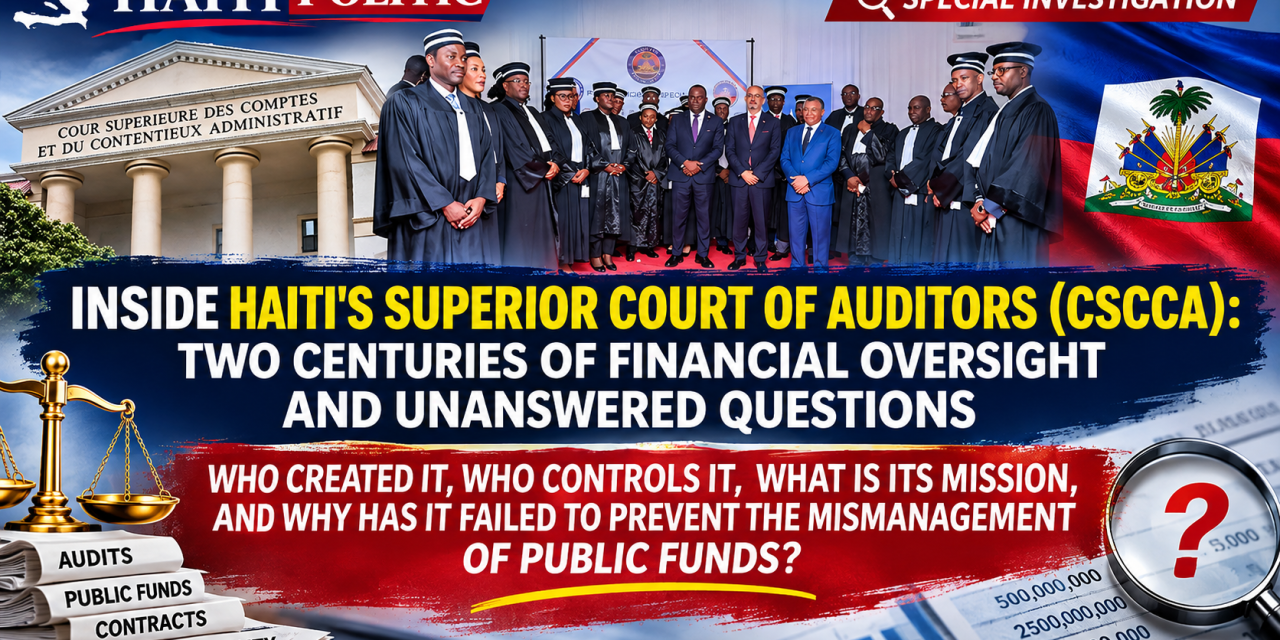
WHO CREATED IT, WHO CONTROLS IT, WHAT IS ITS MISSION, AND WHY HAS IT FAILED TO PREVENT THE MISMANAGEMENT OF PUBLIC FUNDS?
Established during Jean-Pierre Boyer’s presidency in 1823, reorganized under successive Haitian governments, and granted modern constitutional authority, Haiti’s Superior Court of Auditors has existed in various forms for more than 200 years. Yet corruption, weak financial accountability, and the limited enforcement of audit findings continue to raise fundamental questions about the effectiveness of one of Haiti’s most important oversight institutions.
HAITI POLITIC | SPECIAL INVESTIGATION
November 9, 2026
PART I — THE ORIGINS OF HAITI’S SUPERIOR COURT OF AUDITORS
1. WHICH GOVERNMENT CREATED THE CSCCA?
The Cour Supérieure des Comptes et du Contentieux Administratif (CSCCA), commonly translated as the Superior Court of Auditors and Administrative Disputes, is one of Haiti’s oldest financial oversight institutions.
However, its history requires an important distinction.
The institution was not created by a single decree. It evolved through several laws, constitutional reforms, and government reorganizations.
Its origins date to 1823, while its present institutional structure developed principally during the twentieth century.
1823: President Jean-Pierre Boyer establishes the Chamber of Accounts
On June 27, 1823, during the presidency of Jean-Pierre Boyer (1818–1843), the Haitian government established the Chambre des Comptes, or Chamber of Accounts.
The institution was created through legislation rather than a presidential decree.
Its original responsibilities included examining government revenues and expenditures and overseeing public financial accounts.
The Chamber consisted of seven members appointed by the president.
Before its establishment, financial oversight responsibilities were largely concentrated within the government’s finance administration.
The creation of the Chamber represented an early attempt to establish a specialized institution responsible for examining how public money was collected and spent.
This makes the Chamber of Accounts the institutional predecessor of today’s CSCCA.
1957: The Military Council creates the Superior Court of Accounts
A major transformation occurred on September 23, 1957.
The Military Council of Government (Conseil Militaire de Gouvernement) issued a decree establishing the Cour Supérieure des Comptes.
The decree provided for five councilors serving seven-year terms.
An important historical clarification is necessary.
François Duvalier did not issue the September 23, 1957 founding decree.
The decree preceded his assumption of the presidency on October 22, 1957.
However, the Duvalier administration subsequently modified the institution.
1959: François Duvalier reorganizes the Court
On January 21, 1959, President François Duvalier’s government adopted another decree modifying the Court’s organization and responsibilities.
The changes formed part of the institution’s continued evolution under successive Haitian administrations.
1983: Jean-Claude Duvalier establishes the modern institutional framework
Another major development occurred under President Jean-Claude Duvalier (1971–1986).
The constitutional framework of 1983 recognized the institution under the name:
Cour Supérieure des Comptes et du Contentieux Administratif (CSCCA).
The decree of November 4, 1983 reorganized its operations and expanded the institutional framework.
The Court’s responsibilities included financial oversight and the adjudication of certain administrative disputes.
This development helped establish the modern identity of the institution.
1987: Constitutional recognition
The Haitian Constitution of March 29, 1987 further established the CSCCA’s constitutional status.
Article 200 identifies the Court as an independent and autonomous institution responsible for administrative and jurisdictional control over public revenues and expenditures.
The Constitution also provides for its role in reviewing administrative disputes and public financial matters.
This constitutional recognition is essential.
The CSCCA is not simply an administrative department operating under the Ministry of Finance.
It is a constitutionally recognized oversight institution intended to exercise independent authority over public financial management.
2005: The Boniface Alexandre–Gérard Latortue government reforms the Court
One of the most important modern reforms came through the decree of November 23, 2005.
It was adopted under the transitional government of:
-
Interim President Boniface Alexandre.
-
Prime Minister Gérard Latortue.
The decree amended the November 4, 1983 framework and reorganized the Court’s structure and operations.
It was published in Le Moniteur, Extraordinary Issue No. 24, on March 10, 2006.
The decree remains an important reference for understanding the CSCCA’s modern responsibilities.
Historical timeline
| Year | Government | Institutional development |
|---|---|---|
| 1823 | Jean-Pierre Boyer | Creation of the Chamber of Accounts |
| 1957 | Military Council of Government | Establishment of the Superior Court of Accounts |
| 1959 | François Duvalier | Modification of the Court’s organization and responsibilities |
| 1983 | Jean-Claude Duvalier | Development of the modern CSCCA framework |
| 1987 | Constitutional referendum | Constitutional recognition of the Court’s independence |
| 2005 | Boniface Alexandre / Gérard Latortue | Major reform of the Court’s organization and operations |
The historical conclusion is significant: the CSCCA is a Haitian institution created and repeatedly reorganized by Haitian governments.
Its present institutional weaknesses cannot be understood without examining those governments and the legal structures they established.
PART II — WHO MAKES UP THE CSCCA?
2. HOW IS THE SUPERIOR COURT ORGANIZED?
Under its modern legal framework, the CSCCA is organized around a council of ten members.
The council includes:
-
One president.
-
One vice president.
-
Eight additional councilors.
The councilors serve ten-year terms.
Under Article 200-6 of the 1987 Constitution, the Senate elects the members of the Court.
The constitutional framework is intended to protect the institution from direct control by the executive branch.
The Court also includes administrative and judicial structures necessary to carry out its responsibilities.
These include financial and administrative chambers, registry services, auditors, and other professional personnel.
A constitutional problem: What happens when Haiti has no functioning Senate?
The Constitution assigns the Senate an important role in selecting CSCCA councilors.
However, Haiti has experienced extended periods without a functioning Parliament.
This creates a serious institutional question.
How can an institution whose members are constitutionally selected by the Senate maintain continuity when the Senate itself does not exist as an operational legislative body?
Any alternative appointment procedure must be evaluated against the Constitution and applicable legislation.
This issue deserves particular scrutiny because the legitimacy and independence of the Court depend partly on the legality of its appointments.
Current membership: The complete list of councilors serving as of November 9, 2026, has not been independently verified for this investigation. Historical officeholders should not be presented as current members without confirmation.
PART III — WHAT IS THE CSCCA SUPPOSED TO DO?
3. THE COURT’S CONSTITUTIONAL MISSION
The CSCCA has three broad categories of responsibility.
A. Oversight of public revenues and expenditures
The Court examines how public institutions collect and spend government money.
Its jurisdiction includes public financial management within the limits established by law.
The institutions subject to oversight may include government ministries, autonomous public agencies, and local government entities.
For example, suppose the Ministry of Education receives 500 million gourdes to build public schools.
The CSCCA may examine whether the funds were spent according to applicable financial rules, whether expenditures were properly documented, and whether public officials complied with their obligations.
It may also identify financial irregularities and deficiencies in administrative procedures.
Its central responsibility is to help ensure that public money is managed according to law.
B. Adjudication of public accounts and administrative disputes
The CSCCA also performs jurisdictional functions.
It can examine public accounts and adjudicate certain matters involving public financial responsibility.
It also has authority over specified administrative disputes.
However, an important legal distinction must be maintained.
The CSCCA is not a general criminal court.
It does not replace criminal prosecutors or ordinary criminal courts.
If an audit reveals possible criminal conduct, further action may require involvement by the appropriate investigative, prosecutorial, and judicial authorities.
C. Financial advice and review of government contracts
The Court also has responsibilities involving financial review and advice.
These may include opinions on certain public contracts, budgetary matters, and other financial decisions within its statutory jurisdiction.
Its work can help identify financial risks before public institutions undertake major commitments.
The CSCCA therefore combines oversight, advisory, and judicial responsibilities.
PART IV — WHERE HAS THE CSCCA FALLEN SHORT?
4. WHY HAS THE COURT NOT PREVENTED WIDESPREAD FINANCIAL MISMANAGEMENT?
This is the central question of the investigation.
Haiti has maintained a specialized financial oversight institution for approximately two centuries.
Yet successive governments have faced allegations of corruption, irregular public contracting, undocumented expenditures, and weak financial accountability.
Why has the institution not been more effective?
The answer requires distinguishing between failures within the CSCCA and failures elsewhere in Haiti’s public accountability system.
FAILURE NO. 1 — INCOMPLETE AND INEFFECTIVE FINANCIAL OVERSIGHT
The CSCCA’s own strategic planning documents acknowledged significant institutional weaknesses.
Its 2016–2024 Strategic Plan identified challenges involving legal procedures, institutional capacity, and the implementation of oversight responsibilities.
The plan also emphasized the need to strengthen financial control after public expenditures have occurred.
These findings matter because they are not simply accusations made by political opponents.
They reflect weaknesses identified by the institution itself.
The relevant investigative questions are whether the planned reforms were completed and whether they improved the Court’s performance.
A strategic plan is meaningful only if its objectives are implemented and evaluated.
FAILURE NO. 2 — AUDIT FINDINGS DO NOT AUTOMATICALLY PRODUCE SANCTIONS
One of the most serious weaknesses in public financial accountability is the gap between identifying irregularities and obtaining consequences.
An audit report may reveal questionable expenditures.
But publishing a report does not automatically produce a criminal conviction, financial recovery, or administrative sanction.
Other institutions may be required to investigate, prosecute, adjudicate, or enforce decisions.
This creates a fundamental accountability problem.
What happens after the CSCCA identifies financial irregularities?
How many findings result in formal proceedings?
How many decisions are enforced?
How much public money is recovered?
How many responsible officials face administrative or criminal consequences?
Without reliable figures, the public cannot determine whether oversight produces meaningful results.
This is a failure of the broader accountability system, although the CSCCA’s own follow-up practices must also be examined.
FAILURE NO. 3 — WEAKNESS IN POST-EXPENDITURE CONTROLS
The reforms associated with the 2005 legal framework altered the balance between controls exercised before expenditures and those performed afterward.
The Court’s strategic planning documents identified the need to strengthen its capacity for subsequent financial oversight.
This is particularly important because post-expenditure auditing requires extensive documentation, qualified personnel, access to records, and effective follow-up mechanisms.
If the institution cannot obtain the necessary documents or complete audits promptly, irregularities may remain unresolved for years.
FAILURE NO. 4 — INSUFFICIENT INSTITUTIONAL CAPACITY
Effective oversight requires more than constitutional authority.
It requires trained auditors, financial investigators, legal specialists, functioning information systems, adequate budgets, and access to public records.
The CSCCA’s strategic documents recognized the need to improve its administrative and technical capacity.
An institution responsible for overseeing public financial management across the country cannot operate effectively without sufficient resources.
However, limited resources do not automatically excuse every failure.
The investigation must determine whether available resources were properly managed and whether institutional priorities were appropriately established.
FAILURE NO. 5 — CONSTITUTIONAL INDEPENDENCE DOES NOT GUARANTEE PRACTICAL INDEPENDENCE
The Constitution describes the CSCCA as an independent institution.
But independence must exist in practice.
Several issues deserve examination:
Can the Court obtain the documents it needs without political obstruction?
Does it have adequate control over its operating resources?
Are councilors appointed through constitutionally valid procedures?
Can it publish sensitive findings without interference?
Are its decisions respected by other branches of government?
These questions are particularly important in a country where political institutions have experienced prolonged instability.
An oversight institution can possess constitutional independence while still facing practical constraints that limit its effectiveness.
PART V — IS THE CSCCA RESPONSIBLE FOR CORRUPTION IN HAITI?
5. THE DIFFERENCE BETWEEN DETECTING CORRUPTION AND PREVENTING IT
The CSCCA has an important responsibility in Haiti’s financial accountability system.
However, it would be inaccurate to hold the Court solely responsible for every act of corruption committed by public officials.
Responsibility must be examined at several levels.
A minister who unlawfully spends public money may bear direct responsibility for those expenditures.
A public accountant who falsifies records may bear responsibility for the accounting violations.
An oversight institution that fails to perform legally required examinations may bear responsibility for failures within its own mandate.
And prosecutorial authorities that fail to act on properly documented allegations may bear responsibility for their own decisions or omissions.
These responsibilities are related, but they are not identical.
The absence of criminal convictions does not automatically prove that the CSCCA failed to perform its legal duties.
Conversely, publishing audit reports does not necessarily establish that the Court has fulfilled every aspect of its mission.
A proper evaluation must examine the quality, timeliness, completeness, and consequences of its work.
PART VI — PETROCARIBE: THE TEST OF FINANCIAL ACCOUNTABILITY
6. WHAT HAPPENED AFTER THE CSCCA INVESTIGATED PETROCARIBE?
The PetroCaribe controversy remains one of the most important cases for evaluating Haiti’s financial oversight institutions.
The CSCCA produced reports examining the management of funds associated with PetroCaribe-financed projects.
Its findings raised questions about public contracts, expenditure documentation, project implementation, and administrative compliance.
These reports became central to public demands for accountability.
But the most important investigative question concerns what happened afterward.
What concrete consequences followed the audit findings?
To answer that question, investigators should trace each significant finding through the accountability process.
Which public officials or institutions were identified?
Which findings involved possible financial liability?
Were matters transmitted to competent authorities?
Were investigations opened?
Were financial or administrative judgments issued?
Were any decisions enforced?
Was public money recovered?
The answers would help determine whether the problem lies primarily in the Court’s auditing work, the judicial system, political interference, or a combination of institutional weaknesses.
The PetroCaribe reports should therefore be examined not only for their findings but also for their documented consequences.
PART VII — TEN QUESTIONS HAITI POLITIC SHOULD ASK THE CSCCA
1. Since the 2005 reform, how many financial audits has the CSCCA completed involving ministries and other public institutions?
2. How many of those audit reports have been published and made accessible to the public?
3. How many decisions has the Court issued involving financial liability or irregular public expenditure?
4. How much public money has actually been recovered following its findings or judgments?
5. How many cases involving suspected criminal conduct have been referred to competent judicial authorities?
6. Why have some public institutions failed to submit complete and timely financial accounts?
7. How has the absence of a functioning Senate affected the appointment or renewal of CSCCA councilors?
8. Does the Court currently have sufficient auditors, legal specialists, funding, and technological resources to fulfill its constitutional responsibilities?
9. Which recommendations from the PetroCaribe audits have been implemented, and which remain unresolved?
10. Does the CSCCA publish an annual performance report showing how many of its recommendations have been implemented and how many remain outstanding?
These questions are essential because financial accountability must be measured through verifiable results.
PART VIII — TWO CENTURIES OF OVERSIGHT: WHAT HAS HAITI ACHIEVED?
7. THE INSTITUTIONAL PARADOX
Haiti established its first Chamber of Accounts in 1823.
The institution evolved into the Superior Court of Accounts in 1957.
It developed its modern structure under Jean-Claude Duvalier in 1983.
The 1987 Constitution recognized its independence.
The transitional government of Boniface Alexandre and Gérard Latortue adopted a major reform in 2005.
Across these different political periods, Haitian governments repeatedly recognized the need for financial oversight.
Yet the persistence of serious financial-management problems raises an unavoidable question:
Why has the existence of a constitutionally recognized financial oversight institution not produced stronger and more consistent public accountability?
Part of the explanation may lie in the institution’s capacity and effectiveness.
Another part lies in the responsibilities of ministries, Parliament, prosecutors, courts, and successive governments.
The CSCCA cannot substitute for the entire system of public administration and justice.
But its effectiveness remains central to that system.
HAITI POLITIC CONCLUSION
WHO WATCHES THE INSTITUTION RESPONSIBLE FOR WATCHING HAITI’S PUBLIC MONEY?
The Superior Court of Auditors is not a foreign institution imposed on Haiti.
Its origins date to the presidency of Jean-Pierre Boyer in 1823.
Its modern structure emerged through reforms adopted by Haitian governments, including those of the Duvalier era and the 2005 transitional administration.
Its authority is recognized by the Haitian Constitution.
Its mission is to examine public financial management, adjudicate matters within its jurisdiction, and contribute to the accountability of government institutions.
Yet after more than two centuries of institutional history, Haiti continues to face serious challenges involving public expenditures, financial transparency, and enforcement of accountability measures.
The CSCCA’s own strategic documents have acknowledged institutional weaknesses.
Its PetroCaribe reports demonstrated the importance of financial oversight while also exposing the need to examine what happens after irregularities are documented.
The central issue is no longer simply whether Haiti has an institution capable of identifying financial irregularities.
The issue is whether that institution—and the wider accountability system—can ensure that its findings lead to lawful, measurable consequences.
A serious evaluation of the CSCCA should therefore examine its leadership, appointment procedures, budgets, audit performance, decisions, and enforcement record.
It should also examine the responsibilities of the other institutions required to act on its findings.
THE QUESTION HAITI POLITIC LEAVES WITH THE CSCCA:
AFTER MORE THAN 200 YEARS OF FINANCIAL OVERSIGHT, HOW MUCH PUBLIC MONEY HAS THE COURT HELPED PROTECT OR RECOVER, HOW MANY OF ITS DECISIONS HAVE BEEN ENFORCED, AND WHAT MEASURABLE RESULTS CAN IT PRESENT TO THE HAITIAN PEOPLE?
The public deserves documented answers.
Not simply additional reports.
Not simply institutional declarations.
But transparent financial records, enforceable decisions, and measurable accountability.
PRIMARY LEGAL AND INSTITUTIONAL SOURCES
1. CSCCA — Official Institutional History
https://cscca.gouv.ht/historique
2. Haitian Constitution of March 29, 1987
Articles 200–205, concerning the Superior Court of Auditors and Administrative Disputes.
3. Decree of November 23, 2005
Amending the decree of November 4, 1983, governing the organization and functioning of the CSCCA. Published in Le Moniteur, Extraordinary Issue No. 24, March 10, 2006.
https://cscca.gouv.ht/uploads/documents/1748213746_decret_du_23_novembre_2005_1.pdf
4. CSCCA — Missions and Responsibilities
https://cscca.gouv.ht/missions-et-attributions
5. CSCCA — Organization
https://mobile.cscca.gouv.ht/organisation
6. CSCCA — Strategic Plan 2016–2024 and Operational Plan 2016–2021
https://cscca.gouv.ht/uploads/documents/1748220956_plan_strategique_cscca_2016_2024_plan_operationnel_cscca_2016_2021.pdf
7. CSCCA — PetroCaribe Audit Reports
Official reports examining the management of PetroCaribe-funded public projects.
HAITI POLITIC
Independent Investigative Journalism | Public Finance | Government Accountability | Institutional Oversight
Editorial note: This article distinguishes documented institutional weaknesses from allegations of misconduct. It does not establish that individual CSCCA councilors committed corruption or intentionally obstructed accountability. Such conclusions would require specific documentary evidence and examination of the applicable legal responsibilities.
#HaitiPolitic #CSCCA #Haiti #PublicFinance #PetroCaribe #GovernmentAccountability #Corruption #Transparency #HaitianPolitics #FinancialOversight