Inside Robenson Lauvince’s Federal Prosecution, Clear Shot Entertainment’s COVID-19 Loans, and the Unanswered Questions Behind July 7: Who Killed the President of Haiti?
HAITI POLITIC | SPECIAL INVESTIGATION
November 6, 2026
Before Haitian filmmaker Robenson Lauvince brought the assassination of President Jovenel Moïse to American movie theaters, he faced federal criminal charges involving hundreds of thousands of dollars in pandemic-relief loans. FBI investigators alleged fraudulent payroll records, questionable business revenues, and financial transactions connected to a broader multimillion-dollar scheme. But the prosecution ended with a decisive judicial ruling: Lauvince was acquitted of every charge. What do the court records actually reveal, and what remains unknown about the financing of his politically sensitive film?
THE STORY BEHIND THE FILMMAKER
On July 7, 2021, Haitian President Jovenel Moïse was assassinated inside his private residence in Pèlerin, near Port-au-Prince.
The assassination triggered criminal investigations, political controversy, and years of unanswered questions about the people responsible for planning, financing, and executing the attack.
Four years later, Haitian filmmaker Robenson Lauvince brought a dramatized interpretation of that event to American movie theaters.
His film, July 7: Who Killed the President of Haiti?, was released theatrically in May 2025.
The production involved Haitian writers Paul Henry Athis, Gary Victor, and Hollandy Desrosiers, with Lauvince serving as director.
The movie attracted attention because of its subject matter: the assassination of a sitting Haitian president and the continuing controversy surrounding the investigation.
But a separate story had already unfolded in a federal courthouse in South Florida.
In December 2022, approximately eighteen months after Moïse’s assassination, federal prosecutors brought criminal charges against Lauvince.
The allegations involved his production company, Clear Shot Entertainment, and federal pandemic-relief loans.
The case was part of a larger investigation into alleged fraud involving the Paycheck Protection Program (PPP) and Economic Injury Disaster Loan (EIDL) program.
What happened next is essential to understanding the case: Lauvince contested the allegations, proceeded to trial, and obtained a judgment of acquittal from the federal court.
The criminal case is documented. So is his acquittal.
What has not been established is whether any money from the pandemic-relief loans was used to finance July 7.
That distinction is central to this investigation.
PART I — THE FBI INVESTIGATION
A federal complaint filed in December 2022
On December 12, 2022, FBI Special Agent Michelle McDaniel submitted a sworn affidavit supporting a criminal complaint against Robenson Lauvince.
The complaint was filed in the United States District Court for the Southern District of Florida.
Case number: 9:22-mj-08579-WM
The government alleged violations of two federal statutes:
18 U.S.C. § 1349: Conspiracy to commit wire fraud.
18 U.S.C. § 1956(h): Conspiracy to commit money laundering.
According to the affidavit, federal investigators were examining a network of individuals and businesses suspected of obtaining pandemic-relief loans through fraudulent applications.
The investigation involved the FBI and other federal agencies, including the Small Business Administration’s Office of Inspector General.
The alleged activity extended across Palm Beach, Broward, Miami-Dade, and St. Lucie counties.
The FBI identified Lauvince’s production company, Clear Shot Entertainment, as one of the businesses involved in the investigation.
Source: Federal Criminal Complaint, Document 3, filed December 13, 2022, pages 2–3.
A broader multimillion-dollar investigation
The FBI affidavit described an alleged network involving approximately 152 businesses that had received roughly $25 million in PPP and EIDL loans.
Investigators alleged that some businesses used fabricated payroll documents and inaccurate employee information to obtain loans.
The affidavit identified Joff Philossaint and his business, Elite International Venture Capital, as participants in the broader scheme.
According to the FBI, 26 businesses associated with that operation received approximately $4.88 million through 33 loans.
These figures describe the government’s broader investigation.
They do not represent amounts personally received by Lauvince.
Nor do they establish that every individual identified in the investigation was guilty of a crime.
PART II — THE $446,252 CONNECTED TO CLEAR SHOT ENTERTAINMENT
What federal investigators documented
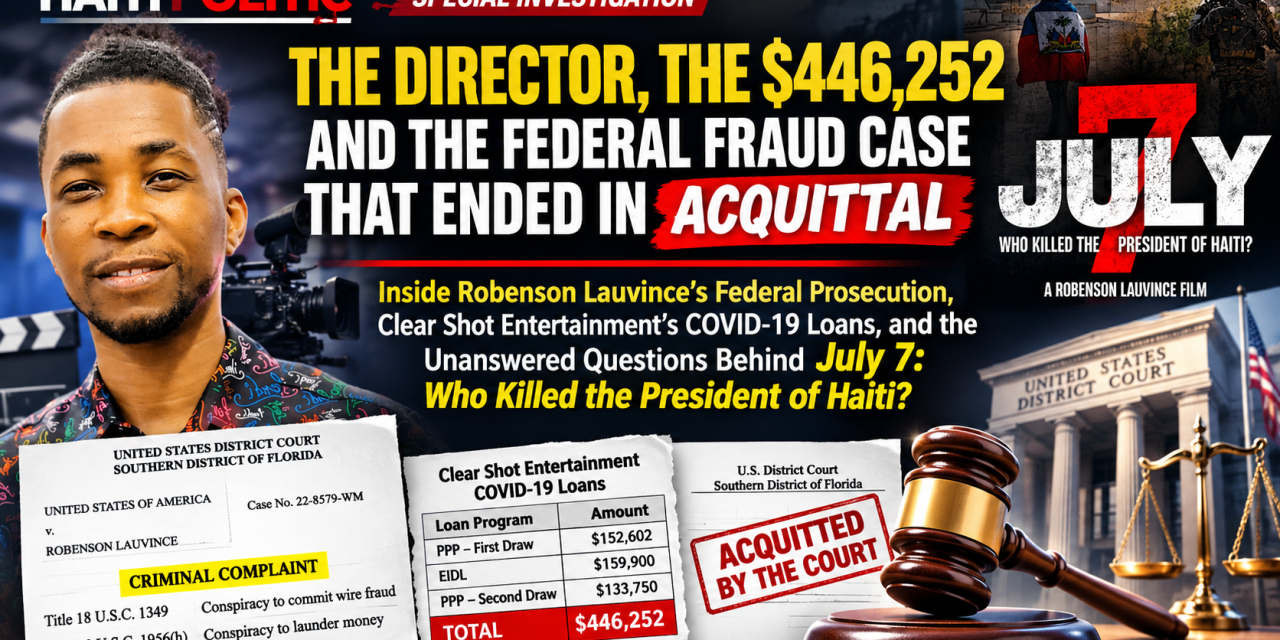
One of the most important sections of the affidavit concerns three pandemic-relief loans issued to Clear Shot Entertainment.
The FBI identified Lauvince as the company’s owner.
According to the government’s financial records, the company received:
| Date funded | Loan program | Amount |
|---|---|---|
| June 16, 2020 | PPP — First Draw | $152,602 |
| July 13, 2020 | EIDL | $159,900 |
| February 24, 2021 | PPP — Second Draw | $133,750 |
| TOTAL | $446,252 |
The affidavit states that the funds were deposited into a Wells Fargo account controlled by Lauvince.
The receipt of loan proceeds was a central fact examined in the federal prosecution.
However, receiving PPP or EIDL financing was not itself unlawful.
The criminal allegations concerned whether the applications contained knowingly false information and whether the resulting transactions violated federal law.
The court ultimately acquitted Lauvince.
Source: FBI Affidavit, paragraphs 27–31, pages 12–14.
PART III — THE PAYROLL ALLEGATIONS
What did Clear Shot Entertainment report?
According to the FBI affidavit, Clear Shot Entertainment’s first PPP application reported six employees and an average monthly payroll of $61,041.
Its second PPP application reported an average monthly payroll of $64,542.
Investigators questioned those figures.
The affidavit stated that Florida Department of Revenue records did not show wage-and-earnings information for Clear Shot before its first loan application.
Federal investigators also examined bank transactions to estimate the company’s payroll activity.
Their calculations produced substantially smaller figures than those reported in the applications.
For 2019, investigators estimated monthly payments to potential employees at approximately $1,045.84.
For 2020, they estimated approximately $9,237.33 per month, even when including transactions whose classification as payroll they questioned.
The government also alleged that counterfeit IRS Forms 941 had been submitted in support of loan applications.
These allegations became part of the criminal prosecution.
But they must be understood in light of the final outcome: the federal court acquitted Lauvince.
An FBI affidavit presents the government’s account of suspected criminal conduct. It is not a judicial determination that the allegations are true.
Source: FBI Affidavit, paragraphs 29–33, pages 13–14.
PART IV — THE $18,270 PAYMENT
A financial transaction examined by the FBI
Another detail appears in paragraph 34 of the affidavit.
Federal investigators reported that Clear Shot Entertainment issued a check for $18,270.
The check was payable through an account associated with Joff Philossaint.
Its memo line reportedly described the transaction as an account-setup payment.
The government interpreted the payment within its broader theory that participants paid fees or kickbacks for assistance obtaining fraudulent pandemic-relief loans.
However, the existence of a payment and the government’s interpretation of its purpose are two different matters.
The payment was examined during an investigation that ultimately resulted in Lauvince’s acquittal.
The uploaded records do not establish that the $18,270 payment financed July 7 or any other particular film.
Source: FBI Affidavit, paragraph 34, page 15.
PART V — THE FEDERAL TRIAL AND ACQUITTAL
What happened in court?
The federal docket identifies Lauvince as Defendant 6 in:
United States v. Philossaint et al.
Case No. 9:22-cr-80144-RS
The case was assigned to United States District Judge Rodney Smith.
Lauvince pleaded not guilty and contested the prosecution.
The proceedings continued through 2023.
In September and October 2023, Lauvince and another defendant, Maurice Shazier, proceeded to trial.
The docket records testimony, documentary exhibits, and arguments presented during the proceedings.
On October 3, 2023, Lauvince filed a motion for acquittal.
The following day, Judge Smith heard arguments under Rule 29 of the Federal Rules of Criminal Procedure.
October 4, 2023: The decisive ruling
The court granted Lauvince’s motion.
The federal docket states:
“As to Lauvince, motion granted, judgment of acquittal to be entered.”
The court subsequently entered its judgment of acquittal.
The docket identifies the disposition of Lauvince’s charges as:
“ACQUITTED BY THE COURT.”
His portion of the case was closed.
This was not simply a dismissal following a negotiated agreement.
It was a judicial acquittal entered during trial after the government had presented its evidence.
Under Rule 29, a court must enter a judgment of acquittal when the evidence is insufficient to sustain a conviction.
The docket establishes the ruling, although the complete reasoning would require examination of the court’s oral findings or trial transcript.
Source: Federal docket, October 3–4, 2023, Entries 462–465.
What the acquittal means
Lauvince was not convicted of the federal charges.
The prosecution’s allegations cannot properly be reported as established criminal conduct.
Nor should the criminal accusations be used to imply that Lauvince’s subsequent filmmaking activities were unlawful.
The acquittal is not a minor procedural detail.
It is the final judicial outcome of the prosecution against him.
PART VI — THE CONNECTION TO JULY 7
Two separate timelines
The financial investigation and the movie’s production history overlap chronologically in ways that justify examining the records carefully.
But chronological overlap does not establish financial involvement.
Consider the timeline:
| Date | Event |
|---|---|
| June 2020 | Clear Shot receives its first PPP loan |
| July 2020 | Clear Shot receives EIDL financing |
| February 2021 | Clear Shot receives its second PPP loan |
| July 7, 2021 | President Jovenel Moïse is assassinated |
| 2022 | Development and production of July 7 receive public attention |
| December 2022 | Federal criminal complaint filed against Lauvince |
| October 4, 2023 | Federal court acquits Lauvince |
| May 2025 | July 7 receives its U.S. theatrical release |
The timing creates a legitimate accounting question.
Did Clear Shot Entertainment maintain separate financial records for its pandemic-relief loans and subsequent film-production activities?
The uploaded court documents do not answer that question.
They also do not establish when the film’s initial financing was secured, which investors supplied the capital, or how production expenses were paid.
Consequently, there is no documented basis in these records for claiming that pandemic-relief funds financed the film.
PART VII — THE REPORTED $10 MILLION MOVIE BUDGET
A production figure that requires verification
Earlier reporting about July 7 described a production budget of approximately $10 million.
That reported figure raises questions about the project’s financing structure.
But an announced or reported production budget is not the same as an audited expenditure.
A filmmaker might announce an intended budget that differs significantly from the amount ultimately raised or spent.
A production may also combine private investment, loans, sponsorships, deferred compensation, and distribution arrangements.
To determine the actual financing of July 7, investigators would need documentation identifying the production entity, its investors, financing agreements, and final expenditures.
The federal criminal complaint does not provide that information.
The distinction between production financing and box-office revenue
Previously published box-office data indicated a relatively modest reported U.S. theatrical gross.
But domestic box-office revenue does not necessarily reflect a film’s total income.
International distribution, streaming rights, private screenings, licensing agreements, and other revenue streams may not appear in domestic theatrical figures.
Without verified production costs and complete revenue records, the film’s profitability cannot be reliably calculated.
More importantly, a movie’s commercial performance does not establish anything about the lawfulness of its financing.
PART VIII — THE PEOPLE BEHIND THE SCREENPLAY
The movie’s political significance also makes its editorial development relevant.
The production credits identify Paul Henry Athis, Gary Victor, and Hollandy Desrosiers as writers.
Gary Victor is an established Haitian novelist and screenwriter whose work has frequently explored political power, corruption, and social conflict.
Paul Henry Athis has professional experience in acting and filmmaking.
Less independently verified biographical information is available concerning Hollandy Desrosiers.
The available federal criminal documents do not accuse these three writers of participating in the alleged pandemic-relief loan scheme.
They should not be associated with Lauvince’s criminal prosecution merely because they collaborated on the film.
The relevant editorial questions are different.
Who developed the original concept?
Which writers conducted historical research?
What judicial records or witness interviews informed the screenplay?
Did any political figure or investor exercise editorial control?
And how did the filmmakers distinguish documented facts about the assassination from fictional interpretations?
Those questions concern the credibility and transparency of a historical dramatization.
They are not allegations of criminal conduct.
PART IX — THE QUESTIONS THAT REMAIN UNANSWERED
Haiti Politic believes the following questions would help clarify the film’s production history and the relationship, if any, between Clear Shot Entertainment’s earlier financing and its subsequent filmmaking activities.
1. What was the final production budget?
Was the reported $10 million figure an initial target, a financing commitment, or the actual amount spent?
2. Who were the principal investors?
Were the investors individuals, corporations, film-financing companies, or other organizations?
3. Which legal entity owned the film?
Was July 7 produced directly through Clear Shot Entertainment, a separate production company, or a combination of entities?
4. Were the film’s accounts maintained separately?
What accounting arrangements distinguished the company’s earlier business operations from the movie’s production expenses?
5. Did Clear Shot’s PPP or EIDL proceeds contribute to any film-development expenses?
The uploaded court records do not establish that they did. This question would require transaction records and production accounting.
6. What was the complete financial disposition of the pandemic-relief loans?
The criminal docket establishes Lauvince’s acquittal but does not, by itself, provide a complete SBA loan-servicing history.
7. What was the court’s full reasoning for granting acquittal?
The docket records the Rule 29 ruling. A trial transcript or detailed judicial findings would provide additional context.
8. Did the production receive financial support from politically connected investors?
No such financing has been established by the uploaded records. Investor disclosures would be needed to investigate the question.
9. Who controlled the final screenplay?
Did the director, writers, producers, or distributors have final authority over the film’s portrayal of the assassination?
10. Will the filmmakers release a production-financing summary?
A voluntary accounting could help distinguish the project’s documented financing from speculation.
PART X — WHAT THE DOCUMENTS PROVE, AND WHAT THEY DO NOT
The distinction between allegations, judicial findings, and unanswered questions is essential.
What the records establish
Clear Shot Entertainment received three pandemic-relief loans totaling $446,252, according to the FBI’s examination of loan and banking records.
Federal prosecutors accused Robenson Lauvince of participating in wire-fraud and money-laundering conspiracies.
The allegations were litigated in federal court.
Lauvince contested the charges.
On October 4, 2023, Judge Rodney Smith granted his motion for acquittal.
Lauvince was acquitted of all charges against him in the case.
What the records do not establish
They do not establish that Lauvince committed the alleged crimes.
They do not establish that Clear Shot Entertainment used pandemic-relief proceeds to finance July 7.
They do not identify the film’s complete investor group.
They do not establish political sponsorship of the movie.
They do not prove that any investor influenced its portrayal of Jovenel Moïse’s assassination.
And they do not establish that the film’s writers participated in the conduct alleged in the federal complaint.
CONCLUSION — THE COURT RECORD AND THE PUBLIC’S RIGHT TO KNOW
Robenson Lauvince’s federal criminal case is part of the public record.
So is its outcome.
Federal investigators accused him of participating in a pandemic-relief fraud scheme involving Clear Shot Entertainment.
They examined hundreds of thousands of dollars in loans, questioned payroll information, and scrutinized financial transactions.
But the government’s case against Lauvince did not result in a conviction.
On October 4, 2023, a federal judge acquitted him.
That judicial outcome must remain central to any responsible account of the prosecution.
The separate question of how July 7: Who Killed the President of Haiti? was financed remains unresolved by the documents reviewed.
The movie addresses an assassination that profoundly affected Haiti’s political history. Its creators have the right to interpret historical events through cinema, just as audiences have the right to question the evidence, financing, and editorial choices behind a dramatization.
Financial transparency would help answer legitimate questions about the production.
But transparency cannot be replaced by speculation.
For Haiti Politic, the distinction is straightforward:
The federal prosecution is documented. The acquittal is documented. A financial connection between the disputed pandemic-relief loans and the movie has not been established.
The public deserves all three facts.
DOCUMENTARY SOURCES
Source 1 — Federal Criminal Complaint
United States v. Robenson Lauvince
Case No. 9:22-mj-08579-WM
United States District Court, Southern District of Florida
Document 3, filed December 13, 2022.
Source 2 — FBI Affidavit
Special Agent Michelle McDaniel
Affidavit in Support of Criminal Complaint
December 12, 2022.
Relevant sections include the broader PPP/EIDL investigation, Clear Shot Entertainment’s loan applications, the payroll allegations, and the reported $18,270 transaction.
Source 3 — Federal Criminal Docket
United States v. Philossaint et al.
Case No. 9:22-cr-80144-RS
United States District Court, Southern District of Florida.
Relevant entries:
-
Docket 462: Lauvince’s motion for acquittal, October 3, 2023.
-
Docket 464: Court grants the motion, October 4, 2023.
-
Docket 465: Judgment of acquittal, October 4, 2023.
Editorial disclosure: This investigation relies principally on the three federal court documents supplied for review. The documents establish the prosecution’s allegations and the final judgment of acquittal. They do not provide complete film-production accounting, investor records, or a transaction-level analysis of the film’s financing. No allegation concerning the movie’s financing should be treated as established without additional documentary evidence.
© 2026 Haiti Politic | Investigative Reporting